
A vendor issue can turn into a patient care issue fast. In healthcare, third parties were tied to 58% of the 77.3 million people affected by breaches in 2023, and the Change Healthcare attack in February 2024 showed how one upstream failure can disrupt care across the U.S.
If I had to sum up the article in plain English, it’s this:
- Annual vendor reviews are not enough to secure the ecosystem
- Software and vendor risk can hit EHRs, imaging, pharmacy, scheduling, and access systems
- Fourth parties - the companies your vendors depend on - can fail without warning
- Supply chain threat intelligence helps me track breaches, exploited flaws, SBOM data, and vendor changes over time
- Clinical criticality should drive response, so Tier 1 systems get attention first
- The goal is simple: know what happened, what’s affected, how bad it is, and what to do now
Here’s the core point: healthcare teams need more than a checkbox review during procurement. They need a steady view of supplier risk tied to patient care. That means watching for vendor incidents, known exploited vulnerabilities, dependency exposure, patch status, and support changes - then linking those signals to the systems clinicians use every day.
A few numbers make the case:
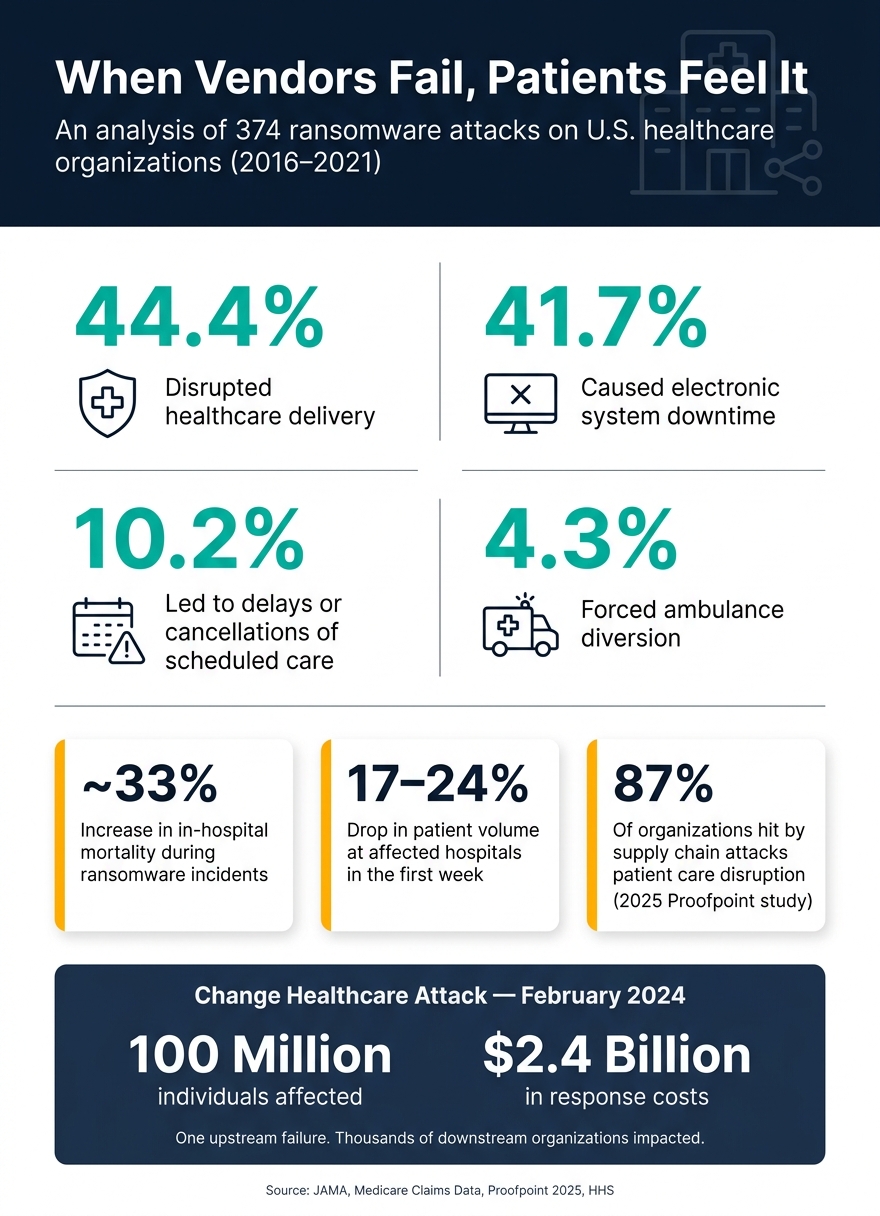
- 374 ransomware attacks on U.S. healthcare delivery groups from 2016 to 2021 were studied
- 44.4% disrupted healthcare delivery
- 41.7% caused electronic system downtime
- 10.2% led to delays or canceled scheduled care
- 4.3% forced ambulance diversion
- A 2025 study found 87% of organizations hit by supply chain attacks reported patient care disruption
What matters most is not just whether a vendor had a security problem. It’s whether that problem can delay treatment, block records, affect medication workflows, or shut down clinical access. That is why supply chain threat intelligence belongs in healthcare risk work.
Healthcare Supply Chain Cyber Risk: Key Statistics & Patient Impact
Top 3 Healthcare Cyber Threats in 2026
sbb-itb-535baee
How Software Supply Chain Risk Reaches Patient Care
Upstream software risk turns into a patient care problem the moment it touches clinical systems. In healthcare, that path usually runs through a vendor’s code, services, or infrastructure.
A tampered software update can drop a backdoor into a pharmacy or PACS system. From there, attackers may steal PHI or change medication records. An insecure or unpatched open-source library can do the same kind of damage. The Log4j flaw is a good example. It forced emergency patching across EHR systems, patient portals, and medical device management platforms because it opened the door to remote code execution in clinical systems.
APIs add another route in. Scheduling, lab, and imaging systems often depend on API connections to share data and keep work moving. If those connections are abused, attackers can scrape data or disrupt downstream workflows. The result can be delayed lab results, canceled appointments, and a lot of confusion for care teams. Perimeter controls alone don’t stop these paths into clinical systems.
Third-Party and Fourth-Party Exposure in Clinical Environments
A lot of the risk sits one layer deeper than most teams expect. Hospitals may review their direct vendors, but the biggest weak spot often comes from the shared services those vendors use behind the scenes.
Fourth-party dependencies are the upstream providers a vendor relies on. They create hidden risk that often does not appear in a standard vendor questionnaire. If one of those upstream providers is compromised or goes offline, the vendor’s service can fail even when the hospital’s own systems are fine. In practice, that might look like:
- A cloud-hosted telehealth platform going dark
- A secure messaging service becoming unavailable during on-call coordination
- An identity system failure that locks clinical staff out of applications
One clear example is the February 2024 Change Healthcare ransomware attack. The February 2024 Change Healthcare ransomware attack shows the scale of fourth-party concentration risk. As a clearinghouse sitting upstream of thousands of healthcare providers, its compromise disrupted claims processing and care workflows nationwide, affecting an estimated 100 million individuals and generating $2.4 billion in response costs.[4] One upstream failure hit thousands of downstream organizations at the same time. That’s what makes concentration risk so dangerous.
Why Supply Chain Incidents Are a Patient Safety Issue
This is not just an IT outage story. It is a care delivery story.
An analysis of 374 ransomware attacks on U.S. healthcare delivery organizations between 2016 and 2021 found that 44.4% disrupted healthcare delivery, 41.7% caused electronic system downtime, 10.2% led to delays or cancellations of scheduled care, and 4.3% forced ambulance diversion.[7] When EHRs go down, clinicians switch to paper orders and manual documentation. That slows care and increases transcription risk. When pharmacy verification tools are offline, medication safety checks vanish.
The patient impact goes further. Research shows in-hospital mortality increased by approximately 33% during ransomware incidents, and Medicare claims data found patient volume at affected hospitals drops 17–24% in the first week of an attack.[3][5] That drop reflects diverted patients and postponed procedures, not just a temporary system glitch.
Supply chain incidents can change records, block access to systems, and delay care. That is why healthcare needs continuous supply chain threat intelligence instead of periodic vendor checks.
What Is Supply Chain Threat Intelligence in Healthcare?
In healthcare, the main issue isn't only whether a vendor got breached. It's whether that problem can spread into clinical systems or interrupt care.
Supply chain threat intelligence in healthcare is decision-ready information about the vendors, software, and dependencies tied to clinical systems. The goal is to rank risk, guide escalation, and connect vendor exposure to patient care. In practice, that means knowing which supplier issues could hit medication, scheduling, imaging, or access to records.
A health-sector guide defines healthcare threat intelligence as a continuous process of collecting, analyzing, and operationalizing security insights tailored to patient care environments, turning raw indicators into actionable guidance that protects data, devices, and clinical workflows.[14] Put simply, threat intelligence helps you see whether an event affects your vendors, which clinical systems may be exposed, and what to do next.
The Intelligence Inputs That Matter Most
Useful supply chain threat intelligence comes from a few concrete sources that work best together.
- Vendor breach disclosures and business associate incidents, tracked through public reporting, HHS Office for Civil Rights (OCR) notifications, and security advisories, can signal when a supplier has been compromised.
- CISA's Known Exploited Vulnerabilities (KEV) Catalog flags CVEs that attackers are already using in the wild. Healthcare organizations need to watch for KEV entries that affect third-party software in clinical settings, such as VPNs, remote access tools, or medical device companion apps.[8][9][10][11]
- Software Bill of Materials (SBOM) data adds component-level visibility. CISA and its partners now treat SBOMs as a "key building block" of software security and supply chain risk management, stressing that component-level inventories are needed to track vulnerabilities in complex healthcare software stacks.[15][16]
When a new CVE appears, an SBOM helps you spot which devices or applications include the affected library right away, instead of waiting for a vendor to notify you. Patch status, internet-exposed assets, and H-ISAC and HHS HC3 bulletins round out the picture.[9][12][13]
How Threat Intelligence Differs from One-Time Assessments
An annual vendor questionnaire is just a snapshot. And snapshots age fast. Ownership changes, subprocessors shift, hosting moves, and new vulnerabilities show up on their own schedule.
Threat intelligence follows change over time. If CISA adds a new KEV entry for a widely used remote access product, threat intelligence can quickly show which vendors in a health system rely on that product and whether those services support critical clinical workflows.[8][9][10][11][12][13] That's what allows healthcare teams to reassess risk when the facts change.
Those shifts don't wait for the next review cycle.
Why Static Third-Party Reviews Are Not Enough
Annual questionnaires and inventories miss changes that happen fast. A supplier can get breached, add a new integration, or turn off MFA long before the next review. And those shifts matter. They can change clinical risk well before the next annual check.
Where Periodic Reviews Miss Risk Changes
Delayed disclosure is a stubborn issue. When a vendor gets breached, legal and forensic review can slow notification for weeks. During that gap, HDOs may keep using affected systems for billing, scheduling, and documentation. The February 2024 Change Healthcare cyberattack showed how one missing MFA control on a Citrix portal can ripple into claims, pharmacy, and payment disruption.[17][18][19]
Hidden fourth parties make this harder. Vendor questionnaires usually don’t spell out the cloud services and sub-processors a supplier depends on. So when one of those upstream providers has an outage or failure, EHR access or imaging can go down with no warning. That can leave clinical staff stuck in the middle of a shift without the systems they rely on.
Control drift is another blind spot. MFA may get disabled. Log retention may get cut short. Patching may start slipping. A vendor that looked acceptable six months ago can become risky fast, with no event that forces a new review.
Without a current SBOM, HDOs have to manually ask vendors which products include a newly exploited library. That slows response at the exact moment teams need answers and clinical systems may be exposed.
Point-in-Time Assessment vs. Continuous Intelligence Monitoring
Each method covers a different part of the problem. None is enough by itself. The big difference comes down to speed: how fast can each one bring a new risk to light?
| Approach | Timing | Depth of Insight | Healthcare Impact | Decision Support |
|---|---|---|---|---|
| Point-in-Time Vendor Assessment | Onboarding and fixed schedule (annual or every 2–3 years) | High-level policies, certifications, and declared controls | Establishes baseline risk for PHI and clinical systems; supports compliance documentation | Useful for initial classification and contract terms; weak between review cycles |
| Continuous Threat Intelligence Monitoring | Near real-time, daily or weekly updates | Current vendor-specific signals: vulnerabilities, breaches, active exploits, and cloud incidents | Identifies impacted clinical applications, devices, and third-party services when new threats arise | Strong for immediate remediation, escalation, and re-prioritization of critical suppliers |
| SBOM / Dependency-Based Visibility | Onboarding and updated with each major release or patch | Detailed component mapping, including transitive and fourth-party dependencies | Clarifies which products are vulnerable to specific CVEs and how they connect to clinical workflows | Supports targeted patching and precise escalation by specifying affected components |
Put simply, these three methods cover each other’s weak spots.
- Point-in-time assessments set the baseline for governance.
- SBOM visibility adds technical detail.
- Continuous threat intelligence adds the time-sensitive context that turns the other two into something teams can act on.
That’s why healthcare teams need to sort incoming signals by clinical criticality. A new alert isn’t just a security data point. It may point to a system that affects patient care right now.
How Healthcare Organizations Should Act on Threat Intelligence
Knowing a risk exists is only half the job. The other half is deciding what to do next - and moving fast enough for that decision to count. That takes clear workflows, the right people at the table, and a shared view of what's on the line for patient care.
Ranking Suppliers and Products by Clinical Criticality
Clinical criticality should set response priority because downtime hits care, not just IT. Not every vendor needs the same level of urgency.
Tier 1 includes life-critical systems such as EHRs, PACS, infusion pumps, OR scheduling, and emergency department workflows. These systems can affect care within 72 hours and are hard to replace at scale within 30 days.[20] Tier 2 covers care-supporting tools like telehealth platforms, eMAR, and lab results routing. Tier 3 and Tier 4 include administrative, business, and ancillary non-clinical functions.
This tiering shouldn't come from the security team alone. Cybersecurity, clinical engineering, and procurement all need input. That shared process matters because the same alert can lead to very different next steps.
For example, a known exploited vulnerability tied to a Tier 1 supplier should trigger immediate triage, notice to clinical leadership, and fast remediation. A Tier 3 supplier with that same alert may move into tighter monitoring and a scheduled review instead.
The inventory also needs to do more than list vendor names. It should show deployed versions, clinical dependencies, system connections, and fallback options. That's what turns an alert into a response a team can defend.
Feeding Threat Intelligence into Governance and Risk Operations
Once priorities are set, threat intelligence has to feed directly into governance and remediation work. Teams with mature programs use structured playbooks that spell out what happens when intelligence flags a high-risk event. That can mean reassessing the vendor, reviewing contracts, updating the risk register, and notifying the right stakeholders when patient care or large volumes of PHI may be at risk.
Compliance, privacy, and legal teams all have a part to play. If intelligence shows that a vendor has a pattern of delayed breach disclosure or repeated unpatched critical vulnerabilities, that may support updated security documentation, tighter contract terms, or stricter notification SLAs before renewal. Procurement can use the same intelligence to check whether vendor certifications like SOC 2, HITRUST, or ISO 27001 still match the vendor's current security posture.
A centralized risk platform can help keep this work moving by tracking assessments and remediation. Executive dashboards should give CISOs, CIOs, and board committees a plain view of where exposure is concentrated and whether remediation is staying on track.
A few metrics matter most here:
- Time to triage
- Time to remediation or accepted risk
- Share of Tier 1 and Tier 2 suppliers with current assessments
Over time, those numbers show whether the program is reducing exposure - or just producing reports.
Conclusion: What a Mature Healthcare Program Should Monitor
Static reviews and annual questionnaires can't keep up with how fast software changes. A vendor that cleared a security check during procurement can turn into a serious risk later - after a newly disclosed vulnerability, a compromised dependency, or a shift in cloud hosting or support. In healthcare, that delay can hit patient care hard. In a 2025 Proofpoint study, 87% of organizations hit by supply chain attacks reported patient care disruption.[2]
That's why mature programs watch for change all the time, not just during a review. Instead of relying on third-party risk assessments, they maintain a continuous view of supplier risk. That means tracking vendor incidents, exploited vulnerabilities, SBOM and dependency data, product integrations, patch and support status, and active exploitation or end-of-life notices[1][8][6]. The point is simple: teams need to know whether a supplier change could affect medication, imaging, access, or scheduling.
But those signals only matter when they're tied to clinical systems. Monitoring on its own isn't enough. A technical issue becomes far more urgent when it sits inside an EHR, imaging platform, or bedside device.
Censinet RiskOps™ supports this work by bringing third-party risk assessments, remediation tracking, and governance workflows into one place for clinical applications, medical devices, PHI, and supply chain dependencies. The aim is coordinated action, not a flood of alerts.
When the signal is clear, teams can move fast. The programs that reduce risk best are the ones that can answer four questions without delay:
- What happened?
- What's affected?
- How severe is the exposure?
- What should we do right now?
That speed is what helps protect patients.
FAQs
What is supply chain threat intelligence in healthcare?
Supply chain threat intelligence in healthcare means proactively collecting, analyzing, and using cyber threat data to protect the connected vendor ecosystem.
Instead of relying on a periodic, reactive approach, it moves security to continuous, real-time monitoring across medical devices, clinical applications, cloud services, and third parties. That gives organizations a better shot at spotting vulnerabilities early, seeing disruptions coming, and acting before incidents put patient safety, PHI, or critical care at risk.
Censinet RiskOps™ helps make that possible with continuous monitoring, automated risk scoring, and real-time visibility.
Why aren’t annual vendor reviews enough?
Annual vendor reviews aren’t enough because they show only a single moment in time. Risk doesn’t sit still. It can change from one day to the next.
That means a once-a-year review can miss new security flaws, changes in a vendor’s security stance, and risks from sub-tier vendors that show up between review cycles.
Without steady visibility into threat data as it comes in, healthcare groups can’t track patterns or incidents with confidence while they’re unfolding. And when that happens, gaps open up fast enough to disrupt operations and affect patient care.
How can supplier cyber risk affect patient care?
Supplier cyber risk can disrupt patient care in direct, painful ways: system outages, data breaches, and patient safety problems.
When vendors that support EHRs, medical devices, or pharmacy systems get hit by cyberattacks, the fallout doesn’t stay on the vendor’s side. It lands in the hospital. That can mean canceled procedures, delayed tests, and staff scrambling to use manual workarounds just to keep care moving.
There’s also a second layer of risk that’s easy to miss. Unsecured vendor software or unpatched connected devices can interfere with therapy delivery and patient monitoring. And when that happens, a situation that looked under control can turn into an emergency fast.
