
If you review vendors one by one, you fall behind. I see the core point of this article as simple: in healthcare GRC, a shared network with 50,000 vendors and products helps teams make decisions with less repeat work, better context, and fewer blind spots.
Here’s the short version:
- I’m dealing with a healthcare vendor problem that is too big for spreadsheets and one-off reviews.
- Each new vendor can add security, compliance, device, and supply chain risk.
- When teams work in silos, they often ask for the same SOC 2, BAA, and questionnaire more than once.
- That slows procurement, delays rollout, and leaves risk data old before the review is done.
- A shared vendor network lets me start with prior assessments, documents, remediation history, and benchmark data instead of a blank form.
- That means less duplicate work for vendors and internal teams.
- It also helps me spot shared dependencies, concentration risk, and product issues that a single review may miss.
- AI can shorten questionnaire and evidence review time, while internal teams still keep approval and escalation control.
- The main win is not just speed. It is better judgment at the point of approval, escalation, or rejection.
What changes with a network model? I move from rebuilding vendor records from scratch to validating what is already known, comparing vendors against shared standards, and focusing team time on the gaps that matter.
| Review Model | One-Off Review | Network-Based Review |
|---|---|---|
| Starting point | Blank intake | Prior vendor data |
| Team visibility | Split across functions | Shared record |
| Vendor effort | Repeat requests | Fewer repeat asks |
| Decision support | Limited local context | Shared benchmarks |
| Main team work | Collecting data | Reviewing gaps and risk |
Bottom line: I’d sum this article up this way: healthcare GRC works better when vendor risk data is shared across a large network, because 50,000 vendor records give teams more than scale alone - they give a stronger basis for decisions.
Creating Cyber Resilience: Your Guide to Healthcare Vendor Risk Management [On-Demand Webinar]
sbb-itb-535baee
The problem: healthcare vendor risk is too large for one-off reviews
U.S. health systems depend on cloud platforms, connected devices, billing partners, and supply chain vendors. But one-off reviews just can't keep pace. When teams don't share vendor data, each review starts from scratch.
And that creates a very real problem: without ongoing risk data, health systems can miss changes in vendor risk between annual or biennial reviews [1]. Manual vendor risk reviews are slow, split across teams, and often out of date almost as soon as they're finished.
Why siloed GRC workflows break at healthcare scale
The biggest issue with many GRC workflows isn't the amount of work. It's that the work is scattered.
Security, procurement, clinical engineering, and supply chain teams often keep separate vendor lists. So there isn't one shared inventory showing which third parties are active, what data they can access, or what level of risk they bring. As a result, two teams may end up asking the same vendor for the same SOC 2, BAA, and security questionnaire [1].
That repeated work slows procurement and delays clinical rollout. Worse, by the time the review is done, the risk picture may already be stale [1]. So the process keeps moving, but visibility stays broken.
Why vendor risk goes beyond compliance
This isn't just a paperwork problem. It's an operations problem too.
Vendor risk goes far beyond compliance. Misconfigured devices and vulnerable clinical IoT and medical device security risks can create patient safety issues and weaken operational resilience [1].
That's why clinical engineering and biomedical teams need to be part of vendor reviews. If IT handles assessments alone, device-specific risk can slip through the cracks [1]. Leaving those teams out can expose health systems on three fronts at once: patient safety, operational resilience, and governance.
The solution: how shared vendor data becomes usable risk intelligence
The main issue with one-off vendor reviews isn't the work itself. It's the fact that the work stays stuck in one place. When each team rebuilds the same vendor record from scratch, they're repeating work someone else has likely already finished.
A shared network changes that. It turns single assessments into a shared pool of information. As more healthcare organizations add data, each new review begins with more context. So the next review becomes less about redoing everything and more about checking what's already there.
That's how Censinet RiskOps™ is built to work. Shared assessments, SOC 2 reports, BAAs, and remediation history can be reused to form a stronger starting point for the next review. Instead of treating every vendor like a brand-new case, teams can begin with existing evidence and focus on the evidence needed to make a decision. Security, compliance, procurement, and clinical teams all work from the same set of records.
What a 50,000-vendor network adds to healthcare GRC
Scale changes what teams can see before a review even starts. In a network with 50,000 vendors, there's a much better chance that a vendor has already been reviewed somewhere else. That means fewer empty intake forms, more records ready for validation, and better benchmark data for comparison.
Shared network data also brings to light something isolated reviews usually miss: concentration risk and hidden dependencies. A telehealth platform, for example, may depend on the same cloud provider or identity service as other vendors in the network. When those links show up in shared records, teams can focus first on the vendors that carry the most risk. Emory Healthcare reported that access to risk assessment questions across the network sped assessments and risk resolution.[2]
How shared inventories and reused assessments improve visibility
A centralized vendor and product catalog gives security, compliance, procurement, and clinical teams one shared record to work from. Instead of opening a blank spreadsheet and starting cold, a team can pull an existing vendor profile with prior assessment results, document freshness dates, open remediation items, and evidence such as SOC 2 reports and penetration test summaries. The review moves from repetitive intake to focused validation.
Take a simple example. If a hospital is reviewing a cloud-hosted imaging vendor that already works with several other health systems in the network, the team can quickly check whether a current BAA is in place, whether access-control gaps came up in an earlier review, and how the vendor's posture stacks up against similar vendors in the network. That cuts the time from vendor identification to a risk-based decision. It also reduces duplicate requests later in the process.
How network-driven workflows cut assessment time and duplicate work
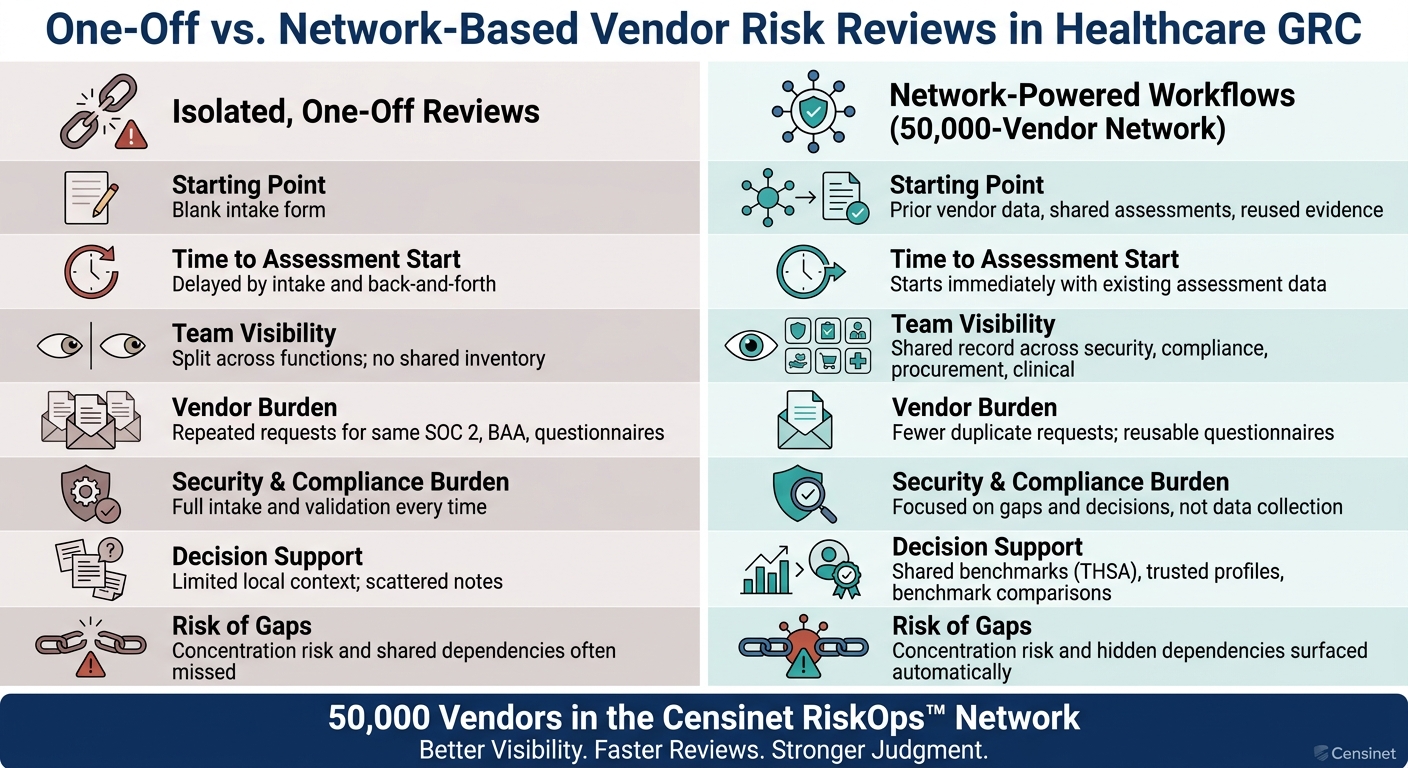
One-Off vs. Network-Based Vendor Risk Reviews in Healthcare GRC
Shared visibility only matters if it saves time and trims repeat work. That’s where network-driven workflows stand out. The big change isn’t just what teams can see. It’s how much manual work they no longer have to do.
Reusable questionnaires and shared evidence cut repeated requests
Censinet maintains a risk network of 50,000 vendors [1]. That gives healthcare teams a shared pool of assessment data to start from instead of rebuilding every review from scratch.
When teams can reuse questionnaires and shared evidence, they can move straight into review. That means less back-and-forth for procurement, security, and compliance teams. It also shifts effort away from chasing documents and toward making decisions. The payoff is even bigger when the right evidence goes to the right reviewer right away, without reopening the full assessment.
How AI speeds reviews without removing control
Censinet AI™ helps shorten the slowest parts of the review process. It supports vendors as they complete security questionnaires, automates evidence summarization, and drafts risk summaries.
At the same time, risk teams stay in control through configurable rules and review processes that determine what gets escalated, what needs sign-off, and what calls for extra scrutiny. That balance matters. Teams can move faster without giving up oversight.
It also connects straight to healthcare GRC outcomes. Faster questionnaire completion and evidence summarization can shrink the time between vendor identification and procurement approval, security sign-off, and remediation decisions.
Isolated assessments vs. network-powered assessment workflows
In day-to-day work, network-driven workflows change four parts of the review process:
| Assessment Area | Isolated, One-Off Reviews | Network-Powered Workflows |
|---|---|---|
| Time to assessment start | Delayed by intake and back-and-forth | Starts with existing assessment data and workflow support |
| Visibility into context | Limited to what a single team has gathered | More complete context from shared assessment data |
| Burden on vendors | Repeated requests from multiple teams | Fewer duplicate requests |
| Burden on security and compliance teams | Full intake and validation every time | Focused on gaps and decisions, not data collection |
This shift isn’t only about moving faster. It changes where teams spend their time. Instead of gathering the same basic information again and again, they can focus on analyzing it. That’s where security, compliance, and procurement teams do their best work. And when assessments are faster and cleaner, leaders have a stronger basis for risk decisions.
Why better data leads to better vendor risk decisions
Speed matters. But when teams need to approve, escalate, or reject a vendor, shared benchmarks matter even more. The main gain from a shared vendor network isn’t speed by itself. It’s better decision-making.
When teams review vendors using shared evidence and standard benchmarks, they stop making calls without comparable context. That changes the conversation. Instead of arguing from scattered notes or one-off judgments, teams can look at the same facts and move forward with more confidence.
Benchmarked vendor risk insights for security and procurement leaders
Without shared benchmarks, teams don’t have a steady way to compare vendors or explain why a decision was made. Trusted profiles and the Together Health Security Assessment (THSA) give security and procurement teams a shared benchmark for pre-onboarding review [3].
That shared benchmark helps in a practical way. When teams compare vendors against the same evidence, they can defend decisions with less debate. It also becomes easier to apply one standard across the vendor portfolio and focus attention where it matters most.
From faster reviews to stronger governance decisions
Once that shared baseline is in place, governance gets more consistent. Approvals, exceptions, and escalations become easier to justify across security, compliance, and procurement.
Automated workflows replace spreadsheet reviews and give teams real-time portfolio visibility [3]. In plain English: less back-and-forth, fewer judgment calls based on incomplete information, and better support for each decision.
Conclusion: the 50,000-vendor advantage means better visibility, speed, and judgment
Healthcare third-party risk has become too big, and too tangled, for isolated one-off reviews to keep up. At network scale, that problem starts to ease. With more than 50,000 vendors in the network, teams begin with shared evidence instead of a blank intake, reuse questionnaires and documents like SOC 2 reports and BAAs instead of redoing the same tasks, and make decisions with better context [1].
That shows up most clearly at the decision point. Shared benchmarks give security, compliance, and procurement teams a steady basis for approvals, escalations, and rejections across the full vendor portfolio. Shared intelligence adds the context teams need to approve, escalate, or reject vendors with confidence. The network effect shows up in lower effort and better decisions.
That’s the 50,000-vendor advantage: better visibility, faster reviews, and stronger judgment.
FAQs
How does a shared vendor network improve risk decisions?
A shared vendor network makes risk decisions better by replacing siloed, manual reviews with collective insight. Instead of starting from scratch each time, teams can work from data on 50,000+ vendors, along with pre-assessed risk profiles, standardized questionnaires, and shared proof such as SOC 2 reports and BAAs.
That gives teams a clearer way to compare vendors, spot trusted providers, and respond to current security posture updates. The result is faster, better-informed decisions with less guesswork.
What kinds of vendor evidence can teams reuse?
Teams can reuse many kinds of vendor evidence across the network, which cuts down on repeat manual requests. That can include completed security questionnaires, SOC 2 reports, HITRUST certifications, BAAs, policy documents, incident response plans, penetration test summaries, business continuity plans, and other files like PDFs and spreadsheets.
Once a vendor uploads this evidence to the centralized digital risk catalog, other healthcare organizations in the network can use it too.
How does AI speed reviews without reducing oversight?
AI cuts review time by taking over repetitive, document-heavy work. Vendors can finish standard security questionnaires in seconds, and the system reviews and sums up submitted evidence, integration details, and fourth-party risks into detailed risk reports.
Human-guided governance keeps oversight in place. Findings and tasks go straight to the right stakeholders for review and approval, while real-time workflows help teams stay focused on exceptions, overdue items, and high-priority risks.
