
If I had to give the short answer in one line, it would be this: use AES for patient data and RSA for device trust and setup.
Telemedicine devices send a steady flow of ePHI across home Wi‑Fi, cellular links, and hospital systems. With 13.5 million+ U.S. remote-monitoring services logged from 2019 to 2023, worth about $664.5 million, encryption has to protect data without slowing care down.
Here’s the plain-English takeaway:
- AES is the right fit for bulk data encryption
- telemetry
- video
- images
- logs
- RSA is the right fit for identity and setup
- certificates
- digital signatures
- session key exchange
- AES-128 is often the default for constrained devices because it uses less power and compute
- AES-GCM and AES-CCM help protect both privacy and data integrity
- RSA-2,048 is still the common baseline for device certificates and signatures
- RSA should not encrypt nonstop patient streams directly
- TLS 1.2 or 1.3, key rotation, and certificate revocation still matter just as much as the algorithm choice
What this means for you is simple: if a blood pressure cuff, ECG patch, or pulse oximeter is sending patient readings all day, AES should carry that traffic. If the device needs to prove who it is, verify firmware, or start a secure session, RSA should handle that part.
Symmetric vs Asymmetric Encryption: AES, RSA, Digital Signatures & More
sbb-itb-535baee
Quick Comparison
| Criteria | AES | RSA |
|---|---|---|
| Main job | Encrypt patient data | Verify identity, sign data, help set up sessions |
| Best use in telemedicine | Continuous telemetry, video, imaging, uploads | Certificates, signatures, key exchange |
| Device impact | Lower CPU and battery use | Higher CPU and battery use |
| Fit for constrained devices | Good for daily traffic | Better for infrequent tasks |
| Common telemedicine choice | AES-128 or AES-256 with GCM/CCM | RSA-2,048, sometimes RSA-3,072 |
| Best overall approach | Use for data in motion | Use for trust and setup |
So when I look at AES vs. RSA for telemedicine devices, I don’t treat it as an either/or decision. I use both, but I keep each one in its own lane.
AES for telemedicine devices: fast bulk encryption with low overhead
AES protects the steady flow of patient data moving between telemedicine devices, apps, and cloud systems. It uses the same secret key on both sides, and it's fast enough for continuous monitoring. For constrained telemedicine devices, AES-128 is usually the practical default because it delivers strong security with less compute cost than larger keys. The best published attacks still need roughly 2^126 operations.[8]
That speed matters. Modern hardware handles AES well, and low-power devices can run it without draining the battery too hard. For monitors that send data all day, that makes a big difference.
When you need both privacy and tamper detection, AES-GCM (Galois/Counter Mode) and AES-CCM (Counter with CBC-MAC) are the standard picks.[11][9] Both modes add an authentication tag to the ciphertext, so the receiving system can spot tampering before the data ever reaches a clinician's dashboard. In telemetry, that's a big deal. A changed or damaged vital sign reading isn't just bad data - it can turn into a patient safety problem.
Where AES works well in clinical device communication
AES fits continuous or high-volume telemedicine data well.[2][3] Streams such as heart rate, SpO2, blood pressure, and respiratory rate benefit from AES's low per-block processing time. That helps systems stay responsive in real time without noticeable lag.[2]
Wearables like cardiac patches and glucose sensors can run AES-128 on low-power microcontrollers, which helps keep RAM use and CPU load in check while still protecting sensitive health data.[1][2]
AES also handles larger payloads well. Diagnostic images, waveform recordings, and device logs uploaded from home monitoring gateways can be encrypted efficiently, and AES plugs neatly into transport protocols like TLS.[4][5] That shared-key setup is also why RSA still has a place during initial setup and trust establishment.
AES limits: secure key distribution still matters
AES has one main catch: both sides need the same secret key before they can communicate.[5] In practice, telemedicine systems often use a hybrid model. An asymmetric algorithm like RSA protects the AES key during initial provisioning, and AES then handles the patient data that follows.[5] RSA can protect the AES key during provisioning, while AES carries the patient data.
The session key should live in secure hardware on the device side, such as a secure element or trusted execution environment, and in a hardened key management system on the server side.[3] Rotating keys on a regular schedule - per session, per patient encounter, or by time - limits the damage if a key is exposed.[3][5]
Revocation matters too. If a device is stolen or retired, the backend must stop accepting traffic encrypted with that device's key as part of third-party vendor risk management and provision a replacement through a secure channel.[3]
That key-exchange gap is where RSA fits.
AES attributes for telemedicine devices: comparison table
| Attribute | AES-128 | AES-256 |
|---|---|---|
| Key size | 128-bit | 256-bit |
| Processing rounds | 10 | 14 |
| Speed on constrained IoT hardware | Faster (~16.1 ms average encryption time)[10] | Slower (~19.7 ms average encryption time)[10] |
| CPU cycles per byte (AES-NI) | ~1.28 cycles/byte[7] | ~1.76 cycles/byte[7] |
| Battery impact | Lower | About 40% higher than AES-128[6] |
| Authenticated encryption modes | AES-GCM, AES-CCM | AES-GCM, AES-CCM |
| Fit for continuous telemetry | Well suited | Well suited |
| Key management dependency | Required | Required |
RSA for telemedicine devices: identity, key exchange, and signatures
Where AES protects the payload, RSA handles identity and session setup.
RSA uses a public/private key pair. The public key is shared, while the private key stays secret. That makes RSA a good fit for identity checks, signatures, and session setup, but not for bulk telemetry. In telemedicine, that split helps protect device trust and the integrity of clinical data.
For telemedicine deployments, 2,048-bit RSA is the common baseline today. NIST SP 800-78-5 lists RSA 2,048 or 3,072 bits for digital-signature key use.[17] Use 3,072-bit RSA only when a longer device lifespan or a higher level of assurance is worth the extra overhead.
Where RSA adds value in telemedicine ecosystems
RSA’s clearest role in telemedicine is trust establishment, not data transport.[15][16][19] In practice, it handles two main jobs:
- Certificate-based authentication and TLS session setup: Device certificates verify identity before AES carries telemetry.[15][16]
- Digital signatures: Devices or manufacturers sign firmware updates, configuration messages, and clinical data headers with their RSA private key. Any downstream system with the matching public key can verify the signature and confirm the data hasn't been altered.[12][19]
Why RSA is a poor fit for bulk patient data
RSA operations rely on modular exponentiation with large integers. That takes far more CPU work than AES block operations. On battery-powered wearables, implantables, or home sensors, that cost piles up fast.
Research on constrained IoT hardware found that an alternative scheme outperformed RSA by 57x for encryption and 61x for verification in execution time, while cutting energy use by 36x to 42x in some scenarios.[14] So if a device tries to use RSA for continuous telemetry, like continuous ECG or oxygen saturation data, the result can be a mess: higher CPU load, more latency, memory pressure from large-integer arithmetic, and faster battery drain.[13][14][20]
That’s why the usual split makes sense: use RSA for setup and verification, and use AES for payloads. RSA handles trust. AES carries the data.
RSA attributes for telemedicine devices: comparison table
| Attribute | RSA for telemedicine devices |
|---|---|
| Ecosystem role | Identity, signatures, and session setup[15][16][19] |
| Computational overhead | High on constrained devices[13][14][20] |
| Key management complexity | High: private keys and certificates need tight lifecycle control[16][18] |
| Scalability across device fleets | Works well for trust infrastructure; inefficient if misapplied to bulk data across large device populations[13][14] |
| Fit for authentication | Strong; widely used for signatures and certificate-based verification[15][16][19] |
| Fit for direct payload encryption | Poor; not suited for large patient data streams or real-time telemetry[13][20] |
AES vs. RSA for telemedicine devices: direct comparison and best-fit use cases
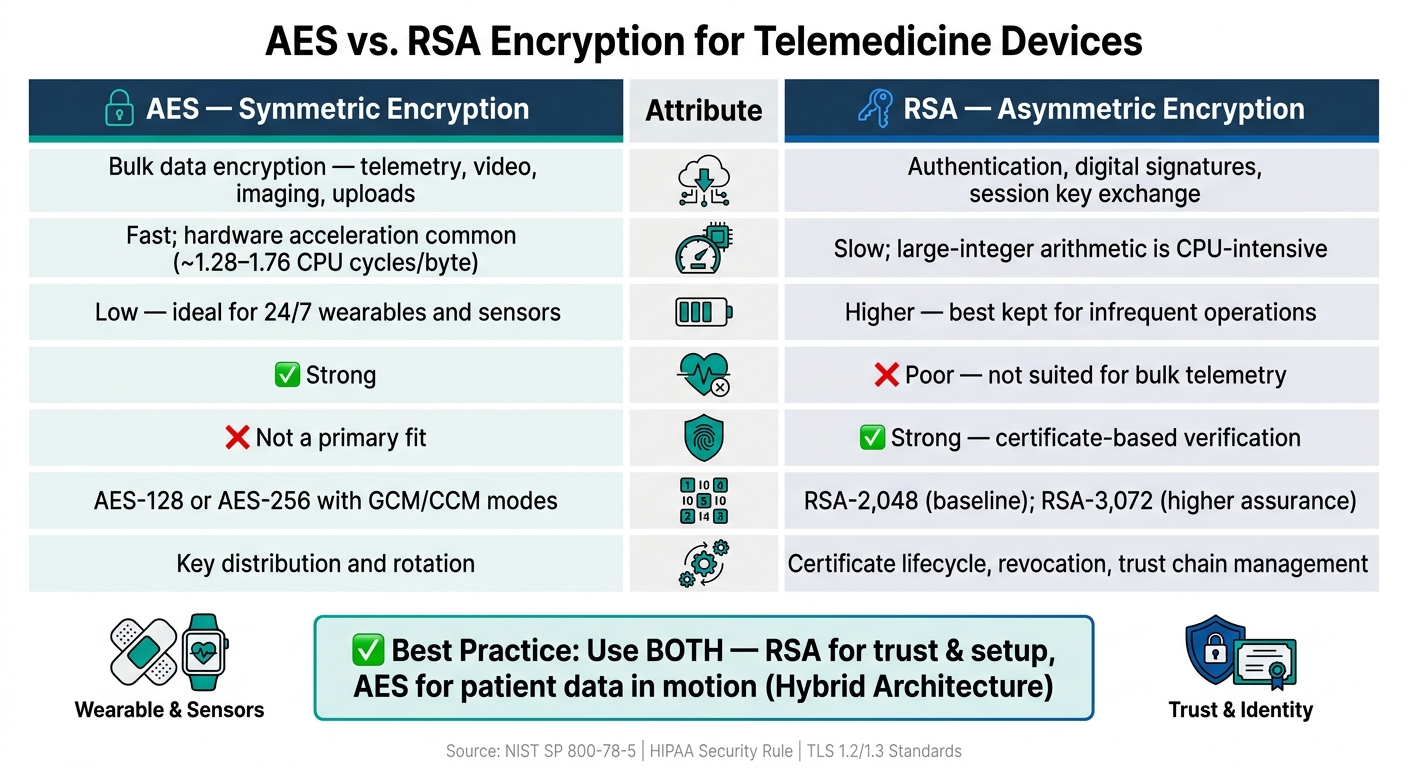
AES vs. RSA Encryption for Telemedicine Devices: Side-by-Side Comparison
When you compare AES and RSA for telemedicine, three things tend to matter most: latency, battery life, and trust.
Key differences for healthcare IT leaders
AES is symmetric. RSA is asymmetric. That one split shapes how each one behaves in the real world, especially on telemedicine devices with limited power and processing headroom.
For continuous monitoring workflows - like heart rate or glucose data streaming 24/7 - AES is the clear fit. It encrypts large amounts of data fast, keeps latency steady, and puts far less strain on the CPU. On a wearable or home sensor, that matters. RSA, by contrast, is too slow for bulk telemetry, and it can only handle small payloads. So it works best for setup, not for nonstop device traffic.
RSA earns its place in tasks that happen once in a while, not every second. Think device authentication when a unit first connects, firmware update validation, or signing a diagnostic report. In video visits, AES protects the media stream, while RSA helps verify certificates during setup.
Why hybrid encryption is the practical answer for most deployments
Most telemedicine deployments use both. RSA handles identity and session setup. AES handles the data stream.
That division is pretty straightforward in practice: RSA secures the handshake, and AES carries the session. A remote patient monitoring device might use RSA-based certificates to prove its identity to a cloud API, then switch to AES for the live telemetry stream. A hospital gateway can keep RSA trust relationships with several cloud services while running AES-encrypted tunnels for connected devices.[21]
This setup keeps the expensive RSA work limited to setup events, while AES takes over the high-frequency traffic that remote care depends on.
The result is a clean division of labor: RSA underpins trust, identity, and session setup; AES provides ongoing confidentiality for patient data in transit. But that split holds up only if teams stay tight on key rotation and certificate revocation.
AES vs. RSA for telemedicine devices: comparison table
| Attribute | AES | RSA |
|---|---|---|
| Typical role in telemedicine | Bulk data encryption: telemetry, video, imaging, episodic uploads | Authentication, digital signatures, and session key exchange |
| Speed on constrained hardware | Fast; hardware acceleration is common | Slow; large-integer arithmetic is CPU-intensive |
| Battery impact | Low; a good fit for 24/7 wearables and sensors | Higher if overused; best kept for infrequent operations |
| Fit for continuous telemetry | Strong | Poor; not suited for bulk telemetry |
| Fit for authentication | Not a primary fit; needs separate key distribution | Strong; certificate-based verification is a core use case |
| Operational complexity | Key distribution and rotation are the main pain points | Certificate lifecycle, revocation, and trust chain management |
Governance and conclusion: choosing encryption that supports compliance and resilience
Once AES and RSA have clear roles, governance is the piece that keeps the setup honest. AES protects the data. RSA supports trust. So the review process should confirm that each one stays in its lane.
Use that split as the starting point for security review.
What security and compliance teams should check
Under HIPAA's Security Rule, encryption for ePHI is an addressable implementation specification. That means your organization has to decide whether encryption is reasonable and appropriate, put it in place when it is, and document the decision either way. NIST SP 800-66 Rev. 2 is the current implementation guide for mapping those controls to HIPAA expectations.[22][23]
Security and compliance teams should check four areas.
- Algorithms and modes: Confirm AES-GCM or AES-CCM is used for data, and RSA is used for identity, signatures, and key exchange - not for patient data.
- Key and certificate management: Verify that rotation schedules exist, long-term private keys are stored in hardware-backed secure storage, and monitoring is set up for expiring certificates.
- Protocol configuration: Make sure TLS 1.2 or 1.3 is enforced, weak cipher suites are disabled, and devices properly validate certificate chains.[24][25]
- Operational impact: Encryption can't slow things down to the point that alerts are delayed or care is disrupted by latency or dropped connections.
Use Censinet RiskOps™ to track encryption findings, owners, and remediation across telemedicine vendors and devices.
If any of these checks fail, the deployment isn't ready.
Key takeaways and final recommendation
For U.S. healthcare organizations, the clearest path is a hybrid AES + RSA architecture backed by clear policy. Use AES for telemetry and video with authenticated encryption. Use RSA for identity, certificate handling, key exchange, and signatures inside standard protocols like TLS. Each algorithm has a job, and neither does its best work outside that job.
Governance should lock this split into enterprise cryptography standards, vendor contracts, and procurement criteria. Key management and certificate lifecycle need the same level of scrutiny as algorithm choice. Encrypted PHI is safer from breach reporting only when the key material remains protected.[25]
Treat encryption as a risk management decision, not just a technical choice: AES for telemetry, RSA for trust, and both under strict key and certificate control.
FAQs
Why not use RSA for all telemedicine data?
RSA is too heavy and inefficient for large telemedicine datasets. Encrypting a 1 GB file with RSA-2048 can use up to 95% of CPU resources, compared with 20% for AES.
RSA still has an important job. It works well for secure key exchange and authentication. But for nonstop, high-volume telehealth traffic and medical device data, it’s simply too slow.
That’s why a hybrid approach is the standard setup: RSA for key management, AES for the data itself.
When should a device use AES-256 instead of AES-128?
Use AES-256 in healthcare settings, especially for data at rest, large PHI stores, and information that needs to stay protected for a long time. It’s the preferred standard for safeguarding sensitive PHI under HIPAA and FIPS 140-2 validation guidelines.
AES-128 is generally acceptable for data in transit within secure TLS channels. In modern deployments, AES-256-GCM is the better choice when maximum security, long-term protection, or specific regulatory safe harbor requirements are the top priority.
How often should telemedicine keys and certificates be rotated?
Healthcare organizations need a clear, repeatable rotation schedule for telemedicine keys and certificates. The goal is simple: if a key is exposed, the window of risk stays smaller.
A common baseline is:
- AES keys: rotate every 6 to 12 months
- RSA keys: rotate every 2 to 3 years, or sooner if security requirements change
Some environments need a tighter schedule, with updates every 90 days.
Whatever timeline you use, the process should be automated and handled through Hardware Security Modules (HSMs) or cloud-based key management services. Manual rotation tends to create mistakes, delays, and gaps that no healthcare team wants to deal with.
