
AI is moving faster than hospital oversight, and that creates patient, privacy, legal, and board-level risk. In 2025, specialized AI use in healthcare went up 7x, but only 16% of health systems had an enterprise AI governance plan. My takeaway is simple: if you let AI spread before you set rules, owners, logs, and review steps, you invite unsafe output, PHI leaks, weak audit trails, and compliance trouble.
Here’s the short version:
- Patient care can slip when AI output is wrong, biased, or accepted without enough review.
- PHI can leave approved systems when staff use shadow AI tools or vendors have weak data controls.
- Audit defense gets weaker when teams can’t show what the model said, which version ran, or who overrode it.
- Legal and compliance risk grows under HIPAA, FDA rules, state AI laws, and False Claims Act scrutiny.
- The fix is clear: set up governance, assign owners, test models before and after launch, tighten vendor review, and monitor tools after go-live.
A few facts make the risk hard to ignore:
- Kaiser Permanente affiliates agreed to pay $556 million over diagnosis coding issues.
- DOJ healthcare False Claims Act recoveries hit more than $5.7 billion in fiscal year 2025.
- 20% of healthcare groups reported a data breach tied to unsanctioned AI tools in 2025.
- Only 30% keep an enterprise AI inventory.
If I had to boil the article down to one point, it would be this: AI oversight can’t stop at procurement or pilot review. You need a clear system for approval, monitoring, vendor change review, incident response, and shutdown when a tool starts creating risk.
That’s what this article is about.
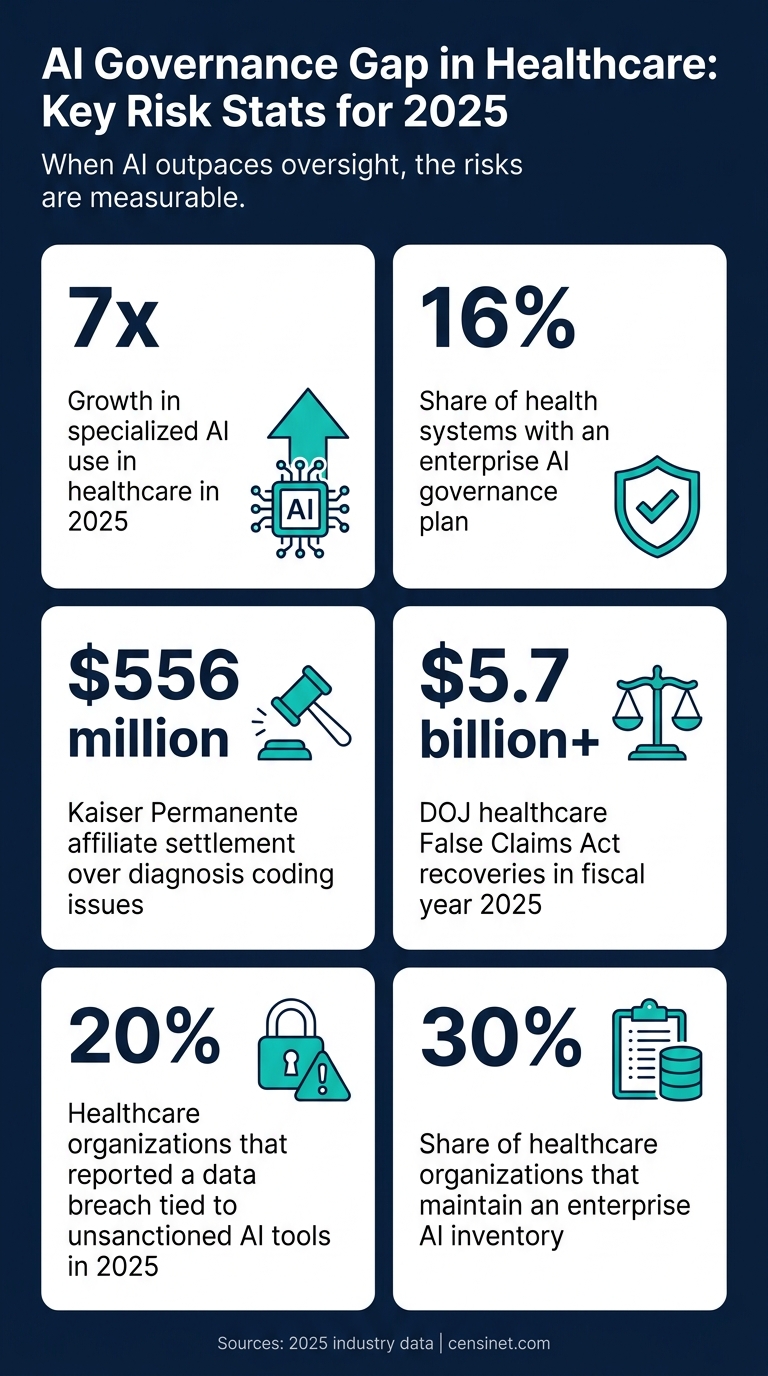
AI Governance Gap in Healthcare: Key Risk Stats for 2025
Healthcare AI Governance - Risks, Compliance, and Frameworks Explained
sbb-itb-535baee
What Breaks When AI Outpaces Oversight
When AI moves faster than governance, the damage shows up fast: in dashboards, daily workflows, and audit logs. And once that happens, the issue isn't just operational. It turns into compliance risk and business risk.
Unsafe Clinical Output and Biased Triage Decisions
Without clear review standards and escalation rules, AI suggestions can slide into unsafe default actions. An AI scribe that hallucinates symptoms in a patient summary doesn't just add cleanup work. It can push a clinician toward the wrong diagnostic path. [3]
In a rushed setting, "approve" can become a habit instead of a real check. That's where things get dangerous. In triage, for example, an AI model may rank some demographic groups too low because the training data was biased or because the patient population changed after validation. The result is uneven care. High-risk patients may face treatment delays, and no alert may fire at the time. The problem may only show up later in outcomes data. Without continuous monitoring and bias testing, model drift can slip by unnoticed. [1][4]
PHI Leakage, Misuse, and New Cybersecurity Exposure
When staff turn to unapproved tools, PHI can leave controlled systems and end up inside vendor environments. A clinician who pastes patient notes into a consumer AI tool may be sending that data to a vendor that keeps it and uses it to train commercial models. That's a HIPAA risk. [1][5]
And the danger doesn't stop with the main vendor. A vendor's HIPAA claim does not prove its LLM chain is covered by BAAs across every subprocessor. [5] A 2025 breach at Moltbook exposed 1.5 million AI agent keys, showing how non-human identities tied to AI workflows can become entry points for attackers. [6]
Audit Failures, Documentation Gaps, and Vendor Blind Spots
Without logs, override records, and model version tracking, an organization may have no clear way to piece events back together. It may not know which AI recommendation a clinician saw, whether the clinician overrode it, or what data the model used. That makes adverse event investigations and malpractice defense much harder. [1][3]
In early 2026, the VA Office of Inspector General identified a critical lack of oversight regarding the use of generative AI chat tools within the Department of Veterans Affairs. [2]
Poor AI governance also makes vendor blind spots worse. A vendor can ship a silent model update that changes tool behavior, and if the health system has no monitoring baseline, it may miss the shift. Once the vendor chain gets murky, accountability falls apart.
These failures tend to group into four recurring risks:
- Unsafe output
- Biased triage
- PHI leakage
- Broken auditability
These are not just workflow problems. They create compliance exposure.
How Weak AI Oversight Creates Compliance and Enterprise Risk
The operational failures described above don’t stay stuck inside clinical workflows. They can turn into regulatory findings, legal exposure, and financial liability long before leadership sees the pattern.
Where Organizations Become Noncompliant With U.S. Requirements
A lot of healthcare organizations assume the vendor has compliance handled. That’s a risky bet. Unsafe output, PHI leakage, and missing audit trails can become compliance failures when oversight falls behind. At that point, this isn’t just an operations problem. It becomes direct exposure under HIPAA, FDA rules, state law, and fraud enforcement.
Under HIPAA, each covered entity must conduct its own system-specific risk analysis [5]. A vendor’s “HIPAA compliant” claim does not satisfy that duty.
The FDA’s revised Clinical Decision Support guidance, issued in January 2026, makes the line clearer. AI tools face tighter regulation when clinicians can’t independently verify the basis for a recommendation, or when the software starts to replace clinical judgment [3][4]. State law adds another layer. California’s AB 3030 and the Colorado AI Act require specific disclosures when AI influences clinical decisions, and shadow AI tools often miss them [4][5]. The fix isn’t guesswork. It takes formal governance and model risk controls.
Automated coding and utilization review can also create False Claims Act exposure when documentation controls and traceability fall short. In fiscal year 2025, the U.S. Department of Justice reported more than $5.7 billion in healthcare-related False Claims Act recoveries [3].
Why AI Risk Is a Board and Executive Issue
As of 2026, only 16% of healthcare systems had an enterprise-wide AI governance strategy in place [6].
"AI in health care is not just a technology story; it is a governance story." - Christine Chasse, Attorney, Spencer Fane [3]
AI risk belongs in board reporting because the liability lands on the organization, not the vendor. Boards need a defined owner, a clear escalation path, and a reporting line. Otherwise, problems sit in the cracks until they get expensive. And those costs can hit from more than one side: financial loss, legal trouble, and reputational damage.
When boards treat AI like a simple IT project, risk goes unmanaged. What works better is treating AI oversight as an enterprise control, with governance, risk assessments, and monitoring that keep up with deployment.
How to Restore Control With AI Governance and Model Risk Management
You restore control with an operating model that governs review, approval, monitoring, and suspension of AI tools. That’s what closes the gaps behind unsafe output, PHI leakage, and broken audit trails. Put simply: the fix is a control structure that assigns ownership before AI reaches patients.
Build a Formal AI Governance Structure
Start with a multidisciplinary AI governance committee. Bring in clinical leadership, IT, cybersecurity, privacy, compliance, legal, data science, and operations - this is not a single-team problem [3][7].
The committee should own intake, risk tiering, approval, exceptions, escalation, and human oversight for higher-risk tools. That matters because not every AI use case carries the same level of risk.
Risk tiering matters here. A scheduling chatbot and an AI tool that flags sepsis risk are not in the same league. The same goes for a tool that recommends a treatment path. Governance controls should match the level of risk.
Each AI tool also needs a named clinical owner and a named operational owner. Those people are accountable for performance and responsible for escalating problems when something goes wrong [4][9].
Apply Model Risk Assessments Before and After Deployment
Pre-deployment validation is the starting line, not the end of the job. Before any AI tool goes live, organizations should define its intended use, assess data quality and possible bias, and validate it against their local patient population - not just the vendor’s training data [4][8].
After go-live, the work doesn’t stop. Use the NIST AI RMF to turn governance into repeatable operating controls.
| NIST AI RMF Function | Healthcare Operational Control | Evidence to Retain |
|---|---|---|
| GOVERN | Define decision rights, risk tolerance by use case, and escalation paths with executive authority | AI Governance Committee Charter, Risk Tolerance Policy by Use Case, Escalation Workflows |
| MAP | Use-case intake and risk tiering; identify affected populations, error types, and outcome boundaries | Intake Forms (Intended Use), Use-Case Inventory, Bias/Equity Assessments, Affected Population Docs |
| MEASURE | Continuous monitoring for drift, performance decline, and subgroup bias | Local Validation Records, Subgroup Stratification Logs, Drift/Performance Dashboards, Vendor Update Logs |
| MANAGE | Act on monitoring signals; document residual risk decisions; maintain kill switches | Approval/Rejection Decisions, Residual Risk Sign-offs, Human-in-the-Loop/Override Logs, Incident Response Plans |
At a minimum, routine tools should get a standing monthly review of performance and clinician override rates. Clinical decision tools should be checked more often [4].
Use Censinet to Centralize AI Risk Workflows and Evidence
Once controls are in place, teams need one place to store evidence, approvals, and remediation work. Right now, only 30% of healthcare organizations keep an enterprise-wide AI inventory [9].
Censinet RiskOps™ gives organizations a central hub to inventory AI systems and vendors, standardize risk assessments, store policies and approval decisions, and track remediation in one place.
Censinet AI adds human-guided automation for policy drafting, assessment summaries, and evidence checks. The result: less manual work, with people still accountable for the final call.
The platform also supports routing across governance, risk, and compliance teams. It sends findings and tasks to the right stakeholders - including AI governance committee members - for review and approval. An AI risk dashboard shows live status and open actions for the right owners.
How to Strengthen Vendor Due Diligence, Monitoring, and Accountability
Vendor oversight needs to cover the whole lifecycle, from procurement to decommissioning. Risk doesn’t stop at contract signing. It can show up in subcontractors, buried terms, and later model changes just as easily.
Use a Healthcare AI Vendor Due Diligence Checklist
A vendor saying it is HIPAA-compliant is not enough. You need proof tied to the exact use case. If a vendor falls short, the result can be unsafe output, PHI leakage, and audit gaps just as fast as with an internal system.
Before procurement or renewal, ask for written evidence across five core areas:
| Due Diligence Category | What to Request / Verify |
|---|---|
| PHI handling and lawful use | Data flow map; PHI use/disclosure limits; BAA; retention/disposal terms; training and secondary-use restrictions |
| Security controls | Encryption, access controls, unique user IDs, audit logging, deployment-specific risk analysis, regional storage details |
| Model governance | Intended use, limitations, human oversight requirements, validation evidence, drift monitoring, retraining practices, change-notification policy |
| Subcontractors and fourth parties | Subprocessor list; downstream BAAs; third-party model/API dependencies; flow-down obligations |
| Regulatory responsibilities | HIPAA role allocation; audit rights; liability allocation; breach notification duties; termination rights |
As Morgan Lewis notes, "A generic BAA frequently will not satisfy these obligations and leave the organization materially exposed." [10] That warning matters. The BAA should spell out the AI use case, data flows, retention, limits on secondary use, and downstream flow-down obligations.
Once a vendor is approved, keep watching those same risk areas in production.
Implement Continuous Monitoring and Technical Guardrails
After go-live, monitoring has to stay on. The main trouble spots are the same ones already on the table: output quality, PHI leakage, auditability, and vendor drift.
On the technical side, put runtime controls in place that inspect both inputs and outputs in real time. Those controls can block PHI from leaving the environment and stop unsafe recommendations before they reach clinicians and cause harm [6]. Log every AI request with the user, prompt, response, model version, and downstream calls. If that record is missing, audit defense gets shaky fast.
On the operational side, track clinician warning override rates. Watch for blind acceptance rates and review completion rates too. These metrics can show when clinicians are rubber-stamping AI output or when the workflow has started to drift from its intended design [4].
Your contracts should also require vendors to report any material changes to models, training, or infrastructure. The Health Sector Coordinating Council has warned that accelerating changes in AI infrastructure, algorithms, and models create an ever-evolving set of new and updated risks and expand the attack surface [11].
AI-related events should feed into your current cybersecurity and patient-safety incident response processes. This is not a side issue. In 2025, 20% of healthcare organizations experienced a data breach tied specifically to unsanctioned AI tools [6]. Discovery tools that map AI access paths, including browser-based tools and vendor-enabled features added to current platforms without notice, are a practical first step for closing that gap.
Vendor controls don’t mean much if they go quiet after launch.
Conclusion: Slow Down Risk, Not Innovation
What works is a control structure that governs AI before, during, and after deployment, not a one-time review that treats go-live like the end of the job. In plain terms, that means setting up a multidisciplinary committee, using model risk assessments at intake and on a recurring schedule, tightening vendor due diligence beyond marketing badges, monitoring for drift and unsafe output, and giving named owners clear accountability when something goes wrong.
Censinet RiskOps™ centralizes AI inventory, assessments, evidence, and remediation tracking. The aim is not to slow innovation. It is to keep risk under control.
FAQs
Who should own AI governance in a hospital?
AI governance in a hospital should be handled as an enterprise risk, not as a side project run by one team.
Why? Because AI can affect patient safety, legal liability, and regulatory compliance all at once. That means ownership can't sit in a single department. It needs a cross-functional oversight committee with shared responsibility across clinical leadership, legal, compliance, IT, cybersecurity, and data science.
Each AI tool should also have a named owner. That person is responsible for the tool's performance, day-to-day monitoring, and incident response.
How can a health system find shadow AI use?
Health systems can find shadow AI by treating it as a visibility problem. The goal is to map AI apps, prompts, model calls, and downstream actions that touch PHI.
That means looking at where AI shows up across day-to-day work, not just in approved tools. A clinician might paste notes into a chatbot. A staff member might use an AI writing tool to draft a message. Someone else might send PHI through a plug-in without realizing where that data goes. If you can't see those paths, you can't control them.
A few practical ways to spot it:
- Monitor network traffic for known AI service endpoints
- Use egress proxies or HTTP enforcement layers to identify AI traffic
- Review documentation patterns for AI-assisted content
- Configure data loss prevention tools to detect PHI sent to unauthorized destinations
This approach helps teams move from guesswork to a clear picture of where PHI may be flowing through unapproved AI use.
When should an AI tool be paused or shut down?
Pause or shut down an AI tool when it creates risks your organization can’t govern, monitor, or justify.
That means stopping it if it accesses PHI without a signed BAA. It also means stopping it if clinicians can’t independently review its recommendations, or if it starts to meaningfully replace clinical judgment.
The same goes for performance drift, demographic bias, factual errors, or use outside approved limits. If any of those issues could put patient safety or compliance at risk, the tool shouldn’t stay in use.
