
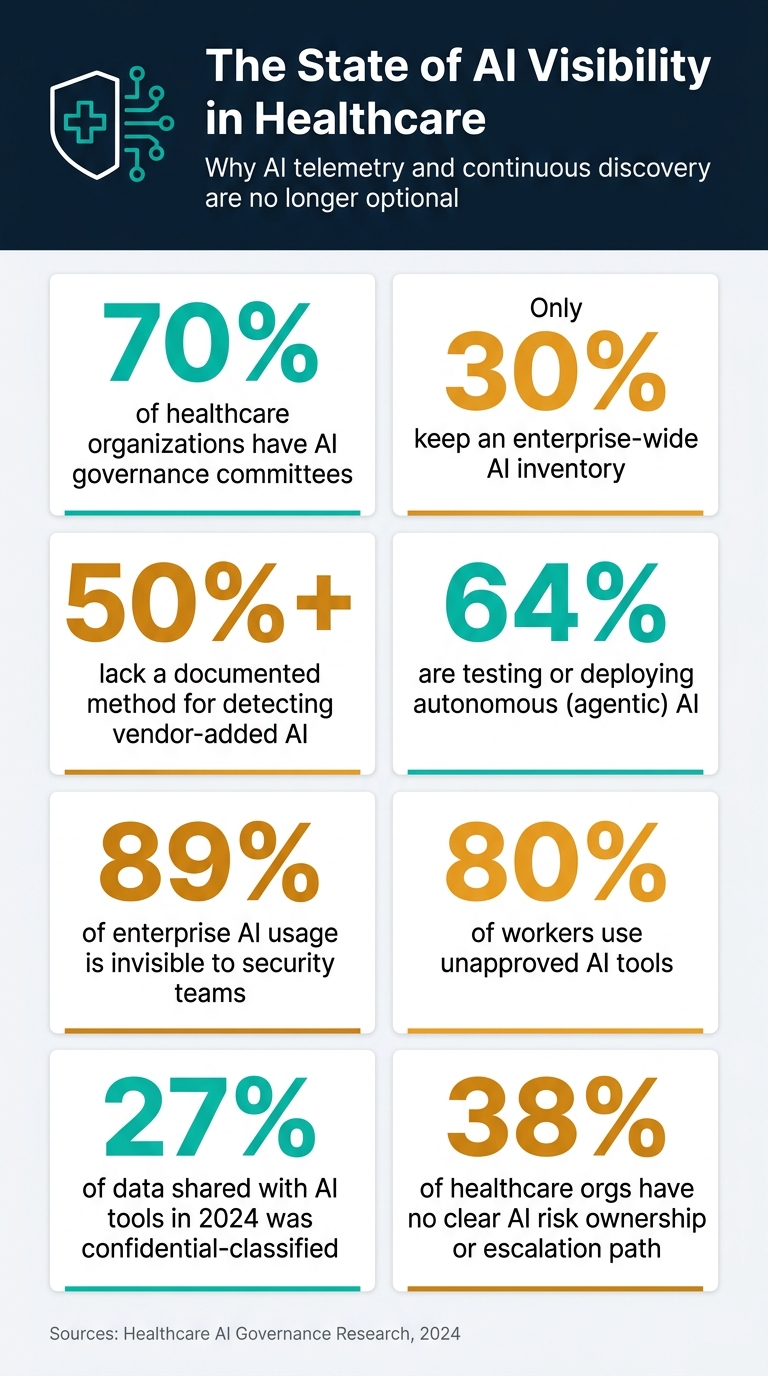
Most healthcare groups have AI oversight teams, but only 30% keep a company-wide AI inventory. That is the core problem this article tackles.
If I had to sum it up in one line: AI telemetry is how I keep a live list of every AI model, tool, API, vendor feature, and agent that touches patient or business data.
Here’s the plain-English takeaway:
- A one-time inventory is not enough. AI tools change fast, vendors add features, and staff use tools outside formal review.
- My inventory needs more than names. I need owners, data access, PHI scope, risk tier, BAA status, integrations, and revocation rules.
- Telemetry keeps records current. I can use signals from network logs, IAM, browser activity, cloud logs, source code, and vendor records.
- Shadow AI is a big issue. Research cited here says 89% of enterprise AI use is invisible to security teams, and 80% of workers use unapproved AI tools.
- Agents need closer tracking. If an AI agent can log in, pull data, and take action by itself, I need a named human owner and a way to shut access off.
- This is not just about compliance. It is also about patient safety, breach prevention, vendor review, and faster incident response.
A few numbers stand out:
- 70% of healthcare groups have AI governance committees
- Only 30% keep an enterprise-wide AI inventory
- More than 50% lack a documented way to spot AI added by vendors
- 64% are testing or using autonomous AI agents
- 27% of data shared with AI tools in 2024 was marked confidential
At a basic level, the article argues for a simple process: find every AI asset, map who owns it, track what data it touches, watch for change, and trigger review when risk shifts. That is the work AI telemetry makes possible.
If you want a short read on what matters most, start there.
AI Telemetry in Healthcare: Key Stats Every Compliance Team Must Know
The Hidden Cybersecurity Risks When Doctors Use AI Diagnostics | Ep. 58
sbb-itb-535baee
Build an AI asset inventory with the minimum telemetry required
An AI inventory falls apart if it only lists names. Each record needs to show what the asset does, what data it can reach, and who owns it. That’s what turns an AI inventory into a live control record instead of a stale spreadsheet.
Core inventory fields for every model, tool, API, and agent
Every asset record should cover five field groups: identity, risk, technical context, data governance, and operational control.
Identity and ownership fields spell out what the asset is and who answers for it. Risk and compliance fields show whether it touches PHI and whether the current Business Associate Agreement covers AI use and contract duties. Technical context fields explain how the asset is deployed and what systems it connects to. Data governance fields track what data goes in, what comes out, and what the system may process. Operational control fields show the autonomy level and the human checks around it, including who approved access, who the named human owner is for autonomous agents, when access was approved, and the conditions for revoking it.
| Field Category | Minimum Required Fields |
|---|---|
| Identity & Ownership | Asset name, version, vendor/provider, business sponsor, technical owner |
| Risk & Compliance | PHI access level, contractual obligations, BAA status, clinical impact potential, risk tier (Low/Med/High) |
| Technical Context | Deployment type (SaaS/on-prem/API), integration points, authentication method |
| Data Governance | Training data sources, inference input types, output data classification, allowed-use scope |
| Operational Control | Autonomy level (agentic vs. human-in-the-loop), authorizing party, named human owner, authorization date, revocation conditions |
These fields are the floor, not the ceiling. Telemetry is what keeps them from drifting over time.
One field teams skip all the time is allowed-use scope. This is the boundary around the data classes a system may access. For example, a clinical tool may be allowed to access diagnosis data but not billing records. If that line isn’t written down and enforced, the inventory describes the system, but it doesn’t protect anything.
Telemetry signals that keep the inventory current
Once the baseline is in place, telemetry keeps the record current. Watch for shifts in data volume, frequency, and request complexity. Those changes often point to a new model version, a new integration, or a vendor update.
That matters because over 50% of healthcare organizations have no documented method for detecting when vendors embed AI into existing products [1]. So if a vendor tool suddenly starts making more requests or handling different data, that may be your first clue that an AI feature was added quietly. Telemetry helps you spot it early.
A centralized audit trail helps verify change, surface shadow AI, and support HIPAA activity review.
Agentic AI makes this harder. Autonomous agents can authenticate and act across systems all day, without pause. So telemetry needs to track those actions at the data level, not just the login event. If you only log the sign-in, you can miss over-privileged access until the blast radius gets much bigger.
High-priority AI asset examples in healthcare that must be tracked
Some AI assets need closer tracking because of the data they touch or the decisions they shape. Clinical decision support tools fall into that group. So do other systems tied to patient safety and PHI exposure.
You also need to watch autonomous agents that can move across systems on their own. And keep an eye on AI features added to already-approved products after procurement review. That’s a common place for shadow AI to show up.
Every AI asset needs the same chain of accountability:
- Owner
- Sponsor
- BAA status
- Revocation conditions
- Named human owner for autonomous systems
From here, continuous discovery catches the assets that never show up in procurement records.
Use continuous discovery to find new, changed, and hidden AI assets
Procurement records don't tell the whole story. A lot of AI is already running long before any approval trail shows up. That's why continuous discovery matters. It scans the environment for what paperwork missed and pulls signals from identity, endpoints, cloud, and vendor records.
Discovery sources that surface AI use across the environment
No single source can spot every AI asset. Each one shows a different part of the picture. The best approach layers signals from network/DNS, identity/OAuth, endpoint/browser, SaaS/CASB, source code/CI/CD, cloud control plane, and vendor risk records.
Here's what each source can surface:
- Network telemetry flags outbound connections from hospital or clinic workstations to known AI endpoints. That can reveal external AI services that never went through procurement.
- IAM and SSO logs show when a new AI SaaS app is added to an identity provider and which users or roles are already using it.
- CASB and browser telemetry show when clinicians access unsanctioned generative AI sites and upload patient notes or imaging descriptions.
- Source code scanning finds AI SDK imports and model API calls inside custom-built applications, including symptom checkers and triage chatbots.
- Cloud provider logs can surface new AI services, model endpoints, or serverless functions that call AI APIs.
- Vendor risk records catch vendor-added AI features. A telehealth vendor may add an AI visit summarization feature that automatically sends structured notes back into the EHR, and vendor risk reviews are often where that change shows up first.
How telemetry detects drift, new integrations, and shadow AI
Telemetry usually sees change before tickets do. Vendor toggles show up in SaaS and EHR config logs. Model swaps show up in deployment and CI/CD logs. New data access shows up in database, storage, IAM, and integration logs.
Shadow AI is the harder issue. Research shows 89% of enterprise AI usage is invisible to security teams, and 80% of workers use unapproved AI tools [3][4]. Generative AI has also become the single largest vector for corporate-to-personal data movement, accounting for 32% of all such transfers [3][5]. Endpoint research found that 27% of data shared with AI tools in 2024 was confidential-classified [2][5].
Those numbers change the job. Passive monitoring isn't enough. Telemetry needs to connect signals across sources so teams can spot staff using unsanctioned tools with sensitive clinical content before the exposure spreads.
When telemetry detects a material change, move fast. That could be a new AI endpoint, PHI flowing to an unreviewed service, or a model version swap. Update the asset record and trigger review right away. Once discovery updates the record, the next step is assigning ownership and data access.
Map ownership, data access, and risk to each AI asset
Discovery tells you what exists. Ownership tells you who is on the hook. Once telemetry surfaces a model, tool, or agent, the next move is to tie it to a person, a use case, and a risk tier. Without that, you don’t have control. You have a list.
Ownership and accountability fields that close gaps
Every AI asset should have a technical owner, business owner, and clinical owner. It also needs an accountable sponsor, vendor contact, review cadence, and BAA status.
This isn’t just a paperwork issue. It’s an operations issue. 38% of healthcare organizations either share AI risk responsibility across multiple groups without clear escalation paths or have not defined ownership at all [1]. When an AI tool shifts behavior or a vendor pushes an update, the right people need to be named and easy to reach. If response owners are assigned ahead of time, the inventory stays useful when something goes wrong.
A shared audit trail that the CISO, compliance officer, and privacy officer can all see helps fix split ownership and cuts response time when an asset changes or fails.
Once owners are assigned, telemetry can do more than observe. It can trigger review and escalation.
Data lineage and risk tiering for PHI and clinical impact
Ownership is only part of the story. You also need to know what data an asset touches, where that data moves, and how bad the fallout would be if it failed. That means recording PHI access scope, training data sources, inference inputs, output classification, and the downstream systems that receive those outputs. These fields shouldn’t stay frozen after intake. Telemetry should keep them current so the record matches how the asset works now, not how it looked on day one.
That same record should help teams sort response by risk, not just store facts. A scheduling assistant using de-identified data does not carry the same risk as an autonomous clinical decision support tool with PHI access. Here’s a simple way to split those tiers and flag when an asset needs another look:
| Risk Tier | Criteria | Telemetry Trigger for Re-Tiering |
|---|---|---|
| High (Clinical/Safety) | PHI access, autonomous decision-making, clinical workflow impact | Change in data record types accessed; new external API integrations |
| Moderate (Operational) | Access to sensitive business data; human-in-the-loop requirements | Increase in query volume; change in user permission levels |
| Low (Administrative) | De-identified data; low-autonomy tasks (e.g., scheduling) | Detection of PHI in inputs/outputs; shift to autonomous execution |
Pay close attention to agentic AI. A passive assistant might suggest or summarize. An autonomous agent can retrieve data, trigger workflows, and update records, often with no human checking each step. 64% of healthcare organizations are already experimenting with or deploying agentic AI [1], which means each agent in the inventory should point back to the human owner who approved it. Purpose binding matters here. An agent should only reach the data and functions tied to its approved use case.
The HIPAA Security Rule requires documented activity reviews for systems that process electronic PHI [1]. An inventory that records ownership, data lineage, and risk tier - and updates those fields when telemetry spots a change - turns that rule into something teams can show and use. Those fields feed governance, managing third-party AI risk, and breach response.
Turn AI telemetry into governance, vendor risk, and breach prevention
Ownership mapping and risk tiering give you a starting point. Telemetry is what turns that inventory into something teams can actually use to make control decisions.
How a real-time inventory drives control decisions
Once ownership and risk are mapped, telemetry needs to do more than refresh records. It should trigger action.
When telemetry spots a new asset or a change in scope, that event should move straight into approval, reassessment, or exception review. If a vendor quietly adds AI features to a product that was already approved, telemetry can flag shifts in data volume, access frequency, or query complexity. That gives teams a reason to start a BAA re-evaluation before the change slips by unnoticed.
This gets even more serious when the asset can act on its own. With agentic AI, the risk is higher. If an autonomous agent starts pulling record types outside its approved scope, there needs to be a clear path to revoke access. Purpose binding only works if telemetry checks each data access against the approved use case. If behavior starts to drift, the inventory should surface that drift as something people need to review and act on. Status changes should trigger that same review cycle too.
What healthcare security and compliance teams gain from continuous AI visibility
With change detection in place, security and compliance teams can use the same inventory for incident response and HIPAA review. Security teams can move faster during an incident because the audit trail already shows which assets touched which data, who approved access, and what changed before the event. Compliance teams can show the documented information system activity review required by the HIPAA Security Rule as a continuous record [1].
"Cybersecurity and AI governance are no longer separate disciplines. To defend one is to defend all." - John Riggi, National Advisor for Cybersecurity and Risk, American Hospital Association [1]
The payoff is pretty direct: hidden AI gets found sooner, records stay up to date, ownership stays clear, PHI exposure goes down, and each decision leaves behind an audit trail.
FAQs
How do I start AI telemetry with limited resources?
Start with the data you already have: technical logs, purchasing records, and staff interviews. Those three sources can help you spot shadow AI use that might otherwise slip through the cracks.
From there, build a central, living inventory. Include key details such as the owner, whether PHI is exposed, and the tool’s intended use.
Put your attention on high-risk workflows first. Then set up a repeatable intake process so new AI tools are reviewed the same way every time.
It also helps to weave AI oversight into the programs you already run, especially cybersecurity and risk management. That way, AI governance becomes part of day-to-day operations instead of a separate track.
What telemetry signals are most important to collect first?
Start with audit logs. They show who accessed which data, which AI tool took the action, when it happened, and the purpose behind that interaction. That gives you a clear trail instead of a black box.
It also helps to watch vendor data access patterns. If query volume, frequency, or complexity suddenly spikes, that can point to misuse or activity that doesn't fit the norm.
From there, expand your view across the rest of the stack. Monitor:
- Network traffic
- DNS queries
- API connections
- Service account activity
- Endpoint logs
- Browser activity
- SaaS discovery data
Taken together, these signals can help surface unknown or shadow AI use that might otherwise slip by unnoticed.
How should we handle shadow AI and autonomous agents?
Move past one-off procurement checks and shift to continuous discovery with lifecycle governance. That means keeping an up-to-date inventory of every AI app, agent, and conversation, including pilots and unsanctioned use. To do that well, use visibility tools, make self-reporting easy, and back it all with an acceptable use policy and a centralized AI intake process.
Autonomous agents need tighter guardrails based on what they’re allowed to decide or do. Start with least-privilege access so they only get the access they need. For consequential actions, require human approval. Log every action, and keep a containment or kill-switch option in place in case something goes off the rails.
