
AI can cut a vendor evidence review from a slow document read into a decision-ready risk check. In healthcare, that matters because 54% of healthcare vendors have had at least one PHI breach. If I’m reviewing a vendor, I don’t just want summaries. I want to know what controls are in place, what proof is missing, where documents conflict, and what needs human review.
Here’s the short version:
- I use an assessor agent to review SOC 2 reports, questionnaires, BAAs, policies, pen test results, and audit files
- It checks scope, dates, carve-outs, subservice providers, CUECs, and control claims
- It flags stale reports, missing artifacts, weak PHI terms, contradictions, and open remediation items
- It helps sort findings by severity and owner: Security, Privacy, Legal, or business teams
- It speeds up review work, but people still make the final call on materiality, exceptions, and approval
A simple example: if a questionnaire says all backups are encrypted, but the SOC 2 lists unencrypted backups as an exception, the agent marks that conflict right away. That gives me a short list of issues to review instead of making me hunt through long files.
At a glance, this article shows what the agent checks, what risk signals it finds, how findings move through review, and where human judgment still matters. It also explains why healthcare teams use this approach to deal with heavy vendor volume without adding the same level of staff time.
AI-Driven Third-Party Risk Management: Turning Vendor Data into Real-Time Intelligence
sbb-itb-535baee
What AI checks inside SOC 2 reports, questionnaires, and supporting documents
It pulls control evidence from SOC 2 reports, questionnaires, and supporting artifacts, then tests whether those claims stand up. In healthcare, that means checking PHI-related vendor evidence against HIPAA, HITRUST, NIST, and SOC 2 control requirements. It's not just a box-check for completeness.
How AI reads scope, boundaries, carve-outs, and exceptions
It begins with the report's scope: the audit period, in-scope services, in-scope environments, and any exclusions. That step matters because a PHI-related module or cloud region can sit outside the audit boundary [3][4].
The agent also spots subservice organizations and notes whether they fall under an inclusive or carve-out method. With a carve-out method, a cloud provider or data center's controls are left out of the main report. For a healthcare buyer, that can mean needing separate assurance for that dependency [4][7].
It also flags CUECs, which are the customer-side controls needed for the vendor's controls to work as stated. In healthcare, missed CUECs can leave key obligations untracked at the hospital or health system level [2][5][6].
Once scope is set, the review moves to a plain question: do the same claims hold up across the questionnaire, policies, and supporting evidence?
How AI compares statements across multiple documents
After the agent processes each document, it compares them side by side. A questionnaire response that says all data at rest is encrypted gets checked against the SOC 2 system description and any listed exceptions. An incident response policy gets compared with the vendor's questionnaire responses and supporting documents. If those claims don't line up, it flags the mismatch.
SOC 2 Type 2 reports usually cover a 6- to 12-month observation window [8]. If a report is older than the expected review cycle, the agent marks it as potentially stale. It also checks whether policies and supporting documents are current. Old policies and artifacts can point to stale assurance.
Table: What the AI looks for, why it matters, and the risk signal
These checks create the risk signals reviewers use.
| What the AI looks for | Why it matters | Typical risk signal |
|---|---|---|
| Report date | Shows whether assurance is current for the vendor's risk tier | SOC 2 or penetration test older than the required review cycle |
| Scope coverage | Confirms whether PHI-related systems are actually covered by the audit | PHI-handling module or region excluded from audit scope |
| Subservice coverage | Shows dependencies that may weaken end-to-end PHI protection | Critical cloud or hosting provider carved out with no separate SOC report on file |
| Customer obligations | Brings up obligations the healthcare customer must meet for controls to work | CUECs undocumented or untracked by the health system |
| Claim consistency | Checks whether vendor self-assessments match audited results | Encryption or incident response claims in the questionnaire contradict the SOC 2 |
| PHI terms clarity | Makes sure contract duties around patient data are documented | Vague or missing language on breach notification or access restrictions |
| Hidden third-party risk | Shows operational risk from vendors the vendor depends on | Subservice provider with no assurance documentation and no disclosed controls |
| Open remediation | Tracks whether earlier risks were actually resolved | Stagnant or unresolved high-severity findings |
The findings and risk signals an assessor agent can surface
Common evidence gaps and inconsistencies
After the agent compares the documents, it trims the evidence down to a short list of findings a team can act on. That cross-document review usually surfaces four types of issues: missing evidence, control gaps, contradictions, and scope issues.
Some of the most common problems are easy to recognize once you know where to look:
- Stale SOC 2 reports
- Incomplete policies
- Control claims with no supporting evidence
- Missing subservice-provider evidence
The agent also spots contradictions across documents. Say a SOC 2 says administrative access on legacy systems is not protected by MFA, but the questionnaire says MFA is required for all administrative accounts. That kind of mismatch matters. Each finding is tagged with document citations, so reviewers can jump straight to the exact place where the gap or contradiction shows up in the evidence set.
Healthcare-specific risk signals that need attention
In healthcare, these findings matter more because vendor breaches are common and PHI exposure is costly [9][10]. So the agent gives extra attention to missing BAAs, broad and persistent admin access to EHRs or devices, vague incident-response language, and weak ransomware or downtime coverage.
Incomplete logging or encryption evidence is a high-risk signal in clinical systems. If logs don't show retention, storage, access controls, or PHI-event coverage, that finding should be marked high priority.
How findings are routed by severity and owner
Once the agent identifies a risk signal, it assigns both severity and ownership. Findings are labeled High, Medium, or Low based on data sensitivity, system criticality, regulatory impact, and control failure.
A finding like direct write access to an EHR with no documented MFA or session logging lands as High. Why? Because it combines PHI exposure with a gap in a core clinical system. Outdated policies or partial MFA coverage for non-clinical systems usually land as Medium.
Routing depends on the type of finding. Security teams get technical control issues, such as encryption gaps, access control problems, logging deficiencies, and vulnerability management weaknesses. Privacy and compliance teams get findings tied to PHI handling, HIPAA duties, BAAs, and data retention. Legal gets contract issues: weak breach-notification language, indemnification gaps, and unclear data ownership. Business owners, including clinical department leads and operations managers, get findings tied to the systems they sponsor, especially when those issues could affect how safely a system can be used in patient care.
A finding set with no BAA, direct PHI access, and weak logging calls for joint legal, privacy, and security review.
How the review workflow works in practice with human oversight
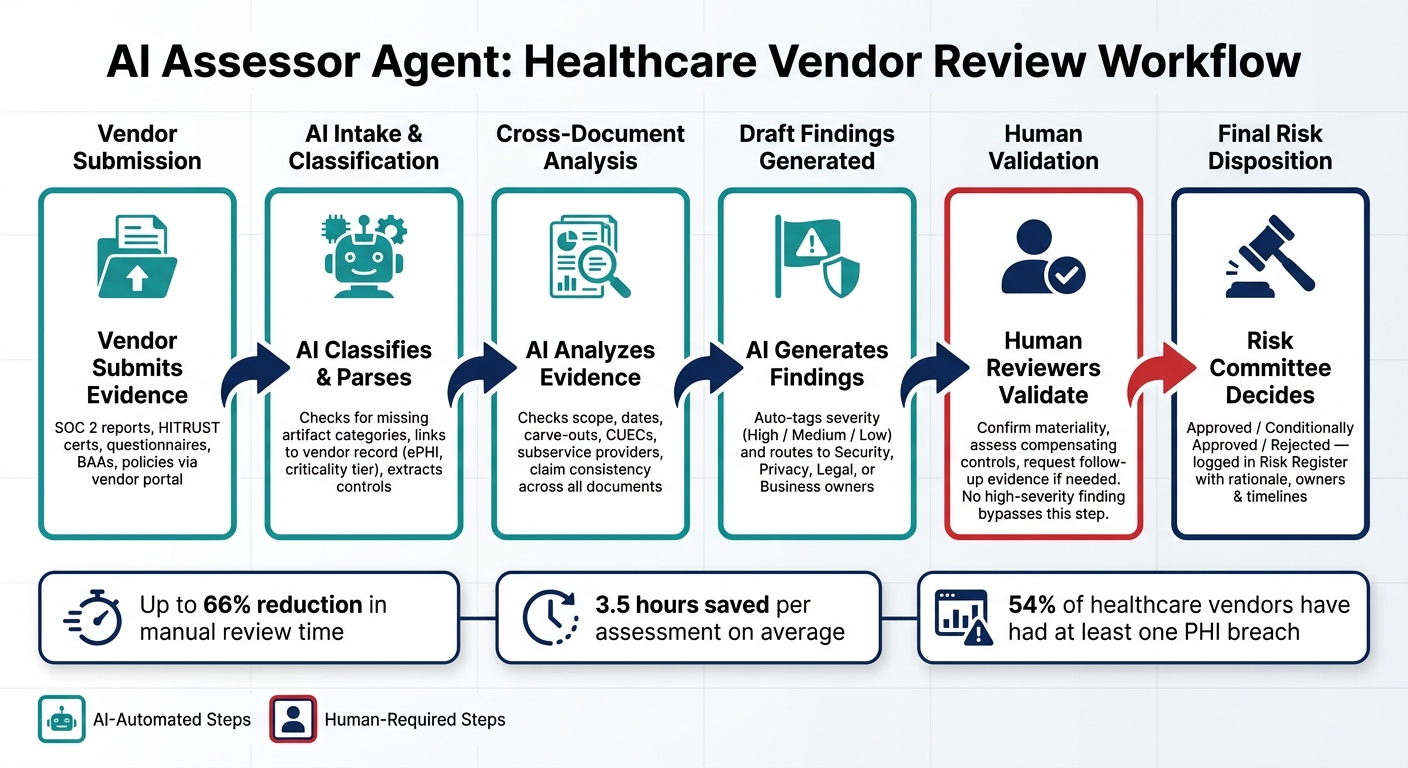
How an AI Assessor Agent Reviews Healthcare Vendor Evidence
From intake to final risk disposition
Once evidence is scored, it moves into a fixed review-and-disposition workflow. Every vendor goes through the same sequence, which helps keep decisions consistent and auditable. After that, the findings move into human validation and formal disposition.
A vendor submits materials - SOC 2 reports, HITRUST certifications, security questionnaires, BAAs, and policies - through a vendor portal. The assessor agent classifies the submission, checks for missing artifact categories, and links the package to the vendor record, including the data types handled, such as ePHI, and the system criticality tier. It parses the documents, extracts controls, and maps them to the target frameworks. Then it generates draft findings automatically, with severity tags and evidence references attached.
Human reviewers step in next. They validate each finding, confirm whether a flagged issue matters for the healthcare use case, and decide whether more evidence is needed. When it is, the system can send standardized follow-up requests to the vendor. Once findings are validated and vendor responses are reviewed, the risk committee, security office, or privacy office makes the final call: approved, conditionally approved with a remediation plan, or rejected. Every decision is logged with rationale, owners, and timelines in the vendor risk register.
Assessment findings flow into the Risk Register, where ownership, timelines, and remediation are tracked through resolution [1]. That keeps AI output tied to accountable remediation. This is the point where AI review turns into day-to-day risk management.
What AI handles well and where humans must decide
AI is fast and consistent at pattern-based review, but people still make the judgment calls on materiality, compensating controls, and exception acceptance. Censinet's Risk Assessor Agent delivers up to 66% time reduction on key third-party risk assessment workflows [1], and healthcare AI governance teams report reclaiming an average of 3.5 hours per assessment when AI reads complex vendor disclosures and maps them to healthcare controls [11].
Humans decide whether a flagged gap is material to the clinical use case. They look at whether compensating controls - such as strict network segmentation or enhanced monitoring - bring risk down to an acceptable level even when a specific control is missing. They accept or reject exceptions based on institutional risk appetite, regulatory strategy, and patient safety concerns. They also read the legal nuance in BAA language that AI can flag but cannot fully judge.
No high-severity finding bypasses human review. AI flags; humans decide.
The table below shows the line between tasks AI can automate, decisions that stay with human reviewers, and cases that need escalation.
Table: AI-flagged items, human-reviewed items, and escalation items
| Category | AI-Flagged / Automated | Human-Reviewed / Decided | Escalation Required |
|---|---|---|---|
| Evidence Review | Document staleness, missing artifact categories, expired SOC 2 reports | Adequacy of compensating controls for a missing requirement | Unresolved critical control exceptions or major assurance gaps |
| Risk Analysis | Inconsistencies between questionnaire answers and SOC 2 content | Materiality of a specific security gap in the clinical context | Business trade-offs for vendors tied to critical clinical workflows |
| Compliance | Missing BAA for ePHI-handling vendors; detection of embedded AI features | Exception acceptance aligned with institutional risk appetite | BAA legal conflicts, regulatory ambiguities, or state-law obligations |
| Reporting | Draft summary reports and corrective action plan (CAP) findings | Final validation and approval of risk disposition | Critical vendor dependencies with systemic enterprise risk implications |
Why healthcare teams use assessor agents and what they get from them
Faster reviews, more consistent assessments, clearer decisions
Once findings are routed, the upside shows up fast: shorter review cycles and more consistent decisions. Healthcare teams use assessor agents to work through evidence backlogs, standardize reviews, and move risk decisions along. Without that support, backlogs drag out reviews and lead to uneven assessments.
The payoff is pretty direct. Teams get faster cycles, steadier findings, and clearer decision records. And when the logic stays consistent from one review to the next, decisions are much easier to defend.
That is the problem Censinet's workflow is built to solve.
How Censinet supports assessor-agent workflows in healthcare
Censinet RiskOps™ and Censinet AI™ turn this review model into a repeatable workflow. They automate evidence summarization, capture integration and fourth-party dependency details, and draft risk summary reports from assessment data [12]. Findings then route straight into the Risk Register, where ownership and remediation timelines are tracked through resolution [1].
The setup supports self-directed, hybrid, or fully managed operating models, which means teams can handle more review volume without adding headcount at the same rate. Censinet says its Risk Assessor Agent can cut manual review and shorten assessment cycles by up to 66% on key workflows [1].
Key takeaways for healthcare leaders
Assessor agents don't replace risk expertise. They help teams move faster and stay more consistent. The agents handle repeatable evidence work, while people focus on materiality, compensating controls, and exception approval.
FAQs
What is an assessor agent?
An Assessor Agent is an AI-powered tool that handles repetitive, document-heavy work in healthcare third-party risk management and cybersecurity assessments.
Inside a secure, private container, it pulls technical details from request forms, summarizes evidence such as SOC 2 reports and penetration test results, and drafts findings for corrective action plans.
The payoff is simple: teams can cut assessment cycle times by up to 66%. And the human part still matters. Experts review and approve every recommendation before anything moves forward.
How accurate is AI evidence review?
AI evidence review works well for routine, evidence-heavy tasks. That includes pulling out technical details, summarizing SOC 2 and pen test documents, checking for missing items, and mapping results into structured findings and draft remediation notes.
A human analyst still makes the final call on validation and approval. In testing, Censinet reports up to 66% less time spent on these workflows when AI is used to support prioritization rather than replace expert judgment.
When should humans override AI findings?
Human analysts should step in over AI findings any time review, validation, and approval call for expert judgment. They keep full control over agent recommendations, especially for safety-sensitive decisions, complex risk scoring, and final prioritization.
This human-in-the-loop setup keeps the organization in charge of final outcomes while cutting down repetitive, documentation-heavy work.
