
I treat clinical trial vendors as part of third-party risk management - not a separate checklist. Before you sign a contract or grant access, identify what each vendor handles, check its safeguards, and name someone responsible for the risk.
A contract, BAA, or certification alone doesn’t prove that participant data and trial records are safe. I focus the review on 4 areas: data protection, access, record integrity, and recovery.
Here’s the approach I use:
- Scope: Map vendors, subcontractors, data flows, and study dependencies - even without a direct contract.
- Review: Check source documents, access controls, usable record exports, and recovery test results.
- Decide: Document approval, fixes, deadlines, and who accepts remaining risk.
- Monitor: Review critical vendors at least annually, reassess after material changes, and verify access removal and record transfer at offboarding.
I keep mandatory legal duties separate from FDA guidance, which is generally advisory. Tools such as Censinet RiskOps™ and AI can support the workflow, but <u>people remain responsible for approval and risk acceptance</u>.
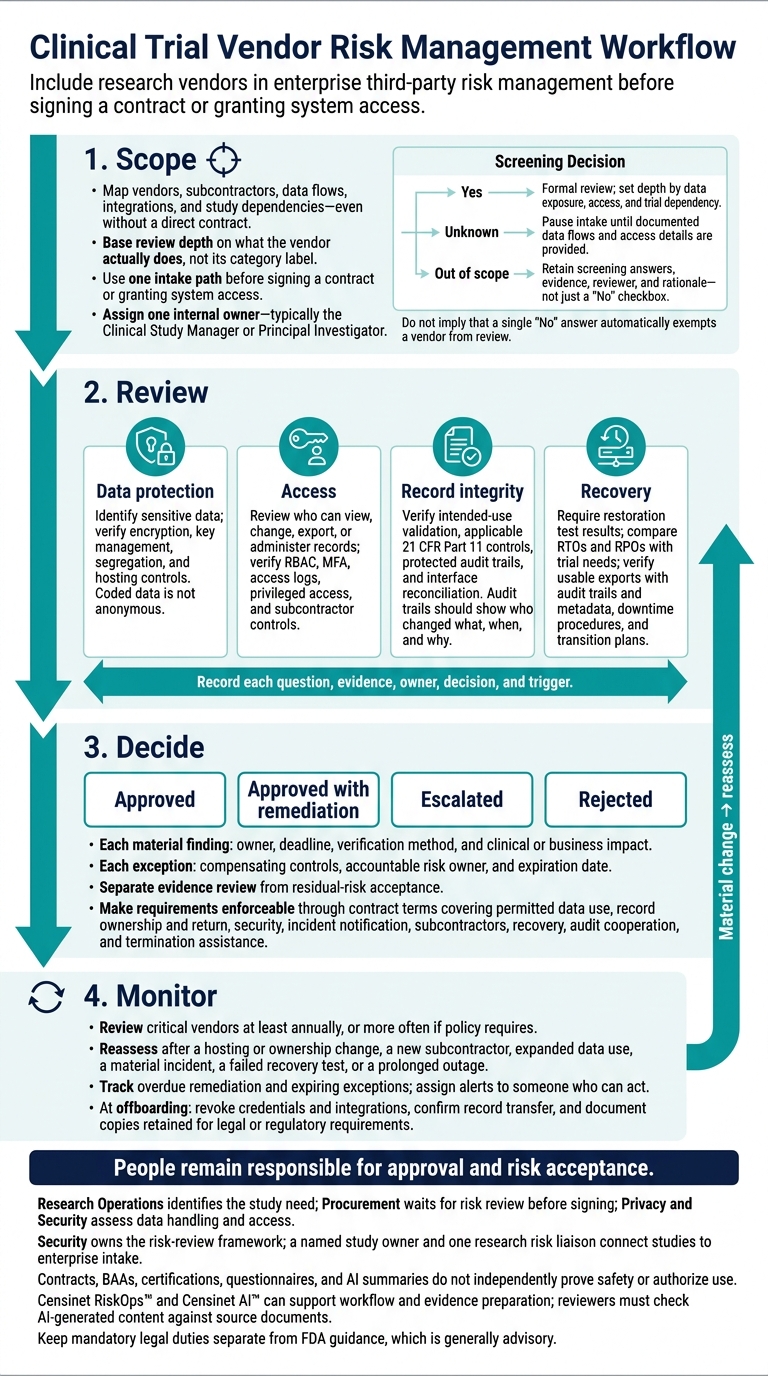
Clinical Trial Vendor Risk Management Workflow
ICH E6(R3): Who's Watching Your Vendors? Third-Party Risk Explained
sbb-itb-535baee
Checklist: Identify Research Vendors and Define Review Scope
Use one intake path before signing a contract or granting system access. Research Operations identifies the study need. Procurement waits until risk review is complete before signing. This ensures a scalable TPRM program that handles high vendor volumes efficiently. Privacy and Security assess data handling and access.
Assign one internal owner - typically the Clinical Study Manager or Principal Investigator - to receive security alerts, remove access, and confirm deletion when the retention period ends. The review scope sets the depth of the data, access, and continuity checks that follow.
List Clinical Trial Vendors by Role
Record each vendor’s role, data flows, integrations, subcontractors, and internal owner in the intake log. Include sponsor-selected vendors and any vendor that affects your data, systems, or trial activities - even if you don’t have a direct contract. Base review depth on what the vendor actually does, not its category label.
Use this table to match each vendor’s role to the minimum review path.
| Vendor function | Typical data | System access | Trial dependency | Minimum review path |
|---|---|---|---|---|
| Recruitment or scheduling support | Participant contact details | Limited processing; confirm any integrations | Recruitment and scheduling | Standard privacy and security review |
| Contract research organization (CRO) | Full participant records, study results, regulatory files | High; admin or privileged access | Critical | Full security, privacy, and GxP review |
| Electronic data capture (EDC) provider | Primary trial records, participant data, metadata | High; database access | Critical | Data integrity and availability review |
| Trial management or eConsent platform | Participant contact info, consent records, study operations data | Medium; platform accounts and integrations | High | Privacy, consent, and record retrieval review |
| Central laboratory | Bio-specimen data, participant PII | Medium; data transfer and portal access | High | Privacy and data protection review |
| Digital health device provider | Raw sensor data, biometric data, metadata | Low to medium; APIs and cloud sync | Medium | Device security and data flow review |
| Hosting or archival service | Encrypted backups, historical records, regulatory files | Low; infrastructure administration or record retrieval | High; post-trial | Recovery and long-term retention review |
Separate contact-data processing from record hosting and system administration. Limited contact data may call for a narrower assessment, but that doesn’t automatically make it low risk. Document where data enters, where it goes, who can access it, and which subcontractors store or process it. Hosting and archival services still need review after active trial work ends.
Once you’ve defined the role, use the Yes / No / Unknown screen to decide whether the vendor needs formal review.
Screen Vendors With Yes, No, or Unknown Answers
Use Yes / No / Unknown answers to screen for data handling, record administration, system connections, continuity support, and subcontractor processing. Apply the same criteria to the vendor and its subcontractors.
Send any Yes answer to formal review. Set review depth based on data exposure, access, and trial dependency. For Unknown answers, pause intake until the vendor provides documented data flows and access details.
If you decide a vendor is out of scope, keep the screening answers, evidence, reviewer, and rationale - not just a “No” checkbox.
Checklist: Assess Data, Access, and Trial Reliability
Use these checks to confirm that the vendor’s controls fit the role and risk you’ve already defined.
Record each question, evidence, owner, decision, and trigger. Review data exposure separately from system access. Scale integrity and recovery checks to the records’ sensitivity, access permissions, and the trial’s reliance on the vendor.
Check Data Protection and Record Retrieval
What data needs protection, and how is it protected? Identify PHI, PII, coded participant data, omics data, and study results. Coded data is not anonymous: confirm who holds the identity-linking key and who can obtain it.
Request evidence of encryption, key management, data segregation, hosting controls, and 21 CFR Part 11 validation. Treat SOC 2 Type II and ISO/IEC 27001 as supporting evidence only.
Check that exports include audit trails and metadata - not just study results. Confirm that retention, deletion, legal-hold, disaster recovery, business continuity, export, and transition controls have been tested. The contract must also require record return in a usable, nonproprietary format.
Once you’ve reviewed data handling, check who can access the records and systems.
Review Vendor and Subcontractor Access
Who at the research vendor can view, change, export, or administer records? Request RBAC settings, individual user lists, MFA evidence, access logs, and privileged-access logs. Review EHR, lab, EDC, and VPN connections separately.
Require the same controls for subcontractors with logical access, including prompt access removal after departure or termination. For high-risk access, set a specific removal deadline rather than accepting an open-ended response.
| Exposure or access | Likely impact | Required evidence | Approval authority |
|---|---|---|---|
| Limited data exposure | Privacy breach; regulatory fines | Encryption keys, SOC 2 Type II, DPA | Privacy Officer |
| Application access | Data corruption; unauthorized study changes | MFA logs, RBAC configuration, 21 CFR Part 11 validation | Clinical Lead / IT Security |
| Network connectivity | Lateral movement; ransomware | Penetration test results, firewall/VPN configs, IDS/IPS logs | IT Security / CISO |
| Privileged administration | Total compromise; audit-trail deletion | PAM logs, background checks, immutable audit logs | CISO / Risk Committee |
Next, test whether the vendor can keep records usable and recover within the trial’s required timelines.
Verify Data Integrity and Trial Recovery Plans
Can the vendor preserve reliable records and recover within trial-required timelines? Review intended-use validation, 21 CFR Part 11 controls, attributable audit trails, change controls, and interface reconciliation.
Audit trails should record who changed what, when, and why, with protection against editing or deletion. Require restoration test results - not just a backup policy. Compare RTOs and RPOs with enrollment, dosing, safety reporting, and data-lock needs. Also verify downtime and transition procedures.
| Risk event | Affected trial activities | Notification path | Evidence to review | Risk owner |
|---|---|---|---|---|
| Integrity failure | Dosing, safety reporting, data lock | Study team → Quality / Regulatory | Audit trails, reconciliation reports | Quality Assurance |
| Confidentiality breach | Participant trust, enrollment | Security → Privacy / Legal | Access logs, forensic findings | Privacy Officer |
| Outage | Enrollment, safety monitoring, data entry | Vendor support → IT / Clinical Operations | Restoration results, RTO/RPO performance, downtime procedures | Clinical Operations Manager |
| Termination | Record retrieval, archival, regulatory audits | Procurement / Legal → Sponsor IT | Verified export manifest, transition plan | Procurement / Sponsor IT |
Checklist: Set Evidence, Contract, and Monitoring Requirements
Verify Evidence and Document Approval Decisions
Check what the evidence covers - not just whether it exists. Compare assurance reports, vulnerability-management or penetration-testing summaries, incident-response procedures, business-continuity and disaster-recovery test results, subcontractor inventories, access-control documentation, and computerized-system validation records with the service you’re buying. Record dates, covered systems, exclusions, unresolved findings, and complementary customer controls - the safeguards your organization must provide. FDA guidance recommends evaluating IT service providers before entering into an agreement.[5]
Document one decision: approved, approved with remediation, escalated, or rejected. Give each material finding an owner, deadline, verification method, and clinical or business impact. For every exception, document compensating controls, an accountable risk owner, and an expiration date. Name the reviewers from research, security, privacy, legal, and procurement, and separate evidence review from residual-risk acceptance. Completing a questionnaire does not authorize use.
Set Contract Terms and Reassessment Triggers
Make assessment requirements enforceable contract duties. Specify permitted data use, limits on secondary use, record ownership and return, security controls, incident-notification deadlines, subcontractor obligations, recovery expectations, audit cooperation, and termination assistance. Privacy and legal teams should decide whether a business associate agreement is required and assign responsibility for regulatory requests, participant-impact analysis, and record preservation. Applicable HIPAA obligations must also apply to subcontractors handling PHI.[2][3][4]
Review critical vendors at least annually, or more often if policy requires. Reassess sooner after a hosting or ownership change, a new subcontractor, expanded data use, a material incident, a failed recovery test, or a prolonged outage. Between reviews, track overdue remediation and expiring exceptions, and assign each alert to someone who can act. At offboarding, verify that credentials and integrations have been revoked, confirm record transfer, and document any copies retained to meet legal or regulatory requirements.
Coordinate Research Vendor Reviews in Censinet RiskOps™
Use Censinet RiskOps™ to keep research vendor records in one place, link them to studies and accountable owners, route assessments, and track evidence, corrective actions, approvals, and lifecycle monitoring. Censinet AI™ can help complete questionnaires, summarize evidence, and prepare risk summaries. Require reviewers to check AI-generated content against source documents and document uncertainty. Clinical, privacy, regulatory, security, legal, and business owners must remain responsible for material findings and approval decisions. They must not delegate risk acceptance to a questionnaire, certification, or AI summary.
Conclusion: Make Research Vendor Reviews Standard Practice
Start by matching active study vendors against the enterprise vendor inventory. Have Clinical Operations and security compare CTMS or TMF records with procurement records, including vendors paid through study budgets. Give priority to missing vendors that handle sensitive data, have privileged access, or support critical trial activities. Use that gap list to bring research vendors into intake before the next protocol review.
Review each vendor against the same evidence standards as other critical third parties to effectively manage third-party risk. Use the same intake, assessment, and monitoring workflow, checking data protection, access, integrity, and recovery evidence for each supported trial. Name a study manager or principal investigator as the business owner. Security should own the risk-review framework.
Assign one research risk liaison to connect study startup with enterprise intake. Tie approval, risk acceptance, reassessment, and offboarding to each protocol. Bring research vendors into the program at study start - not after a review gap appears.
FAQs
How can we assess sponsor-selected vendors we don’t contract with?
Include sponsor-selected vendors in your centralized vendor inventory and risk management program, no matter how the contracts are structured. Identify their third-party connections, and flag where they interact with protected health information (PHI) or support critical clinical functions.
Assess each vendor’s risk based on its access levels and impact on operations. Use standardized security questionnaires to evaluate controls, then request supporting evidence - such as SOC 2 reports or penetration test summaries - to verify its security posture.
What if a critical vendor fails our risk review?
Treat the review as a chance to fix the gaps, not just penalize the vendor. Work together to find the root cause and agree on changes that prevent the issue from happening again. You may need to require specific remediation steps or revise the contract terms [1].
If the vendor can’t or won’t make those changes, consider other partners that better match your organization’s security and risk management goals [1].
How do we distinguish legal duties from FDA guidance?
HIPAA and the HITECH Act set the mandatory baseline for data protection. Business Associate Agreements (BAAs) spell out the required security controls and breach notification protocols [1][2][3].
FDA guidance and requirements - including validated systems and electronic signatures under 21 CFR Part 11 - focus on data integrity and audit trails for regulatory submissions. Protecting research outcomes means meeting both legal duties and technical requirements [3][1].
