
I’d fund cybersecurity based on tested risk reduction - not completed checklists. Start with one critical service, estimate the cost of a 24-, 72-, and 168-hour outage, and test whether care can resume within approved recovery targets.
IBM reported an average global healthcare breach cost of $7.42 million in 2025. That’s context, not your hospital’s loss estimate. I’d use local costs and keep patient-safety harm separate from dollar figures.
For a CFO-ready view, I’d focus on four questions:
- What could hurt us? Map threats to clinical services, PHI, devices, vendors, and their suppliers.
- What could it cost? Estimate downtime, recovery expenses, lost revenue, and delayed payments without counting the same loss twice.
- What changed? Check recovery tests, PHI safeguards, vendor continuity, and breach-response exercises - not just policies.
- What decision is needed? Compare funding options, name an owner, and set deadlines for fixes or time-limited risk acceptance.
My rule: <u>untested recovery stays unknown</u>. A short dashboard should show spending, test results, remaining exposure, and the next decision - not imply that lower risk means cash savings.
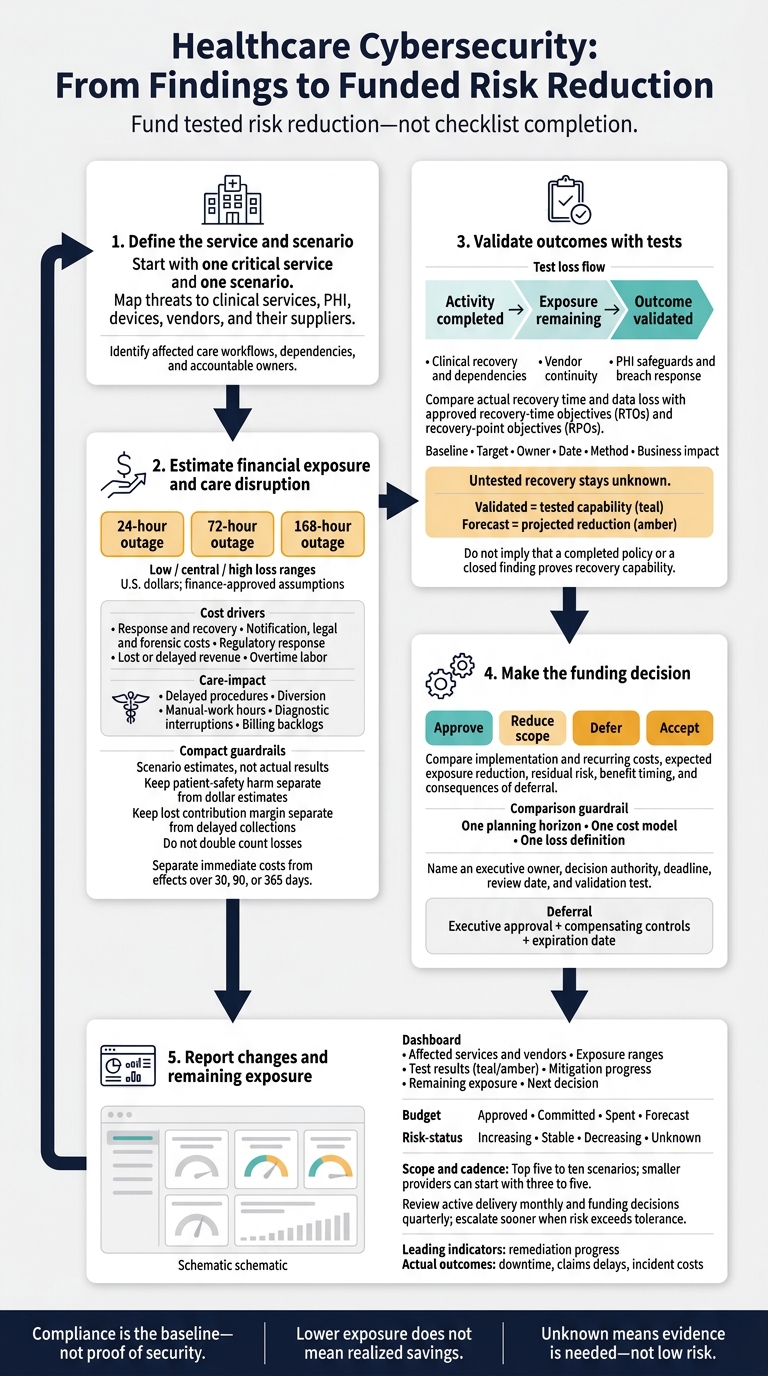
Healthcare Cybersecurity: From Findings to Funded Risk Reduction
What is Cyber Risk Quantification?
sbb-itb-535baee
Connect Cybersecurity Findings to Business Risk
Each finding should explain what exposure remains, what it could cost, and what decision needs to be made.
Replace Activity Counts With Risk Outcome Measures
Report three layers: activity completed, exposure remaining, and outcome validated. For every measure, include the baseline, target, owner, date, method, and business impact.
Show assessment coverage alongside finding counts. Fewer findings don't always mean less risk; they may mean fewer vendors or systems were reviewed. Include closure status, but keep the focus on remaining exposure and verified outcomes.
Compliance activity Remaining exposure Outcome to validate Critical vendor assessments completed Unresolved critical findings and vendors without evidence from tested recovery Critical findings resolved with verified evidence; service recovery meets recovery-time and recovery-point objectives Backup policy approved Priority systems without tested restoration procedures Restoration time and data loss meet recovery-time and recovery-point objectives Segmentation audit findings closed Administrative systems can still reach critical clinical networks Segmentation tests show administrative compromise cannot reach clinical networks.
Estimate Financial Loss and Care Disruption
Build low, central, and high loss ranges for 24-, 72-, and 168-hour outages. Use finance-approved assumptions for response, recovery, notification, legal and forensic costs, regulatory response, lost or delayed revenue, and overtime labor.
Separate immediate costs from effects over 30, 90, or 365 days, and show amounts in U.S. dollars. Keep lost contribution margin separate from delayed collections. Don't double count canceled procedures or delayed billing. Label forecasts scenario estimates, not actual results.
The February 2024 Change Healthcare incident disrupted eligibility checks, authorizations, claims processing, and payments. In a March 2024 American Hospital Association survey of nearly 1,000 hospitals, 74% reported direct patient-care impacts and 94% reported financial impacts.[11]
For each service, connect downtime to delayed procedures, diversion, manual-work hours, diagnostic interruptions, and billing backlogs. Clinical operations should define when workarounds become unsafe or can no longer meet care needs.
Keep patient-safety consequences separate from dollar estimates. Lost revenue alone can't adequately represent the harm from unavailable medication records or delayed laboratory results.
Use the loss range to decide which risks to fund, defer, or accept.
Turn Assessments Into Risk Decisions
Use NIST SP 800-30 to assess likelihood and impact,[5][8] NIST CSF 2.0 to define current and target states,[6][7] and HHS/HIPAA requirements to identify critical services, ePHI, dependencies, safeguards, and owners.[4][3]
Every material finding should state its scenario, affected service, patient-safety impact, cost drivers, treatment, owner, deadline, and decision authority.
Use test evidence to judge whether the remaining risk is acceptable. Compare implementation and recurring costs with expected exposure reduction, using consistent assumptions. Show residual risk for funded, partial, and deferred options.
Deferral requires executive approval, compensating controls, and an expiration date - not an open-ended finding.
Measure Outcomes for Critical Healthcare Risks
Test Ransomware Recovery and Clinical System Availability
Measure whether clinical teams can use the service - not just whether a backup restores. Test critical applications along with their identity, network, pharmacy, laboratory, imaging, and connected-device dependencies. Compare actual recovery time and data loss against approved RTOs and RPOs. Record failed restores, affected departments, hours of clinical downtime, and how long teams take to move from manual workarounds back to normal operations.
For each measure, keep the baseline, test logs, accountable clinical and technology owners, and next review date. Review active material risks monthly, stable risks quarterly, and results after major changes. Label tested capability validated. Any projected reduction in downtime remains a forecast.
Keep unsupported or unpatchable devices in an exception register. Include each device’s function, location, version, exposure, replacement lead time, and recovery procedure. Use technical tests to verify segmentation, restricted administrative access, and other compensating controls. Clinical and financial owners should decide whether to accept, mitigate, transfer, or replace each device risk. A device outage can last longer than software recovery if replacement hardware can’t arrive quickly.
Track Critical Vendor and Fourth-Party Risk
Apply the same outcome test to third-party dependencies. Rank vendors by the services they support and the impact of a failure. For clinical and revenue-cycle dependencies, track the age and scope of evidence, unresolved material findings, remediation time, notification obligations, and tested continuity against your downtime tolerance. Map critical fourth parties to identify shared dependencies.
Centralize assessments, evidence, remediation, and reporting so each finding connects to a service owner and a decision. Report validated continuity coverage separately from estimated interruption exposure. Vendor-management and business owners should review material gaps monthly and after supplier changes.
Validate PHI Protection and Breach Readiness
Measure PHI protection and breach readiness through tested results, too. Pair training completion with tests of safeguards around PHI. Define which systems and accounts are in scope, then measure phishing-resistant multifactor authentication coverage, excessive or dormant privileged accounts, encryption exceptions, logging and alerting coverage, and exploitable critical vulnerabilities.
Support these measures with access reviews, configuration checks, logs, and simulated misuse testing. Track how long it takes to detect and disable inappropriate access - not just whether a monitoring tool is installed. Technology and privacy owners should review high-impact gaps monthly.
Run breach-response exercises with privacy, legal, clinical operations, communications, IT, finance, insurance, and executives to assess readiness and financial exposure. Measure the time needed to identify affected PHI, preserve evidence, make notification decisions, and coordinate restoration. Record whether each decision was correct, complete, and timely.
Finance should estimate investigation, legal, notification, monitoring, call-center, and downtime costs using defined record counts, affected states, and response assumptions. Separate known costs from scenario ranges, and treat possible regulatory penalties as uncertain, not assumed. Assign an owner to each exercise gap and retest after remediation. A revised response plan alone does not validate improvement.
Use Risk Outcomes to Guide Funding and Reporting
Turn validated risk outcomes into budget decisions and clear CFO reporting.
Build a Funding Case for Each Material Risk
Fund risk reduction, not checklist completion. Create a one-page funding case for each material scenario. Include the affected service, current exposure range, implementation and recurring costs, expected risk reduction, residual risk, benefit timing, dependencies, and consequences of deferral.
Name the executive owner and review date. Spell out the decision needed - approve, reduce scope, defer, or accept - and the evidence that will show whether the investment worked.
Use the same assumptions across proposals so the CFO can compare trade-offs directly. Rank proposals by risk reduction, urgency, feasibility, and patient-care impact. Give emergency-care protection priority when warranted.
Lower exposure does not mean realized savings. When likelihood estimates are weak, show changes in potential loss severity or interruption duration instead of claiming an annual return.
Compare Investments With Consistent Assumptions
Use one planning horizon, one cost model, and one loss definition across proposals. The comparison below is hypothetical; replace it with local data. Keep delayed cash receipts separate from permanently lost revenue, and don’t credit two projects with preventing the same loss.
Each row should show how spending changes the remaining exposure to a material business risk.
Initiative Risk scenario Current exposure Estimated cost Expected outcome Residual risk Benefit timing Cost of deferral EHR dependency restoration testing Ransomware or infrastructure failure prevents restoration of EHR and connected clinical services 12–36 hours of disruption $180,000 implementation plus $60,000 annual testing and storage Restore priority EHR functions within the recovery target and expose failed interfaces or staffing gaps. Vendor outage, identity-service failure, or corrupted recovery dependencies may still delay full restoration 3–6 months Continued uncertainty about backup, interface, and downtime performance. Critical billing vendor remediation A revenue cycle vendor compromise or outage delays claims, payment posting, or access to protected health information 15–30 days of billing disruption; exposure depends on transaction volume and vendor controls $125,000 for remediation, contract changes, monitoring, and contingency processing Close material findings, define notification and recovery obligations, and validate an alternate processing path. Vendor concentration and sector-wide outages may still affect service availability 2–4 months Prolonged cash disruption, delayed claims, unresolved findings, and weaker contract leverage.
Build a CFO Dashboard That Tracks Risk Changes
Turn funding decisions into a short list of risks the CFO can review at a glance.
Show the top five to ten scenarios, exposure ranges, affected services and vendors, mitigation progress, recovery readiness, material findings, and expiring risk acceptances. Include budget amounts approved, committed, spent, and forecast.
Separate leading indicators, such as remediation progress, from actual outcomes, such as downtime, claims delays, and incident costs. Keep metric definitions and assumptions consistent. Label any changes in scope or calculation so better measurement doesn’t look like worsening risk.
Review active delivery monthly and funding decisions quarterly. Escalate sooner when risk exceeds tolerance - don’t wait for a lagging indicator or major incident [12]. Each entry should request a decision and name an owner and deadline.
Smaller providers can start with three to five scenarios and a one-page dashboard, with emphasis on concentrated dependencies. Report exposure as increasing, stable, decreasing, or unknown. Treat unknown as a request for evidence, not a sign of low risk.
Conclusion: Make Risk Reduction the Standard
Compliance is the required baseline - not proof of security. CFOs need validated risk reduction. HHS’s Healthcare and Public Health Cybersecurity Performance Goals focus on resilience and lower residual risk, not perfect security.[9][10]
Fund work based on clinical harm, downtime, and financial loss. Require tested improvements, clear trade-offs, and a judgment about how much exposure leadership will still accept. A control matters only if it reduces exposure or improves recovery.
Start with one service and one scenario. Turn its highest-priority finding into a loss scenario: what could fail, which care workflows would stop, and what downtime could cost. Set a baseline, and label untested recovery as unknown.
Use that scenario to make one decision. Document the action, expected outcome, cost range, deferred work, accountable owner, review date, and validation test. Measure the change in risk, the exposure that remains, and business value - not checklist completion.
FAQs
How do we estimate cyber losses with limited data?
Use the Factor Analysis of Information Risk (FAIR) framework to model scenarios like an EHR outage or a third-party breach in dollars, not static heat maps. Estimate minimum, most likely, and maximum losses to account for uncertainty [1].
Include response costs, legal and regulatory costs, reputational costs, and downstream operational costs [1]. Start with industry benchmarks - such as approximately $408 per record or hourly downtime costs - then adjust that baseline to fit your organization [2][1][3].
How should we weigh patient safety against financial exposure?
Turn technical security gaps into business-impact scenarios, not just audit checklist results. Show how each gap could disrupt operations, cause financial losses, create regulatory exposure, and put patients at risk.
For example, a network segmentation gap could lead to a 36- to 48-hour EHR outage, delaying procedures, increasing medical complications, and deferring millions of dollars in revenue.
Use minimum, most likely, and maximum loss estimates to compare an investment’s cost with how much it could reduce financial and clinical risk.
What if a critical vendor won't provide recovery evidence?
Treat missing recovery evidence as a risk to the organization’s ability to recover from disruption - not just a compliance gap. Classify the vendor as high-risk and prioritize a formal remediation plan that ranks actions by risk and sets specific deadlines that will be enforced.
Explain to the CFO what’s at stake financially, including lost revenue, and how patient care could be disrupted if the vendor’s systems fail without a verified recovery path.
Related Blog Posts
- From Undervalued to Indispensable: How to Elevate ERM in Board-Level Discussions
- Risk Register Optimization: Aligning Cost, Impact, and Likelihood Assessments for Enhanced Security Posture
- The Board Wants Numbers. Translating Cyber Risk Into Dollars and Disruption.
- Why Cyber Maturity Models Mislead. And What to Measure Instead.
