
If you store PHI in the cloud, delayed review is not enough. In the first half of 2025, healthcare saw 311 breaches affecting about 23.1 million people, and 78% of large breaches tied back to hacking or IT events.
I see the research pointing to a simple answer: real-time anomaly detection can spot odd access, device activity, workload behavior, and data movement in milliseconds to seconds. But I also see the catch: lab scores above 90% do not guarantee smooth use in hospitals. Drift, false alarms, care delays, and logging limits still shape what works.
Here’s the short version:
- What it does: watches live logs, API calls, network traffic, user access, and device telemetry
- What it looks for: stolen credentials, insider misuse, data theft, malware, and odd IoMT or workload behavior
- What models show up most: autoencoders, LSTMs, VAEs, isolation forests, and ensemble methods
- What studies report: latency often around 15 to 55 ms, with many test results above 90% on curated datasets
- What matters most in practice: low false-alarm rates, model drift control, explainable alerts, and access safeguards that do not slow care
- What healthcare teams should do: combine identity, runtime, and device monitoring instead of relying on one signal
A few points stand out to me:
- For EHR and access logs, the main issue is not raw accuracy. It’s whether staff can trust the alerts.
- For cloud workloads, runtime monitoring helps catch malware and misuse that login checks may miss.
- For IoMT, edge and fog setups can cut detection time from over 150 ms to under 20 ms in some tests.
- For compliance, HIPAA, NIST, and HITRUST all push teams toward audit review, continuous monitoring, and incident response.
Bottom line: I’d treat real-time anomaly detection as a core cloud PHI control, but not as a set-it-and-forget-it tool. It works best when you pair strong telemetry, review steps, baseline updates, and clear ownership. This approach helps in measuring what matters for cybersecurity across the enterprise.
| Area | What the article shows | Main risk |
|---|---|---|
| Access monitoring | Finds odd chart access, off-hours logins, and role misuse | Too many false alarms |
| Workload monitoring | Finds malware, exploit activity, and odd API behavior | Harder to map to patient impact |
| IoMT monitoring | Finds device and telemetry anomalies with low delay | Governance across edge, fog, and cloud |
| Compliance | Supports HIPAA, NIST, and HITRUST monitoring needs | Logging too much PHI or poor alert review |
If you want the plain-English takeaway, it’s this: the best setups watch people, systems, and devices at the same time - and they do it without blocking care unless the signal is strong.
AI-Powered Predictive Analytics for Cloud Performance Optimization and Anomaly Detection
sbb-itb-535baee
Detection Models and Architectures Used in Healthcare Cloud Security
No single model catches every cloud PHI threat. In practice, the best setups stack identity, runtime, and network monitoring. That matters because attacks rarely stay in one lane. A stolen password can turn into odd workload behavior, then into data exfiltration. Those layers line up with the main risk areas: insider misuse, credential abuse, malware, and PHI theft.
Access and Identity Anomaly Detection for EHR and PHI Workflows
These models learn what “normal” looks like for each role. They track which records a person opens, when they access them, what device they use, and how often they do it. Once that baseline is in place, the system can spot behavior that feels off.
For example, it may flag a nurse opening far more charts than usual, a clinician viewing records outside their assigned unit, or a successful login that comes right after several failed attempts late at night.
The stronger setups don’t stop at role-based rules. They also look at session context, such as:
- Location
- Device
- Time of day
That extra context helps the system keep checking whether access still fits the expected pattern, not just whether the user logged in with valid credentials.
Runtime and Network Monitoring Across Cloud Workloads and IoMT
Identity controls show who is acting. Runtime and network monitoring show what the workload or device is doing.
For cloud workloads, CWPP and CNAPP watch runtime behavior across VMs, containers, and serverless functions. That includes process activity, system calls, API calls, and odd network connections. These tools are useful when a workload has been compromised or a bad configuration exposes PHI without setting off an identity-layer alert.
IoMT adds another layer: constant device telemetry, including vital signs, heartbeats, and protocol signals. That data needs to be checked close to where it starts. Edge–fog–cloud designs handle this by running lightweight detectors at gateways and edge nodes, then sending summarized telemetry to the cloud.
The speed gap here is hard to ignore. A fog–edge adaptive cybersecurity system (FE-ACS) achieved an AUC-ROC of 0.985 and an F1-score of 0.923, with end-to-end latency of just 18.7 ms, outperforming cloud-centric designs that took 152.3 ms.[6] A separate hybrid fog–edge health monitoring architecture reported anomaly detection times of 30–40 ms using One-Class SVM and Local Outlier Factor models at edge nodes.[5]
Algorithms Most Commonly Studied
Across these layers, research keeps circling back to a small group of models that offer a good tradeoff between speed, accuracy, and explainability.
Common methods include autoencoders, LSTMs, VAEs, ensembles, isolation forests, and distance-based detectors. Each one fits a slightly different job.
Autoencoders learn normal behavior, then flag records or events that show high reconstruction error. That makes them a common choice for PHI access logs and EHR record integrity checks. LSTMs work well with sequential data, so they fit session logs and time-series device telemetry where event order matters. VAEs add a probabilistic layer that suits streaming PHI telemetry and cloud logging pipelines.
One combined autoencoder-LSTM framework reported 94.8% precision and recall, a 94.0% F1-score, and 70 ms latency at 12 GB/hour throughput on network traffic data.[4]
Ensemble and hybrid methods are gaining ground when telemetry sources differ a lot. That makes sense: structured access logs, runtime events, and IoMT streams do not behave the same way, so one algorithm usually won’t handle all of them equally well. Isolation forests and distance-based detectors still have a place, especially when labeled data is limited or teams want results they can explain more easily.
Effectiveness: Metrics, Datasets, and Measured Outcomes
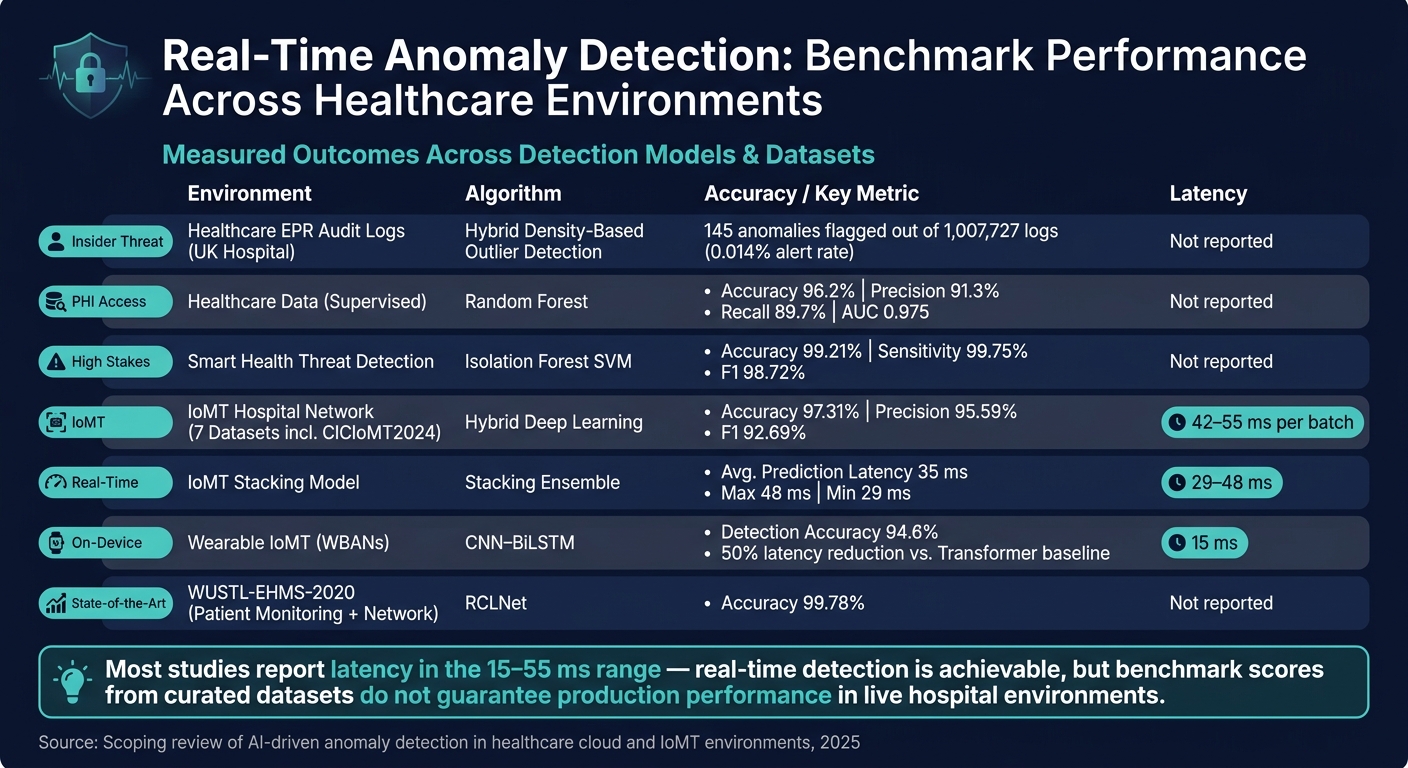
Real-Time Anomaly Detection Models for Cloud PHI Security: Performance & Latency Benchmarks
Performance Metrics Reported Across Studies
Model choice matters, but performance on healthcare telemetry matters more. And there isn't one standard way researchers measure anomaly detection. A scoping review found 17 different performance metrics used across healthcare anomaly detection studies, including accuracy, F1-score, precision, recall, AUC-ROC, false-positive rate, and mean time to detect (MTTD).[18][12] The metric has to fit the job.
For PHI access monitoring, precision and false-positive rate matter most. If a system floods clinical staff or privacy officers with alerts they can't act on, that's a problem in itself. For IoMT traffic and cloud security logs, studies tend to focus on accuracy, recall, latency, and throughput, because those systems have to spot attacks fast and handle large volumes of data.
One Random Forest model trained on healthcare data reported 96.2% accuracy, 91.3% precision, 89.7% recall, and an AUC of 0.975.[15] An Isolation Forest SVM variant posted 99.21% accuracy, 99.75% sensitivity, 99.32% specificity, and a 98.72% F1-score.[19] A broader systematic review of AI-driven anomaly detection in EHR settings found that more than half of studies reported accuracy above 90% and recall above 0.85, with deep models often showing the best scores on curated datasets.[13][14]
What Datasets and Evaluation Methods Reveal
Those numbers only mean something when you know what dataset produced them. Put simply: dataset design can shape results just as much as the algorithm. Most studies pull from a small set of data sources:
- EHR and EPR audit logs
- IoMT network traffic captures
- Healthcare monitoring datasets that combine biometric signals with network features
- Cloud security logs
Real hospital logs are sparse and heavily imbalanced. Synthetic datasets, or datasets packed with attack traffic, can make performance look better than it may be in day-to-day use. In one example, a hybrid density-based outlier detection model used on a UK specialist hospital's EPR system flagged 145 anomalous behaviors out of 1,007,727 audit log entries - just 0.014% of all accesses.[11] That's useful from an operations standpoint, but under that level of imbalance, accuracy by itself doesn't tell you much.
IoMT datasets such as CICIoMT2024 and WUSTL-EHMS-2020 look very different. They often include attack traffic in large shares. One medical dataset had 253,680 records with roughly 60% anomalous data.[7][3][9] That's a huge gap from live hospital conditions, so results from those datasets need to be read with care.
Comparative Study Findings
The examples below show how results shift based on dataset mix and deployment setting.
| Dataset / Environment | Algorithm | Key Metrics | Latency | Notes |
|---|---|---|---|---|
| Healthcare EPR audit logs (UK hospital) | Hybrid density-based outlier detection | 145 anomalies flagged / 1,007,727 logs (0.014% alert rate) | Not reported | Surfaces rare insider PHI access; requires expert review [11] |
| Healthcare data (supervised) | Random Forest | Accuracy 96.2%, Precision 91.3%, Recall 89.7%, AUC 0.975 | Not reported | Suited for labeled PHI access datasets [15] |
| Smart health threat detection | Isolation Forest SVM | Accuracy 99.21%, Sensitivity 99.75%, Specificity 99.32%, F1 98.72% | Not reported | Low false-negative rate for high-stakes PHI monitoring [19] |
| IoMT hospital network (7 datasets incl. CICIoMT2024) | Hybrid deep learning | Accuracy 97.31%, Precision 95.59%, Recall 92.43%, F1 92.69% | 42–55 ms per batch | Near real-time across hospital IoMT device traffic [16] |
| IoMT stacking model | Stacking ensemble | Avg. prediction latency 35 ms, max 48 ms, min 29 ms | 29–48 ms | Meets real-time constraints for medical device monitoring [8] |
| Wearable IoMT (WBANs) | CNN–BiLSTM | Detection accuracy 94.6%, 50% latency reduction vs. Transformer baseline | 15 ms | Low overhead; viable for on-device PHI stream monitoring [17] |
| WUSTL-EHMS-2020 (patient monitoring + network) | RCLNet | Accuracy 99.78% | Not reported | Outperformed recent state-of-the-art IDS methods on this dataset [10] |
Across these studies, ensemble and deep learning models tend to post the strongest scores on curated datasets. Unsupervised and density-based methods make more sense when labeled attack data is hard to get, which is often the case in live hospital settings. Latency figures in the 15–55 ms range suggest real-time detection is possible. Still, most of these results come from controlled test setups, so they're better read as benchmark numbers than as promised production outcomes.
Limits, Tradeoffs, and Compliance Considerations
Strong benchmark scores can look great on paper. They do not erase operational risk in live cloud PHI environments.
False Positives, Data Drift, and Clinical Workflow Disruption
Benchmarks almost never match day-to-day hospital operations. Telehealth workflows change. Staff rotate. Seasonal surges hit. And static baselines in cloud EHR, telehealth, and connected-device workflows can fall out of sync fast.[20][22] Once that happens, teams usually get one of two bad outcomes: too many false alerts or missed detections.
That’s not just a security problem. It can become a care problem.
If an anomaly engine marks a valid remote login or cross-coverage access event as suspicious and blocks the session, that delay can affect care decisions.[1][5] False alerts tied to telehealth call transfers and changing staff workflows are already documented sources of disruption when baselines are not kept current.[26][27] And when false positives pile up, alert fatigue follows. Then real compromises are easier to miss.[1][23]
A safer setup is to use adaptive retraining, tiered responses, and break-glass access. In plain English: use soft controls when the signal is uncertain, and reserve hard blocks for confirmed threats.
Telemetry, Privacy, and Governance Requirements
Good detection depends on broad telemetry. That usually means authentication logs, EHR access events, cloud API calls, IoMT connection patterns, and container runtime behavior flowing into a detection pipeline in real time.
The hard part is doing that without crossing HIPAA’s minimum necessary standard for ePHI. A common approach is to log identifiers, hashes, or pseudonyms instead of raw PHI, keep high-volume technical logs for 30 to 90 days, and tightly limit access to patient-identifiable data.[24][25] Edge and fog nodes can also filter data locally and send forward only suspicious events, which cuts raw PHI exposure.[21][24][25]
Collection is only part of the job. Teams also need to explain why an alert fired, especially when that alert limits access. Compliance officers and clinicians usually won’t accept a black-box answer, and they shouldn’t have to.
Current best practices point in a few clear directions:
- Maintain a model inventory with training data descriptions and known limits
- Treat model updates like software changes, with testing and rollback plans
- Include security, clinical, and compliance leaders in formal governance
Censinet RiskOps™ can support shared model inventory, testing, and governance across PHI-related systems.
Deployment Model Tradeoffs
The tradeoffs change based on where the signal starts: users, workloads, or devices.
| Deployment Model | Strengths | Weaknesses | Latency Profile | Explainability | Best-Fit PHI Use Cases |
|---|---|---|---|---|---|
| Access-centric monitoring | Direct alignment with insider threat and account-compromise risks | Limited visibility into network or device-level anomalies; susceptible to drift as roles and workflows change | Low for auth events; higher for behavior-based aggregation | High - alerts map to user actions | EHR access monitoring, privilege escalation, compromised credential detection |
| Workload runtime detection | Catches malware, exploitation, and lateral movement in cloud workloads | Limited visibility into user intent; mapping runtime events to clinical impact requires expertise | Very low for process anomalies | Moderate | Backend APIs, data lakes, containerized PHI services, microservices |
| Edge–fog–cloud IoMT monitoring | Reduces bandwidth; keeps raw data local; suited for continuous device monitoring | Managing model updates across layers; legacy devices may not support local inference | Lowest latency, but higher governance complexity | Lower without XAI tooling | Remote cardiac monitoring, wearable sensors, infusion pumps, and other connected medical devices |
In practice, many healthcare security programs mix these models. They use access-centric monitoring for EHR and identity risk, runtime detection for cloud workloads, and edge-fog setups for IoMT streams. That mix helps answer the core question: which anomaly detection layer does the most to cut cloud PHI risk without getting in the way of care?
The catch is integration overhead. But leaving out one layer creates its own gap, and that gap can be costly.
Conclusion: What the Evidence Means for Healthcare Risk Leaders
The research points to one clear pattern: real-time anomaly detection works best when it brings together identity, workload, and IoMT telemetry in one continuous monitoring layer.[2][29][4][31][30] That’s the model healthcare teams need now.
For healthcare leaders, the change is straightforward: when PHI sits in cloud systems, continuous detection matters more than periodic review.
The next issue is practical. How do you put it in place without getting in the way of care?
Key Takeaways for U.S. Healthcare Organizations
Recent studies show strong benchmark performance, but live results still depend on data quality, drift, and governance.[14] A lab score doesn’t tell you how a hospital will perform in production. For CISOs, CIOs, and compliance leaders, that means pulling signals together, keeping baselines current, and assigning clear ownership before an incident puts the team under pressure. Set baseline refresh cycles, alert ownership, and escalation paths before deployment.
Continuous monitoring aligned with NIST SP 800-53 CA-7, SP 800-137, and HIPAA Security Rule requirements is a core control at this level of risk.[30][28][32] If an organization is putting that model in place, vendor and enterprise risk controls have to keep pace. Censinet RiskOps™ supports third-party and enterprise risk assessments, cybersecurity benchmarking, and collaborative risk management, helping teams make practical risk decisions for cloud and IoMT PHI environments.
FAQs
How does real-time anomaly detection protect cloud PHI?
Real-time anomaly detection helps protect cloud-based PHI by keeping a constant watch on user behavior, network traffic, and system logs. The goal is simple: spot activity that drifts from normal patterns before it turns into a bigger problem.
With AI and machine learning, these systems can flag suspicious behavior as it happens. That might include unauthorized access attempts, logins at odd hours, or bulk record downloads that don’t fit a user’s usual pattern. Once detected, the system can respond right away by isolating accounts, blocking malicious traffic, and alerting security teams.
In plain terms, it acts like a guard that doesn’t blink. Instead of waiting for someone to review logs after the fact, it catches warning signs in the moment and helps teams react fast.
Why do high lab scores fail in hospitals?
High lab scores often fall apart in hospitals because day-to-day clinical work is messy and data lives in different places.
A hospital isn't a controlled test setting. Care teams deal with emergency overrides, rotating staff, and cross-consultation around the clock. If security systems aren't tuned for that 24/7 reality, they can flag too many normal actions as threats.
That creates alert fatigue. And once that happens, staff may start ignoring warnings or overriding them just to keep care moving.
There's another problem too: logs are often inconsistent, and clinical apps may have missing fields. When the data is patchy, behavioral baselines become shaky.
What data should hospitals monitor first?
Hospitals should start by tracking PHI audit-trail signals that show who accessed ePHI, what they did, and whether access or system controls changed.
That includes:
- user identity and authentication status, including failed logins
- read, write, and delete actions on PHI, including bulk downloads or mass deletions
- timestamps, source IP/geo, and privileged or configuration changes
Pull these logs into one place in near real time so security teams can spot odd behavior sooner and investigate faster.
