
AI risk in healthcare vendor tools is a growing concern. With AI integrated into systems like EHRs and medical devices, healthcare organizations face increasing challenges in managing data security and compliance. Third-party vendors are involved in 90% of major healthcare data breaches, with an average cost of $4.88 million per breach. AI adds risks like data leakage, inference attacks, and shadow AI, where unauthorized tools process sensitive information.
Key insights:
- AI risks include PHI exposure, rogue prompts, and hidden AI usage.
- HIPAA and HITECH apply but often fall short for AI-specific risks.
- 76% of AI incidents in 2024 occurred outside Business Associate Agreements (BAAs).
- Governance strategies include mapping vendor AI usage, enforcing access controls, and updating contracts with AI-specific terms.
- Tools like Censinet RiskOps™ centralize AI risk management.
To address these challenges, healthcare organizations must:
- Create a full inventory of vendor AI tools.
- Implement access controls and monitor shadow AI activity.
- Update BAAs with clauses for AI-specific risks.
- Use technical controls like encryption and zero-trust architecture.
- Perform AI-focused risk assessments and audits.
AI risk management isn’t optional - it’s essential for protecting sensitive data and maintaining compliance.
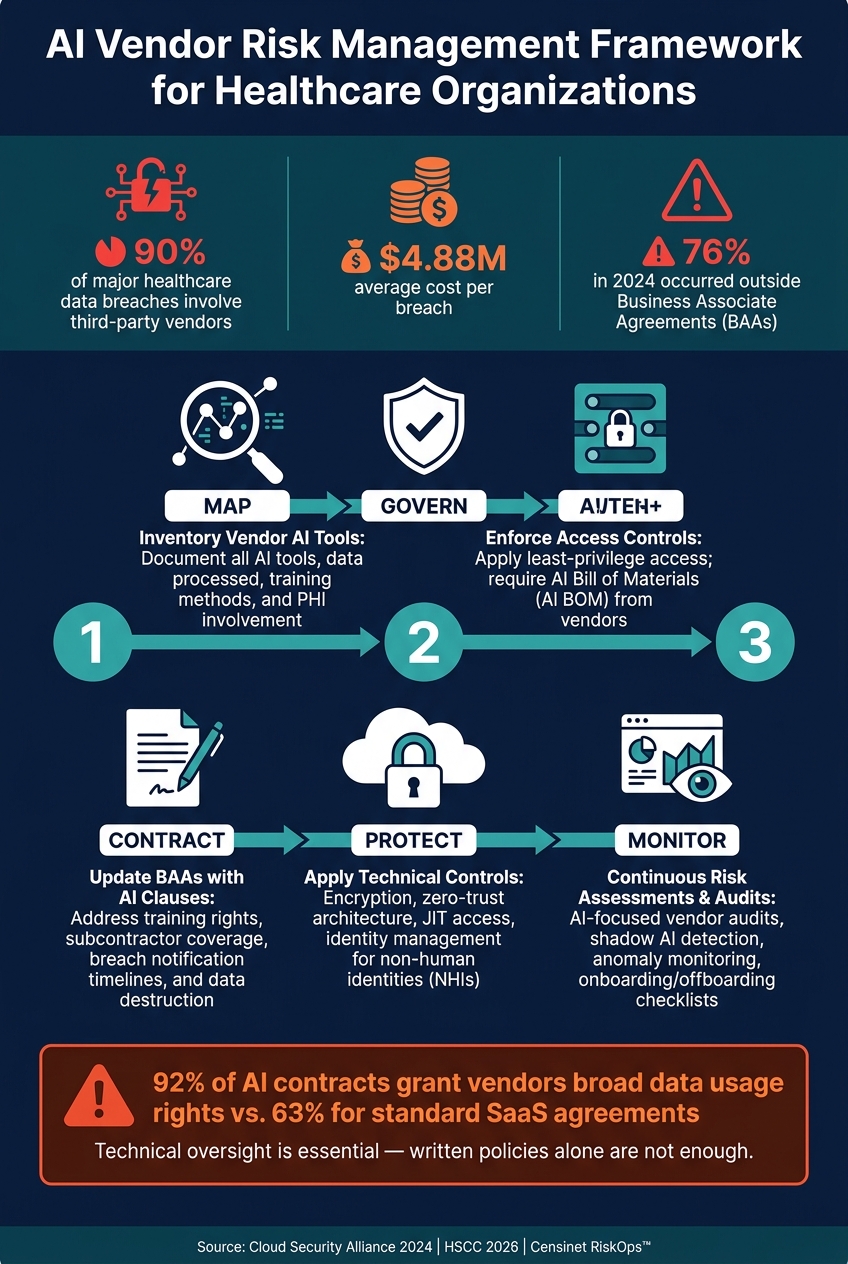
AI Vendor Risk Management Framework for Healthcare Organizations
Navigating AI Vendor Risks: Essential Considerations for Healthcare Organizations
sbb-itb-535baee
Mapping AI Use Across Third-Party Vendors
Understanding how AI is integrated into your vendor ecosystem is a critical first step in managing AI-related risks. Healthcare organizations often lack a complete view of AI's presence within their systems. This is largely because AI elements are frequently embedded in tools like revenue cycle platforms, imaging systems, and EHR modules, often with limited or no disclosure.
"The healthcare sector's accelerating adoption of artificial intelligence has dramatically expanded its dependence on third-party tools and services, introducing complex cybersecurity challenges that traditional risk management models cannot adequately address." - Health Sector Coordinating Council (HSCC) [3]
Identifying AI Tools and Services Used by Vendors
The foundation of effective AI risk management is creating a thorough inventory of all vendor AI tools interacting with your systems. This isn't as simple as checking a box on a vendor questionnaire - it requires a deeper dive. Each tool's purpose, the data it processes, its training methods, and whether it involves PHI (Protected Health Information) must be clearly documented.
Setting up a dedicated AI oversight committee, separate from general IT governance, can help track these tools throughout their lifecycle. Additionally, requiring vendors to disclose all AI components - whether proprietary, third-party, or open-source - through contractual clauses minimizes reliance on vendor self-reporting alone.
Once this inventory is established, the next challenge is identifying hidden or unauthorized AI activities.
Finding Shadow AI and Tracking Data Flows
Shadow AI, or unauthorized AI usage, poses a significant challenge because it often operates outside the visibility of standard policies. Addressing this issue requires more than just written guidelines - it demands technical solutions.
"Written data usage policies don't suffice. Implement technical controls over all interactions between your environment and LLMs using a middleware or proxy layer." - Transcend Team [4]
Middleware and proxy layers offer real-time monitoring of data exchanges between your systems and vendor AI services. This approach helps detect unauthorized activity that might go unnoticed in traditional contracts. Alarmingly, 92% of AI contracts grant vendors broad data usage rights, compared to 63% for standard SaaS agreements [4], making technical oversight essential for managing data flows effectively.
Platforms like Censinet RiskOps™ can simplify these efforts by centralizing AI inventory management, monitoring shadow AI activity, and providing comprehensive oversight of vendor ecosystems. This not only strengthens PHI security but also enhances overall risk management strategies.
Governance Policies for AI in Vendor Access
Once you've cataloged vendor AI tools, the next step is to put governance policies in place to reduce potential risks. These policies build on your inventory by formalizing controls throughout the vendor lifecycle, ensuring a structured approach to managing AI-related risks.
Access Control Policies for AI Tools
Start by documenting approved AI tools and defining strict access conditions. Implement a least-privilege access model, where each tool is limited to only the data and systems it absolutely requires to function effectively.
Incorporate AI risk considerations into every phase of your Third-Party Risk Management (TPRM) process. This includes initial planning, due diligence, ongoing monitoring, and even contract termination. Require vendors to provide an AI Bill of Materials (AI BOM) that outlines key details like model dependencies, open-source components, APIs, and third-party integrations.
Tools like Censinet RiskOps™ can help streamline this oversight. By using a centralized dashboard, you can route AI risk findings to the appropriate stakeholders, such as members of your AI governance committee. This platform also tracks policies, risks, and action items, offering a comprehensive view of your AI governance landscape.
These internal controls lay the groundwork for stronger contractual protections.
Contract Terms and BAAs for AI Vendors
Once access control policies are in place, it's essential to reflect these standards in vendor contracts. Standard Business Associate Agreements (BAAs) were not designed with AI in mind, so they need to be updated to address how AI systems process, store, and learn from data.
"Contracts play a critical role in governing third-party AI risk and should extend well beyond executing a business associate agreement (BAA)." - RSM US [1]
Here are some critical AI-specific provisions to include in vendor contracts:
| BAA Component | AI-Specific Requirement |
|---|---|
| Permitted Uses | Clearly define approved AI use cases (e.g., clinical decision support, prior authorization). |
| Training Rights | Restrict vendors from using your PHI to train or fine-tune general-purpose models. |
| Subcontractors | Ensure downstream BAAs cover all cloud providers and third-party API integrations. |
| Breach Notification | Set stricter timelines for reporting AI-related incidents - shorter than HIPAA's 60-day rule. |
| Data Return/Destruction | Include derived works and intermediate artifacts created during AI processing, not just raw data. |
One common oversight is subcontractor coverage. According to a 2024 study by the Cloud Security Alliance, 76% of healthcare AI incidents involved PHI processing outside the scope of the original BAA [2]. To address this, confirm that your vendor has downstream BAAs in place with every infrastructure provider or API partner involved in delivering their AI service.
Lastly, add a right-to-audit clause to your contracts. This allows you to periodically verify how AI-related data is being handled, including checks for any PHI inadvertently used in training sets. This clause can reveal compliance issues that traditional questionnaires might miss.
Technical Controls for AI-Enabled Vendor Access
Building on the governance policies and contract terms already discussed, technical controls ensure these standards are enforced in real time, addressing potential security gaps in AI vendor management.
Identity and Access Management for AI Workloads
Managing access is the first step in securing AI-enabled vendor environments. These systems involve a mix of human users, application identities, and automated workflows, each requiring tailored access controls.
Every external party should be treated as part of your broader access management ecosystem. Assign unique accounts, identities, and roles to each vendor and AI subcontractor, specifically scoped to their AI-related tasks. Avoid shared logins or generic service accounts, as they make it nearly impossible to trace activities in case of a security issue. A 2024 report revealed that 92% of organizations expose non-human identities (NHIs) to third parties, and 85% lack full visibility into third-party vendors connected via OAuth apps [5]. This presents a major risk, especially when protected health information (PHI) is involved.
"If a partner can reach PHI, their access should be reviewed, scoped, and revoked with the same rigor as internal privileged access." - NHI Mgmt Group Editorial Team [5]
Use role-based access control (RBAC) to define baseline permissions, combined with Just-in-Time (JIT) access for sensitive workflows. Secrets, API keys, and tokens should be short-lived and rotated immediately after use. Every access event must be logged with details like the vendor, subcontractor, purpose, and dataset involved. This level of granularity is critical for audits and incident investigations.
For nested subcontractors, ensure they have their own identity records and approval processes. Access should not be inherited from the parent vendor. Each layer of access must be visible and independently accountable.
Once identity management is in place, the next step is safeguarding data throughout AI workflows.
Data Protection in AI Workflows
AI workflows create unique vulnerabilities that traditional data protection measures can't fully address. These risks are especially pronounced during model training, inference, and the handling of intermediate data artifacts.
In April 2026, the Health Sector Coordinating Council (HSCC) emphasized that rapid changes in AI infrastructure result in "an exponentially complex and broad attack surface" [3]. This makes it crucial for healthcare organizations to scrutinize not only how vendors store data but also how they process it. For instance, PHI could unintentionally end up in a training dataset or a model's memory, creating compliance and privacy risks.
Vendors should be required to demonstrate encryption for data both in transit and at rest, covering every stage of the AI pipeline - not just storage. Additionally, data should be de-identified or tokenized before being used for model training. Establish clear shared responsibility agreements that outline which party is accountable for each data protection measure. Without these agreements, critical safeguards could be overlooked.
With data protection controls in place, continuous monitoring becomes the next priority to address evolving threats.
Continuous Monitoring and Zero-Trust Architecture
AI systems evolve quickly, and static security reviews can't keep up. Continuous validation is necessary to ensure that access remains appropriate and that systems behave as expected.
Zero-trust architecture provides a strong foundation for this approach. Its guiding principle is simple: never trust, always verify. Rather than assuming a vendor is secure after an initial review, zero trust incorporates security checks into every interaction with your cloud environment.
"By combining Zero Trust principles with adaptive AI governance in cloud environments, healthcare enterprises can mitigate cyber threats, prevent unauthorized data access, ensure regulatory compliance, and maintain operational resilience." - Sandeep Gupta, Independent Researcher [6]
This strategy includes network segmentation to isolate AI workloads from other clinical systems, anomaly detection to flag irregular access, and alignment with frameworks like NIST SP 800-207 (Zero Trust) and NIST CSF 2.0. Tools like Censinet RiskOps™ can support this model by consolidating real-time risk data into a single dashboard. This allows teams to identify and address vendor-related issues before they escalate.
Managing AI Vendor Relationships Over Time
Managing AI vendors goes beyond implementing technical controls. It requires structured processes for risk assessments, onboarding, offboarding, and incident response. These practices, combined with technical safeguards, ensure a more secure and well-managed AI ecosystem.
AI Risk Assessments for Third-Party Vendors
Traditional third-party risk assessments often fall short when it comes to addressing the unique challenges of AI. To bridge this gap, healthcare organizations need to tailor their evaluation frameworks with AI-specific questions and metrics. For instance, vendors should be asked how they manage training data, whether protected health information (PHI) is used in model training, and how often their AI systems are updated or retrained.
The Health Sector Coordinating Council (HSCC) emphasized this in its April 2026 guidance, urging organizations to align their risk programs with industry benchmarks and include AI-specific metrics to evaluate vendor security - especially in areas like training data management [3]. A practical first step is requiring vendors to provide a detailed inventory of all AI components in their stack, including tools from subcontractors. Without this transparency, assessing the full scope of risks becomes nearly impossible.
"The healthcare sector's accelerating adoption of artificial intelligence has dramatically expanded its dependence on third-party tools and services, introducing complex cybersecurity challenges that traditional risk management models cannot adequately address." - Health Sector Coordinating Council (HSCC) [3]
Platforms like Censinet RiskOps™ can streamline this process by directing AI-specific findings to the right stakeholders, such as members of an AI governance committee, ensuring vendors are thoroughly vetted.
Once risk metrics are established, organizations can move to the next step: managing vendor integration through detailed onboarding and offboarding procedures.
Onboarding and Offboarding AI Vendors
Onboarding AI vendors requires a formalized, AI-focused checklist. Before granting access, organizations should:
- Justify the AI use case.
- Validate the vendor's security measures through model quality assurance checks.
- Clearly document shared responsibility boundaries [3].
Offboarding is just as critical. When ending a vendor relationship, organizations should immediately revoke all IAM roles, service accounts, and API keys. Vendors must provide a signed Certificate of Data Destruction confirming that all PHI, personally identifiable information (PII), fine-tuning datasets, and related logs have been erased from their systems, including backups and model caches. For vendors using organizational data to fine-tune models, documentation on their machine unlearning processes is essential to ensure data cannot be reconstructed through techniques like model inversion attacks. A final audit of access logs should confirm compliance with offboarding protocols.
Additionally, it's important to identify and shut down any shadow accounts or ad hoc arrangements that may have bypassed central procurement during the vendor's tenure.
Incident Response for AI-Related Vendor Failures
Even with proper onboarding, incidents can happen. Whether it’s a data breach, a compromised model, or unexpected PHI exposure through an inference pipeline, having a robust incident response plan is critical. This plan should outline clear roles for vendor communication, internal investigations, and regulatory notifications. Preparing for these scenarios in advance ensures a faster, more coordinated response when issues arise.
Conclusion: Strengthening AI Risk Governance for Cloud Vendors
This guide has laid out a detailed framework for managing AI risks associated with cloud vendor access. It's important to remember that managing these risks isn't a one-and-done task - it requires continuous effort and vigilance. For context, HIPAA was enacted in 1996, long before AI became part of clinical workflows and revenue cycle management tools [3]. This gap between older regulations and today's technological advancements underscores the need for AI-specific governance in healthcare.
As discussed earlier, key strategies like mapping vendor AI usage and enforcing strict access controls form the backbone of effective AI risk management. Combined with steps such as updating Business Associate Agreements (BAAs) and formalizing onboarding and offboarding processes, these measures work best when supported by a clear governance framework. Establishing a dedicated AI governance body to review use cases, set standards, and maintain an AI inventory is critical for identifying and mitigating emerging risks.
"Acceleration of change of AI infrastructure, algorithms, and models at unprecedented rates introduce complexity, steep learning curves, an ever-evolving set of new and updated risks, and an exponentially complex and broad attack surface." - Health Sector Coordinating Council (HSCC) [3]
Healthcare organizations should also adopt vendor contracts that include standardized AI-specific clauses. These clauses should address key areas like data ownership, training rights, and shared security responsibilities. By doing so, organizations can avoid the pitfalls of shifting compliance and cybersecurity liabilities onto themselves - a concern that aligns with the BAA and contract provisions highlighted earlier.
Solutions like Censinet RiskOps™ can streamline oversight by centralizing AI-related policies, risks, and tasks into a single dashboard. This allows findings to be routed to the appropriate governance stakeholders and enables continuous monitoring throughout the vendor lifecycle. Such tools help translate governance policies into actionable practices. Ultimately, healthcare organizations must remain adaptable, continually refining these practices to protect patient data while staying compliant with regulatory requirements.
FAQs
How can we quickly spot shadow AI in our vendor ecosystem?
To spot shadow AI effectively, keep a centralized inventory of all vendors and their AI tools. Clearly outline where AI is used within clinical workflows and how it interacts with patient data. Tools like Censinet RiskOps™ offer real-time monitoring, helping track vendor updates and flag unauthorized data flows. This approach ensures that unapproved tools are avoided and every AI application is thoroughly assessed for potential risks and compliance issues.
What AI-specific clauses should we add to BAAs and vendor contracts?
Healthcare organizations need to revisit their Business Associate Agreements (BAAs) and vendor contracts to tackle the risks associated with AI. For BAAs, it's essential to:
- Prohibit the use of Protected Health Information (PHI) for training AI models.
- Ensure vendors comply fully with HIPAA regulations.
- Require rapid breach notifications within a short, specified timeframe.
- Hold subcontractors to the same rigorous standards.
Vendor contracts should also address critical areas like:
- Defining liability for errors caused by AI systems.
- Including performance guarantees to ensure reliability.
- Requiring bias audits to prevent discriminatory outcomes.
- Allowing immediate termination of agreements if safety concerns arise.
Additionally, contracts should clearly outline data ownership terms and provide rights for data deletion to maintain control over sensitive information. These measures help safeguard patient data and ensure accountability in AI implementations.
What should an AI-focused vendor offboarding process include?
When wrapping up a partnership with an AI vendor, it's crucial to handle access and data removal securely. Vendors should delete all organizational data within 30 days of the contract ending and provide a formal certificate of destruction as proof.
All access to systems, networks, and applications must be revoked immediately. Additionally, confirm that no PHI (Protected Health Information) or sensitive data remains in the vendor's systems. This step ensures compliance with the data ownership and retention policies agreed upon in the original contract.
