
Passing an audit does not mean you are secure. I’d treat compliance as the baseline, then check whether controls work when access is misused, a vendor is hit, or staff click a phishing link.
Here’s the short version:
- A signed BAA shows a legal agreement, not current vendor security.
- A written policy does not prove MFA, encryption, or offboarding are in place.
- A training completion rate does not show whether people report threats fast.
- A response plan that is never tested can fail when pressure hits.
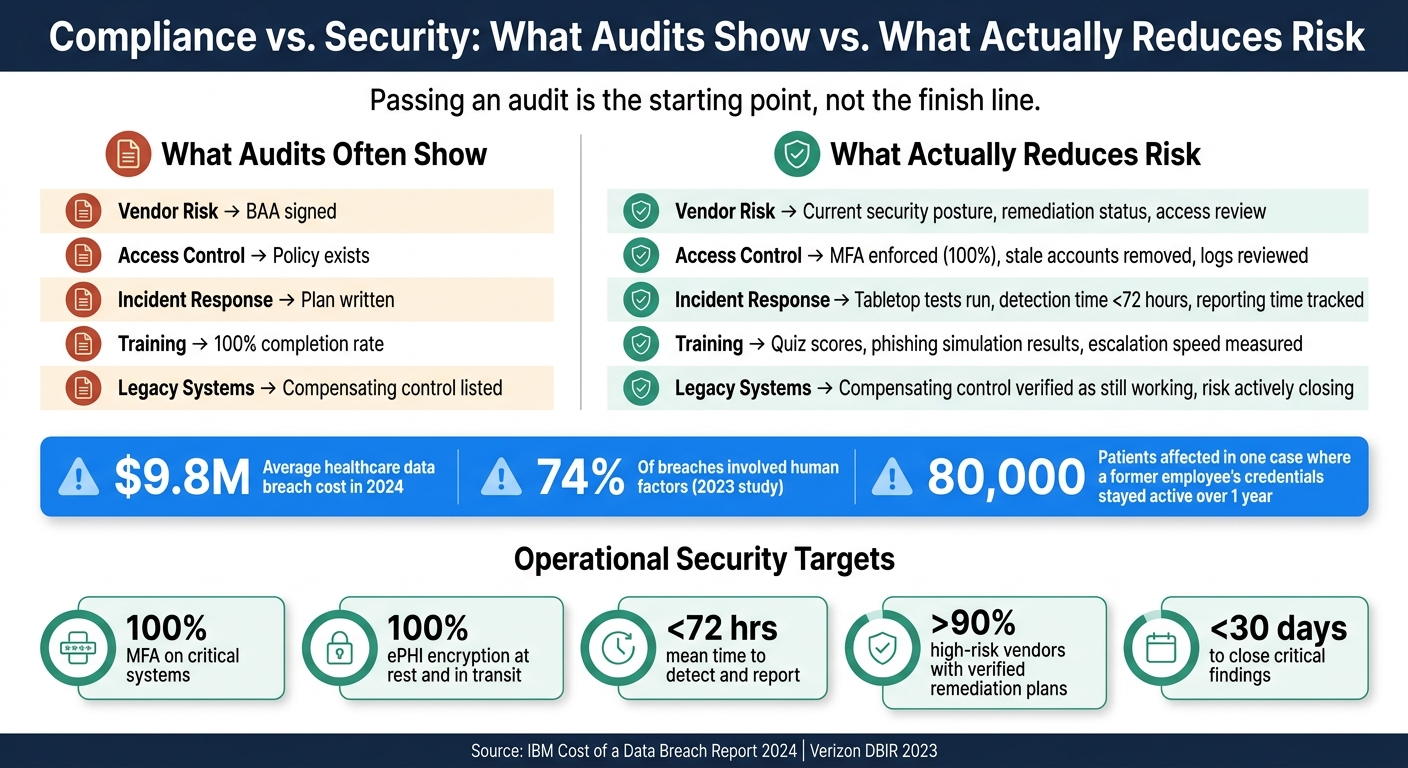
- Breach costs are high: healthcare averaged $9.8 million per incident in 2024.
- Human factors played a role in 74% of breaches in one 2023 study.
If I wanted to close the gap between audits and outcomes, I’d focus on a few plain checks:
- 100% MFA on critical systems
- 100% encryption for ePHI at rest and in transit
- Less than 72 hours to detect and report
- More than 90% of high-risk vendors with verified remediation plans
- Less than 30 days to close critical findings
The main point is simple: paperwork shows intent, but tested controls and tracked fixes show whether risk is dropping.
A quick view:
| Area | What audits often show | What I’d check instead |
|---|---|---|
| Vendor risk | BAA signed | Current security posture, remediation status, access review |
| Access control | Policy exists | MFA enforced, stale accounts removed, logs reviewed |
| Incident response | Plan written | Tabletop tests, detection time, reporting time |
| Training | 100% completion | Quiz scores, phishing results, escalation speed |
| Legacy systems | Compensating control listed | Whether the control still works and risk is closing |
If you only measure documents, you may miss the very gaps that lead to reportable breaches. That’s the problem this article addresses.
Compliance vs. Security: What Audits Show vs. What Actually Reduces Risk
Healthcare Security: Why Compliance Does Not Mean Secure
sbb-itb-535baee
Where Healthcare Audits Miss Actual Cyber Risk
The gap shows up most clearly in three places: third-party vendor risk, legacy systems, and workforce behavior.
Vendor Access and Third-Party Risk That Look Controlled on Paper
A signed Business Associate Agreement means a vendor has made a legal promise. It does not tell you whether that vendor is protecting PHI right now. A BAA shows a legal commitment, not present-day security performance. And annual questionnaires? They give you a snapshot, not a live view of access, offboarding, or account hygiene.
The Memorial Healthcare Systems case shows what that gap looks like in practice. Investigators found that a former employee's login credentials stayed active for more than a year. During that time, the ePHI of 80,000 patients was accessed. The case shows the cost of having policies in place without access revocation or log review. It settled for $5.5 million. [2] On paper, the control was there. In day-to-day use, the risk was still wide open.
That same gap between paperwork and practice shows up in older clinical systems too.
Legacy Systems and Incident Response Plans That Are Documented but Never Tested
A policy may say encryption is required. But unencrypted devices, backup media, and clinical systems can still sit inside unsupported environments. Teams often document compensating controls, then never check whether those controls work.
Children's Medical Center of Dallas received a $3.2 million civil penalty for failing to address known risks over a multi-year period. The issue was specific: portable devices were not encrypted, and those devices were later lost or stolen. [2] Again, the control existed on paper. The risk stayed in operation.
Written incident response plans break down for the same reason when no one tests them under stress.
A written plan can pass an audit, but phishing and malware events may still get handled like routine help-desk tickets instead of being logged and managed through a formal incident response process. Once that happens, the organization loses more than a clean paper trail. It loses documentation, lessons learned, and a chance to fix the same problem before it happens again. [2]
The last blind spot sits with workforce behavior, where audit completion can hide weak reporting habits.
Training Completion Rates That Do Not Change Behavior
A 100% training completion rate looks great in an audit report. But it doesn't tell you whether anyone remembered the material or changed how they work.
That matters because human factors, such as social engineering, influenced 74% of breaches in a 2023 study [2]. In plain English, people are still one of the biggest risk points in healthcare security, even though they are one of the least measured controls.
The split between compliance-driven training and security-driven training comes down to what happens after the course ends. Completion rates measure attendance. What matters more is whether staff can spot phishing, report it fast, and avoid making the same mistake twice.
Those signs show up in metrics like:
- quiz scores
- phishing simulation results
- incident escalation times
Those numbers tell you whether behavior is changing in the real world. They rarely show up in audit evidence.
That is why HIPAA, HITECH, and NIST lower risk only when they are tied to measurable operational controls.
Using HIPAA, HITECH, and NIST as Starting Points for Security Outcomes
HIPAA, HITECH, and NIST help ONLY when they lead to tested controls and clear risk reduction, not more audit paperwork. That’s the point: frameworks matter when they change day-to-day security work, not when they just fill a folder for review.
Connect Framework Requirements to Real Attack Paths and Business Impact
Start by tying each framework requirement to actual attack paths, patient safety impact, and recovery targets. This changes the conversation fast. Instead of asking, "Does this requirement appear in our policy?", ask, "What real attack path or business disruption does this control address, and what happens if it fails?"
That shift makes the next step pretty obvious: turn each requirement into a control you can test.
Use Measurable Controls Instead of Policy-Only Evidence
A policy shows intent. A control shows whether the thing works.
Vendor risk assessments should check actual security posture, not just verify that someone signed an agreement. Those findings should move into a prioritized, risk-ranked list with assigned owners and due dates. High-risk vendors should be reassessed on a risk-based cycle, and any lapse should be flagged right away.
The same logic applies across the board. Measure MFA by enforced coverage across critical systems, not by whether it exists as a setting on paper. Document recovery procedures with specific recovery time targets for critical systems. Check compensating controls against the exact risk they are supposed to offset.
Benchmark Gaps Between Documented Coverage and Tested Readiness
Without outside reference points, it’s hard to spot the gap between documented coverage and tested readiness. Healthcare-specific benchmarking helps bring that gap into view. If you compare your MFA enforcement, incident response maturity, or third-party assessment rates against peer organizations with similar size and complexity, weak spots show up fast. Internal audits often miss that kind of underinvestment.
The table below shows how each framework fits into an operational benchmarking approach:
| Framework | Regulatory Status | Primary Purpose | Security Scope | Operational Benchmark |
|---|---|---|---|---|
| HIPAA Security Rule | Mandatory Regulation | Protect ePHI confidentiality, integrity, and availability | Administrative, Physical, and Technical safeguards | Vendors with validated assessments vs. BAAs only |
| HITECH Act | Mandatory Regulation | Strengthen HIPAA enforcement and expand PHI protections | Breach notification and business associate accountability | Time-to-notification after a third-party incident |
| NIST CSF | Voluntary Framework | Provide a common language for managing cybersecurity risk | Identify, Protect, Detect, Respond, Recover | Recovery time for critical clinical systems |
| HICP (405(d)) | Industry Best Practice | Provide practical cybersecurity guidelines for healthcare | 10 specific practices (e.g., Email, Endpoint, IAM) | MFA enforcement across clinical and administrative access |
| HPH CPGs | Voluntary Goals | Align healthcare sector with high-priority security outcomes | Essential and Enhanced cybersecurity performance goals | Completion of Essential goals tied to patient safety risks |
Use frameworks to benchmark what’s working in practice: vendor assessments, notification speed, recovery time, MFA enforcement, and completion of essential goals. Then feed those benchmarks into ownership, deadlines, and follow-up inside the risk workflow.
Metrics, Workflows, and Tools That Turn Compliance Into Risk Reduction
Benchmarking only helps if it leads to action. Run an active risk program: assign an owner, set a due date, and track whether risk is going down. Once you can see the gaps, the next job is simple: make sure they close.
Track Outcome-Focused Metrics That Executives Can Act On
Use metrics to show whether controls are working, not just sitting on paper. Focus on enforced MFA coverage for critical systems that store or process ePHI, mean time to detect and report, remediation closure time, verified remediation plans for high-risk vendors, and encryption coverage for ePHI.
These metrics tie straight to the risk areas discussed earlier. MFA and encryption address access and device gaps. Remediation time shows how long legacy system exposure stays open. Detection and reporting time points to incident response readiness. Vendor remediation plans help contain third-party risk.
With the average healthcare data breach costing $9.8 million per incident in 2024 [3], a single weak vendor or one encryption gap can create major financial and operational exposure.
| Metric | Target Threshold | Why It Matters |
|---|---|---|
| MFA coverage on critical systems that store or process ePHI | 100% enforced | Blocks credential-driven compromise [3] |
| ePHI encrypted at rest and in transit | 100% | Lowers breach-notification exposure [3] |
| Mean time to detect and report | < 72 hours | Cuts reporting delay and disruption [3] |
| High-risk vendors with verified remediation plans | > 90% | Limits vendor risk [1] |
| Critical finding remediation closure time | < 30 days | Forces timely remediation [1] |
Metrics only matter when they feed assigned remediation.
Build Continuous Risk Management With Censinet RiskOps
Censinet RiskOps™ gives healthcare organizations one place to manage third-party and enterprise risk assessments, cybersecurity benchmarking, and collaborative remediation. That means vendor gaps, internal SRA findings, and scan results don't disappear into spreadsheets or long email threads.
The platform standardizes assessments across vendor tiers and ties each finding to a risk-ranked remediation list with assigned owners and due dates. Censinet Connect™ supports collaborative vendor assessments, and Censinet One™ extends team capacity with on-demand support.
Once ownership is set, the next bottleneck is usually evidence review. That's where automation starts to help.
Use Censinet AI™ to Speed Evidence Review and Follow-Through
Manual evidence review can drag out the whole workflow. Censinet AI™ helps vendors complete security questionnaires in seconds, summarizes evidence, surfaces integration and fourth-party risks, and drafts risk reports.
It also supports the review-and-approval workflow through configurable rules that keep human oversight in place. That includes evidence validation, policy drafting, risk mitigation support, and task routing across GRC teams.
| Feature | Traditional Compliance Workflow | RiskOps-Enabled Workflow |
|---|---|---|
| Speed | Manual back-and-forth | AI-assisted questionnaires [1] |
| Evidence Quality | Policy-only | Validated controls and documentation [1] |
| Remediation Tracking | Separate documents | Single risk-ranked task list [1] |
| Stakeholder Accountability | Annual signature | Continuous alerts for lapses [1] |
| Linkage to Outcomes | Passing the audit | Reducing risk scores [1] |
Conclusion: A Practical Roadmap to Close the Gap Between Audits and Outcomes
Passing an audit is the starting point, not the finish line.
The goal is to move from documented controls to proven results. Start with outcome-based goals. Define what secure means in measurable terms, then compare that standard against HIPAA, HITECH, and NIST to find the gaps that affect actual readiness. Focus first on the areas with the most exposure: vendor access, high-risk third parties, legacy systems, and response plans that haven’t been tested. Those areas tend to carry the highest breach risk and the biggest financial downside.
Then shift from point-in-time audits to ongoing measurement. Track whether critical controls remain enforced and whether high-risk findings are closed on schedule. That tells you if the controls discussed earlier are working in day-to-day practice, not just during audit season.
It also helps to keep every finding moving with clear ownership, due dates, and verified close-out. Censinet RiskOps™ supports risk management across vendor and enterprise assessments.
Compliance frameworks give you the map. Operational security is the destination. Treat every finding as a fix that must happen, not as proof that progress has already been made.
FAQs
Why isn’t passing an audit enough to prove we’re secure?
Passing a compliance audit does not mean you’re secure. Compliance and security aim at different things.
Compliance sets a baseline. It checks whether you meet a set of required controls at a specific moment. Security is different. It’s a day-to-day effort to protect systems, data, and people from threats that keep changing.
That gap matters. Audits often focus on documentation, evidence, and checklist items. Those things matter, of course, but they can miss what’s happening in daily operations. A company can pass an audit and still leave clear openings behind.
For example, an organization might be compliant on paper while still exposed to:
- real-world breaches
- weak spots in legacy systems
- third-party risk
Put simply, compliance shows that certain boxes were checked. Security asks a harder question: Are you ready for what attackers are doing right now?
Which security metrics should we track beyond compliance?
Track metrics tied to actual prevention and response, not just paperwork. Focus on mean time to detect and respond, patching rates, staff training completion, and results from tabletop exercises.
Vendor risk needs its own set of metrics too. Look at the percentage of vendors with current security assessments, onboarding time, and how fast teams close high-risk findings.
How can we test whether our controls actually work?
Shift away from paperwork-driven compliance and move toward operational testing and continuous verification.
That means checking whether your controls work in practice, not just whether they exist on paper.
Run tabletop exercises and simulated attacks. Continuously monitor your network, identity systems, and endpoints. Actively test controls like multi-factor authentication and logging. Then track metrics such as mean time to detection and mean time to response to confirm those controls are being enforced and are working as expected.
