
When a cyberattack hits healthcare, your response must be immediate, especially when third-party vendors are involved. Over 60% of healthcare breaches now include vendors like EHR providers, cloud services, or medical device manufacturers. Coordinating with these partners during an incident is critical because disconnecting them could disrupt patient care and violate HIPAA requirements.
Key Points:
- Pre-Incident Prep: Classify vendors by risk, ensure contracts have clear timelines (e.g., 24-hour notifications), and maintain updated contact sheets.
- During an Incident: Use pre-arranged communication tools, establish 24/7 response teams, and act quickly to contain risks while keeping leadership informed.
- Post-Incident Review: Conduct joint evaluations with vendors, update processes, and store records for six years to meet compliance.
Manual coordination can be slow and error-prone, especially during high-pressure situations. Platforms like Censinet RiskOps™ simplify this by automating vendor tracking, communication, and audits, reducing delays and improving response efficiency.
The choice between manual and automated approaches depends on your organization's size and complexity, but automation is increasingly becoming the standard for managing vendor-related incidents effectively.
Vendor Management During Incidents: Third-Party Coordination
sbb-itb-535baee
1. Manual Coordination Methods
Managing vendors manually during incidents requires careful groundwork during calmer periods. Here's how to prepare, act, and review effectively.
Pre-Incident Preparation
Start by organizing your vendors based on their risk levels. This means evaluating how much Protected Health Information (PHI) they handle and how essential they are to patient care. High-risk vendors should undergo assessments at least once a year, while moderate-risk vendors might follow a 12–18 month review cycle [4][5].
Contracts play a huge role in incident preparedness. Phrases like "prompt notification" can lead to confusion during a crisis, so it's better to use specific deadlines. For example, many organizations require vendors to notify them within 24 hours of an incident, even though HIPAA allows up to 60 days [4]. Business Associate Agreements (BAAs) should also include clear escalation steps, audit rights, and detailed reporting obligations to avoid misunderstandings.
Another key tool is the "Vendor IR One-Sheet" - a concise document with 24/7 contact details, escalation paths, and a list of systems the vendor uses. These one-sheets should be integrated into ticketing or on-call tools to ensure they're always accessible and up-to-date [5].
When these measures are in place, they enable a faster and more organized response when incidents occur.
Real-Time Coordination
Effective incident management relies on quick, organized communication. To make this happen, you'll need pre-arranged tools like dedicated conference bridges, secure communication channels, and round-the-clock on-call rotations for teams in security, legal, privacy, and vendor management.
"Incidents do not respect office hours. Build a 24/7 Incident Response model with clear ownership across you and your vendors so PHI risks are contained quickly and communications stay synchronized." - Kevin Henry, Incident Response Expert [4]
During the incident, keep leadership informed with brief, scheduled updates. These should provide enough information without overwhelming them. If a vendor's access needs to be revoked, have processes ready to disable SSO, revoke credentials, and block integrations immediately. It's worth mentioning that manual processes can sometimes cause delays compared to automated solutions like Censinet RiskOps™, which streamline many of these steps.
Post-Incident Review and Resilience
After the incident is resolved, hold a joint review session with vendors within two weeks. Focus on whether notification deadlines were met, what evidence was shared, and where communication could improve. Use these insights to refine your risk assessments and vendor classifications, tying back to the pre-incident framework. Update contracts and playbooks based on the findings, and run annual tabletop exercises with key vendors to test these updated processes against scenarios like ransomware attacks or credential breaches [4][5].
Finally, ensure all incident records, risk assessments, and notifications are stored for at least six years to stay compliant with HIPAA requirements [4].
"Hospitals that treat vendor risk as an operational discipline rather than a checkbox exercise are better positioned to respond quickly during security incidents, minimize disruption to clinical workflows, and protect patient safety." - Forescout [3]
2. Censinet RiskOps™ Platform
The Censinet RiskOps™ platform is specifically designed to simplify healthcare vendor risk management, covering every stage of the incident lifecycle in one integrated system. Unlike manual methods, this automated solution optimizes each step of incident response, making it far more efficient and effective.
Pre-Incident Preparation
RiskOps™ brings all vendor-related information into one place - details like PHI exposure, system dependencies, BAA status, and escalation contacts. This allows for quick and accurate risk-tiering, separating critical vendors from lower-risk ones.
The platform also includes standardized security questionnaires (aligned with HIPAA-compliant vendor risk management, NIST CSF, and HICP) and compliance reports. This ensures that Service Level Agreements (SLAs) and incident obligations are agreed upon in advance, avoiding the chaos of negotiating during a crisis. According to Censinet, customers have cut third-party risk assessment cycles by up to 80% compared to manual processes. For example, a major healthcare delivery organization reduced vendor assessment times from weeks to just days by switching to RiskOps™.
Real-Time Coordination
When an incident occurs, RiskOps™ enables teams to quickly identify impacted vendors by querying affected systems or data types. A real-time dashboard provides up-to-the-minute updates on vendor responses, tracking acknowledgments, investigation statuses, and any missed response deadlines. SLA breaches are automatically flagged for escalation.
Instead of managing multiple email threads, teams can use the platform's centralized communication portal to streamline interactions. This includes sharing IOC lists, requesting log exports, and documenting vendor responses, all with time-stamped records. This feature becomes indispensable during complex incidents - such as a zero-day vulnerability affecting multiple vendors - where manual coordination would be overwhelming.
Post-Incident Review and Resilience
RiskOps™ simplifies post-incident evaluations by automating audit trails and corrective action processes. Once an issue is contained, the platform links incident records to the involved vendors, creating a clear and structured audit trail. This eliminates the need to piece together email histories.
Automated Corrective Action Plans (CAPs) ensure vendors are held accountable for remediation steps, and their performance during the incident is factored into updated risk scores. These updated profiles are then used for future contract renewals and reassessments, ensuring that past behavior influences ongoing vendor management instead of being overlooked.
Pros and Cons
Manual vs. Automated Vendor Incident Response in Healthcare
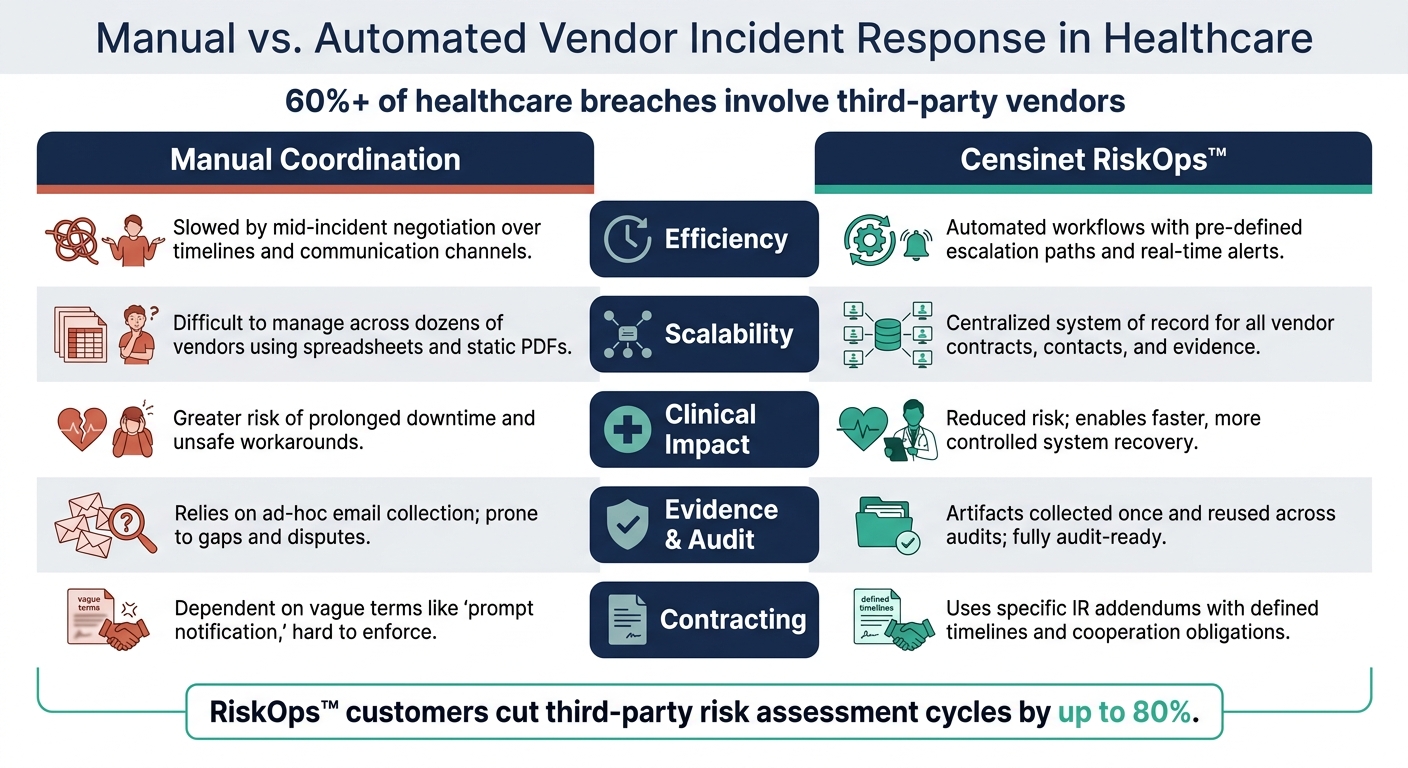
Both manual coordination and automated solutions come with their own set of trade-offs, especially when it comes to managing vendor incident responses. Manual coordination can be effective for organizations with a small, stable vendor base and strong relationships. However, its limitations often become glaringly obvious during an actual incident.
"Vendor incident response coordination fails most often for one reason: you discover during a real incident that you and the vendor disagree on what must be reported, how fast, and through which channel." - Daydream [5]
On the flip side, Censinet RiskOps™ requires an upfront commitment in terms of setup and onboarding. But once in place, it offers speed and control when it’s needed the most. With third-party vendor breaches on the rise and tight notification windows to contend with, the stakes are undeniably high.
Here’s a side-by-side comparison of the two approaches during a live incident:
| Factor | Manual Coordination | Censinet RiskOps™ |
|---|---|---|
| Efficiency | Slowed by mid-incident negotiation over timelines and communication channels [5] | Automated workflows with pre-defined escalation paths and real-time alerts [1][5] |
| Scalability | Difficult to manage across dozens of vendors using spreadsheets and static PDFs [1][5] | Centralized system of record for all vendor contracts, contacts, and evidence [5] |
| Clinical Impact | Greater risk of prolonged downtime and unsafe workarounds [5][6] | Reduced risk; enables faster, more controlled system recovery [6] |
| Evidence & Audit | Relies on ad-hoc email collection; prone to gaps and disputes [5] | Artifacts collected once and reused across audits; fully audit-ready [5] |
| Contracting | Dependent on vague terms like "prompt notification", which are hard to enforce [5] | Uses specific IR addendums with defined timelines and cooperation obligations [5] |
These distinctions have a direct impact on clinical operations during an incident. Manual coordination often falters due to outdated contact information or disputes over reporting, leaving clinical teams scrambling for solutions. This can lead to delays and unsafe improvisations. As Rich DeFabritus from Forescout points out:
"The difference between a contained incident and a patient-impacting crisis often comes down to speed, visibility, and precision." - Rich DeFabritus, Forescout [3]
For healthcare organizations managing complex ecosystems - spanning EHR providers, cloud infrastructure, medical device manufacturers, and revenue cycle services - the administrative burden of manual coordination can outweigh any perceived cost savings. This makes automation not just a convenience but a necessity for ensuring patient safety and maintaining operational continuity during cyber incidents.
Conclusion
When a cyber incident involves a third-party vendor, preparation is the key to a swift and effective response. Relying on manual coordination often leads to delays and confusion, especially during high-pressure situations. Tight deadlines, outdated contact information, and unclear reporting structures can quickly turn a manageable incident into a chaotic scramble. As Trudie E. Kozar from Schneider Downs aptly states:
"Preparation kills panic. Having pre-established roles, third-party communication trees, and simulation exercises turn chaos into a well-rehearsed response." [2]
Censinet RiskOps™ tackles these challenges head-on by centralizing vendor information, automating escalation processes, and consolidating audit data into a single platform. For healthcare organizations juggling relationships with EHR providers, medical device manufacturers, cloud service partners, and revenue cycle vendors, this level of preparedness can mean the difference between a contained issue and a crisis that impacts patients.
This approach shifts vendor incident response from being a reactive, cumbersome task to a proactive, strategic advantage.
To move forward, organizations must treat vendor incident response as an operational priority rather than a mere compliance requirement. This includes setting clear notification timelines - typically 24–72 hours for high-risk vendors - conducting annual tabletop exercises with critical partners [7], and ensuring escalation contacts are easily accessible within the tools your team uses regularly, not buried in an outdated document no one can locate during an emergency.
Using a platform-based solution for vendor coordination isn't just a better way to manage incidents - it’s becoming the new standard for operational resilience.
FAQs
Which vendors should be prioritized first during a cyber incident?
During a cyber incident, it's essential to prioritize vendors based on how they affect patient care, clinical operations, and the security of sensitive data. Pay close attention to key partners, especially those handling electronic health records (EHRs), medical devices, or pharmacy systems. Implementing a risk-based tiering system can help identify which dependencies pose the highest risk. Tools like Censinet RiskOps™ simplify this process by centralizing vendor risk profiles and automating assessments, ensuring that vendors critical to maintaining care and protecting data get immediate attention.
What should a vendor contract or BAA require for incident notification and cooperation?
Clear timelines for incident notifications (such as 24–72 hours) should be a standard requirement in vendor contracts and Business Associate Agreements (BAAs). These timelines need to outline specifics like which systems were affected, the methods used in the attack, and the preliminary impact assessment.
Contracts should also include clauses for joint forensic investigations, evidence preservation, and log sharing to ensure a coordinated response. Additionally, they must define communication escalation paths, clarify responsibilities for restoring services, and grant audit rights to verify compliance.
It's equally important to ensure these obligations are passed down to any subcontractors who handle protected health information, maintaining accountability across all parties involved.
What incident evidence should we collect from vendors for HIPAA audits?
To ensure compliance with HIPAA audit requirements, it's essential to collect and maintain thorough documentation that supports the vendor's response and demonstrates your oversight. Key pieces of evidence include:
- Security logs and forensic reports to track and analyze incidents.
- Detailed incident timelines and a list of affected systems.
- Information about potential PHI (Protected Health Information) exposure and the steps taken for remediation.
- Root cause analyses, audit results, and findings from penetration tests.
Tools like Censinet RiskOps™ can make this process easier by centralizing vendor documentation. This ensures all critical information is readily available for audits and enables better coordination during responses.
