
Medical device labeling is evolving. Traditional labels focus on safe operation and intended use for patients and clinicians. But as devices become more connected, cybersecurity labeling addresses digital threats, targeting IT and healthcare technology teams.
Here’s the key difference: Traditional labeling is static, guiding clinical use. Cybersecurity labeling is dynamic, updating as threats emerge. Both are critical for patient safety, but they serve different purposes.
Key Points:
- Traditional Labeling: Covers clinical use, risks, and instructions. Target audience: patients, clinicians, caregivers.
- Cybersecurity Labeling: Focuses on secure setup, maintenance, and updates. Target audience: IT admins, security teams.
- Regulatory Drivers: Traditional labeling follows FDA 21 CFR Part 801. Cybersecurity labeling aligns with FD&C Act Section 524B and FDA’s 2025 guidance.
- Update Frequency: Traditional labels change only with design updates. Cybersecurity labels must evolve with new vulnerabilities and patches.
Quick Comparison
| Dimension | Traditional Labeling | Cybersecurity Labeling |
|---|---|---|
| Objective | Safe clinical use | Secure device management |
| Audience | Patients, clinicians | IT admins, security teams |
| Content | Usage guides, warnings | SBOM, patch plans, network details |
| Updates | Rare, tied to design changes | Frequent, tied to vulnerabilities |
| Lifecycle Coverage | Active use and storage | Full lifecycle, including decommissioning |
Cybersecurity labeling isn’t just about compliance - it’s about staying ahead of risks in a connected healthcare environment. Let’s explore the details.
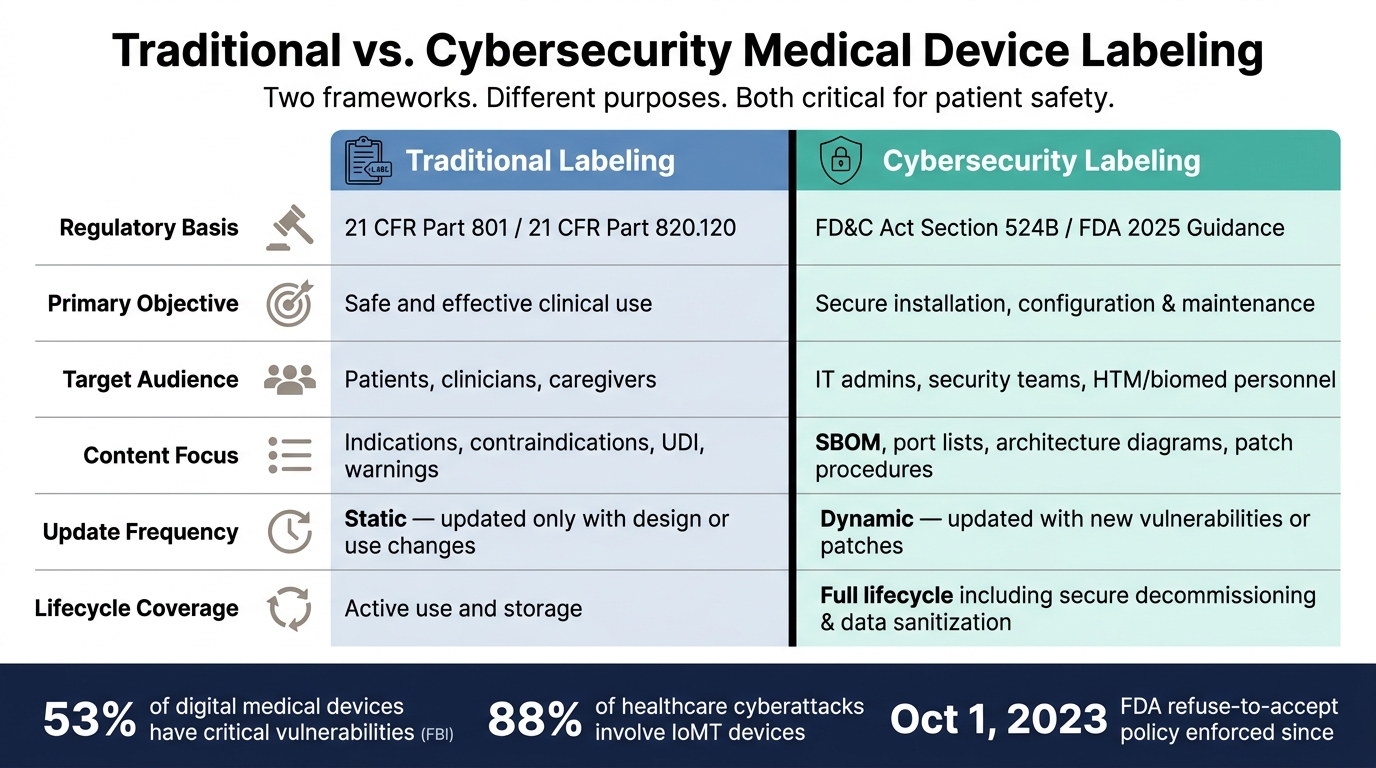
Traditional vs. Cybersecurity Medical Device Labeling: Key Differences
Cybersecurity Labeling and MedTech Transparency | Ep. 25
sbb-itb-535baee
Regulatory Foundations
The rules surrounding medical device labeling have developed over decades, shaped by various regulatory frameworks designed to address different levels of risk.
FDA Requirements for Traditional Labeling
Traditional labeling requirements for medical devices are outlined in 21 CFR Part 801, which specifies the minimum information manufacturers must provide. This includes identifying the manufacturer's name and location, clearly stating the device's intended use, and offering "adequate directions for use" [1]. Additionally, the Quality System Regulation (21 CFR Part 820) mandates that labeling be part of the Device Master Record (DMR). Labels must remain legible and securely attached throughout the device's expected lifespan [2].
When the FDA refers to "labeling", it doesn't just mean the physical label on the device. It also includes all accompanying materials such as manuals, brochures, package inserts, and even on-screen instructions. Failing to meet these standards can lead to the device being classified as misbranded under §502(f) of the FD&C Act [3].
Emerging Cybersecurity Labeling Standards
While traditional labeling focuses on long-standing safety and usage guidelines, new cybersecurity requirements are adding layers of complexity. A key driver of this shift is Section 524B of the FD&C Act, which applies to "cyber devices." These are devices that incorporate software, connect to the internet, and have features that could be vulnerable to cyber threats [6]. Under this section, manufacturers are required to include a Software Bill of Materials (SBOM), a plan for monitoring vulnerabilities, and documented patch procedures in their premarket submissions.
The FDA's 2025 cybersecurity guidance lays out 14 critical labeling elements that manufacturers must address. These range from disclosing network ports and providing system architecture diagrams to specifying end-of-support timelines and secure decommissioning processes [4]. As of October 1, 2023, the FDA enforces a "refuse-to-accept" policy for premarket submissions lacking the necessary cybersecurity documentation [6].
Here’s a quick comparison of the regulatory frameworks:
| Regulatory Driver | Focus Area | Key Requirement |
|---|---|---|
| 21 CFR Part 801 | General safety | Adequate directions for use, intended use, label prominence [1] |
| 21 CFR Part 820.120 | Quality systems | Labeling control, legibility, adhesion, and inspection [2] |
| FD&C Act Section 524B | Cybersecurity | SBOM, vulnerability management plans, patch procedures [6] |
| FDA 2025 Guidance | Cyber transparency | 14 elements, including ports, protocols, and end-of-support timelines [4] |
What sets the cybersecurity framework apart is its dynamic nature. Traditional labeling typically requires updates only when a device's design or clinical use changes. In contrast, cybersecurity labeling must be revised whenever new vulnerabilities emerge or when there are changes to support policies [3]. This introduces an ongoing compliance challenge for manufacturers and shifts expectations for healthcare organizations. Navigating these evolving requirements is essential for maintaining strong device security throughout its lifecycle. These regulatory changes also directly impact patch management strategies, which are explored in the next section.
Key Differences Between Traditional and Cybersecurity Labeling
Comparison Table
The differences between traditional and cybersecurity labeling go beyond just the content - they extend to the purpose, target audience, and how often updates are required. Here's a breakdown of the key distinctions:
| Dimension | Traditional Device Labeling | Cybersecurity Labeling |
|---|---|---|
| Regulatory Basis | 21 CFR Part 801; 21 CFR Part 820.120 | FD&C Act Section 524B; FDA 2025 Guidance [4][7] |
| Primary Objective | Safe and effective clinical use | Secure installation, configuration, and maintenance [4] |
| Target Audience | Patients, clinicians, and practitioners | IT admins, security teams, and HTM/biomed personnel [3] |
| Content Focus | Indications, contraindications, UDI, warnings | SBOM, port lists, architecture diagrams, patch procedures [4] |
| Update Frequency | Static; updated solely with design or use modifications | Dynamic; updated with new vulnerabilities or patches [3] |
| Lifecycle Coverage | Active use and storage | Full lifecycle, including secure decommissioning and data sanitization [4] |
One standout difference is how often updates are made. Cybersecurity labels are treated as living documents, updated whenever new vulnerabilities or patches emerge. In contrast, traditional labels remain static, only changing when there are design or usage modifications [3].
Why These Differences Matter for HDOs
These distinctions carry significant implications for healthcare delivery organizations (HDOs). Traditional labels are designed to guide clinical staff on safe device operation. On the other hand, cybersecurity labels provide IT and biomedical teams with the tools they need to securely deploy, configure, and maintain devices on hospital networks. The instructions in each are tailored to completely different audiences and purposes.
"In today's connected healthcare environment, a medical device's labeling is no longer just about operating instructions - it's a critical cybersecurity safeguard." - Christian Espinosa, Founder & CEO, Blue Goat Cyber [3]
Take network deployment as an example. Cybersecurity labels often include an "Interfaces & Services" table, which outlines the ports and protocols a device uses. This information is vital for IT teams to set up firewall rules and segment networks appropriately before a device is even operational [3]. Traditional labels, however, provide no equivalent guidance for these tasks.
Another major gap is in patch management. Cybersecurity labels include a detailed update runbook, covering everything from delivery methods and integrity checks (like digital signatures) to expected downtime and rollback procedures [3]. Without this, HDOs are left guessing how to apply critical patches without interrupting patient care. As Christian Espinosa noted, "Hospitals care less about buzzwords and more about whether they can patch safely without disrupting care." [3]
Compliance risks also come into play. Since October 1, 2023, the FDA's refuse-to-accept policy has been in effect, meaning premarket submissions lacking proper cybersecurity documentation are automatically rejected [3]. Even after approval, inadequate cybersecurity labeling can lead to a device being classified as misbranded under §502(f) and §502(j) of the FD&C Act, potentially triggering recalls or enforcement actions [3][5]. For HDOs, purchasing a device that later faces a recall due to labeling issues can jeopardize both patient safety and operational workflows.
Impact on Patch and Update Management
Where Traditional Labeling Falls Short
Traditional device labeling was built for a time when device instructions rarely changed after leaving the factory. This static approach creates roadblocks for managing software patches and cybersecurity updates. IT administrators often lack clear instructions for verifying firmware integrity or handling patches that might interfere with clinical functions.
Without a structured plan for updates, healthcare delivery organization (HDO) staff are often left improvising - a risky scenario, especially when patient safety is on the line. For instance, consider pacemakers that could be reprogrammed remotely. This vulnerability led the FDA to require in-person firmware updates, highlighting how unresolved security gaps can directly endanger patients [3]. These limitations make it clear why a more flexible and detailed strategy, like cybersecurity labeling, is necessary.
How Cybersecurity Labeling Supports Patch Management
Cybersecurity labeling takes update guidance to the next level by turning it into a clear, actionable process. The labels outline how updates are delivered and verified - whether through over-the-air methods or local media using digital signatures - and include rollback instructions in case a patch causes device issues [3][4].
Another game-changer is the Software Bill of Materials (SBOM). It helps HDOs quickly identify which components of a device are affected by a newly disclosed Common Vulnerabilities and Exposures (CVE). This accelerates the decision-making process for triage and remediation. Garrett Schumacher, MS, CISSP, of Velentium Medical, explains:
"Cybersecurity labeling connects design intent to real-world device use. It communicates to clinicians, IT administrators, and healthcare delivery organizations how to install, configure, maintain, and retire a device securely." [4]
The FDA's 2025 guidance adds another layer of support by mandating End-of-Support (EOS) dates and secure decommissioning procedures. These requirements give HDOs the foresight to plan for device retirement before security updates are discontinued [3][4].
Challenges in Adopting Cybersecurity Labeling
Even with the benefits of structured update protocols, implementing cybersecurity labeling in practice comes with hurdles. A major issue is labeling drift - when the information on the label no longer matches the device's actual state due to accumulated patches and updates. Manufacturers must treat cybersecurity labels as dynamic documents, updating them with each new software release, vulnerability discovery, or configuration change [3][4]. This ongoing effort can be particularly demanding for companies managing extensive device portfolios.
For HDOs, the challenge lies in integrating these manufacturer-provided update runbooks into existing clinical workflows without disrupting patient care. Labels need to address both basic user instructions and the technical needs of security teams, such as port lists, protocol details, and compatibility with Security Information and Event Management (SIEM) systems [9]. These challenges highlight the importance of lifecycle security management - ensuring that the label's disclosures are practical and executable throughout the device's lifespan. Tools like Censinet RiskOps™ can help by centralizing medical device risk assessments and tracking cybersecurity practices over time, bridging the gap between label information and real-world application.
The Future of Medical Device Labeling
Digital and Machine-Readable Labels
Paper inserts are quickly becoming a thing of the past. Manufacturers are shifting to digital delivery methods like web portals, QR codes, and in-app notifications. These tools allow real-time updates to Software Bill of Materials (SBOMs) and vulnerability advisories without waiting for the next product revision cycle [4][9].
The FDA now mandates that SBOMs be provided in machine-readable formats such as SPDX or CycloneDX. This enables Healthcare Delivery Organization (HDO) security tools to instantly process component data and flag affected devices when a new Common Vulnerabilities and Exposures (CVE) is identified [3]. For Software as a Medical Device (SaMD), essential labeling and UDI (Unique Device Identifier) details are often integrated directly into startup screens or "About" menus, ensuring critical information is always accessible and tied to the product [8].
Manufacturers are also tailoring Instructions for Use (IFU) to specific audiences. For example, patients using devices like insulin pumps receive simplified guides, while network administrators are provided with detailed technical manuals, including port lists, firewall rules, and SIEM compatibility information [9]. This approach ensures users get the exact level of detail they need, reducing confusion and improving usability.
Standardization and Integration
The adoption of the Manufacturer Disclosure Statement for Medical Device Security (MDS2) is giving HDOs a consistent way to evaluate security controls across multiple vendors during procurement. This eliminates the need to gather fragmented security details from various sources [4][9]. With standardized, structured labeling formats, machine-readable data can now integrate directly into platforms like Censinet RiskOps™, automating vulnerability assessments and tracking device security across inventories [3][4]. This transforms labeling from a mere compliance measure into a dynamic operational resource.
"Cybersecurity is now evaluated as a lifecycle obligation rather than a static design feature assessed only at the point of market entry." - Wayne Stewart, Vice President, Intertek [10]
This shift highlights the transition toward a more comprehensive, automated approach to lifecycle security. Standardized labeling processes are paving the way for long-term security benefits that extend well beyond initial deployment.
Long-Term Benefits for Lifecycle Security Management
By combining digital tools and standardized labeling, manufacturers and HDOs achieve comprehensive visibility throughout the device lifecycle. This ensures actionable insights at every stage - from deployment and network segmentation to patching, incident response, and eventual decommissioning.
The table below outlines how specific labeling elements support operational improvements over time:
| Labeling Element | Long-Term Benefit for HDOs |
|---|---|
| Machine-Readable SBOM | Speeds up vulnerability assessments for new CVEs [3] |
| End-of-Support (EOS) Dates | Aids in capital planning and proactive risk management [4] |
| Forensic Logging Specs | Improves incident detection and response via SIEM integration [4] |
| Secure Default Settings | Reduces risks from misconfiguration during setup [3] |
| Decommissioning Procedures | Ensures data sanitization and secure key revocation [4] |
These advancements embed security directly into the manufacturer's Quality Management System (QMS) and Secure Product Development Framework (SPDF). For HDOs, this means fewer unexpected issues, smoother maintenance cycles, and stronger protections for patient safety throughout the device's lifecycle [4][5].
Conclusion
Traditional labeling focuses on static risks, while cybersecurity labeling tackles the ever-changing landscape of digital threats. This difference is especially critical in healthcare, where the FBI reports that 53% of digital medical devices have critical vulnerabilities, and 88% of healthcare cyberattacks involve IoMT devices [3]. This evolution in labeling not only satisfies regulatory requirements but also modernizes patch management to address the limitations of traditional approaches.
"The strongest labeling is device-specific, actionable, aligned to your SPDF, and kept current as vulnerabilities, configurations, and support policies evolve." - Christian Espinosa, CEO, Blue Goat Cyber [3]
Cybersecurity labeling transforms static documentation into a dynamic tool. By incorporating SBOM transparency, patch runbooks, and clear end-of-support procedures, it empowers healthcare delivery organizations (HDOs) to shift from reactive to proactive risk management [3][4]. This approach closes critical safety gaps while equipping organizations to address vulnerabilities more effectively.
Solutions like Censinet RiskOps™ help operationalize this data. By integrating SBOM summaries, vulnerability disclosures, and device-specific security configurations into risk assessment workflows, HDOs gain better visibility. This enables them to respond quickly to emerging threats and adopt a more proactive stance on risk management [3][4].
FAQs
What should I look for in a medical device cybersecurity label?
When evaluating physical and logical interfaces like Bluetooth or Ethernet, look for clear, actionable details. These should include secure installation instructions and steps for hardening, such as implementing strong password policies and using network segmentation to limit access.
The label should also provide a machine-readable SBOM (Software Bill of Materials) to give transparency into the software components. Additionally, it’s essential to include clear update and patching procedures, timelines for end-of-support, and disclosures about known vulnerabilities.
For enterprise-grade security, features like forensic logging are critical to track and analyze incidents. A coordinated vulnerability disclosure plan ensures that security issues are reported and addressed efficiently, helping maintain a robust security framework.
How often should cybersecurity labeling be updated after launch?
Cybersecurity labeling isn't a one-and-done process - it should evolve alongside a product's lifecycle. Changes like emerging vulnerabilities, updates to mechanisms or configurations, deprecation of older components, or shifts in secure configuration guidelines all call for updates. For healthcare organizations, Censinet provides tools to streamline risk assessments and monitor medical devices, helping ensure both security and compliance stay on track.
How can hospitals use an SBOM to respond faster to new CVEs?
Hospitals can rely on a machine-readable Software Bill of Materials (SBOM) to respond swiftly to newly discovered CVEs (Common Vulnerabilities and Exposures). By using standardized formats like CycloneDX or SPDX, automated tools can efficiently match device inventories against vulnerability databases, such as the NVD (National Vulnerability Database) or the CISA KEV catalog (Known Exploited Vulnerabilities). Incorporating VEX files further refines this process by helping to prioritize threats, as these files indicate whether a vulnerability is actually exploitable in a device's specific setup.
