
AI is transforming how healthcare data is de-identified, making it faster and more accurate. However, this progress comes with ethical challenges, including risks of re-identification, gaps in patient consent, and biases in datasets. Advanced tools, like large language models (LLMs), are powerful but can inadvertently expose sensitive information, even when data complies with regulations like HIPAA.
Key points:
- AI’s strength: LLMs can handle complex clinical language, improving de-identification accuracy. For example, Llama 3.3 achieved a recall of 0.99 in 2025.
- Ethical concerns: AI can infer identities from "de-identified" data, raising privacy risks and data breaches. In a 2026 study, AI increased re-identification risks 37-fold, even with HIPAA-compliant data.
- Solutions: Techniques like synthetic data, differential privacy, and human oversight help reduce risks, but they must be paired with strong governance and transparency practices. This is especially critical when managing healthcare third-party risk across the data supply chain.
AI in healthcare data management offers potential but requires careful handling to ensure privacy, trust, and fairness.
De-identification in Healthcare: Challenges and AI Solutions
sbb-itb-535baee
Regulations and Challenges
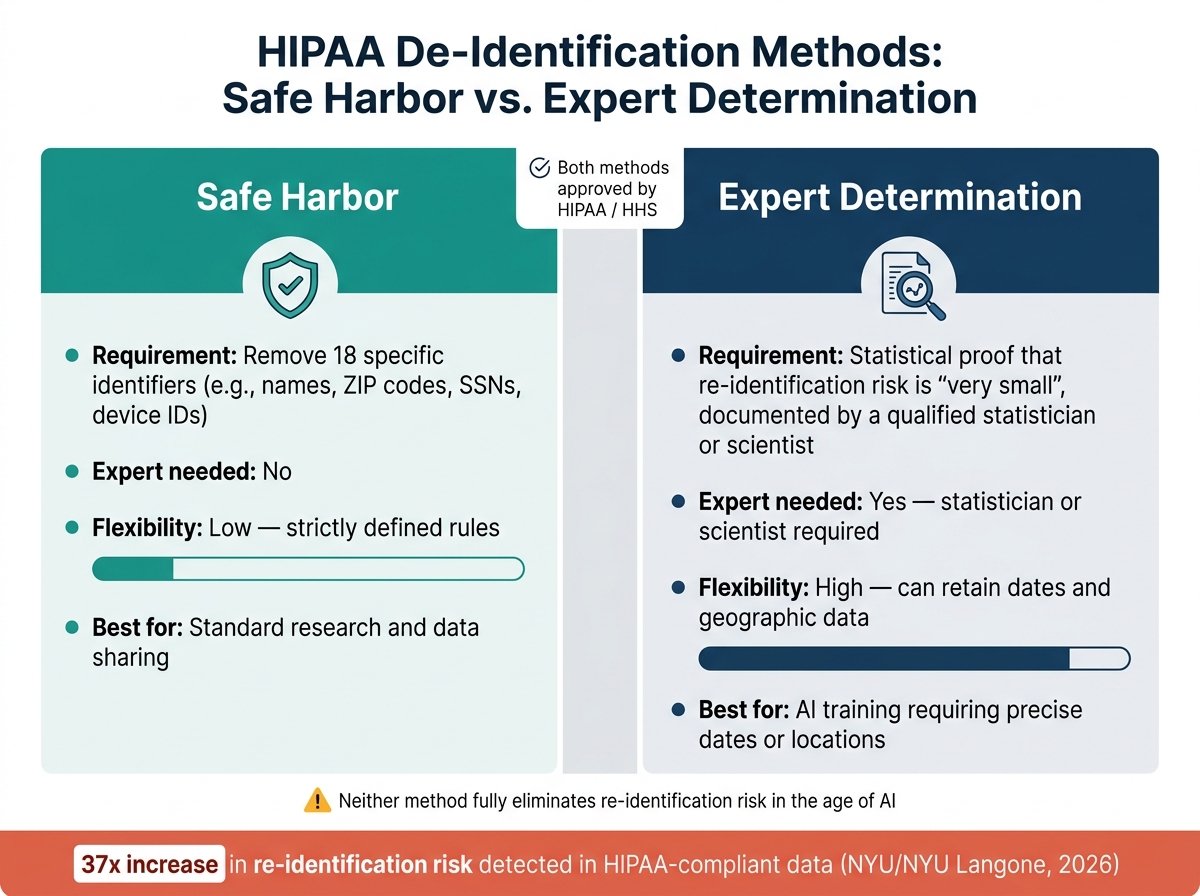
HIPAA De-Identification Methods: Safe Harbor vs. Expert Determination
HIPAA Standards for De-Identified Data
Under HIPAA, once data is properly de-identified, it is no longer classified as Protected Health Information (PHI), meaning the Privacy Rule no longer applies to it [4].
To de-identify data, organizations can choose between two approved methods:
- Safe Harbor method: This approach removes 18 specific identifiers, such as names, ZIP codes, Social Security numbers, and device IDs.
- Expert Determination method: This relies on a qualified statistician or scientist to confirm and document that the risk of re-identification is "very small" [4][6].
| Feature | Safe Harbor | Expert Determination |
|---|---|---|
| Requirement | Remove 18 specific identifiers | Statistical proof of "very small" risk |
| Expert needed | No | Yes (statistician or scientist) |
| Flexibility | Low (strictly defined) | High (can retain dates and geography) |
| Best for | Standard research and data sharing | AI training needing precise dates or locations |
The U.S. Department of Health and Human Services (HHS) highlights that de-identification reduces privacy risks while enabling secondary uses of data, such as research, policy analysis, and life sciences studies [4]. However, these traditional methods face new hurdles in the age of AI.
How AI Complicates Current De-Identification Rules
HIPAA treats de-identification as an all-or-nothing concept: data is either identified or it’s not. But advanced AI systems challenge this binary approach by uncovering patterns, inferring attributes, and even reconstructing identities from seemingly innocuous data.
A striking example comes from a February 2026 study by researchers from New York University and NYU Langone titled "Paradox of De-identification: A Critique of HIPAA Safe Harbour in the Age of LLMs." The study analyzed 222,949 de-identified clinical notes from 170,283 patients. Despite Safe Harbor compliance, AI models could predict six demographic attributes - like biological sex, neighborhood, and insurance type - with alarming accuracy, increasing the re-identification risk 37-fold [7].
The researchers noted:
"Under perfect Safe Harbor compliance, 'de-identified' notes remain statistically tethered to identity through the very correlations that confirm their clinical utility. The conflict is structural instead of technical." [7]
For instance, AI could determine biological sex with over 99.7% accuracy by detecting indirect signals in clinical notes - such as specific diagnoses, lifestyle mentions, or even writing styles - that Safe Harbor was never designed to address [7]. Gulshan Prajapati, a software development expert at Nirmitee, remarked:
"Safe Harbor's 18 identifiers are still the right starting point, but they are not sufficient for modern healthcare AI." [5]
This also complicates the Expert Determination method. As AI grows more powerful, it becomes harder to certify that re-identification risk remains "very small." Experts suggest that instead of relying on a single certification, organizations should consider time-limited evaluations to account for the rapid advancements in computational power [7].
Ethical Issues in AI De-Identification
Re-Identification Risks and Patient Privacy
AI's ability to predict demographic details from de-identified clinical notes raises serious ethical concerns. Even when data is stripped of personal identifiers, techniques like Membership Inference Attacks (MIA) can reveal whether a specific patient's record was part of an AI model's training data. For example, a study demonstrated that a membership inference attack achieved a 0.47 advantage with an AUC of 0.79, highlighting the potential for re-identification even in de-identified datasets [1].
"De-identification of real clinical notes does not protect records against a membership inference attack." - Scientific Reports [1]
These risks grow when sensitive health conditions, such as HIV or mental health issues, are involved. In January 2026, researchers at MIT's Abdul Latif Jameel Clinic for Machine Learning in Health revealed that foundation models trained on de-identified electronic health records could be manipulated by adversarial actors to expose private diagnoses, including HIV and alcohol abuse [10]. Such vulnerabilities not only compromise privacy but also raise questions about patient consent and the transparency of data use.
Informed Consent and Transparency
Most patients are unaware that their de-identified data is often used to train AI models. This lack of awareness undermines trust, especially when commercial AI systems profit from such data without explicit patient consent. The issue is compounded by outdated frameworks like Safe Harbor, which prioritize data availability over stringent privacy protections. Additionally, the lucrative market for de-identified health data, valued in the billions, discourages the adoption of stricter consent and privacy measures [2]. Without addressing these issues, the trust necessary for advancing AI in healthcare could erode.
Bias in De-Identified Datasets
De-identification might remove explicit identifiers, but it doesn't eliminate biases embedded in the original data. Electronic health records often reflect systemic issues like disparities in care, incomplete documentation, or the underrepresentation of certain groups. These biases can carry over into AI training datasets, perpetuating inequities. A March 2026 study by the Dutch LEAPfROG project, using data from Amsterdam UMC and the PHARMQ Database Network, found that biased or incomplete de-identified datasets could exacerbate health disparities, particularly for patients with multimorbidity [9].
"Responsible AI development requires explicit attention to how EHR data are produced, interpreted, and governed in practice, recognizing that data quality and meaning are shaped by the clinical, institutional, and social contexts in which they originate." - Menno T. Maris, MSc, Amsterdam UMC [9]
The result? AI systems may unintentionally discriminate, favoring certain patients or conditions over others. This could reshape healthcare delivery, determining who benefits most from AI-driven advancements and who is left behind. Addressing these biases is crucial for ethical and equitable AI development.
Risk Management and Mitigation Strategies
Technical Methods for Stronger Privacy Protection
Protecting patient privacy in healthcare AI involves tackling challenges like re-identification risks, consent gaps, and dataset bias. To address these issues, researchers and healthcare tech teams have developed practical methods that significantly reduce vulnerabilities.
One standout approach is synthetic data generation. Instead of using actual de-identified patient records, AI systems create entirely new clinical notes based on key phrases from real data. This breaks the connection between AI models and individual patients, making malicious inference attacks (MIAs) much harder [1]. However, fewer source phrases mean better privacy but can reduce clinical accuracy.
Another protective method is differential privacy, which introduces calibrated noise during training to prevent reverse-engineering of records [8]. When paired with a multi-pass de-identification strategy, this approach significantly boosts recall rates. For example, Oracle Health & AI's RedactX framework, implemented in their Clinical AI system in July 2025, achieved a 91.59% PHI recall across 33 entity types on the i2b2 2014 benchmark. They also improved PHI detection in clinical audio by about 10% using a two-step redaction process compared to transcript-only techniques [8].
"Ensuring that replaced entities blend seamlessly with any remaining leaked PHI/PII makes re-identification attempts significantly more challenging." - Oracle Health & AI [8]
For organizations handling varied data formats like imaging, audio, handwritten notes, and structured tables, multimodal AI frameworks provide a unified solution. In May 2026, researchers at Charité – Universitätsmedizin Berlin tested the "Multimodal Anonymizer", a locally deployed multi-agent system, on 250 MIMIC-IV patients. The system achieved a 98.80% patient-level de-identification sensitivity while retaining 99.60% of clinically critical content [11]. Running entirely on-premises, it ensures sensitive data stays secure, avoiding the risks tied to external cloud services.
While these technical tools are essential, they must be paired with effective oversight to ensure ethical and secure AI use.
Governance and Oversight for Ethical AI Use
Technical solutions alone can't guarantee privacy and ethical AI deployment. Strong governance is equally important to address the same risks of re-identification, consent gaps, and bias.
Governance begins with Data Protection Impact Assessments (DPIAs), which help organizations identify and mitigate risks early. For example, deduplicating training data prevents overfitting, while documenting measures to reduce re-identification risk ensures transparency [12]. The European Data Protection Board’s Opinion 28/2024 emphasizes that for AI models to be considered anonymous, re-identification must be highly unlikely, even under direct attacks on model parameters [12].
A human-in-the-loop approach is another key strategy. Automated processes should include human reviews of data schemas and PHI field definitions before processing begins [8]. This ensures sensitive fields don’t slip through unnoticed and adds accountability. Platforms like Censinet RiskOps™ help healthcare organizations manage these oversight processes. By centralizing AI-related risks and policies, these tools enable continuous monitoring and ensure that governance tasks are directed to the appropriate stakeholders. This "air traffic control" model balances comprehensive oversight with the speed required in modern healthcare.
| Governance Measure | What It Addresses |
|---|---|
| Document DPIA | Demonstrates minimal re-identification risk under regulatory scrutiny |
| Re-identification attack testing | Confirms model anonymity before deployment |
| Human-in-the-loop review | Identifies gaps in PHI detection missed by automated systems |
| Multi-layered access controls | Reduces risks from adversarial queries |
| Supply chain transparency | Ensures downstream users comply with data protection rules |
As noted by the HHS, no de-identification method - whether Safe Harbor or Expert Determination - can completely eliminate re-identification risks [4]. That makes continuous monitoring and clear documentation of residual risks not just a best practice, but an ethical responsibility for healthcare organizations leveraging AI in patient data.
Conclusion: Balancing AI Use with Ethical Responsibility
AI has revolutionized patient data de-identification, but with great capability comes the need for accountability. Without it, patient trust could falter. The research explored in this article highlights a crucial point: technical progress and ethical responsibility must move forward together.
"Technological development and ethical reflection must go hand in hand to maintain human data sovereignty, align with core ethical values, and balance emerging trade-offs as early as possible." - Springer Nature, Discover Artificial Intelligence [3]
Creating ethical AI isn't just about deploying advanced tools; it's about embedding ethical thinking at every stage. This is evident in approaches like multi-pass de-identification and human-in-the-loop oversight. Frameworks such as FAIR-MEDS, privacy-preserving methods like Federated Learning, and strong governance structures ensure that human oversight stays at the heart of the process.
Key Takeaways for Healthcare Professionals
Here are some practical insights for professionals working in healthcare:
- Choose the right method for the job. Safe Harbor de-identification works well for population-level studies, while reversible tokenization is better suited for billing workflows. Matching the method to the use case helps balance data utility and risk.
- View consent as a dynamic process. Allowing patients to update or withdraw data permissions in real time fosters trust and aligns with regulatory standards.
- Integrate ethics into development. Practices like bias audits, Data Protection Impact Assessments, and human-in-the-loop reviews aren't just about compliance - they ensure AI systems genuinely benefit patients.
The risks of re-identification must be continuously managed and documented. Tools like Censinet RiskOps™ can centralize AI-related risk management, providing ongoing oversight and clear accountability across organizations.
The goal is not to slow down AI adoption in healthcare but to make sure that as these systems grow more advanced, ethical frameworks evolve just as quickly to keep pace.
FAQs
Why can AI re-identify people from HIPAA “de-identified” data?
HIPAA Safe Harbor standards aim to protect patient privacy by removing 18 specific identifiers, such as names, Social Security numbers, and addresses. However, these rules often miss the subtle patterns found in non-sensitive data. For instance, trends in diagnoses or even unique writing styles in clinical notes can reveal more than you'd expect.
Modern AI tools can piece together these hidden connections to re-identify individuals. This risk becomes even greater when dealing with rare medical conditions or when external datasets are used for cross-referencing. According to Censinet, addressing these overlooked vulnerabilities is critical to ensuring patient data remains secure in an era of advanced technology.
What’s safer for AI training: Safe Harbor or Expert Determination?
When it comes to preparing data for AI training, Expert Determination often comes out ahead in terms of safety and effectiveness. This method involves a qualified professional assessing the data to ensure the risk of re-identification is minimal. One big advantage? It allows you to keep important details like dates and geographic information intact, which can be crucial for AI models.
On the other hand, Safe Harbor offers a simpler, checklist-based approach. It focuses on removing 18 specific identifiers to meet legal requirements. While this sounds straightforward, it often reduces the usefulness of the data. Plus, it may not fully address the risks posed by modern re-identification techniques, making it less reliable in certain scenarios.
In short, while Safe Harbor is easier to implement, Expert Determination provides a more balanced approach to maintaining both data utility and privacy.
How can organizations reduce re-identification and bias risks in de-identified data?
Organizations can better manage re-identification and bias risks by shifting from static HIPAA Safe Harbor compliance to a more dynamic, ongoing risk management approach. Using techniques such as k-anonymity, differential privacy, and synthetic data generation allows for maintaining statistical accuracy while reducing the chance of exposing individual information.
AI-powered tools can also enhance the process by efficiently identifying and redacting Protected Health Information (PHI) with greater precision. Additionally, frameworks like FAIR-MEDS promote ethical, transparent, and well-validated practices throughout every stage of the data lifecycle, ensuring responsible data handling.
