
Artificial intelligence (AI) is reshaping healthcare cybersecurity, offering both opportunities and challenges. It helps detect threats faster, predict vulnerabilities, and automate risk assessments, reducing breach recovery times significantly. However, attackers are also leveraging AI to create sophisticated phishing campaigns, bypass security measures, and automate human-operated ransomware attacks. This dual use of AI has made healthcare systems more efficient but also more vulnerable to advanced cyber threats.
Key points:
- AI's benefits: Real-time threat detection, predictive analytics, and faster risk assessments.
- AI's risks: Enhanced phishing, AI-driven ransomware, and compromised healthcare data.
- Solutions: Combining human oversight with AI, centralized risk management, and securing AI systems using tools like Censinet RiskOps™ and blockchain.
To stay ahead, healthcare organizations must focus on strong governance, advanced security measures, and continuous monitoring to balance AI's potential while mitigating its misuse.
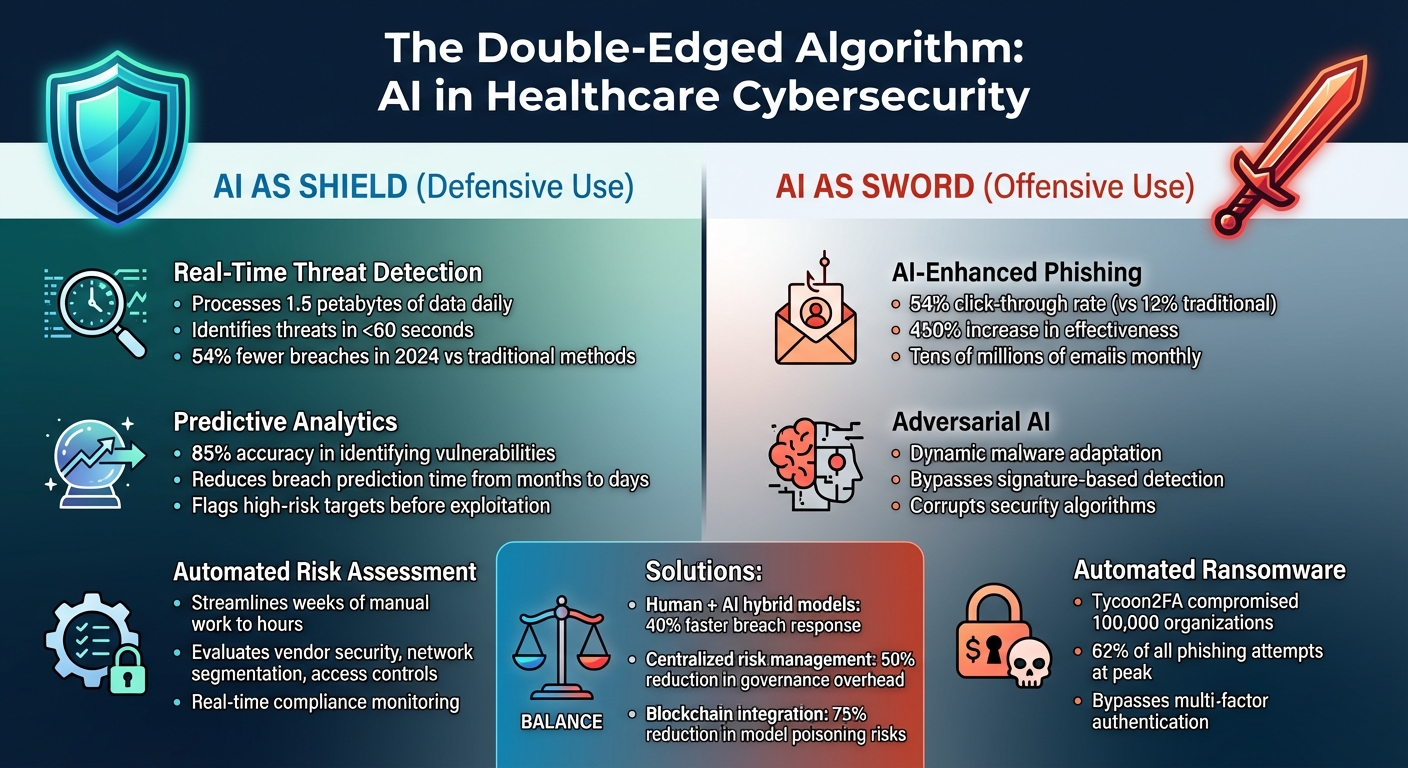
AI in Healthcare Cybersecurity: Defensive vs Offensive Capabilities
Cybersecurity on the Health Care Front Lines Against AI and Ransomware
sbb-itb-535baee
How AI Protects Healthcare Systems from Cyber Threats
AI is transforming healthcare cybersecurity by shifting the focus from reacting to breaches to preventing them altogether. Instead of waiting for threats to materialize, AI-powered systems actively monitor networks, predict potential vulnerabilities, and automate risk assessments. This proactive approach is paying off: healthcare organizations using AI for threat detection reported 54% fewer breaches in 2024 compared to those relying on older methods [1]. Let’s break down how AI achieves this through real-time monitoring, predictive analytics, and automated risk assessments. We’ll also touch on the risks associated with AI misuse to provide a balanced perspective.
Real-Time Threat Detection and Network Monitoring
AI systems excel at spotting unusual activity by learning what "normal" looks like for a network. When something deviates - like an unauthorized login, an unusual file transfer, or abnormal access patterns - AI flags it immediately, often before sensitive data, such as Protected Health Information, is compromised. These systems process an enormous amount of data - 1.5 petabytes daily across healthcare networks - and can identify threats in less than 60 seconds [1].
Unlike traditional methods that rely on predefined attack signatures, AI can detect entirely new attack patterns, including zero-day threats that haven’t been documented yet [1]. This means fewer false alarms and a higher chance of catching real threats. By maintaining constant vigilance, AI sets the stage for even more advanced predictive measures.
Using Predictive Analytics to Prevent Breaches
Predictive analytics takes cybersecurity a step further by anticipating where threats are likely to occur. AI uses a combination of historical breach data, vulnerability databases, and network activity to pinpoint potential weak spots before attackers can exploit them [2]. For example, it might flag an outdated legacy system as a high-risk target, prompting immediate action to secure it.
This capability significantly shortens the time it takes to predict breaches - from months to just days - while achieving an impressive 85% accuracy in identifying vulnerabilities [1]. By addressing these risks proactively, healthcare systems can stay ahead of cybercriminals.
Faster Risk Assessments with Censinet AI™
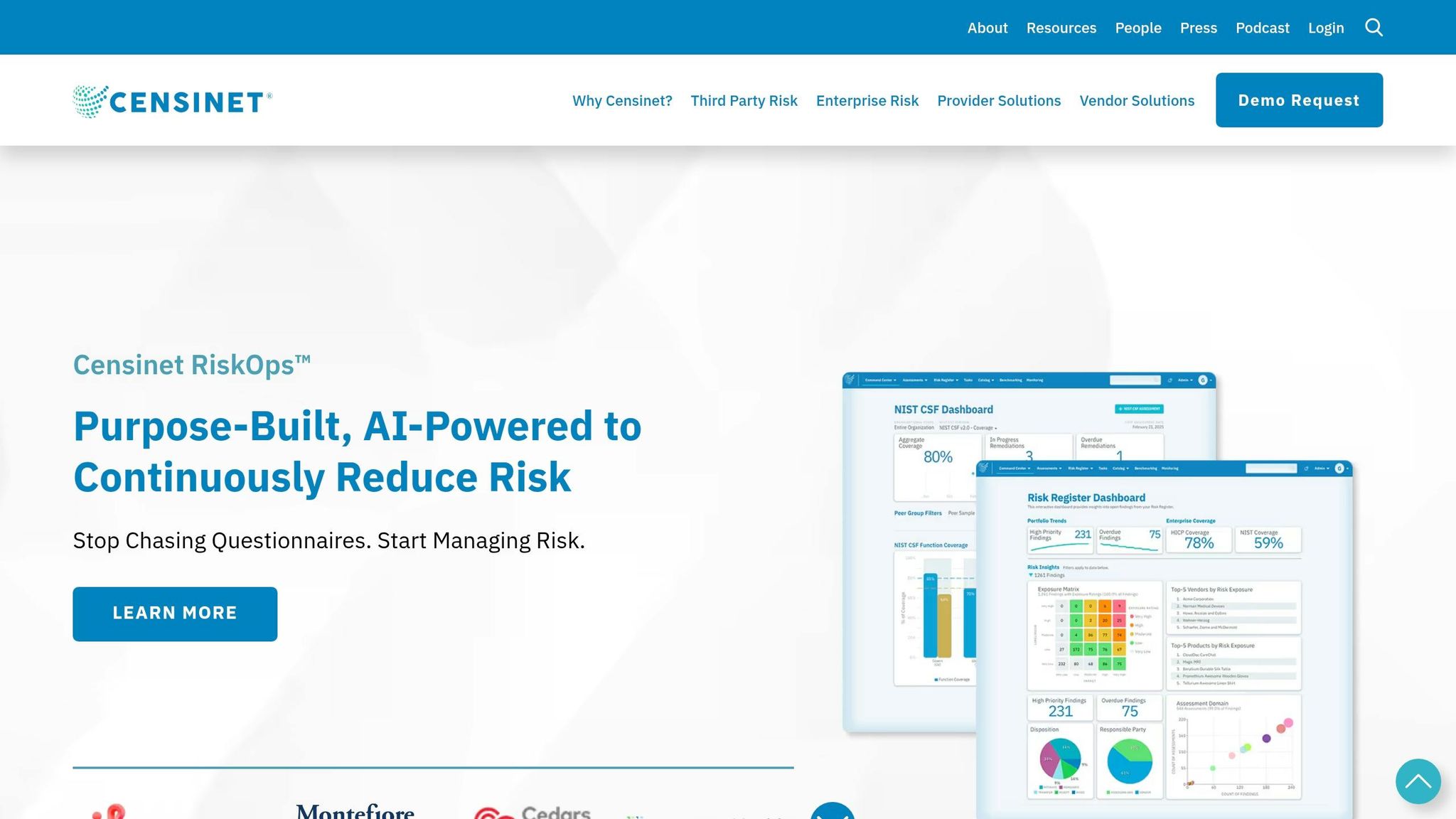
Risk assessments, which used to take weeks of manual effort, are now being streamlined by platforms like Censinet AI™. This tool automates the process by analyzing security evidence, compliance documents, and risk indicators across an organization [1]. It evaluates critical factors like vendor security, network segmentation, access controls, and incident response plans - all without requiring manual input.
How Attackers Use AI to Target Healthcare Organizations
AI isn't just a tool for defending networks - it’s also become a powerful weapon for attackers. By leveraging AI, cybercriminals can bypass defenses, automate their tactics, and scale attacks that once required significant manpower. As Sherrod DeGrippo, Deputy CISO at Microsoft, aptly notes:
"AI is not just being used to do more of the same, it is being used to do it better" [3].
This evolution isn’t just about causing more damage; it’s about executing attacks with greater speed, precision, and scale, often overwhelming traditional security systems.
Modern cybercriminals have adopted a business-like model, subscribing to modular services for various stages of their attacks. This "industrialized" approach means even less experienced attackers can launch highly advanced campaigns. AI-powered platforms now offer tools for bypassing multi-factor authentication (MFA), distributing phishing emails, and harvesting credentials. This has led to a surge in both the frequency and sophistication of attacks on healthcare systems. Let’s break down how attackers are using AI in their strategies.
Adversarial AI and Algorithm Manipulation
Attackers are exploiting AI systems by feeding them malicious inputs or corrupting the algorithms that secure networks. For instance, malware is now being enhanced with AI-driven adaptive coding and debugging. This allows malicious payloads to adjust dynamically to specific environments, avoiding the static signatures that traditional security software relies on to detect threats [3]. By continuously regenerating malware, attackers make it increasingly difficult for signature-based defenses to keep up.
This tactic has also paved the way for AI-enhanced ransomware. Automation accelerates every stage of these attacks, making them more efficient and harder to stop.
AI-Enhanced Ransomware Attacks
AI has supercharged ransomware campaigns, automating everything from target research to phishing and data analysis. Attackers use AI to craft highly convincing phishing emails and process stolen data at lightning speed [3]. The results are alarming: AI-powered phishing campaigns boast a 54% click-through rate - a staggering 450% increase compared to the 12% rate of traditional phishing campaigns [3].
One high-profile example occurred in April 2026, when Microsoft’s Digital Crimes Unit disrupted the Tycoon2FA platform, operated by the threat group Storm-1747. This AI-driven operation, active since 2023, sent tens of millions of phishing emails each month and compromised nearly 100,000 organizations. Tycoon2FA specialized in adversary-in-the-middle attacks, intercepting session tokens in real time to bypass MFA. At its peak, it accounted for 62% of all phishing attempts blocked by Microsoft each month. The operation’s takedown resulted in the seizure of 330 domains [3].
AI’s role doesn’t stop at gaining access. It’s also being used to automate ransom negotiations, enabling attackers to expand their operations with minimal human involvement.
AI-Powered Data Breaches and PHI Theft
AI isn’t just making attacks more efficient - it’s also accelerating data theft, particularly in healthcare. Protected Health Information (PHI) is highly valuable on the black market, making healthcare organizations prime targets. Attackers use AI to quickly locate and extract PHI, automating the exfiltration process. AI also helps them maintain access by creating fake identities and managing covert communications, making it much harder for defenders to detect their presence [3].
As DeGrippo cautions:
"The agent ecosystem will become the most attacked surface in the enterprise" [3].
This highlights the growing sophistication of AI-driven attacks and underscores the urgent need for healthcare organizations to adopt stronger cybersecurity measures. AI may be a double-edged sword, but understanding its offensive capabilities is the first step toward building effective defenses.
How to Reduce AI-Related Cyber Risks with Censinet
Healthcare organizations face a tough challenge: leveraging AI's speed and efficiency while protecting against its misuse. To navigate this, it's crucial to adopt strategies that combine automation with human oversight, streamline risk management, and secure AI systems using advanced tools. Here's how these approaches can help reduce AI-related cyber risks.
Maintaining Human Oversight in AI Automation
AI's ability to process threats quickly is unmatched, but it isn't foolproof. Automated systems can generate false positives, overlook context-specific risks, or make decisions based on incomplete data. For example, during the 2023 Change Healthcare breach, human intervention played a critical role in validating AI-generated alerts. This prevented unnecessary system shutdowns that could have disrupted patient care [4].
A study by Deloitte revealed that 62% of healthcare leaders favor hybrid models combining human and AI efforts. These models not only reduce breach response times by 40%, but also minimize errors [5]. By involving humans in high-stakes decisions, organizations ensure accountability and maintain the contextual awareness that AI lacks. This collaboration between human judgment and AI capabilities naturally supports centralized risk management, which is essential for reducing vulnerabilities.
Centralized AI Risk Management with Censinet RiskOps™
Managing AI risks across various vendors, tools, and departments can create critical blind spots. Censinet RiskOps™ addresses this challenge by bringing AI risks, vendor assessments, and threat data together on a single platform. Its real-time dashboards offer customizable views, including AI model performance metrics, vulnerability heatmaps, and predictive risk trends. This comprehensive visibility eliminates the need for siloed systems [6][7].
The platform also integrates with HIPAA-compliant feeds, making it easier to benchmark AI tools against industry standards. According to users, this reduces governance overhead by 50% [7]. One mid-sized U.S. hospital network used Censinet RiskOps™ to quickly identify and mitigate AI-enhanced phishing risks from a vendor tool. Within hours, the organization prevented potential exposure of protected health information (PHI) and avoided an estimated $2.5 million in breach-related costs [8]. By routing critical findings to the appropriate stakeholders - including AI governance committees - Censinet RiskOps™ ensures that the right teams address the right issues at the right time. Beyond centralizing oversight, incorporating advanced technologies like blockchain can further fortify AI systems.
Using Blockchain to Secure AI Systems
Blockchain technology offers a robust way to protect AI systems from tampering and adversarial attacks. By creating immutable audit trails, blockchain ensures the integrity of AI model training data and decisions, preventing data poisoning [9]. Its decentralized structure also eliminates single points of failure, making it a strong choice for securing AI-driven threat detection.
IBM research highlights that using Hyperledger Fabric in healthcare has reduced model poisoning risks by 75%, thanks to immutable transaction logs [10]. In a 2024 pilot, Mayo Clinic used blockchain to enhance the security of AI anomaly detection. This approach improved transparency and cut verification times down to minutes. Healthcare organizations can begin by piloting blockchain-AI integrations in high-risk areas like PHI encryption. These pilots can be connected to existing systems, such as Censinet, via APIs, and should include regular audits to maintain security. These steps are vital to ensuring AI remains a tool for protection rather than a potential threat.
Governance and Best Practices for AI in Healthcare Cybersecurity
To effectively use AI in healthcare cybersecurity, organizations need clear governance frameworks. These frameworks should define roles, establish policies, and outline procedures for handling incidents. Key components include documented policies, approval workflows for introducing new AI systems, and escalation protocols for managing security events. A governance committee - comprising IT security, clinical leadership, compliance, and legal representatives - should oversee AI deployments. This group would evaluate systems before implementation and monitor their performance over time. Such practices help ensure AI strengthens defenses without introducing new vulnerabilities. Alongside governance, technical safeguards are essential for securing AI systems from potential threats [4][5].
Technical Controls: Securing AI Models and Validating Inputs
Protecting AI systems from manipulation requires robust technical measures. Start by stress-testing AI models using simulated attacks to identify weaknesses. Employ input validation to recognize and block harmful data before it interacts with the AI system, preventing attackers from exploiting vulnerabilities with malicious inputs. Other safeguards include model versioning and integrity checks to confirm that systems remain unaltered. Implement strict access controls to limit who can modify or update AI models, reducing the risk of unauthorized changes. Regularly monitor key performance metrics to detect anomalies, such as performance degradation, which could signal an attack or data poisoning. Maintain detailed audit logs for forensic investigations when incidents occur [4][5].
Developing Policies and Training Staff
Clear policies are the backbone of AI governance. These should define acceptable uses, explicitly prohibit certain applications, and detail procedures for reporting incidents. Training is equally critical: offer basic AI awareness to all staff, provide in-depth technical training for IT and security teams, and deliver advanced sessions for developers. Refresh training annually or whenever policies are updated. Create open communication channels where employees can ask questions about AI practices or report concerns without fear of retaliation. Together, well-crafted policies and comprehensive training ensure AI systems remain secure and effective over time [5].
Ongoing Monitoring and Benchmarking with Censinet Connect™
Continuous monitoring is key to maintaining AI system integrity. Track performance metrics like detection accuracy, false positives, response times, and signs of performance drift. Tools like Censinet Connect™ allow organizations to benchmark their systems against industry standards and peer institutions, revealing potential gaps. Automated alerts should flag metrics that fall outside acceptable ranges, prompting immediate action. Conduct monthly performance reviews with security and clinical leaders, and perform quarterly deep-dives to evaluate whether systems are achieving their goals and addressing emerging threats. This ongoing evaluation ensures AI remains a powerful defense tool while minimizing the risk of it being exploited [4][5].
Conclusion
AI's role in healthcare cybersecurity is a balancing act. On one side, it bolsters defenses with tools like real-time threat detection, predictive analytics, and faster risk assessments. On the flip side, its capabilities can be exploited by cybercriminals to launch targeted ransomware attacks, steal sensitive health data, or corrupt AI systems with misleading inputs.
To maximize AI's benefits while mitigating its risks, healthcare organizations need strong governance paired with ongoing oversight. A Secure-by-Design approach is critical, emphasizing integrated security controls from the start. This includes requiring vendors to prove their systems' security, conducting AI-specific penetration tests throughout the lifecycle, and equipping clinicians to recognize model drift or unusual outputs that automated systems might overlook.
Platforms like Censinet RiskOps™ play a key role in managing these challenges, offering centralized tools to handle AI-related risks effectively. By ensuring that critical risks are flagged for the right decision-makers, these platforms help maintain patient safety. Additionally, Censinet AI™ enhances risk assessments while preserving the human judgment necessary for nuanced decisions.
"AI may be healthcare's most powerful double-edged sword, but with robust security embedded at its core, we can unlock its full potential without ever putting patient safety at risk."
- Ed Gaudet, CEO and Founder of Censinet
This insight underscores the importance of proactive risk management and a steadfast focus on cybersecurity. By combining technical safeguards, clear policies, ongoing training, and vigilant monitoring, healthcare organizations can ensure AI serves as a shield, not a vulnerability. The future of healthcare cybersecurity hinges on finding and maintaining this equilibrium.
FAQs
How can we tell if an AI security alert is real or a false positive?
To figure out whether an AI security alert is legitimate or just a false positive, you’ll need a mix of advanced detection tools and human expertise. AI systems excel at spotting patterns in activity and analyzing contextual data to flag potential threats. However, attackers can manipulate AI through methods like data poisoning, which makes it crucial to double-check alerts.
This is where manual reviews, strong governance frameworks, and ongoing monitoring come into play. These steps help validate alerts, ensure accurate responses, and reduce the chances of false alarms slipping through. Balancing automation with human oversight is key to staying ahead of potential threats.
What are the first signs of an AI-driven phishing or ransomware attack?
Early indicators of an AI-powered phishing or ransomware attack can include extremely personalized phishing emails, convincing deepfake audio or video, and counterfeit websites that leverage publicly available data. These advanced methods make such attacks more challenging to spot, emphasizing the need for greater awareness and proactive measures to counter these threats effectively.
How do we secure our AI models from tampering or data poisoning?
Protecting AI models from tampering or data poisoning is critical for healthcare organizations. To ensure safety and reliability, it's essential to implement thorough validation and monitoring across the entire AI lifecycle.
Key steps include:
- Layered security controls: Use encryption to secure data and implement anomaly detection systems to identify irregularities in data streams.
- Governance frameworks: Establish clear protocols to maintain data quality and protect the integrity of AI models.
- Robust validation processes: Design comprehensive pipelines to rigorously test and validate AI systems.
- Risk assessments for third-party systems: Evaluate external systems for vulnerabilities that could pose risks.
- Cross-functional oversight teams: Bring together experts from different areas to monitor and address potential threats.
By taking these precautions, healthcare organizations can better safeguard AI systems and uphold patient safety.
