
In healthcare, incident response plans (IRPs) are critical because they directly impact patient care, data security, and compliance. The key to making these plans effective lies in measurable metrics. Metrics like Mean Time to Detect (MTTD) and Mean Time to Contain (MTTC) help reduce risks, such as data breaches and disruptions to clinical workflows. For healthcare, where time-sensitive decisions can save lives, metrics also ensure regulatory compliance, such as HIPAA breach notifications.
Here’s what matters most in evaluating IRPs:
- Time-Based Metrics: MTTD, MTTC, and Recovery Time Objective (RTO) track how quickly threats are detected, contained, and resolved.
- Clinical Impact Metrics: Measure patient-care disruptions, canceled procedures, and system downtimes.
- Compliance Metrics: Ensure timely breach notifications and accurate incident documentation.
- Financial Metrics: Quantify costs of downtime, lost revenue, and total recovery expenses.
Centralized platforms, automation, and benchmarking against industry standards can streamline tracking and improve response efficiency. These metrics aren't just technical - they safeguard patient care and ensure operational continuity.
Frameworks for Measuring Incident Response Performance
NIST and MITRE Frameworks for Incident Response

When it comes to structuring and evaluating incident response, two prominent frameworks stand out: NIST SP 800-61 and MITRE's cyber resiliency approach. The NIST SP 800-61, also called the Computer Security Incident Handling Guide, breaks the incident response process into four key phases: preparation, detection and analysis, containment and eradication, and post-incident activity. These phases serve as checkpoints for assessing performance throughout the lifecycle of an incident.
MITRE's framework adds another layer by emphasizing cyber resiliency. This concept revolves around an organization's ability to predict, endure, recover from, and adapt to cyber threats. Together, these frameworks provide healthcare organizations with a roadmap to assign metrics at every stage of incident handling. However, healthcare teams must adapt these frameworks to their unique needs to safeguard patient care and maintain operational stability.
Healthcare-Specific Incident Response Guidance
While general cybersecurity frameworks are an excellent starting point, healthcare organizations face unique challenges that require customization. Factors like multi-site operations, interconnected medical devices, partnerships with third-party vendors, and the need to protect patient health information (PHI) demand a tailored approach. For example, isolating a compromised system in a hospital setting isn't as simple as pulling the plug; it requires collaboration with clinical leadership to ensure patient care remains uninterrupted.
"Preparation decides how quickly you contain threats and restore services." - Kevin Henry, AccountableHQ [1]
Core Domains for Measuring IRP Performance
To effectively implement these frameworks, healthcare organizations must define and measure performance across specific domains that address their unique risks and operations. Below are six key domains, each tied to measurable metrics:
| Core Domain | Priority Metrics for Healthcare |
|---|---|
| Detection | Mean Time to Detect (MTTD), triage accuracy, indicator validation speed |
| Containment | Mean Time to Respond (MTTR), isolation rate, evidence preservation integrity |
| Recovery | Service restoration time, EHR/HL7 interface throughput, data validation accuracy |
| Clinical Impact | Patient-care impact score, downtime duration, revenue cycle disruption |
| Compliance | HIPAA risk assessment duration, breach notification timing, BAA compliance |
| Improvement | Corrective action completion rate, tabletop exercise frequency, dwell time reduction |
Healthcare incidents are typically categorized into four severity levels: Critical (e.g., patient safety risks or EHR outages), High (e.g., active attackers or lateral movement), Medium (e.g., contained malware), and Low (e.g., policy violations) [1]. Aligning metrics with these severity levels ensures faster responses and efficient resource allocation.
A strong Incident Response Plan (IRP) also includes a focus on continuous improvement. After-action reviews (AARs) are critical for tracking corrective actions and reducing dwell times. Organizations that go beyond recovery by learning from incidents often conduct biannual tabletop exercises and regularly update their IRPs to reflect changes in clinical workflows. This proactive approach strengthens their ability to handle future threats effectively.
sbb-itb-535baee
KPIs for Incident Response: Metrics and Measurements - Course Overview
Time-Based and Performance Metrics for Incident Response
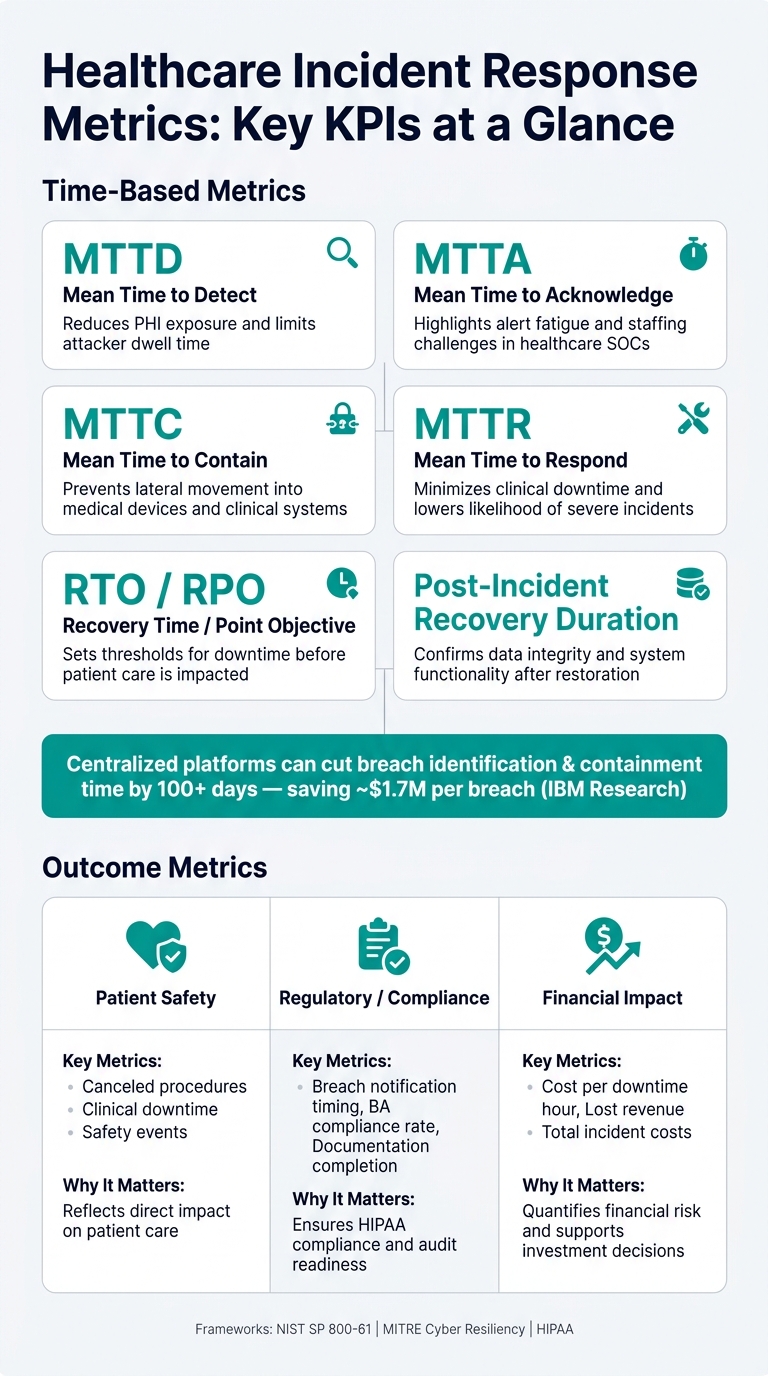
Healthcare Incident Response Metrics: Key KPIs at a Glance
In cybersecurity, time is everything - especially in healthcare. Every minute an incident goes unnoticed increases the risk of exposing sensitive patient data, allows attackers to move deeper into systems, and could even disrupt patient care. For healthcare providers, these time-based metrics aren’t just technical - they’re directly tied to patient safety and the continuity of services.
Detection and Triage Metrics
Mean Time to Detect (MTTD) measures the time it takes to identify an incident from its onset. In healthcare, delays in detection can lead to prolonged exposure of Protected Health Information (PHI) and extended system outages, both of which can have serious consequences [3].
Another key metric is Mean Time to Acknowledge (MTTA), which tracks how long it takes for a responder to act on an alert after it’s triggered. In healthcare environments, a high MTTA often signals problems like alert fatigue or staffing shortages - common issues in security operations centers (SOCs). Pairing MTTD with Detection Coverage - the percentage of systems actively monitored - provides a clearer view of potential blind spots, especially in areas like medical devices or third-party integrations.
"It used to take us days to find out about issues with a new release. Now... we can pinpoint and fix a problem on the same day so that customers can place orders seamlessly." - Willie James, Director of Resiliency Services, Papa Johns [3]
The takeaway for healthcare? Automated, real-time monitoring is essential to reduce MTTD and minimize damage. Once an incident is detected, quick response and containment are critical to limit further risks.
Response and Containment Metrics
Mean Time to Respond (MTTR) measures how quickly a Cybersecurity Incident Response Team (CIRT) transitions from awareness to action. A faster MTTR means less downtime for clinical systems and a reduced chance of severe incidents, such as Electronic Health Record (EHR) outages or risks to patient safety.
Similarly, Mean Time to Contain (MTTC) focuses on how long it takes to stop a threat from spreading. As John Burke, CTO and Research Analyst at Nemertes Research, explains:
"The essence of incident response is stopping further damage and gaining control of the situation." [2]
In healthcare, containment isn’t always straightforward. For example, isolating a compromised system without clinical approval could disrupt critical functions like pharmacy orders, lab results, or imaging workflows. Pre-approved isolation protocols, developed in collaboration with clinical leadership, are one of the best ways to improve MTTC without jeopardizing patient care. Containment Success Rate, which tracks the percentage of incidents contained without operational disruptions, helps measure the effectiveness of these pre-approved actions. After containment, restoring full functionality across clinical systems becomes the top priority.
Recovery and Continuity Metrics
Recovery metrics shift the focus from stopping threats to restoring operations. Questions like "Can clinicians resume their work?" become central. Metrics such as Recovery Time Objective (RTO) and Recovery Point Objective (RPO) set limits on acceptable downtime and data loss. These thresholds determine how long a hospital can operate using manual, paper-based procedures before patient care is compromised.
Post-Incident Recovery Duration measures the actual time required to restore critical systems like EHRs, HL7 interfaces, and clinical device connectivity. This metric ensures that essential data flows - like pharmacy orders or lab results - are functioning properly. Recovery isn’t complete if systems are operational but still processing corrupted data. Using the median recovery duration instead of the average is often more insightful, as it avoids skewing results caused by outliers in complex recovery scenarios.
| Metric | Healthcare-Specific Operational Impact |
|---|---|
| MTTD | Reduces PHI exposure and limits attacker dwell time |
| MTTA | Highlights alert fatigue and staffing challenges in healthcare SOCs |
| MTTC | Prevents lateral movement into medical devices and clinical systems |
| MTTR | Minimizes clinical downtime and lowers the likelihood of severe incidents |
| RTO / RPO | Sets thresholds for downtime before patient care is impacted |
| Post-Incident Recovery Duration | Confirms data integrity and system functionality after restoration |
Healthcare-Specific Outcome Metrics
Time-based metrics tell us how fast responses are, but outcome metrics dive deeper, showing how incidents impact patients, compliance, and finances. This section shifts focus to the aftermath of incidents, particularly their effects on patient care, regulatory obligations, and financial health.
Patient Safety and Clinical Impact Metrics
While response speed is crucial, outcome metrics reveal the real-world consequences of incidents. For example, cyberattacks in hospitals don't just disrupt data - they can jeopardize patient care. Metrics like clinical downtime duration, the number of canceled procedures, and patient safety events highlight the tangible harm caused by these events [1]. In healthcare, any incident labeled "Critical" often involves either a direct patient safety risk or a complete EHR system outage [1]. Such incidents activate a coordinated response involving both clinical and IT leadership. Additionally, monitoring medical device connectivity and vendor reauthorization times provides further insight into how clinical operations are affected [1].
Another key metric is downtime reconciliation accuracy. This measures how effectively and quickly staff can reconcile documentation and transactions recorded manually during system outages [1]. For instance, if a medication is logged manually during downtime but isn't reconciled correctly once systems are back online, the risks to patient safety could linger even after the incident has been resolved.
These patient-focused metrics naturally tie into regulatory concerns, where compliance is another critical measure.
Regulatory and Compliance Metrics
HIPAA regulations demand not only preventing breaches but also responding effectively when they occur. One essential metric here is notification timeliness - how quickly affected individuals, the HHS Office for Civil Rights, and business associates are notified after a breach is discovered [1]. Another important measure is the breach versus incident classification rate, which evaluates how accurately security incidents are classified as reportable breaches using a HIPAA risk assessment [1]. Misclassifying a breach can lead to serious compliance issues. Similarly, tracking the Business Associate (BA) compliance rate ensures that third-party vendors meet their notification obligations within the agreed-upon timeframes [1].
"A strong Incident Response Plan for large health systems unites clinical leadership, the Cybersecurity Incident Response Team, and vendors around clear playbooks, HIPAA-aligned decisions, and proven recovery steps." - Kevin Henry, Accountable HQ [1]
Complete and accurate documentation is another critical metric. High rates of completion for incident forms, timelines, and chain-of-custody records are vital for audit readiness and avoiding liabilities [1].
Financial and Operational Impact Metrics
Incidents in healthcare aren't just clinical or regulatory challenges - they also carry significant financial consequences. Measuring the cost per hour of downtime, segmented by service line (e.g., EHR, PACS, lab, or pharmacy), provides a clear view of financial risks [4]. These costs, combined with lost revenue and overall incident expenses, help justify investments in stronger incident response measures.
Michael Cole, Chief Information Security Officer at Lake Ridge Health, highlighted the extended timeline of incident recovery:
"So many hospital response plans are based on 24 to 72 hours, maybe a week. These take weeks. The ancillary areas you need to focus on from financial and legal can well go into the six to eight-week window." [5]
This extended recovery period underscores the need to calculate total incident costs comprehensively. Forensics, legal fees, regulatory fines, overtime pay, and reputational damage all contribute to the financial toll [4]. Tools like Censinet RiskOps™ simplify compliance tracking and risk assessments across vendors and systems, helping organizations better understand their financial and regulatory exposure. Tracking Annualized Loss Expectancy (ALE), which combines Single Loss Expectancy with the Annual Rate of Occurrence, further translates these financial risks into a framework that resonates with executives and board members [4].
| Metric Category | Key Metrics | Why It Matters |
|---|---|---|
| Patient Safety | Canceled procedures, clinical downtime, safety events [1] | Reflects the direct impact on patient care during incidents |
| Regulatory | Breach notification timing, BA compliance rate, documentation completion [1] | Ensures HIPAA compliance and audit readiness |
| Financial | Cost per downtime hour, lost revenue, total incident costs [4] | Quantifies financial impact and supports risk management decisions |
Putting Metrics to Work with Technology and Data
Knowing which metrics matter is just the start. The real challenge lies in creating the systems to collect, track, and use that data effectively - especially in healthcare, where incidents often span electronic health records (EHRs), medical devices, protected health information (PHI) systems, and multiple third-party vendors at the same time.
Using Centralized Platforms to Track Key Metrics
Fragmented reporting can make it nearly impossible to measure incident response effectively. When teams like security, compliance, clinical operations, and vendor management each maintain their own records, the same incident might be documented differently in each department. This inconsistency complicates trend analysis and makes audits a nightmare.
A centralized platform solves this by offering a single source of truth for the entire incident lifecycle. Tools like Censinet RiskOps™ bring together all incident data - from the initial alert and triage timestamps to containment actions, recovery milestones, and post-incident reviews - across both internal systems and third-party workflows. This is critical because vendor-related metrics, such as notification time, remediation progress, and SLA adherence, are just as important as internal response times. This is especially true given that third-party incidents make up a large percentage of reportable HIPAA breaches. Research shows that many healthcare vendors have experienced data breaches that expose sensitive patient information.
Research from IBM shows that centralized platforms can cut breach identification and containment times by over 100 days on average, saving approximately $1.7 million per breach. Centralizing data is also what enables automation, which further improves incident response. With centralized systems in place, organizations can move on to benchmarking and collaboration to refine their processes even more.
Benchmarking and Collaboration to Strengthen IRP Performance
Metrics only make sense when you have context. For example, a 12-hour containment time might be excellent for a ransomware attack targeting clinical systems, but it could be too slow for a phishing incident. Without benchmarks, it’s hard to tell.
Comparing your metrics to sector peers - whether through platforms offering anonymized data or through collaborative groups like Health-ISAC - helps security leaders evaluate their performance more accurately. These benchmarks provide the context needed to improve patient safety, meet regulatory requirements, and manage financial risks. Health-ISAC, for instance, highlights how sharing incident details and metrics across organizations strengthens collective defenses and helps members spot weaknesses in their own systems faster. Tools like Censinet RiskOps™ make this process easier with built-in cybersecurity benchmarking, allowing healthcare organizations to measure their performance against industry standards instead of working in isolation.
Collaboration also improves how metrics are defined. When IT, clinical operations, compliance, procurement, and vendors agree on what terms like "contained" or "recovered" mean for specific systems, the data becomes reliable enough to drive key decisions. This could include updating playbooks, revising vendor response requirements, or even justifying staffing needs to leadership.
Emerging Trends in Metric-Driven Incident Response
Beyond centralization and benchmarking, automation and AI are changing how healthcare organizations measure and manage incident response.
On the automation front, SOAR platforms and playbook-driven workflows are taking over repetitive tasks like alert enrichment, ticket routing, and evidence collection. These tools also generate clean, time-stamped data, which is essential for accurate metrics. Studies show that organizations using SOAR platforms often see mean time to resolve (MTTR) drop by 50% or more. This happens because automation enforces consistency and eliminates delays caused by manual handoffs, directly supporting faster response times and protecting critical operations.
AI, on the other hand, brings both opportunities and challenges. AI-assisted detection and triage can identify threats more quickly and reduce false positives, but it also requires its own set of metrics to ensure accountability. For instance, organizations need to track AI model accuracy, false-positive and false-negative rates, and how often humans override automated recommendations. Platforms like Censinet RiskOps™ are designed to address this need, serving as centralized hubs for managing AI-related policies, risks, and tasks. They even route key findings to AI governance committees, ensuring that automation enhances operations without sidelining human judgment in high-stakes situations.
Conclusion: Key Takeaways for Metric-Driven IRP Evaluation
In healthcare, evaluating incident response isn't just about IT - it’s a critical factor in patient safety. Metrics like Mean Time to Detect (MTTD), Mean Time to Contain (MTTC), and Mean Time to Recover (MTTR) provide a foundation, but they don’t fully address the high stakes tied to patient safety and the protection of PHI.
Healthcare’s unique challenge lies in the close connection between clinical operations and incident response. Systems like EHRs, imaging tools, lab platforms, and HL7 interfaces must be thoroughly validated to ensure uninterrupted clinical care. Recovery isn’t complete until these systems are back in full working order. These clinical demands also set the stage for stringent regulatory evaluations.
"An effective Incident Response Plan for large health systems aligns clinical safety, continuity of care, and HIPAA Compliance while coordinating across EHR platforms, medical devices, and cloud partners." - Kevin Henry, AccountableHQ [1]
Regulatory metrics add another layer of complexity. Determining whether an incident qualifies as a reportable HIPAA breach requires precise tracking of PHI type, access details, and data management. These distinctions directly influence notification timelines and legal risks. Together, clinical and regulatory metrics ensure both patient safety and compliance are prioritized throughout every phase of incident response.
Technology plays a key role in making this process scalable and accurate. Centralized platforms provide healthcare organizations with the visibility needed to calculate metrics, benchmark against industry standards, and respond efficiently. Combining human oversight with automation separates organizations that simply monitor incidents from those actively improving their response strategies.
FAQs
What’s the difference between MTTD, MTTA, MTTC, and MTTR?
These metrics help evaluate crucial stages in the incident response process:
- MTTD (Mean Time to Detect): Tracks the average time it takes to identify an incident.
- MTTA (Mean Time to Acknowledge): Measures the time between an alert and when a responder begins taking action.
- MTTC (Mean Time to Contain): Focuses on how long it takes to contain the identified threat.
- MTTR (Mean Time to Resolve): Represents the total time from detecting the issue to fully resolving it.
Together, these metrics provide insight into response efficiency and preparedness for security incidents.
Which incident response metrics best reflect patient safety impact?
Healthcare organizations need to prioritize metrics that assess the availability and recovery of essential care systems. Important indicators include the uptime of clinical applications and how quickly systems can recover following disruptions. Additionally, examining the link between cybersecurity incidents and patient safety events offers critical insights. Tools like Censinet RiskOps™ simplify monitoring efforts, reducing response times and safeguarding clinical operations.
How can we benchmark incident response metrics without exposing PHI?
Healthcare organizations aiming to benchmark incident response metrics while safeguarding PHI can leverage centralized, cloud-based platforms such as Censinet RiskOps. These platforms allow teams to measure performance against frameworks like NIST without risking exposure of sensitive patient information. By automating data collection and providing real-time dashboards, they make it possible to track key metrics like Mean Time to Contain (MTTC) and recovery times. This approach turns breach data into actionable, de-identified insights, helping to strengthen both security and privacy efforts.
