
If a hospital uses AI without clear rules, it puts patients, data, and money at risk. I’d boil this article down to one point: AI in healthcare needs named owners, written controls, local testing, vendor checks, and a way to shut tools off fast when they go wrong.
Here’s the short version:
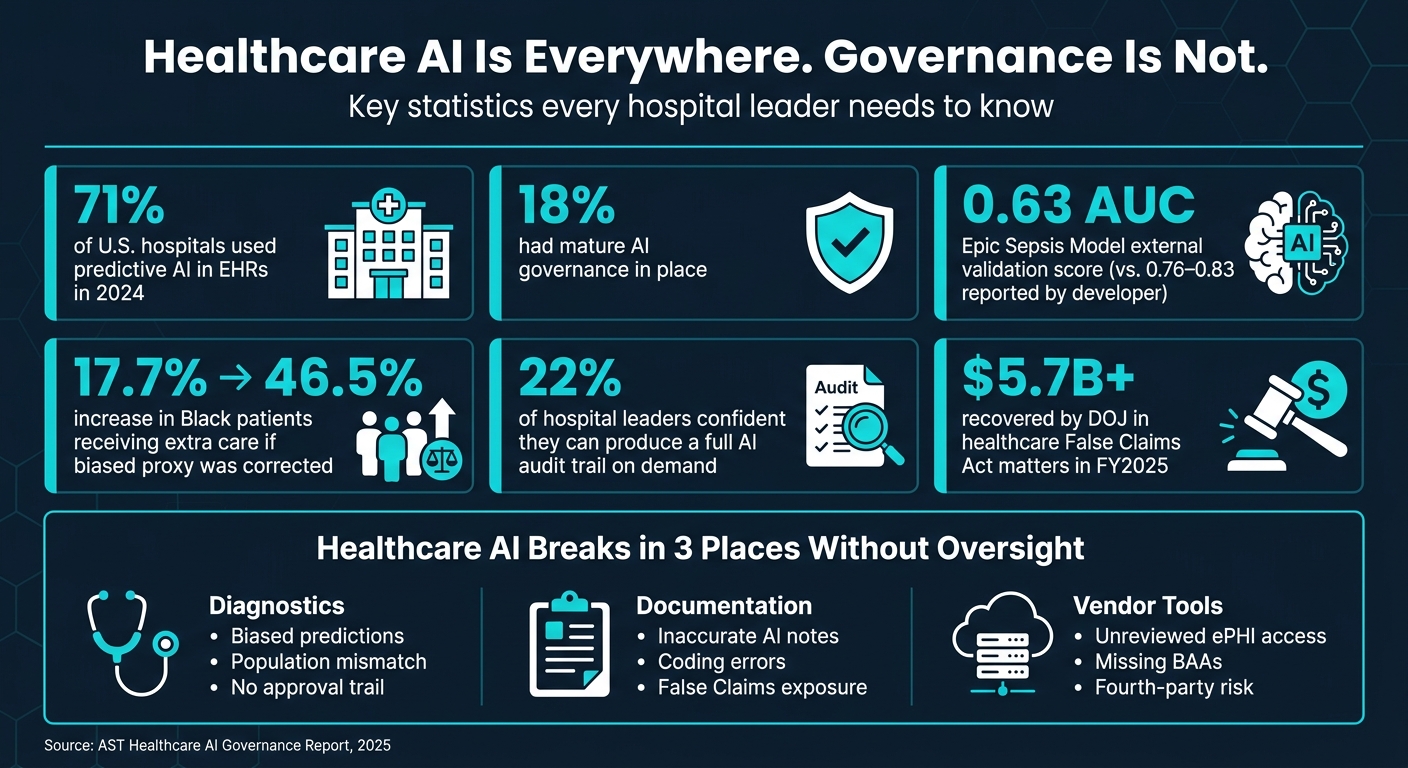
- AI use is already common. In 2024, 71% of U.S. hospitals used predictive AI in EHRs.
- Governance is lagging. Only 18% had mature governance.
- The risk is not just clinical. It also affects privacy, cyber risk, billing, and legal exposure.
- Models can slip after launch. One 2025 study found a respiratory AI model’s AUROC dropped by 0.12 after a lab-test change, and the system did not flag it.
- Bias can change care. In one cited study, fixing a biased proxy would have increased the share of Black patients getting extra care from 17.7% to 46.5%.
- Audit gaps are a major problem. Only 22% of hospital leaders said they were highly confident they could produce a full AI audit trail on demand.
- Vendor AI adds hidden risk. EHR and health IT vendors may turn on AI features or use subprocessors that touch ePHI.
- Money is on the line too. The DOJ recovered more than $5.7 billion in healthcare False Claims Act matters in fiscal year 2025.
If I were summarizing the article for a busy reader, I’d say healthcare AI usually breaks in three places when oversight is weak:
- Diagnostics: bad predictions, bias, and no clear answer for who approved what
- Documentation: note errors, coding issues, and False Claims risk
- Vendor tools: privacy, cyber, and third-party data exposure
And the article’s fix is plain:
- Keep one AI inventory
- Set up a cross-functional governance group
- Tier tools by risk
- Validate models on your own patient population
- Require BAAs for vendors handling ePHI
- Keep versioned logs for inputs, outputs, model changes, and human overrides
- Build an AI incident playbook with rollback and kill-switch steps
In other words: if you can’t trace what the model did, who approved it, what version ran, and where patient data went, you don’t have control. You have exposure.
Below, the article explains where those failures show up and what a hospital should put in place before the next AI error turns into patient harm, a privacy event, or a billing case.
Healthcare AI Governance Gap: Key Stats & Risks at a Glance
Healthcare AI Governance - Risks, Compliance, and Frameworks Explained
sbb-itb-535baee
Where healthcare AI fails without governance
Without governance, healthcare AI tends to break in three plain, predictable ways: misdiagnosis, documentation errors, and hidden vendor risk.
Diagnostic AI: misdiagnosis, bias, and unclear accountability
A model trained on one patient population can fall apart when used on another. The Epic Sepsis Model shows how that can happen. An external validation study found that it predicted sepsis with an AUC of 0.63, well below the 0.76–0.83 range reported by the developer.[3] That kind of gap isn’t minor. It can shift treatment decisions.
Bias makes the problem worse. A widely cited study found that an algorithm using healthcare costs as a proxy for health needs systematically underestimated the illness of Black patients. If that proxy had been corrected, the share of Black patients receiving extra care would have risen from 17.7% to 46.5%.[3] If an organization doesn’t check performance across patient groups, inequity can keep going in the background.
And when there’s no version control, no validation record, and no clear approval path, it becomes hard to answer a basic question: Why did the model make that call? If no one can trace a bad prediction, trust drops and liability goes up.
Clinical documentation AI: inaccurate notes, coding errors, and liability
Clinical documentation AI creates risk when clinicians approve notes without enough time to review them. Human review helps only when people can actually read, edit, and question the output.
Bad notes don’t just create patient safety issues. They can also trigger coding problems and False Claims exposure. Affiliates of Kaiser Permanente agreed to pay $556 million to resolve allegations involving unsupported diagnosis coding tied to Medicare Advantage reimbursement.[1] When coding lacks traceability and review, automation can turn into a legal and financial mess.
Vendor-supplied AI: third-party AI risk, privacy, and fourth-party exposure
EHR vendors and health IT platforms may quietly switch on AI features or rely on subprocessors that were never reviewed when the first contracts were signed. In plain terms, ePHI may be moving to third parties your organization never evaluated.[4]
The risk grows when staff use unauthorized general-purpose AI assistants without a Business Associate Agreement (BAA). That can lead to unauthorized disclosures that neither IT nor compliance can see.[4]
These are the exact kinds of failures governance controls are built to stop.
What governed healthcare AI looks like in practice
Those failures show why governance has to work in day-to-day operations, not live as a nice idea on paper. The fix starts with a clear structure.
Executive accountability and a cross-functional AI governance committee
Governance needs two direct ownership paths.
A clinical line - usually led by the Chief Medical Officer or a Medical Director - owns patient safety, clinical validation, and use-case approval. A technical line - usually led by the CIO or Chief Digital Officer - owns system performance, security, and regulatory compliance. When clinical, technical, legal, compliance, and procurement teams share responsibility, blind spots are less likely to slip through.
One of the committee's first jobs is risk tiering. Every AI use case should be grouped by its potential for harm. A scheduling tool that suggests appointment slots is not in the same category as a diagnostic model that flags sepsis or suggests a treatment path. High-risk tools need stricter approval workflows, mandatory human review, and tighter monitoring. Low-risk tools can move through a lighter workflow. Without that split, teams tend to do one of two things: govern everything too heavily or give too little attention to the tools that can do the most damage.
Framework alignment: HIPAA, FDA, NIST AI RMF, and HITRUST
Four frameworks cover most of what U.S. healthcare organizations need.[4] The smarter move is to use them as one control map, not four separate checklists.
| Governance Component | HIPAA Anchor | NIST AI RMF Function |
|---|---|---|
| AI asset inventory | Risk Analysis | Map |
| BAA confirmation for AI vendors | Business Associate Contracts | Govern |
| Clinical AI risk tiering | Risk Management | Map / Measure |
| Algorithm performance monitoring | Audit Controls | Measure / Manage |
| AI incident response | Security Incident Procedures | Manage |
| Workforce AI use policy | Workforce Training | Govern |
(Source: [4])
HIPAA requires any AI system that touches ePHI to be part of a formal, documented risk analysis. It also requires every vendor processing that data to have a signed Business Associate Agreement. That applies directly to diagnostic models, documentation tools, and vendor systems - the same places where governance failures already lead to harm.
FDA oversight comes into play when an AI tool moves into medical device territory. That includes diagnostic imaging algorithms, sepsis prediction models, and tools where a clinician cannot independently verify the basis for a recommendation. As of 2024, the FDA has authorized more than 950 AI-enabled medical devices.[4] Its 2026 revision of Clinical Decision Support Software Guidance also spells out oversight for tools where clinicians cannot independently review the basis for recommendations.[1] For adaptive algorithms, the Predetermined Change Control Plan (PCCP) framework lets manufacturers spell out ahead of time which model updates are allowed without new clearance.[4]
NIST AI RMF gives teams a working process: Govern, Map, Measure, Manage. It isn't a one-time box-checking task. It's a cycle. HITRUST then gives compliance teams a structured way to choose controls and test whether those controls are working as intended.
Continuous validation, monitoring, and model documentation
Approval is not the finish line. A model can look solid at launch and then slip over time as patient data shifts away from the data used to train it. That's model drift. And it's one of the most common ways AI causes harm without drawing much attention.
If a model cannot be traced back to a versioned dataset, model, and approver, governance is incomplete.
Before deployment, organizations should run shadow deployments. That means the AI runs alongside current workflows, and teams compare its outputs with actual clinician decisions without using its recommendations in care. It's a simple idea, but it helps expose performance gaps before patients feel the impact. After deployment, governance teams need preset thresholds. If accuracy drops below a set level, the model should be recalibrated or retired. Every AI use case also needs a documented rollback plan - a clear process for pulling the tool if its behavior shifts in ways nobody expected.[2]
Documentation has to follow each model through its full lifecycle. That includes records and tamper-evident logs for training data demographics, data lineage, known limitations, validation results, version history, and any human overrides. Those records should be complete, versioned, and searchable from day one. They become the backbone for access controls, vendor oversight, and incident response.
Governance controls that reduce AI-driven harm
AI risk assessments, access controls, and audit trails
Frameworks only help when they turn into day-to-day controls.
Start with one centralized AI inventory that covers every clinical, operational, administrative, embedded, and shadow tool. Review it every year. A 2025 proposed HIPAA update would require a documented technology asset inventory and a written risk analysis reviewed at least once every 12 months.[4]
Any tool that can affect diagnosis, treatment, or reimbursement should be treated as high risk. That means local validation on your patient population, human review, and continuous monitoring. If a model looks fine in a vendor demo but falls apart in your setting, that’s your problem to deal with.
Access controls matter just as much. Use role-based access control (RBAC) and mandatory multi-factor authentication (MFA) for any system that touches ePHI. Then back that up with immutable logs that record inputs, outputs, model version, prompts, and human overrides. Why does that matter? Because when something goes wrong, you need more than a rough timeline.
Only 22% of hospitals are highly confident they could produce a complete AI audit trail within 30 days for regulators.[3] That gap is a liability waiting to surface.
Third-party oversight, contracts, and ongoing vendor review
AI risk doesn’t stop at your firewall.
Before any vendor touches ePHI, require a BAA, model documentation, disclosed update rules, and a right-to-audit clause.[4][3][6] You also need to track fourth-party risk and dependencies. If your vendor depends on another provider behind the scenes, that chain still affects your risk.
And when vendor behavior changes, there should be no scramble over who has authority to act. Your response plan should already name who can disable the tool and when that step kicks in.
AI-specific incident response playbooks
When AI fails, the fix can’t stop at isolating a system. Sometimes you need to roll the model back too.
Standard incident response playbooks usually don’t cover AI drift, unsafe outputs, or vendor model changes. An AI-specific playbook should cover model drift, unsafe model output, AI-related privacy breaches, and compromised third-party AI services. For each case, define a clear containment step, including a documented kill switch or rollback procedure, a downtime decision for taking the tool offline, notification triggers, and a root cause analysis process that traces the failure back to a specific model version, dataset, and approver.[2]
"If you cannot trace a prediction back to a versioned model, dataset, and approver, you do not have governance - you have a memo." - Nadeem Khadim, Healthcare Compliance Lead, AST [2]
After each incident, update thresholds, contracts, and rollback steps based on the root cause.
Conclusion: Healthcare AI will be governed or it will be dangerous
The pattern is clear. AI is already touching patient data and claims across U.S. health systems [5][1]. The question is no longer whether your organization uses AI. It’s whether someone is accountable for what that AI does. That applies just as much to diagnostics and documentation as it does to vendor-supplied tools.
Only 18% of healthcare professionals even know their organization has a formal AI policy [7]. That gap between use and oversight is where patient harm, privacy exposure, and compliance failure can take root quietly.
That’s why the controls above are now baseline requirements, not “someday” goals. The 2026 HIPAA Security Rule overhaul brings AI systems that handle ePHI directly into scope, which makes the requirement explicit [4]. Federal and state enforcement is already active, with agencies going after automated processes that lack clinical support or traceability [1].
The baseline is straightforward: an inventory, a cross-functional committee, validated models, Business Associate Agreements, and a working incident response playbook. Organizations that put governance in place now will be in a much better position to prove accountability when AI fails - and incidents will happen. Governed AI is manageable. Ungoverned AI is dangerous.
FAQs
What counts as high-risk healthcare AI?
High-risk healthcare AI covers any use that can materially affect patient care, treatment choices, clinical diagnosis, or reimbursement claims.
That includes AI used for:
- triage
- coding
- clinical documentation
- patient communication
- consent
It also falls into the high-risk category when it handles PHI, works as an FDA-regulated medical device, or makes patient-impacting decisions without human review.
How should hospitals validate AI before rollout?
Hospitals should validate AI through a formal, enterprise-wide risk management program, not as a side innovation effort.
Before any rollout, they should inventory AI tools and sort them by risk. For example, clinical decision support should not be handled the same way as administrative automation.
Validation needs clear standards for:
- Accuracy
- Hallucination risk
- Bias
For high-impact clinical tools, hospitals should document limits, test edge cases before deployment, build in human oversight, and keep an audit-of-record for model use involving protected health information.
Who should own healthcare AI governance?
Healthcare AI governance works best when it’s owned across the organization, not parked with one isolated team.
That means shared accountability from two sides:
- A clinical lead - such as the Chief Medical Officer or Medical Director - who owns patient safety
- A technical lead - such as the Chief Information Officer or Chief Digital Officer - who owns system performance and data security
On top of that, a cross-functional AI Clinical Advisory Board should help steer the work. That board should include voices from clinical teams, IT, legal, compliance, ethics, and patient advocacy.
Why does this matter? Because healthcare AI doesn’t sit neatly in one department. It touches care delivery, risk, privacy, workflows, and trust all at once. If one team tries to run the whole thing alone, blind spots show up fast.
