
AI agents are already in hospital workflows, but risk controls are lagging. I’d sum it up this way: these tools can save staff time, speed up documentation, help with patient messages, and support billing work - but they also create new paths for PHI exposure, bad outputs, unsafe actions, and vendor risk.
Here’s the short version:
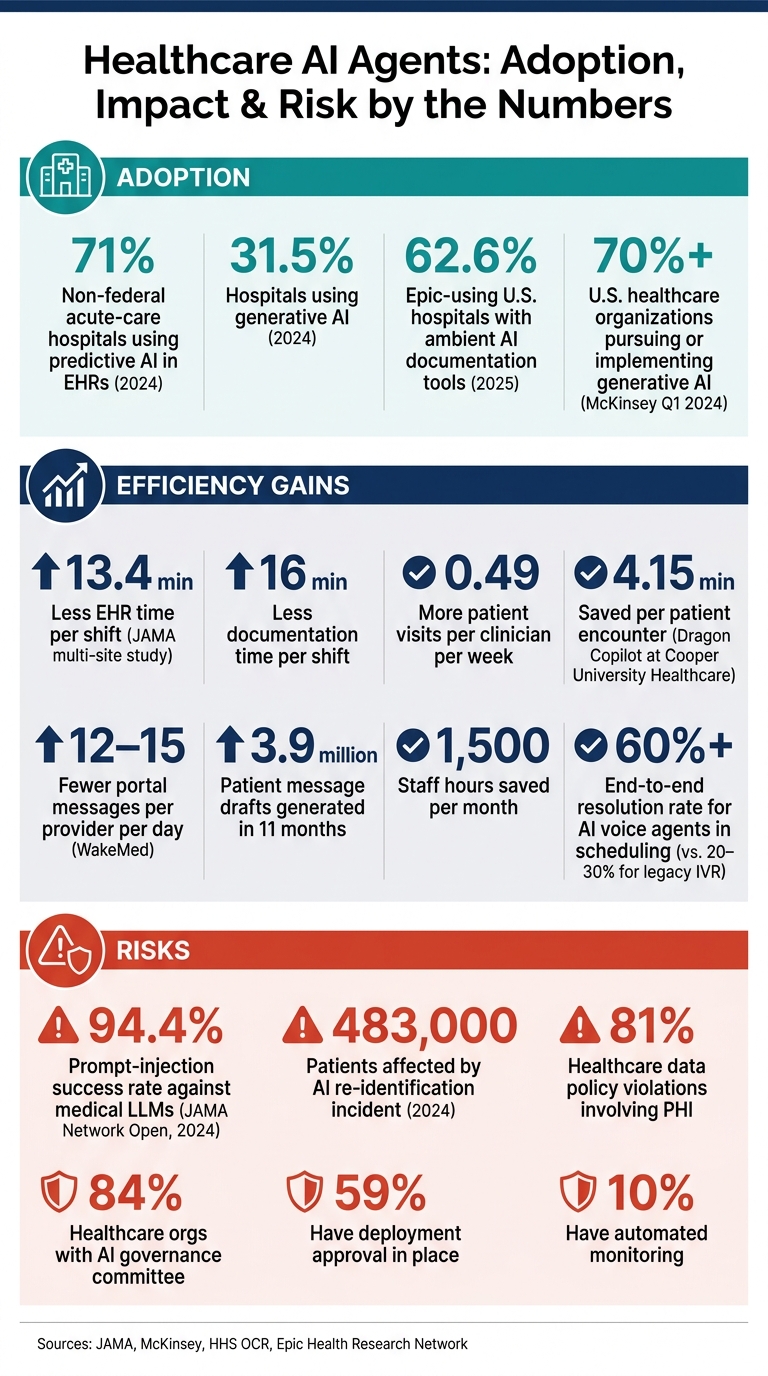
- Hospitals are moving fast: by 2024, 71% of non-federal acute-care hospitals were using predictive AI in EHRs, and 31.5% were using generative AI.
- The main wins are clear: less charting time, fewer portal messages for staff, and more automation in scheduling, coding, and claims work.
- The main risks are clear too: PHI in logs and prompts, prompt injection, too much system access, bad chart updates, and hidden sub-processors behind AI vendors.
- Human review still matters most: risk gets much higher when an agent can send patient advice, change chart data, or submit claims.
- The fix is not to block AI: it’s to control how each agent works - with named owners, least-privilege access, review gates, testing, monitoring, and tighter vendor terms.
A few numbers stand out. Ambient AI tools reached 62.6% adoption in Epic-using U.S. hospitals by 2025. One JAMA study found 13.4 minutes less EHR time per shift and 16 minutes less documentation time per shift. On the risk side, one 2024 study found a 94.4% prompt-injection success rate against medical LLMs, and one privacy case affected 483,000 patients through re-identification.
If I were reading this article for takeaways, I’d keep four things in mind:
- AI agents are not just chat tools. They can read data, use tools, and take action across systems.
- The workflow matters more than the model alone. A low-risk draft tool is very different from an agent with EHR write access.
- Third-party review has to go deeper. You need to look at the vendor, model provider, cloud host, logging layer, and other sub-processors.
- Every agent needs a clear owner. If something fails, accountability cannot be vague.
This article is basically a guide to where healthcare AI agents help, where they can fail, and what health systems should put in place before those failures turn into privacy, billing, or patient-safety problems.
Healthcare AI Agents: Key Stats on Adoption, Efficiency Gains & Risk
Why AI Agents Are Healthcare's Next Biggest Security Risk | Pranava Adduri
sbb-itb-535baee
Where healthcare AI agents add value in clinical, operational, and administrative workflows
The first gains tend to show up in three places: documentation, patient communication, and revenue cycle work. That’s where health systems are moving fast.
Clinical support and documentation
The clearest early wins are in documentation. Ambient AI scribes, such as DAX Copilot, Abridge, and Ambience, listen to clinical visits, turn the conversation into structured notes, and fill EHR fields for clinician review. In a nationwide study of Epic-using U.S. hospitals, 62.6% had adopted ambient AI documentation tools by 2025.[1][5]
The impact isn’t abstract. It shows up in minutes saved and visits added. A multi-site JAMA study found that ambient scribes cut total EHR time by 13.4 minutes per shift and documentation time by 16 minutes per shift. The same study also found 0.49 more visits per week per clinician.[3][2] At Cooper University Healthcare, Dragon Copilot saved 4.15 minutes per patient encounter. Over the course of a day, that added up to roughly an hour or more, which directly helped with throughput.[3]
AI agents also go past note writing. They help with triage and symptom routing, gather patient history before the visit, and send cases to the right care path. They can summarize prior records and pull key findings from radiology and lab reports, so clinicians spend less time digging through charts for context. That time savings also means broader access to PHI and clinical decision support.
The same pattern is now moving into patient-facing communication.
Patient communication and access workflows
AI agents are taking on more patient communication work too. Health systems such as WakeMed, Stanford Medicine, UC Davis Health, and Baptist Health are using generative AI to draft replies to patient portal messages, with clinicians reviewing and approving each message before it goes out.[6][7][8][9]
WakeMed reported a drop of 12–15 portal messages per provider per day after rolling out AI-assisted drafting and routing.[9] In another multi-site rollout, the system generated 3.9 million patient message drafts in 11 months, with an estimated savings of 1,500 staff hours per month.[4]
These tools also send appointment reminders, follow-up instructions, and patient education materials. The upside is pretty clear: faster replies, less staff burden, and more consistent communication. But there’s a catch. Because these systems talk directly with patients and often handle PHI, they need tight controls for message accuracy, identity checks, and escalation rules when something looks clinically sensitive. If identity checks break down, escalation rules fail, or the draft itself is wrong, the risk grows fast.
The back office is shifting in the same direction.
Revenue cycle and administrative tasks
AI agents are showing up across prior authorization, claims review, coding support, scheduling, and document routing. A McKinsey Q1 2024 survey found that more than 70% of U.S. healthcare organizations were pursuing or had implemented generative AI capabilities. Administrative efficiency and coding were among the top use cases.[10][11]
In healthcare call centers, AI voice agents are reaching 60%+ end-to-end resolution rates for scheduling workflows. Legacy IVR systems, by comparison, land closer to 20–30%.[12] That’s a big gap, and it helps explain why teams are leaning in.
On the ground, this looks like agents that read denial letters and draft appeals, pull authorization requirements from payer correspondence, or send claims exceptions to the right queue without manual sorting. It also means broader access across payer portals, billing systems, and vendor tools.
Those gains add new control points that healthcare teams need to govern.
New vulnerabilities that healthcare AI agents introduce
The efficiency gains above come with a real tradeoff. Every new data path and action path adds risk. In practice, the risk comes from the agent’s access, integrations, vendors, and autonomy.
PHI leakage, overprivileged access, and prompt manipulation
In documentation, messaging, and intake workflows, the biggest exposure is PHI handling. AI agents create logs, store chat history, keep cached documents, and pull retrieval data. Any of that can contain PHI. A compliance and AI privacy review found that 81% of healthcare data policy violations involved regulated data, most often PHI uploaded to unauthorized platforms.[20] Even sending a patient’s name to a public LLM without HIPAA-safe handling and a BAA can trigger a HIPAA violation.[21]
Overprivileged access makes the problem worse. If one agent has broad read access to patient records and can also send outbound messages, a single misconfiguration or compromised session can expose data across several systems at once. Shared agent identities make things even harder to track. When one service account is reused across workflows, traceability and auditability get muddy fast.
Then there’s prompt injection. Research published in JAMA Network Open (2024) found a 94.4% prompt-injection success rate when attacking medical LLMs.[16] In direct injection, the attacker places instructions in the prompt itself. In indirect injection, those instructions are buried inside a document or retrieved context. Either way, the agent can be pushed to ignore policy controls, call unauthorized tools, or leak data from connected systems.
Unsafe autonomous actions and clinical workflow errors
Drafting a note for clinician review is fairly low risk. Editing a problem list, routing a triage case, or sending medication guidance to a patient without review is a different story.
Once agents get write access to the EHR, mistakes can snowball. An agent that misreads free text and changes a diagnosis or leaves out a key finding affects every downstream clinician who reads the chart. It also creates billing and malpractice exposure.[13][14] In revenue cycle workflows, agents that auto-apply coding suggestions without coder review can create systematic upcoding or undercoding patterns. That can draw payer audits or fraud scrutiny.[14][15]
Third-party, fourth-party, and AI supply chain weaknesses
The more tools an agent can call, the bigger the attack surface gets. Many organizations stop their review at the contracted AI vendor. But the risk chain doesn’t stop there. That vendor may depend on a model provider, a cloud host, a vector database service, logging tools, and external APIs for clinical knowledge or payer data. Each one is a sub-processor, and each one may touch PHI. HHS OCR has also made clear that AI vendors’ security failures can trigger breach-notification obligations for covered entities, even if the hospital’s core systems were never directly attacked.[17][18][19]
A 2024 incident cited in privacy analysis showed an AI system re-identifying de-identified data, affecting 483,000 patients by linking anonymized records back to individuals.[20] Every scheduling, messaging, or analytics plugin adds another exfiltration path. And plenty of those tools bring along sub-services that were never fully vetted.
The table below maps the main AI-agent use cases to their main weak points, risk level, and the oversight each one needs.
| AI-Agent Use Case | Primary Vulnerabilities | Risk Level | Required Oversight |
|---|---|---|---|
| Ambient documentation / scribing | PHI in logs, hallucinated clinical content, EHR write access | Medium | Clinician review before finalization; audit logs on all writes |
| Patient portal message drafting | PHI leakage to model provider, flawed clinical advice | Medium–High | Clinician approval before send; BAA with vendor; escalation rules |
| Triage routing and symptom intake | Prompt injection via patient input, misrouting of urgent cases | High | Human review for escalation decisions; output filtering; override controls |
| Prior auth and claims support | Upcoding/undercoding, PHI in external APIs, autonomous submission risk | High | Coder review before submission; no autonomous claim filing; audit trails |
| Scheduling and call center automation | PHI in voice/text logs, consent and opt-out failures, mass-message errors | Medium | Consent management integration; logging controls; human escalation path |
| Coding assistance | Hallucinated codes, documentation-billing discrepancy, audit exposure | Medium–High | Human-in-the-loop review; reconciliation against source documentation |
These risks call for clear ownership, least-privilege access, monitoring, and vendor controls.
How healthcare organizations can govern and secure AI agents
Governance needs to turn AI-agent risk into clear ownership and controlled workflows. That matters because AI agents don’t just generate text. They can read, write, and take action across systems. So the focus can’t be only on the model. It has to be on the workflow.
Governance, risk ownership, and use-case classification
Industry data shows that 84% of healthcare organizations have an AI governance committee, but only 59% have deployment approval in place, and just 10% have automated monitoring. That gap is where shadow AI and ungoverned agents can slip in.
A sound governance structure should include executive leadership, along with Legal, Risk Management, and Ethics/Bioethics. It should also assign a named risk owner to every agent.
For each AI agent, the inventory should spell out its intended use, the workflow it enters, the patient population affected, the approval chain, and the level of risk the organization accepts. In plain terms, document the use case, context, roles, and accountability before deployment.[22][23][24][25][26]
Agents should also be classified by autonomy:
- Recommendation only
- Human approval required
- Autonomous action
Use-case classification should get tighter when agents message patients, change chart data, or submit claims. The more autonomy an agent has, the stricter the approval process should be. It should also face tighter access limits and required human review points.
Once ownership is clear, it becomes much easier to match controls to the agent’s autonomy level.
Access controls, guardrails, monitoring, and incident response
Each agent should get access only to the data and tools it needs for its assigned task. An ambient scribe, for example, should not have the same write permissions as a triage agent or a claims bot. Organizations should also turn off retention and training in approved AI services to cut the risk of PHI being reused or exposed in later model outputs.[27]
Human approval gates, escalation rules, and output filtering help stop agents from taking irreversible actions on their own. Pre-launch red-teaming is also a must. Test for prompt manipulation, PHI leakage, and workflow risk. That kind of testing often catches problems that standard QA misses.
After deployment, drift monitoring should track behavior changes over time. SOC integration should send unusual activity into the normal security response process. Alerts should connect to an incident-response playbook that covers PHI leakage, prompt injection, unsafe output, and vendor breach.
| Control Type | Specific Controls | Risks Mitigated | NIST AI RMF Alignment |
|---|---|---|---|
| Identity & access | Least privilege access | Unauthorized access, PHI exposure | Govern / Manage |
| Data handling | PHI retention limits; turn off retention and training in approved tools[27] | PHI leakage, unauthorized reuse | Govern / Manage |
| Output guardrails | Human approval gates, output filtering, escalation rules | Unsafe autonomous actions, clinical errors | Manage |
| Pre-deployment testing | Red-teaming for prompt manipulation, PHI leakage, and workflow risks | Prompt manipulation, workflow errors | Measure |
| Ongoing monitoring | Drift monitoring, SOC integration, incident-response playbook | Behavioral drift, undetected incidents | Measure / Manage |
Vendor due diligence and contract controls for AI-enabled products
Internal controls won’t do the whole job when an agent depends on outside models, cloud services, and sub-processors. That’s why AI-focused due diligence should sit inside the existing third-party vendor risk management program. If AI is built into an EHR module, a patient communication platform, or a revenue cycle tool, the risk doesn’t stop at the app itself.
Any AI-enabled product that touches PHI or carries out clinical or operational actions should go through the same review cycle: initial assessment, periodic reassessment, and a triggered review when the vendor makes material changes to its AI components. Review the model provider, the hosting layer, the logging service, and any outside API the agent can reach.
For each vendor, require:
- BAAs covering all AI components and sub-processors
- Subprocessor disclosure with the right to object to new additions
- Retention limits on PHI processed by the agent
- Audit rights to verify security and compliance controls
- Breach notice obligations within HIPAA-required timeframes
- A ban on training or reuse of your data
Embedding AI-agent oversight into healthcare risk operations with Censinet
Governance and vendor controls only work when every AI-enabled workflow runs through one system of record. That matters because AI-agent risk shows up in the workflow, not just in the model. The next move is putting those controls to work across inventory, assessment, routing, and review.
Using Censinet RiskOps and Censinet AI to assess AI-related third-party risk
Censinet RiskOps™ acts as the system of record for AI-enabled vendors and workflows. Each AI agent is logged with its purpose, the data it touches, system integrations, level of autonomy, and owner.
Standardized assessments cover cybersecurity, privacy, compliance, availability, and clinical safety. For AI use cases, those reviews also extend to training data, retention, model updates, and prompt-injection safeguards.
Censinet AI ingests vendor documents, auto-fills questionnaires, flags gaps, and maps fourth-party dependencies. For example, it can identify a chatbot vendor's LLM provider and analytics service for BAA and security review. That helps risk teams spot supply chain exposure that a questionnaire alone would likely miss. This is critical given the healthcare supply chain security challenges introduced by complex AI integrations.
Using Censinet AI to route oversight and preserve human review
Once the assessment is done, findings should go straight to the right reviewers. Censinet AI routes documentation, revenue-cycle, and patient-facing agents to the right clinical, operational, privacy, and security reviewers based on risk.
Censinet AI packages the evidence, but humans make the approval call.
Risk teams set the rules. Censinet AI coordinates the review and keeps ownership, data use, and external dependencies visible in RiskOps.
FAQs
What is a healthcare AI agent?
A healthcare AI agent is an advanced system that can access, interpret, and act on Protected Health Information (PHI) to carry out clinical, operational, or administrative tasks.
Unlike standard data-processing tools, it doesn't just process information and stop there. It can work on its own, for example by supporting triage, automating documentation, or handling patient communications.
Because it can kick off workflows that involve sensitive health data, it needs regulatory oversight and strong governance.
Which AI agent use cases carry the most risk?
The highest-risk healthcare AI uses include clinical decision support, ambient documentation, and administrative automation.
Clinical tools used for triage, sepsis prediction, and risk scoring can miss signs that a patient is getting worse, reflect bias, or push staff to lean too heavily on outputs they can’t fully see into. That’s a risky mix in a setting where small misses can turn into big problems.
Documentation tools come with their own set of problems. They may add hallucinated details to the medical record or leave out facts that should be there. In healthcare, a bad note isn’t just messy. It can shape later care.
Administrative AI and patient-facing chatbots can also cause harm. They may delay care, expose PHI, or give responses that are unsafe or just plain wrong.
How can hospitals control AI agent risk?
Hospitals need to stop treating AI review as a one-and-done vendor checklist. A better approach is continuous, lifecycle-based governance that follows each tool from intake through day-to-day use.
Start with a full inventory of all AI-enabled tools. That includes not just the main vendor product, but also any third-party APIs and subcontractors involved behind the scenes. From there, group those tools by risk level so teams know where to look first.
For higher-risk tools, hospitals should apply added validation. That can include bias testing and clinical safety reviews before the tool affects patient care. Access should follow least-privilege rules so people only get the permissions they need. Hospitals should also use audit logging, encryption, BAAs, and ongoing monitoring for model drift and security incidents.
If a tool can affect care decisions, human oversight needs to stay in the loop. That guardrail matters because even a polished system can drift over time or behave in ways no one expected.
