
Most healthcare vendor failures do not start with a missing BAA. They start with weak checks, poor access control, and gaps that sit open too long.
I’d sum up the article like this: if a vendor can reach ePHI, connect to your systems, or affect patient care, I need to treat that vendor as part of my HIPAA risk analysis - not as a side task. The article turns HHS 405(d) and HICP into a clear vendor workflow: tier the vendor, collect proof, write tighter contract terms, verify access before go-live, watch for changes after launch, and track fixes to closure.
Here’s the core idea in plain terms:
- A BAA is only the first step.
- Risk tiering should drive how much proof I ask for.
- MFA, incident response, encryption, patching, and PHI disposal should show up in both reviews and contracts.
- Critical vendors need more than annual questionnaires.
- Remediation needs owners, due dates, and records.
A few facts make the point:
- The Change Healthcare ransomware attack in February 2024 showed how one vendor issue can disrupt care across the country.
- HIPAA breach notice may allow up to 60 days, but many healthcare teams now push for 24–72 hours in vendor terms.
- For top-tier vendors, evidence often includes SOC 2 Type II, a pen test from the last 12 months, SBOM, MDS2, and MFA proof.
If I were putting this into practice, I’d focus on six steps:
- Tier vendors by ePHI access, connectivity, clinical impact, and dependency
- Ask for proof tied to HICP practice areas
- Add security terms beyond the BAA
- Check accounts, MFA, and remote access before go-live
- Monitor for vendor security breaches, access drift, vendor changes, and money trouble
- Log every gap in a risk register until it is closed or accepted
This is the article’s main point: HICP only matters if I turn it into repeatable vendor actions.
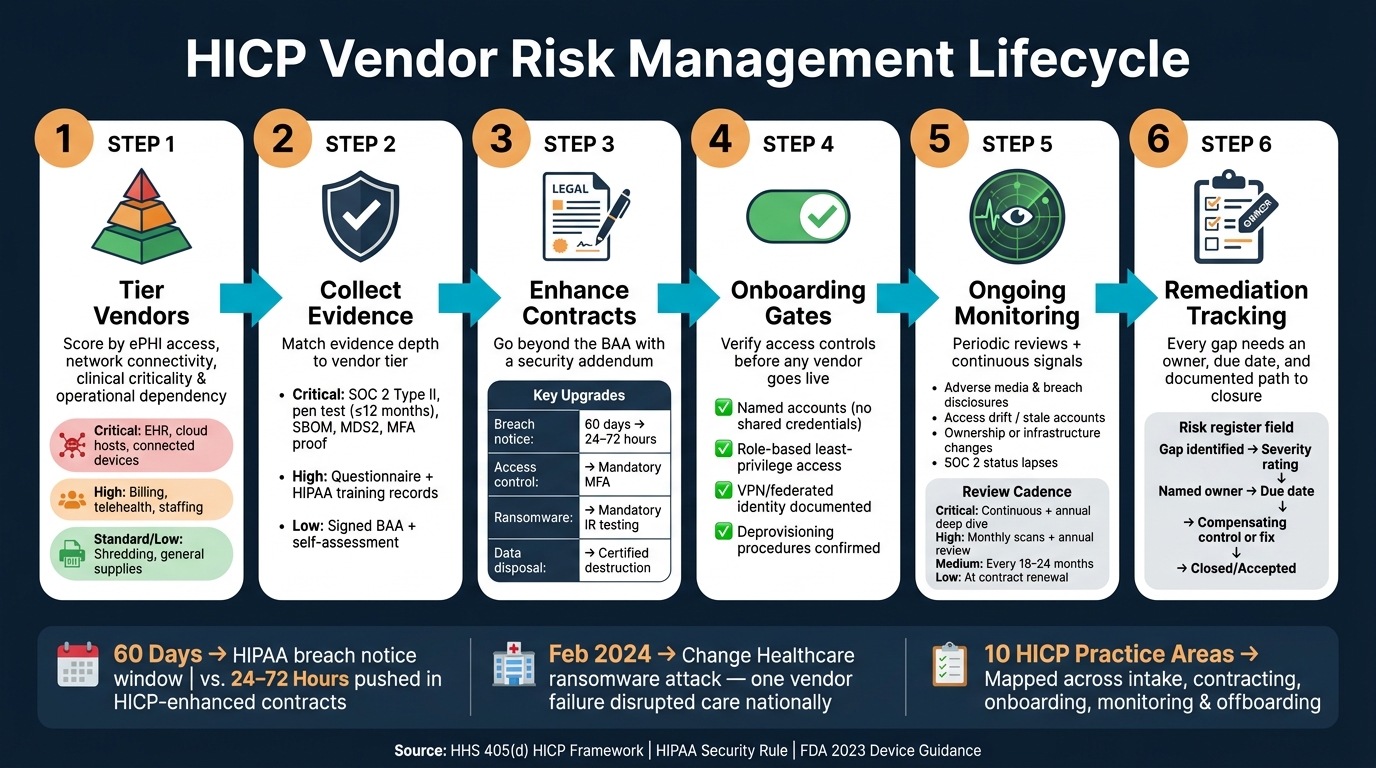
HICP Vendor Risk Management Lifecycle: 6-Step Framework
Third-Party Risk Management Fundamentals for Healthcare Webinar
sbb-itb-535baee
How to Map HICP Practices to the Vendor Lifecycle
Map each HICP practice area to a clear vendor control point. Then use that map to shape intake, contracting, onboarding, monitoring, and offboarding. Once a vendor is tiered, that tier tells you which HICP controls should show up in questionnaires, contract terms, and go-live checks.
Use Intake and Risk Tiering to Scope PHI, Connectivity, and Criticality
Not every vendor needs the same review. Some touch core clinical systems. Others barely touch sensitive data at all. Treating them the same wastes time and muddies risk, often increasing the economic impact of third-party risk.
A simple way to tier vendors is to look at four things:
- ePHI access
- Network connectivity like remote access or system integration
- Clinical criticality
- Operational dependency
A vendor with remote access to systems that hold ePHI and that supports clinical workflows belongs in the top tier. A general supplies vendor with a signed BAA sits much lower. That difference should shape every step that comes next.
| Vendor Tier | Typical Examples | Evidence Depth |
|---|---|---|
| Critical | EHR (Epic, Cerner), cloud hosts, connected medical devices | SOC 2 Type II, recent pen test, SBOM/MDS2, independent audit |
| High | Revenue cycle/billing, telehealth platforms, staffing agencies | Questionnaire + documented safeguards, HIPAA training records, license verification |
| Standard/Low | Shredding services, general supplies | Signed BAA, self-completed security questionnaire mapped to HIPAA safeguards |
Tie Due Diligence, Contracts, and Onboarding to Specific HICP Controls
Once a vendor has a risk tier, each HICP practice area can map directly to what you ask for, what you put in the contract, and what you check before go-live.
For example, access management can show up as an MFA attestation during due diligence, an MFA enforcement clause in the contract, and a least-privilege account check at onboarding. Incident response can mean asking for the vendor's IR plan and recent tabletop results during assessment, adding a 24–72 hour breach notification clause to the BAA, and listing named escalation contacts and response steps. Data protection can mean encryption evidence during due diligence, BAA and data residency terms in the contract, and a formal certificate of PHI destruction or return at offboarding.
The table below shows how all 10 HICP practice areas map across lifecycle stages:
| HICP Practice Area | Lifecycle Stage | Expected Artifacts / Actions |
|---|---|---|
| Cybersecurity Oversight / Governance | Intake & Risk Tiering | Inventory PHI access; verify HIPAA training records; assign risk tier |
| Access Management | Onboarding | Verify MFA enforcement; implement least-privilege account setup |
| Data Protection | Contracting | Signed BAA; encryption-at-rest requirements; PHI disposition terms |
| Incident Response | Contracting & Onboarding | Named escalation contacts and response steps; 24–72 hour breach notification clauses |
| Asset / Network Management | Onboarding | Network segmentation evidence; remote access portal inventory |
| Vulnerability Management | Ongoing Monitoring | Periodic patch tracking; review of latest penetration test results |
| Medical Device Security | Due Diligence | Collection of MDS2 attestation and Software Bill of Materials (SBOM) |
| Endpoint Protection | Due Diligence | Verification of EDR/AV deployment on vendor systems touching PHI |
| Email Protection | Due Diligence | Verification of anti-phishing and secure email gateway controls |
| Ongoing Monitoring | Ongoing Monitoring | Continuous adverse media and breach monitoring; financial distress alerts; BAA renewal tracking |
This mapping sets the evidence you request, the clauses you write, and the checks you complete before go-live.
Extend the Same HICP Control Mapping Into Ongoing Monitoring
The control logic you use at intake and contracting should keep working after go-live. The same 10 practice areas that shaped due diligence should also shape periodic reassessments, access reviews, and patch tracking.
For critical and high-tier vendors, annual reattestation is not enough. Monitoring should cover adverse media and breach activity, disclosed vulnerabilities, access drift, and financial distress alerts. A once-a-year form refresh won't tell you much if conditions changed six months ago.
Use the same control map to drive due diligence, contract language, and go-live checks. That same map should also anchor periodic review work, so monitoring stays tied to the risk the vendor actually brings.
How to Build HICP Into Due Diligence and Contract Requirements
Use the lifecycle map from the previous section to turn HICP controls into three things: vendor evidence, contract terms, and go-live gates.
Write Security Questionnaires That Collect Evidence
A good questionnaire should collect proof, not vague assurances. The easiest way to do that is to organize questions around HICP practice areas and ask for specific artifacts.
For identity and access management, ask for evidence that MFA is enforced for remote and administrative access. For incident response, require a copy of the vendor's incident response plan. For backup and recovery, ask for backup test records that show RTO and RPO. If the vendor provides medical devices, require both the MDS2 and SBOM. FDA 2023 guidance requires device manufacturers to provide an SBOM, so healthcare organizations should collect it during due diligence [2].
For critical vendors, set a higher bar. They should provide:
- A SOC 2 Type II report or ISO 27001 certification
- A penetration test summary from the last 12 months [2]
Lower-risk vendors can usually complete a shorter questionnaire and provide a signed BAA.
Add Specific Security Clauses to BAAs and Vendor Addenda
Once the questionnaire shows where the risk sits, put those same requirements into the contract. A signed BAA creates a legal baseline, but it does not prove the vendor's security posture [2]. That gap is where a security addendum does the heavy lifting [2].
| Contract Area | Baseline HIPAA BAA | HICP-Enhanced Security Addendum |
|---|---|---|
| Breach Notification | Within 60 days of discovery | Within 24–72 hours of discovery |
| Access Control | General "appropriate safeguards" | Mandatory MFA for remote/admin access; named accounts only |
| Subcontractor Risk | Flow-down language required | Mandatory disclosure of fourth parties; proof of their compliance |
| Audit Rights | Cooperation with HHS | Direct right-to-audit by the covered entity; annual independent attestations |
| Ransomware | Not explicitly addressed | Mandatory IR testing and ransomware-specific response obligations |
| Vulnerability Management | General Security Rule compliance | Mandatory SBOM and MDS2 for medical devices; defined patching timelines |
| Data Disposition | Return or destroy PHI | Certified destruction with documented evidence |
Under HITECH, HIPAA obligations flow down to subcontractors. So if you're running a mature vendor risk program, it isn't enough to review the Business Associate alone. You also need to check whether that Business Associate is pushing equivalent safeguards onto its own fourth-party vendors [2].
Verify Access Controls Before a Vendor Goes Live
Contract language on paper still needs a preproduction check. The 2024 Change Healthcare breach showed what can happen when MFA exists as a requirement but not as an enforced control on a remote access portal. PHI can be exposed at scale [2].
Before any vendor with remote access or ePHI connectivity goes live, verify a short set of access controls:
- Named accounts are used instead of shared credentials
- Role-based access is limited to job duties
- VPN or federated identity settings and session logs are documented
- Deprovisioning procedures remove access right away when staff leave or the contract ends [1] [2]
This is the part many teams rush through. They sign the paperwork, schedule the rollout, and assume the setup matches the contract. That's a bad bet in healthcare.
How to Manage Evidence Collection, Monitoring, and Remediation
Once a vendor goes live, HICP alignment doesn't stop. It depends on steady evidence collection, active monitoring, and follow-through on fixes. The tier assigned during intake should drive all of that after launch: what evidence you gather, what changes you watch for, and what issues you track until they're closed.
Use the same HICP control map from due diligence as your guide. That way, the post-go-live process stays tied to the same controls you reviewed at the start.
Match Evidence Depth to Each Vendor's Risk Tier
Use each vendor's tier to set both review timing and evidence depth. In plain English: the higher the risk, the more often you review the vendor and the more proof you should collect.
| Vendor Tier | Review Cadence | Required Evidence | Escalation Path |
|---|---|---|---|
| Critical | Continuous monitoring + annual deep dive | SOC 2 Type II, pen test (last 12 months), MFA proof, SBOM, IR plan, business continuity and disaster recovery test results | CISO, Risk Committee, Executive Board |
| High | Annual + monthly media and breach scans | Security questionnaire, active BAA on file, HIPAA training logs, SLA reports, IR plan | Compliance Officer, Department Head |
| Medium | Every 18–24 months | Updated questionnaire, active BAA on file, insurance certificate | Procurement Manager, Compliance Lead |
| Low | At contract renewal or scope change | Signed BAA (if applicable), basic security attestation | Department Manager |
That structure keeps reviews from turning into guesswork. A critical vendor handling core systems should not be reviewed the same way as a low-risk supplier with limited access.
Monitor for Ransomware Exposure, Access Drift, and Security Changes
Periodic reviews give you a snapshot. Continuous monitoring shows you what changed after that snapshot was taken. For critical vendors, that difference can be huge.
"The Change Healthcare event demonstrated that a single third-party failure can generate systemic healthcare disruption at national scale. The lesson is not to improve vendor questionnaires. The lesson is that questionnaire-based programmes are insufficient for critical vendor relationships." - Dallas Federal Reserve research, 2025 [2]
For critical and high-risk vendors, active monitoring should cover adverse media scans, breach disclosures, and security researcher findings. It should also look for access drift, including stale or orphaned accounts. That's when former vendor employees, or inactive accounts, still have active credentials in your systems. It happens more often than teams want to admit.
A simple fix? Tie periodic account recertification reviews to your contract terms. If access no longer matches the user's role, remove it.
You also need to watch for changes that can alter the vendor's risk profile between formal reviews, such as:
- shifts in infrastructure
- new subcontractor relationships
- ownership changes
- lapses in SOC 2 status
Those changes may not show up on a questionnaire for months, but they can affect risk right away.
Track Remediation Gaps in a Defensible Risk Register
Finding a gap is only part of the job. If it isn't tracked through closure, the process is incomplete. HHS OCR looks at issue management records during investigations, so remediation needs to be documented, not just mentioned in meetings [1].
"A vendor assessment that ends in a score is half-finished. The findings need to land on a prioritized to-do list with owners and due dates." Teams can use automated questionnaire tools to accelerate this evidence review and close gaps faster. - Medcurity [1]
Each gap should go into a risk register with a severity rating, a named owner, a due date, and a defined remediation path. This is where the work becomes traceable.
For example, if a vendor lacks MFA on a remote access portal, mark it as high severity and track it until it's fixed. If a vendor's SOC 2 has expired, trigger an automatic alert and start renewal tracking before access gets restricted. If a fix can't happen right away, document the compensating control and get executive risk acceptance.
That paper trail matters. It's what shows your team didn't just spot the issue - you managed it, assigned it, and followed it through [1].
Conclusion: Build a Repeatable HICP-Aligned Vendor Risk Program
These steps create a vendor risk program you can run again and again, with the depth of review matched to the level of risk. Tiering, due diligence, contracts, onboarding, monitoring, and remediation each tie back to specific HICP controls. Put together, they create a clear vendor-risk workflow. But that workflow only holds up if every vendor is measured against the same control standard, scaled by risk.
The next part is consistency. Apply the same process every time, and you cut down on blind spots and make reviews easier to defend. The aim is simple: documented evidence, tracked remediation, and lower vendor risk across your full vendor network.
At scale, technology helps keep assessments, evidence, and remediation in one place. A repeatable HICP-aligned program runs on standard steps, clear ownership, and follow-through you can measure. HICP becomes useful when it’s built into intake, contracting, monitoring, and remediation - and tracked by outcomes that matter: fewer gaps, faster remediation, and a vendor network that supports safe care delivery.
FAQs
How do we start applying HICP across all vendors?
Start by building a complete vendor inventory. Map what each vendor touches, with extra attention on PHI, EHRs, connected medical devices, imaging, revenue cycle, and managed IT. Then tier each vendor by criticality and PHI access, so no PHI-handling vendor ends up in the lowest tier.
Next, put firm gates in place. Require a signed HIPAA-compliant BAA before any PHI is touched. Use standardized security questionnaires backed by evidence collection. When you find gaps, turn them into contract updates, assign remediation owners, and apply tier-based continuous monitoring.
Which vendors need the deepest security review?
Treat vendors based on risk and criticality, not as if they all carry the same weight. Put the most attention on relationships that can affect clinical operations, patient safety, or the confidentiality of protected health information.
The vendors that usually need the deepest review include EHR providers, connected medical devices with remote access, imaging systems, and clinical SaaS platforms.
For Tier 1 vendors, the bar should be much higher. That means a more rigorous assessment with items like:
- SOC 2 Type II reports
- penetration test results
- proof of safeguards such as MFA and encryption
This kind of tiered approach helps teams spend time where the stakes are highest, instead of giving low-risk and high-risk vendors the same level of review.
What evidence should we require before go-live?
Before go-live, ask for hard proof that each business associate or vendor is under contract and can protect PHI while keeping systems up during trouble.
Collect a signed BAA, completed security questionnaires with supporting documentation, and outside assurance such as SOC 2 Type II, HITRUST, or ISO 27001 reports and penetration test summaries. You should also ask for disaster recovery or backup records and, for connected medical devices, MDS2 or SBOM evidence.
Don’t rely on self-attestations alone.
