
Protecting biometric data under HIPAA is critical for healthcare organizations and their vendors. This includes fingerprints, facial recognition, iris scans, and voiceprints linked to patient records. When tied to medical information, these identifiers become electronic protected health information (ePHI) and require strict safeguards. Unlike passwords, compromised biometric data cannot be reset, making security measures even more important.
Key Takeaways:
- Why it matters: Biometric data is permanent and sensitive, requiring encryption, access controls, and secure storage.
- Who it applies to: Healthcare entities and vendors handling biometric ePHI must follow HIPAA rules.
- Action steps:
- Classify biometric data as ePHI when linked to patient records.
- Conduct detailed risk analyses for biometric systems.
- Secure vendor agreements with Business Associate Agreements (BAAs).
- Implement encryption (AES-256), multi-factor authentication (MFA), and role-based access controls (RBAC).
- Regularly monitor systems and conduct periodic risk assessments.
This guide outlines strategies for compliance, including technical safeguards, vendor management, and ongoing monitoring to reduce risks.
Master HIPAA Compliance: The Ultimate 2025 Checklist for Healthcare Organizations
Pre-Implementation HIPAA Readiness Checklist
Before rolling out any biometric system, it’s critical to establish a strong HIPAA compliance framework. Skipping this step is a common reason healthcare organizations face HIPAA enforcement actions. With biometric data, the risks are even higher due to the irreversible damage a breach can cause. These steps lay the groundwork for compliance before implementing technical or administrative safeguards.
Classifying Biometric Data as ePHI
Start by ensuring your internal policies clearly classify biometric identifiers as electronic protected health information (ePHI) when tied to patient records. For example, a fingerprint used solely for staff timekeeping isn’t typically subject to HIPAA. But if that same fingerprint is used to log a clinician into an electronic health record (EHR) or linked to billing information, it becomes ePHI and must be protected [2].
"If a fingerprint can reasonably identify a person and is stored or used with clinical or billing information, treat it as PHI and apply HIPAA safeguards accordingly." - Kevin Henry, AccountableHQ [2]
To address the unique risks of biometric data breaches, classify this data clearly and enforce strict controls. Map all points where biometric data is captured, stored, or transmitted, and update your Notice of Privacy Practices (NPP) and data governance policies to reflect this classification [3]. Keep in mind that some states, like Illinois, have additional requirements under laws such as the Biometric Information Privacy Act (BIPA). These laws may require written consent and public retention schedules that go beyond HIPAA’s mandates [2].
Running a Biometric-Specific HIPAA Risk Analysis
A standard HIPAA risk analysis isn’t enough when it comes to biometric systems. These systems introduce unique vulnerabilities, including hardware capture points, matching algorithms, and storage repositories, which traditional assessments often overlook. Your analysis should cover every phase of the biometric data lifecycle: enrollment, matching, storage, transmission, and deletion [2].
Don’t forget to evaluate fallback methods and algorithm accuracy. Conducting a Privacy Impact Assessment (PIA) before launching the system can help identify potential gaps early [6]. Pair this with tabletop exercises that simulate real-world scenarios - such as device theft, enrollment errors, or cloud credential breaches - to test the effectiveness of your incident response plans [2][3].
Vendor Compliance and Business Associate Agreements
After identifying internal vulnerabilities, turn your attention to external partners. Any vendor that handles biometric ePHI on your behalf must sign a Business Associate Agreement (BAA) before implementation [3]. This requirement is non-negotiable under HIPAA, and failing to secure a BAA can have severe consequences. In one case, a healthcare system paid a $4.75 million settlement after a vendor exposed fingerprint data from over 60,000 patients [4].
Ensure the BAA outlines clear terms for data usage, prohibits unauthorized secondary use, enforces subcontractor compliance, and secures your audit rights. It should also confirm that your organization retains ownership and control of the data, including the ability to demand its return or destruction when the contract ends [3][5].
When evaluating vendors, verify they meet key technical standards. Look for vendors that store only algorithmic templates, use AES-256 encryption for data at rest, implement TLS 1.2 for data in transit, and enforce role-based access controls with multi-factor authentication for administrative access [3][6]. These measures are the baseline for any vendor managing biometric ePHI.
| Evaluation Category | Key Criteria to Verify |
|---|---|
| Technical Safeguards | AES-256 encryption, MFA for admin access, irreversible template hashing [3][6] |
| Administrative Safeguards | Workforce training, incident response plans, documented risk management [3] |
| Operational Controls | Audit logging of all access events, automatic logoffs, session timeouts [3] |
| Legal/Contractual | Subcontractor compliance, data ownership clauses, audit rights, data disposal terms [3][5] |
Technical Safeguards for Biometric Data Storage
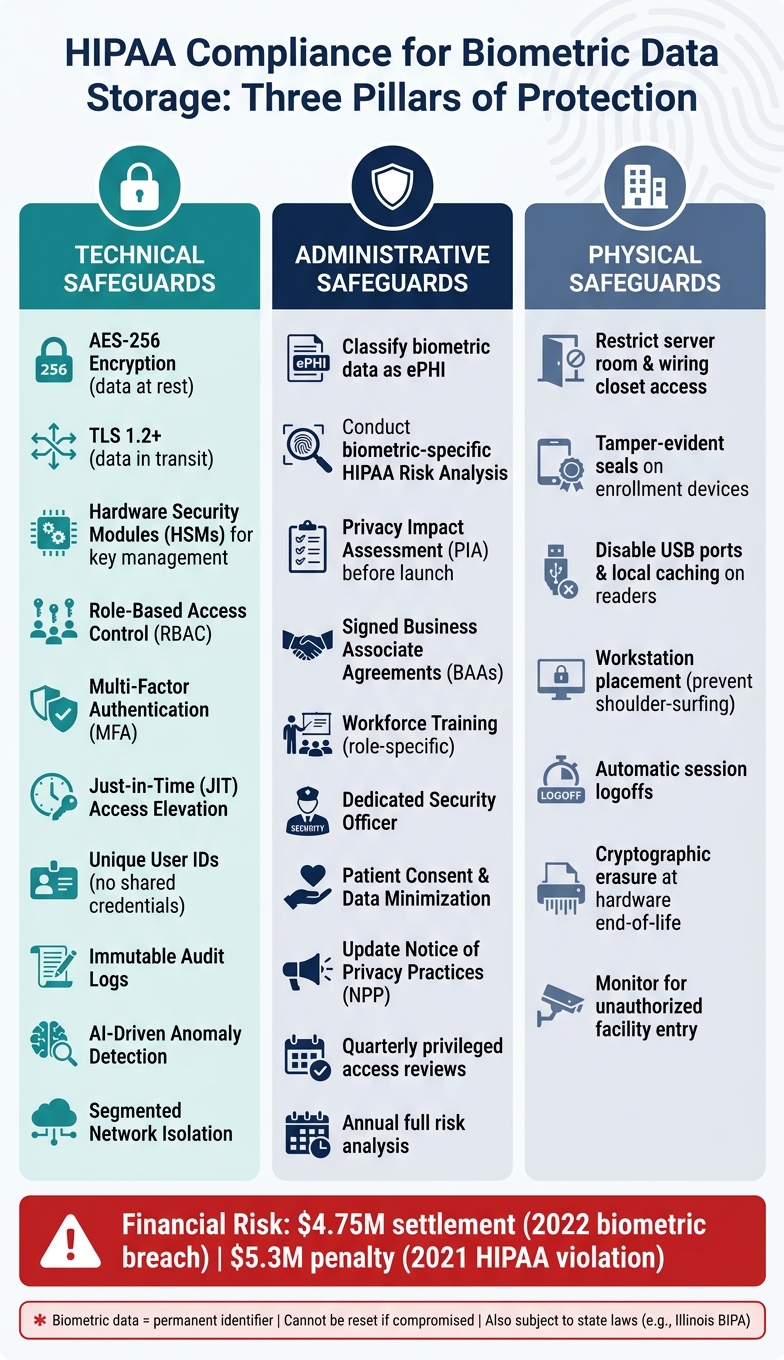
HIPAA Biometric Data Compliance: Technical vs. Administrative vs. Physical Safeguards
Once your vendor agreements and risk analysis are squared away, it's time to focus on the technical measures that protect biometric data on a daily basis. These safeguards align closely with HIPAA's Security Rule, which requires specific protections for electronic protected health information (ePHI). Since biometric data is particularly sensitive, these requirements demand extra care and precision.
Encryption and Key Management
Biometric templates must be encrypted both at rest and in transit. For stored data, AES-256 encryption is the go-to standard, while TLS 1.2 or higher is essential for securing data that moves across networks [4][3]. But encryption alone isn't enough - proper key management is equally critical.
"Encrypt ePHI at rest using strong, industry-accepted algorithms; protect keys in dedicated modules, rotate them regularly, and separate key custody from system administration." - Kevin Henry, HIPAA Specialist, Accountable HQ [3]
To meet these expectations, encryption keys should be stored in Hardware Security Modules (HSMs), with separate personnel assigned for key management and system administration. Keys need regular rotation, and immediate revocation when staff roles change or vendor agreements end.
For additional protection, store biometric data as irreversible algorithmic templates. Using techniques like cancelable biometrics or homomorphic encryption ensures that compromised data can still be revoked. This is critical because, unlike passwords, fingerprints or facial scans can't be "reset."
Encryption is just the first layer - strict access controls are the next step.
Access Controls and Authentication
Encryption protects the data, but access controls determine who can reach it. Poor access management accounts for 63% of healthcare breaches, making this a key area to address [4]. Start by ensuring unique user IDs for everyone interacting with biometric systems - shared logins are a no-go. From there, implement Role-Based Access Control (RBAC) to limit access based on job responsibilities. For instance, a database administrator would have more access than a front-desk employee, but only as much as their role requires.
Strengthen security further with multi-factor authentication (MFA) for any accounts managing biometric databases or encryption keys [3][2]. For maintenance tasks, adopt Just-in-Time (JIT) access elevation, which provides temporary, task-specific privileges that expire after the job is done. Combine this with session recording for accountability. Also, set up automatic session timeouts on enrollment stations and admin consoles to prevent unattended devices from becoming vulnerabilities.
| Access Control Mechanism | Implementation Strategy | HIPAA Alignment |
|---|---|---|
| RBAC | Assign access based on clinical or administrative role | Supports "Minimum Necessary" standard |
| MFA | Require a second factor for all admin and privileged logins | Strengthens ePHI authentication |
| JIT Elevation | Grant temporary access for specific maintenance windows | Limits privileged account exposure |
| Unique User IDs | No shared credentials on enrollment stations or consoles | Ensures full accountability and auditability |
System Hardening and Monitoring
Beyond encryption and access controls, system hardening and monitoring add another layer of defense. Start by isolating biometric data repositories on segmented networks that are separate from general clinical systems [3]. This limits an attacker's ability to move laterally if another part of your network is compromised. Restrict API access to authorized services and disable USB ports and local storage on biometric devices to prevent raw image caching [2][3].
Keep immutable audit logs to track every enrollment, match attempt, administrative override, and data export [4][2]. Use AI-driven anomaly detection to monitor for unusual activity, like excessive failed match attempts, spikes in enrollment, or off-hours administrative access [3][4]. Set up automated responses for specific triggers - for example, temporarily suspending access to a device after multiple failed match attempts in a short time frame. Finally, conduct regular vulnerability scans and penetration tests on all biometric endpoints to identify and fix weaknesses before attackers can exploit them [3].
These measures work together to ensure that biometric data remains secure, even in high-risk environments.
sbb-itb-535baee
Administrative and Physical Safeguards
When it comes to handling biometric ePHI under HIPAA, administrative and physical measures are just as important as technical controls. Together, they ensure data is protected through clear policies and strict adherence by staff.
Workforce Training and Awareness
Administrative safeguards go beyond technical measures to fortify the protection of biometric data. Staff who work with biometric systems need training tailored to their responsibilities. This includes learning the correct way to use devices, understanding privacy expectations, and knowing how to report any biometric-related incidents. Additionally, training should cover backup plans for situations like device malfunctions or enrollment issues to maintain continuity[3]. To uphold these standards, organizations should enforce sanctions for violations of biometric privacy protocols and appoint a dedicated security officer. This officer would oversee workflows involving biometric data and handle incident escalations.
Patient Consent and Data Minimization
HIPAA's "minimum necessary" rule requires limiting biometric data collection to what’s essential. For example, instead of storing raw images of all ten fingerprints, only a single fingerprint template should be captured. Similarly, storing algorithmic templates rather than full images is preferable[3]. If biometric data is used for purposes beyond HIPAA-authorized treatment, payment, or operations, explicit written consent from patients is mandatory[3]. Organizations should also update their Notice of Privacy Practices to include details about biometric data collection and usage. For entities in Illinois, compliance with the Biometric Information Privacy Act (BIPA) is necessary, as it imposes additional requirements for consent and data retention[2].
Physical security measures are another essential layer of protection.
Physical Security of Biometric Systems
Protecting the physical components of biometric systems is just as critical as securing digital data. Enrollment stations, for instance, should be positioned to prevent "shoulder-surfing", where unauthorized individuals could observe data capture[3]. Access to server rooms, wiring closets, and device cabinets must be tightly controlled, with monitoring in place to detect unauthorized entry[3]. Mobile enrollment devices should have tamper-evident seals, and local caching on biometric readers should be disabled to prevent raw image storage. When biometric hardware reaches the end of its lifecycle, organizations must follow documented disposal procedures, such as cryptographic erasure, to ensure data cannot be recovered[3]. For cloud storage managed by vendors, verify that the physical security standards outlined in your Business Associate Agreement (BAA) are being met[1].
| Physical Safeguard | Key Action |
|---|---|
| Facility Access | Restrict access to server rooms and wiring closets; monitor for unauthorized entry |
| Device Hardening | Disable local caching on devices; use tamper-evident seals on enrollment devices |
| Workstation Placement | Position workstations to prevent shoulder-surfing; enforce automatic logoffs |
| Secure Disposal | Use cryptographic erasure or equivalent methods to make biometric data unrecoverable |
Ongoing Monitoring and Compliance Validation
Physical safeguards are a solid first line of defense for biometric systems, but maintaining compliance over time requires consistent reviews, well-tested response plans, and tools to detect issues early on.
Periodic Risk Assessments
Relying on annual risk assessments isn’t enough. Biometric workflows evolve as systems are updated, vendors change, and new devices are introduced. Conduct a thorough HIPAA risk analysis for all biometric workflows every year [2][9].
But don’t stop there - some checks need to happen more frequently. For example:
- Audit logs: Use automated tools for daily reviews and perform manual checks weekly to catch anomalies like repeated failed matches, unusual enrollment spikes, or administrative actions during off-hours [3][9].
- Access reviews: Privileged user access to biometric databases should be recertified quarterly, while standard user access can be reviewed annually [9].
Technical testing is equally crucial. Instead of duplicating general network scans, focus monitoring efforts on biometric endpoints and APIs during each assessment cycle [3][8]. Tabletop exercises are also invaluable. Simulating scenarios like stolen biometric readers or facial recognition spoofing can help teams uncover weaknesses before they lead to real-world incidents [3].
| Assessment Component | Frequency | Focus Area |
|---|---|---|
| Vulnerability Scanning | Ongoing | Addressing unpatched devices and API flaws |
| Audit Log Review | Daily (automated) / Weekly (manual) | Identifying failed matches and unauthorized access |
| Full Risk Analysis | At least annually | Reviewing enrollment, matching, and storage workflows |
| Access Reviews | Quarterly (privileged) / Annually (standard) | Verifying user access to biometric databases |
| Tabletop Exercises | Periodic | Testing response to spoofing and device theft |
Fallback mechanisms also need regular testing. If a biometric reader fails or a patient can’t provide a usable sample, having a reliable backup ensures care continues without compromising security [2][4].
These evaluations ensure your team is ready to respond quickly and effectively when incidents arise.
Incident Response and Breach Notification
A proactive approach to risk assessment directly improves breach preparedness. Biometric data breaches are particularly sensitive - unlike passwords, compromised biometric credentials can’t simply be reset. Your incident response plan should include specific scenarios for biometric systems, such as device theft, spoofing attacks, or cloud credential leaks, rather than relying on generic data breach protocols [3][8].
Under HIPAA’s Breach Notification Rule, you must notify affected individuals, the Department of Health and Human Services (HHS), and possibly the media after a confirmed breach. Notifications should include details about the breach and steps being taken to minimize harm [7]. Encrypting data with AES-256 at rest and TLS 1.2+ in transit can qualify for the Safe Harbor provision, which may exempt organizations from mandatory notifications in the event of an encrypted breach [9].
To limit the impact of a breach, store biometric templates in a dedicated database separate from other personal information [8]. Using cancelable or revocable templates instead of raw images allows compromised credentials to be reissued, reducing the long-term damage [3][4].
Using Risk Platforms for Compliance Management
Managing compliance manually across a large organization is a tall order. That’s where centralized risk management tools come in. Automation platforms can map HIPAA controls to your infrastructure and provide real-time alerts for log anomalies [9].
Censinet RiskOps™ is one example designed for healthcare organizations. It simplifies third-party and enterprise risk assessments, ensuring that biometric vendors meet their Business Associate Agreement (BAA) obligations and that internal controls stay up to date. With AI-powered features like Censinet AI™, the platform speeds up vendor security questionnaire completion, summarizes evidence, and generates risk reports - cutting down manual work while preserving essential human oversight. For organizations juggling multiple biometric vendors or cloud partners, having a centralized hub for risk tracking and compliance visualization helps spot issues early, ensuring biometric data remains HIPAA-compliant.
Conclusion: Key Steps for HIPAA-Compliant Biometric Data Storage
Biometric data is considered a permanent identifier under HIPAA, included among the 18 identifiers that make health information individually identifiable [2]. This highlights the importance of implementing strong security measures.
"Biometric breaches carry heightened risk because iris templates are permanent identifiers. Strong safeguards, timely detection, and rapid containment are critical to reduce impact and regulatory exposure." [3]
The financial risks are significant. In 2022, a healthcare system faced a $4.75M loss due to a biometric breach, while another incurred a $5.3M penalty in 2021 for similar issues [4]. These examples show how lapses in security can lead to severe consequences.
Ensuring compliance requires focusing on three key areas:
- Administrative safeguards: Conducting detailed risk analyses, securing signed BAAs, training staff, and establishing clear consent policies.
- Technical safeguards: Utilizing AES-256 encryption, implementing MFA, enforcing RBAC, and maintaining immutable audit logs.
- Physical safeguards: Protecting hardware and securing facilities where biometric data is stored.
Neglecting any of these areas weakens overall security. Two often-overlooked measures can further reduce risks: storing biometric templates instead of raw images to limit the impact of breaches [1], and adhering to state laws like the Illinois Biometric Information Privacy Act (BIPA). BIPA has stricter consent and data retention requirements than HIPAA, meaning compliance with federal standards alone may not be enough [2].
FAQs
When does biometric data count as ePHI under HIPAA?
Biometric data - such as fingerprints, facial recognition, or voice patterns - falls under the category of Protected Health Information (PHI) when it's connected to health records or used in healthcare services, payments, or operations. Once this data is stored or transmitted electronically, it is classified as Electronic Protected Health Information (ePHI) and must adhere to HIPAA's Security and Privacy Rules.
To ensure compliance and manage potential risks, tools like Censinet RiskOps™ are available. These tools can assist in evaluating and overseeing third-party vendors that handle sensitive biometric data.
Do biometric vendors need a signed BAA before go-live?
Absolutely. If a biometric vendor handles protected health information (PHI), they must have a signed Business Associate Agreement (BAA) in place before going live. This is a requirement under HIPAA because biometric data tied to health records qualifies as PHI.
The BAA ensures that vendors comply with HIPAA regulations, covering critical aspects like:
- Data classification
- Security safeguards
- Breach notifications
- Retention procedures
To streamline this process, tools like Censinet RiskOps can help evaluate vendors and verify that their contracts meet these essential requirements.
How can we revoke biometrics if templates are breached?
Biometric identifiers are particularly sensitive because, unlike passwords, they can't simply be reset. To mitigate risks from breaches, it's better to use cancellable or revocable templates rather than storing raw biometric data. These templates allow for invalidation or replacement if they are compromised. It's also critical to design systems that incorporate privacy-preserving features and to implement clear policies for securely deleting biometric data, as mandated by HIPAA and similar privacy laws.
