
Major HIPAA changes are here for 2026, and they’re not optional. The U.S. Department of Health and Human Services (HHS) has introduced stricter rules for medical device software to combat rising healthcare data breaches. These updates include mandatory encryption, multi-factor authentication (MFA), network segmentation, and shorter breach notification timelines. Here's what you need to know:
- Mandatory Safeguards: Encryption (AES-256), MFA, and network segmentation are now required for all systems accessing electronic protected health information (ePHI).
- Tight Deadlines: Breach notifications must be reported within 24 hours, and systems must restore ePHI access within 72 hours.
- Cost Impact: First-year compliance costs are estimated at $9 billion, with annual costs of $6 billion.
- Vendor Oversight: Business Associate Agreements (BAAs) must now include stricter security terms like encryption and MFA.
With only 240 days to comply after the final rule's publication (expected May 2026), organizations must act fast to meet these requirements and avoid penalties of up to $2.19 million per violation. Start by conducting a full ePHI inventory, updating BAAs, and implementing the required technical controls.
2026 Is Changing HIPAA Compliance - Are You Ready?
sbb-itb-535baee
Major 2026 HIPAA Regulatory Updates Affecting Device Software
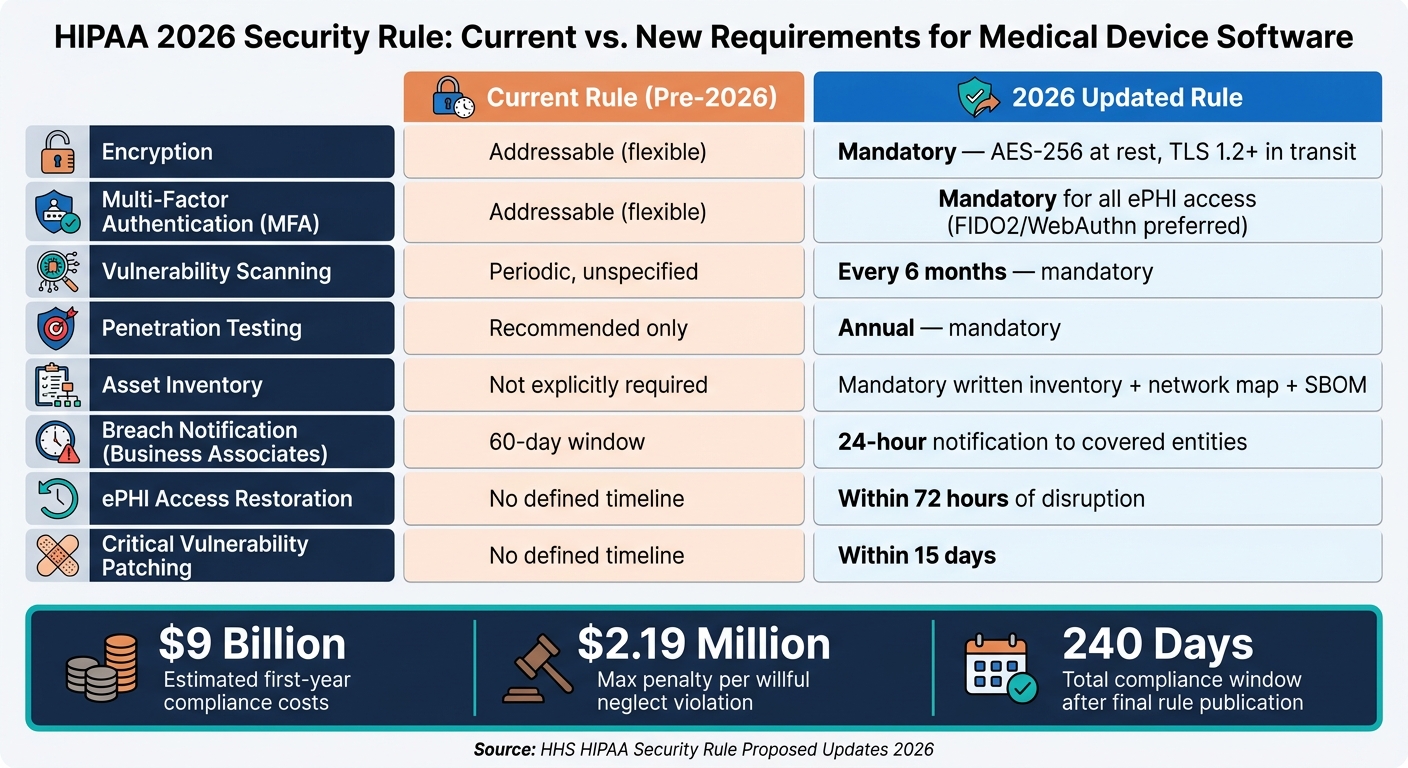
HIPAA 2026 Security Rule: Current vs. New Requirements for Medical Device Software
The 2026 HIPAA updates focus on three key areas - Privacy, Security, and Breach Notification - and bring significant changes for device software compliance.
Privacy Rule Updates: 2024 Final Changes with 2026 Compliance Deadlines
The Privacy Rule updates finalized in 2024 introduce new requirements for device software handling reproductive and behavioral health PHI. These updates mandate that privacy notices reflect the changes. For manufacturers operating as business associates, portfolio risk management and compliance are mandatory by February 16, 2026. These adjustments set the groundwork for the more detailed Security Rule revisions that follow.
Expected Security Rule Updates and Timelines
The Department of Health and Human Services (HHS) is expected to finalize the Security Rule overhaul by mid-2026. Organizations will have a 240-day compliance window - 60 days for the rule to take effect and another 180 days to ensure adherence [1][3]. If finalized in May 2026, the compliance deadline would fall in early 2027.
One major change is the removal of the "addressable versus required" approach. The proposed updates make technical safeguards mandatory, including AES-256 encryption for data at rest, TLS 1.2 or higher for data in transit, and multi-factor authentication (MFA) for accessing electronic PHI (ePHI) [1][3]. Additionally, device software must produce automated evidence, such as access logs, configuration baselines, and vulnerability scan reports, to prove active controls are in place [7].
"HHS OCR is operationalizing HIPAA Security Rule compliance as a demonstrable cybersecurity program, one that must withstand ransomware attacks... with hard evidence, not intent." - Palindrome Technologies [7]
The financial impact is substantial. HHS estimates first-year compliance costs at $9 billion, with ongoing annual costs of $6 billion [1][3]. Penalties for willful neglect violations will also increase, reaching $2,190,294 per violation as of January 28, 2026 [3].
Here’s a quick comparison of current and updated requirements for device software teams:
| Requirement | Current Rule | 2026 Update |
|---|---|---|
| Encryption | Addressable (flexible) | Mandatory (AES-256 / TLS 1.2+) |
| MFA | Addressable (flexible) | Mandatory for all ePHI access |
| Vulnerability Scanning | Periodic, unspecified | Every 6 months |
| Penetration Testing | Recommended | Annual, mandatory |
| Asset Inventory | Not explicitly required | Mandatory written inventory & map |
At the same time, revised breach notification rules are tightening operational timelines.
Shorter Breach Notification Timelines for Business Associates
The updated breach notification rules significantly reduce the time allowed for reporting security incidents. Business associates will now have just 24 hours to notify covered entities, a sharp reduction from the previous 60-day window [1][9]. Additionally, organizations must restore ePHI access within 72 hours of any disruption [1][2].
The University of Vermont Medical Center breach, which required a month for partial recovery and over three months for full IT restoration, highlights how challenging these new timelines could be [10]. For device manufacturers, meeting the 24-hour reporting deadline will require integrating continuous telemetry, anomaly detection, and centralized logging into their software [10].
"The 24-hour reporting window is especially tight - it doesn't give you much time to investigate, but you're required to report based on what you know, not wait until the investigation is complete." - Medcurity [2]
Business Associate Agreements (BAAs) will also need updates to include the 24-hour notification and 72-hour restoration requirements explicitly [1][2].
Security Requirements for Medical Device Software in 2026
With the latest regulatory updates, medical device software teams now face clearly defined technical controls. These changes provide a roadmap for prioritizing essential compliance tasks as deadlines approach.
Multi-Factor Authentication (MFA) and Role-Based Access Control
MFA is no longer optional. Starting in 2026, systems accessing electronic protected health information (ePHI) - like cloud consoles, VPN/RDP connections, and EHR integrations - must implement MFA. The focus is on phishing-resistant MFA protocols, such as FIDO2/WebAuthn, to combat credential-based attacks [1].
The risks of neglecting MFA are serious, as highlighted by previous breaches. To complement MFA, role-based access control (RBAC) enforces the HIPAA "minimum necessary" standard, restricting users to only the ePHI relevant to their roles [11]. In fast-paced clinical settings, technologies like proximity badge readers or biometric authentication can meet MFA requirements without delaying care [12]. Additionally, systems must feature an auditable "break-glass" emergency access mechanism that notifies compliance officers immediately when used [11].
Encryption standards have also been strengthened alongside MFA requirements.
Encryption for Device Data at Rest and In Transit
Encryption has transitioned from a flexible safeguard to a mandatory standard under the 2026 updates. All ePHI stored on device firmware, edge servers, or cloud platforms must use AES-256 encryption. Data in transit must be secured with TLS 1.2 or higher. Organizations are now required to implement formal encryption key management procedures to ensure compliance [1].
Legacy devices unable to support modern encryption standards must be addressed through a documented migration plan. This plan may include compensating controls like network segmentation or secure encryption offloading [1]. However, a March 2026 survey revealed that 60% of healthcare organizations struggle to protect unpatchable medical devices with their current tools [1].
"The rules of the game have changed. The landscape now is to design controls in, period. The FDA's cybersecurity authority is no longer based solely on risk assessments. It's based on statute, and statute says you must prove secure by design." - Naomi Schwartz, VP of Regulatory Strategy, Medcrypt [8]
Asset Inventories for Device Ecosystems
A comprehensive asset inventory is now a cornerstone of securing medical device ecosystems. The 2026 Security Rule mandates this under 45 CFR 164.308 and 164.312 [5]. This inventory must go beyond listing hardware, encompassing firmware versions, third-party libraries, APIs, cloud service integrations, and detailed network maps showing how ePHI moves through the system [5]. Such documentation directly supports risk management and breach readiness [5].
| Inventory Component | 2026 Requirement Detail |
|---|---|
| Device Metadata (type, location, configuration) | Type, location, and physical/logical configuration [5] |
| Software/Firmware | Specific versions and Software Bill of Materials (SBOM) [5] |
| Dependencies | Third-party libraries, APIs, and cloud service integrations [5] |
| Data Flow Maps | Documentation of all pathways where ePHI is transmitted [1] |
| Criticality | Assessment of device function (e.g., life-sustaining vs. administrative) [10] |
SBOMs are now legally required for cyber devices under Section 524B of the FD&C Act. These must be maintained in formats like SPDX or CycloneDX [5]. Inventories should be reviewed annually or after any significant system change [1].
"Spreadsheets of server hostnames and OS versions will not satisfy the updated Security Rule." - Shadab Khan, Security Engineer, Safeguard [5]
For healthcare organizations that cannot deploy security agents on legacy devices with outdated operating systems, automated discovery tools and Software Composition Analysis (SCA) can help build and maintain accurate inventories [14].
Building HIPAA Compliance into Medical Device Software Development
Secure Design and Development Practices
Ensuring HIPAA compliance starts at the very beginning of development and continues throughout the lifecycle of the product.
"HIPAA is not a security features module you bolt on before launch. It is a series of engineering decisions that starts at repository creation and never stops." - Sanjay Prajapati, Head of Business, Acquaint Softtech [13]
One effective strategy is aligning your development process with the FDA's Secure Product Development Framework (SPDF). This framework directly corresponds to HIPAA's 2026 Security Rule requirements, helping developers address both data confidentiality and device safety. Key practices include unified risk assessments, threat modeling, data flow mapping, and adhering to the "least functionality" principle - ensuring the device performs only its essential tasks.
From a coding perspective, auditability should be integrated from the outset. Tamper-proof audit logs are essential and should be implemented to record access and modification events, with a retention period of at least six years. Additionally, tools like Datadog or Sentry can use log scrubbers or redactors to prevent Protected Health Information (PHI) from accidentally appearing in error logs or stack traces [15][16].
These foundational design choices pave the way for rigorous testing and comprehensive documentation.
Testing, Validation, and Documentation
Security testing isn't a one-time task - it’s a continuous process built into the release pipeline. The 2026 standards require vulnerability scans every six months and annual penetration testing. Automating these processes within your CI/CD workflow ensures they are consistently executed [1][6].
| Activity | Frequency |
|---|---|
| Vulnerability Scanning | Every 6 months |
| Penetration Testing | Every 12 months |
| Compliance Audit | Every 12 months |
| Incident Response Tabletop Exercise | Annually |
Documentation plays an equally important role. The Office for Civil Rights (OCR) requires clear, actionable evidence that risks have been identified and addressed in a timely and trackable manner [6]. Healthcare third-party risk management platforms can help by monitoring configuration changes and maintaining audit-ready documentation, reducing last-minute stress before reviews. Teams can also use automated security questionnaire tools to streamline the evidence-gathering process. Additionally, HIPAA mandates quarterly testing of backup restoration to ensure ePHI can be recovered within 72 hours - not just that backups exist [1][15].
Comprehensive testing and thorough documentation also support ongoing monitoring and effective patch management.
Postmarket Surveillance and Patch Management
Even after development and testing, continuous postmarket surveillance is crucial for staying HIPAA compliant. In 2025 alone, the National Vulnerability Database recorded nearly 50,000 new Common Vulnerabilities and Exposures (CVEs) [17]. This highlights the importance of maintaining an up-to-date Software Bill of Materials (SBOM) that tracks all component changes and monitors for newly disclosed vulnerabilities [17][8].
When vulnerabilities are discovered, patching must follow strict timelines. The 2026 standards require patches for critical vulnerabilities to be implemented within 15 days, and high-severity issues within 30 days [6][15]. For devices that cannot be patched - such as those running outdated operating systems - alternative measures like network segmentation or secure gateways can be used, provided there is a documented migration plan [17][1]. The type of patch may also dictate the regulatory pathway, ranging from internal Quality Management System (QMS) updates to new FDA 510(k) submissions for significant changes, such as replacing a cryptographic module [17].
"The rules of the game have changed... The landscape now is to design controls in, period. The FDA's cybersecurity authority is no longer based solely on risk assessments. It's based on statute." - Naomi Schwartz, VP of Regulatory Strategy, Medcrypt [8]
Governance and Third-Party Risk Management for Device Software
Roles and Responsibilities in HIPAA-Aligned Governance
Clear roles and a structured framework are key to effective governance. Under the 2026 HIPAA Security Rule, organizations must appoint a Security Official who holds formal authority over security policies and risk management processes [1][14]. This isn't just a symbolic role - this person is directly accountable to regulatory authorities when questions arise.
In 2026, governance isn't a solo effort. It requires a team approach to handle the overlapping challenges of clinical safety, regulatory compliance, and legal risks during cyber incidents. Here's a breakdown of the essential roles and their responsibilities:
| Role | Primary Responsibility |
|---|---|
| Security Official | Oversees security policies and risk management [1][14] |
| Regulatory Affairs Lead | Identifies reporting triggers for FDA, CISA (CIRCIA), and HIPAA [10] |
| Clinical Safety Lead | Evaluates patient safety risks during cyber incidents [10] |
| Quality Assurance Lead | Documents incidents in the QMSR and initiates corrective actions [10] |
| Legal Counsel | Manages legal privilege, litigation risks, and external counsel coordination [10] |
To streamline processes, align HIPAA's Security Rule with the FDA's Secure Product Development Framework (SPDF) and the Quality Management System Regulation (QMSR), which takes effect on February 2, 2026. A unified NIST SP 800-30 risk assessment can satisfy both HIPAA's administrative safeguards and the FDA's cybersecurity documentation requirements [1][14].
"Cybersecurity is no longer treated as a niche technical concern for medical devices; it is a core regulatory expectation across global markets." - Wayne Stewart, Vice President, Global – IoT & AI, Intertek [18]
This governance structure not only strengthens internal processes but also sets the stage for managing risks tied to third-party vendors.
Managing Third-Party Vendor Risks
Once internal governance is solid, the next step is addressing third-party risks, which are a major concern for HIPAA compliance. 89% of HIPAA breaches investigated by the OCR involve hacking or IT incidents [5]. The 2024 Change Healthcare breach, which exposed personal health data for roughly one-third of Americans, underscored the urgency of this issue [19].
A key starting point is revising Business Associate Agreements (BAAs). These agreements should now include:
- AES-256 encryption
- TLS 1.2+ for data transmission
- Multi-factor authentication (MFA)
- Workforce access termination within one hour of separation
- A machine-readable Software Bill of Materials (SBOM) [1]
For vendors relying on cloud providers like AWS, Azure, or GCP, confirm that the cloud provider has signed a BAA as a subcontractor and complies with encryption standards [1].
Mapping all data flows involving third-party devices or services is critical. This helps determine whether a vendor qualifies as a Business Associate or subcontractor, each with specific compliance obligations [1]. By 2026, cybersecurity concerns have led 56% of hospitals to reject medical devices during procurement [1].
Using Risk Management Platforms to Support Compliance
Annual vendor questionnaires are no longer enough. With the average hospital system connected to over 1,000 vendors, and 90% of serious healthcare data breaches involving third parties, manual tracking is impractical [19].
Platforms like Censinet RiskOps™ are designed to tackle this complexity. These tools automate vendor risk assessments, validate SBOMs against current vulnerabilities, and centralize compliance documents like SOC 2 Type II reports, ISO 27001 certifications, and penetration test results. They integrate seamlessly with HIPAA-aligned risk programs, offering real-time updates on compliance and security for medical device software. Censinet AI™, the platform's AI feature, speeds up security questionnaires and flags risks from subcontractors that might otherwise go unnoticed [19][20].
To maintain oversight without overburdening risk teams, categorize vendors by criticality - Critical, High, Medium, or Low - based on their access to PHI and their impact on clinical safety. For instance:
- Critical vendors with direct patient data access might need quarterly reviews.
- Low-risk vendors without network access could be assessed during onboarding or when specific events occur [20].
This tiered strategy ensures compliance efforts are focused where they matter most while keeping systems audit-ready and manageable.
Conclusion: Getting Ready for HIPAA Compliance in 2026 and Beyond
The 2026 updates to HIPAA's Security Rule mark a major shift, turning what were once "addressable" safeguards into mandatory requirements. Encryption, multi-factor authentication (MFA), network segmentation, and annual penetration testing are now baseline expectations for any organization managing ePHI [1][2].
With compliance deadlines looming, organizations must act quickly. Once the final rule is published - expected in May 2026 - there will be 240 days total to comply: 60 days for the rule to take effect, followed by 180 days to achieve full compliance [1][4]. Immediate steps include conducting a full inventory of ePHI and performing a risk analysis aligned with NIST SP 800-30 to identify vulnerabilities. From there, organizations need to implement mandatory MFA, revise business associate agreements (BAAs) to include 24-hour incident reporting, and ensure proper network segmentation.
Legacy devices pose a unique challenge. With 60% of healthcare organizations reporting that current tools cannot adequately protect unpatchable medical devices [1][4], it's critical to develop documented migration plans. This includes using microsegmentation and secure gateways to protect these devices until they can be replaced or updated to support modern encryption standards.
Failure to comply comes with steep consequences. Beyond regulatory fines, organizations risk breach-related liabilities and potential harm to patients, making the investment in compliance a far better choice.
"The cost of doing nothing is very high." - Melanie Fontes Rainer, Director of the Office for Civil Rights (OCR) [11]
Achieving compliance in 2026 will require more than one-time fixes - it must become an ongoing part of operations. This means integrating compliance into governance, vendor contracts, development processes, and risk management practices. Tools like Censinet RiskOps™ can help by embedding HIPAA requirements into daily workflows, making compliance a seamless part of operations.
FAQs
Do the 2026 HIPAA updates apply to my device software?
If your company deals with protected health information (PHI), the 2026 HIPAA updates could directly impact your device software. This applies if your software accesses, stores, processes, or transmits PHI in any way - whether through cloud connectivity, remote monitoring, or software updates. In such cases, your company is classified as a business associate under HIPAA and must meet compliance requirements.
Tools like Censinet RiskOps can help simplify the process. It’s designed to streamline risk assessments and manage compliance, making it easier to handle medical devices and PHI securely.
What should we do first to meet the 24-hour breach notice and 72-hour restore rules?
To meet the 24-hour breach notification and 72-hour restoration requirements, it's essential to develop comprehensive incident response and disaster recovery plans. Begin by conducting a thorough asset inventory to understand what needs protection. Pair this with continuous monitoring to detect threats as quickly as possible.
Prioritize mandatory technical security controls, as the 2026 updates stress the importance of demonstrable actions. These measures should ensure that critical systems can be restored within the 72-hour window.
How can we handle legacy or unpatchable devices that can’t support AES-256 or modern TLS?
For older or unpatchable devices that don’t support AES-256 or modern TLS, it’s important to put compensating controls in place to maintain HIPAA compliance. Updating firmware on FDA-cleared devices could void their certifications, so alternative strategies are necessary. These might include isolating the devices within encrypted network tunnels, leveraging VPNs, or implementing network segmentation. Additionally, using proxies, gateways, or backend systems can handle encryption and logging, safeguarding sensitive data without requiring any changes to the device itself.
