
A cyberattack in an ER or EMS setting does not stop HIPAA deadlines. If unsecured PHI may have been exposed, I need to do three things at once: keep care moving, limit disclosure, and decide whether the event is a reportable breach.
Here’s the short version:
- Not every incident is a HIPAA breach. The key question is whether there was an improper use or disclosure of unsecured PHI.
- HIPAA assumes a breach unless I can document a low probability of compromise through the four-factor risk review.
- Patient notice usually must go out within 60 days of discovery. The same 60-day deadline can apply to HHS and media notice in larger incidents.
- Emergency disclosures are limited. Sharing PHI for treatment, public health, or to prevent serious harm may be allowed. Sharing with reporters is not.
- Documentation matters at every step. Logs, risk analysis notes, notice copies, law enforcement requests, and forensic records all need to be kept.
- OCR often looks past the breach itself and focuses on weak controls, like missing risk analysis, poor access controls, lack of encryption, weak training, and vendor gaps.
- Civil HIPAA penalties in 2026 can reach $2,190,294 for identical violations in a year, depending on fault level.
If I had to sum up the article in one line, it would be this: treat breach response as both a patient-care event and a enterprise risk and compliance event from minute one.
| Topic | What I need to know |
|---|---|
| Breach test | Is unsecured PHI involved, and does the four-factor review show low probability of compromise? |
| First response | Isolate systems, keep downtime care running, preserve evidence, and log each action |
| PHI sharing | Limit disclosures to what HIPAA allows during treatment, public health response, or threat prevention |
| Deadlines | Most notices: no later than 60 days after discovery |
| Records | Keep risk review, forensic facts, notices, substitute notice proof, and internal policy records |
| Common OCR issues | Missing risk analysis, weak access controls, no encryption, poor vendor oversight, weak training |
That’s the core of it. The rest of the article explains how to make those calls, meet the timelines, and keep proof for OCR.
HIPAA Breach Reporting: Protecting Patient Information in Healthcare
sbb-itb-535baee
Immediate Response Steps That Still Meet HIPAA Requirements
The first hours after a cyberattack in emergency care are tense and high risk. Teams need to move fast, but they also need to stay inside HIPAA rules. Once an incident is treated as a possible breach, the job shifts to three things at once: containment, permitted disclosure, and documentation.
Contain the Incident and Keep Clinical Operations Running
As soon as a breach is detected, the incident response team should work to stop the spread and mitigate the impact of ransomware on healthcare to keep patient care moving. That can mean isolating affected systems, like taking the impacted EHR segment offline or separating ED workstations from the rest of the network, while staff switch at once to pre-set downtime workflows such as paper charting or secure offline data views.[4][10]
The HIPAA Security Rule requires a data backup plan, a disaster recovery plan, and an emergency mode operation plan so critical operations can continue when systems are damaged or unavailable.[4][10] On the ground, that usually means emergency access, or "break-glass", accounts for emergency clinicians should already be in place, with strict logging, real-time alerts, and post-event review built in.[3][4]
At the same time, IT should disable compromised user accounts, cut off suspicious remote-access sessions, and review connection logs. Every move matters here. System changes, account lockouts, and downtime workflows should all be time-stamped and documented for later OCR review and forensic analysis.[2][11] Logs, network traffic, and memory captures also need to be preserved before anyone wipes or rebuilds anything.[13][14][15]
Containment helps limit the damage. But while care continues, staff still have to follow the rules on disclosure.
PHI Disclosures Permitted During an Emergency
The Privacy Rule still applies during an emergency. That said, it does allow limited disclosures for treatment, public health, and serious or imminent threats. Use the minimum necessary standard where it applies.[8][9][12]
For instance, an ED physician may share a patient's diagnosis and other relevant clinical details with a receiving trauma team during a transfer. Public health authorities may receive exposure details needed to contain a communicable disease. And if a patient poses a serious or imminent threat of serious harm, clinicians may disclose needed PHI to anyone reasonably able to help prevent that harm, including law enforcement, family, or public health, based on a good-faith professional judgment.[6][8][9] OCR has stated it will not second-guess a provider's good-faith belief in these situations.[9]
One line should stay bright: do not disclose PHI to media or on social media.
| Disclosure Type | Example Use Case | Documentation Needed |
|---|---|---|
| Treatment | Sharing diagnosis with receiving trauma team | Note recipient and purpose |
| Public health activities | Reporting communicable disease to health department | Log recipient, date, and PHI shared |
| Serious or imminent threat | Notifying law enforcement of a credible violence threat | Document the threat rationale, recipient, and PHI disclosed |
| Media inquiry | Not permitted: sharing patient condition with reporters | Redirect to communications officer |
| Unrelated staff or visitors | Not permitted: discussing patient status in hallways | Follow the minimum necessary standard |
Coordinating With Law Enforcement Without Over-Disclosing PHI
Once containment is underway, coordination with outside parties should stay tight and focused on the investigation, not drift into broad PHI sharing. Report the cyberattack to law enforcement, but don't treat that step as blanket permission to share patient data.[5][7]
When law enforcement asks for information, start with the technical side: indicators of compromise, affected systems, and the attack timeline. Not patient records. PHI may be disclosed to law enforcement only when a specific Privacy Rule provision applies, such as averting a serious or imminent threat or another permitted disclosure under 45 C.F.R. § 164.512. Even then, share only the minimum necessary information.[7][8]
Each law enforcement interaction should go through the privacy or compliance officer. It should also be logged with the requesting agency, the date and time, the legal basis, and exactly what PHI, if any, was disclosed.[5][7] If law enforcement asks for a delay in public breach notification to protect an active investigation, document that request and track the separate OCR deadline.[5]
Risk Assessment, Notification Deadlines, and Required Records
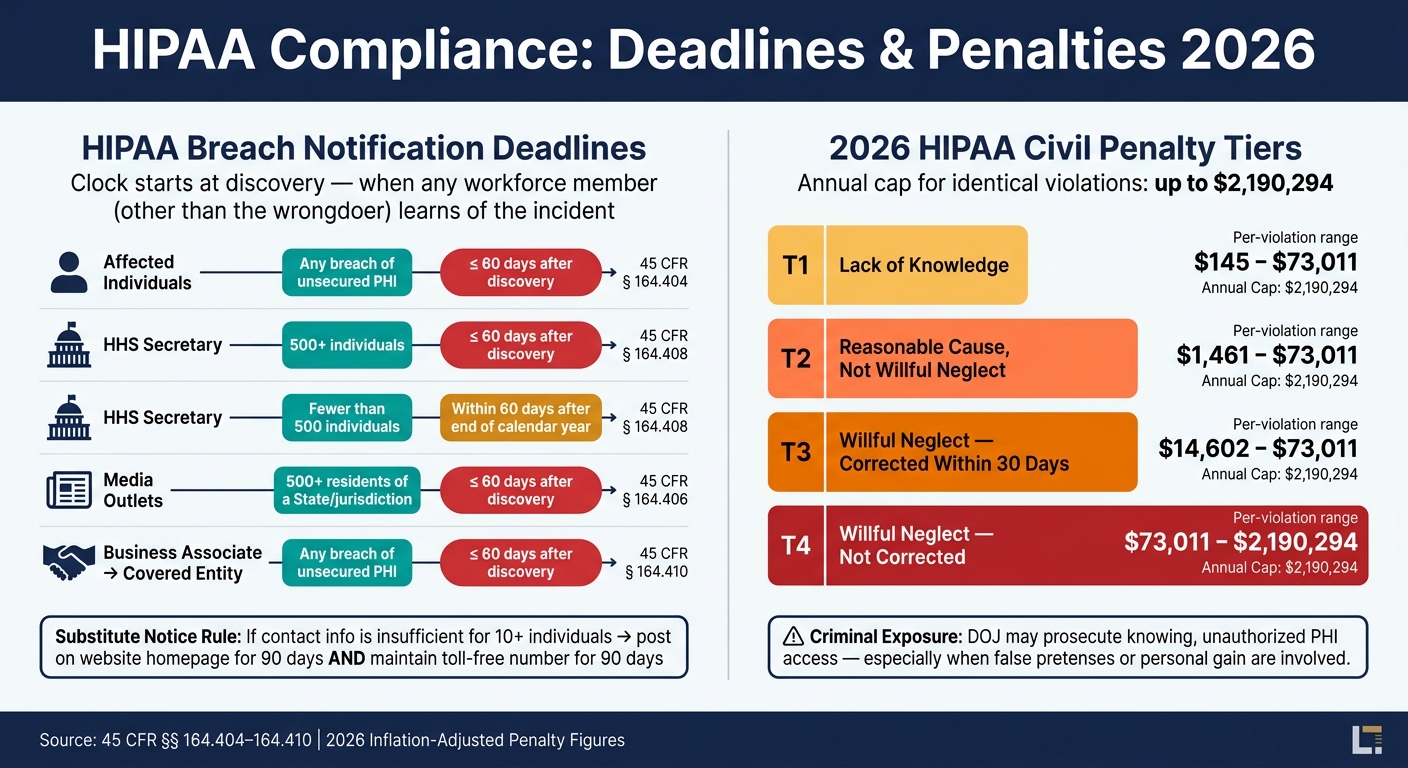
HIPAA Breach Notification Deadlines & Civil Penalty Tiers 2026
After you contain the incident, the next job is to decide whether it counts as a reportable breach using real-time risk management tools. Just as important, you need to write down the facts behind that call. That record drives your notice duties and gives OCR a clear file to review.
How to Apply the Four-Factor Breach Risk Assessment
Under HIPAA, an incident is presumed to be a breach unless the covered entity or business associate can show there was a low probability that the PHI was compromised. That means the burden is on the organization to document why the event did not rise to the level of a reportable breach.
The four factors are:
- Nature and extent of the PHI involved - What identifiers or clinical details were exposed, and how sensitive are they?
- The unauthorized person who used the PHI or to whom the disclosure was made - Who accessed it?
- Whether the PHI was actually acquired or viewed - What do forensic findings show?
- The extent to which the risk to the PHI has been mitigated - What reduced the chance of compromise? Organizations can better evaluate these factors by measuring what matters for cybersecurity to protect patient safety.
Only unsecured PHI triggers breach notice. If your assessment supports a low probability of compromise, document that basis for OCR review.
Notification Deadlines for Individuals, HHS, and the Media
If the assessment does not support a low probability of compromise, the notice clock starts right away. Individual notice must go out without unreasonable delay and no later than 60 days after discovery. Discovery happens when any workforce member or agent, other than the person who caused the breach, learns about it.[16]
| Notification Pathway | Threshold | Deadline | Primary Citation |
|---|---|---|---|
| Affected Individuals | Any breach of unsecured PHI | ≤ 60 days after discovery | 45 CFR § 164.404 |
| HHS Secretary | 500 or more individuals | ≤ 60 days after discovery | 45 CFR § 164.408 |
| HHS Secretary | Fewer than 500 individuals | Within 60 days after end of calendar year | 45 CFR § 164.408 |
| Media Outlets | More than 500 residents of a State or jurisdiction | ≤ 60 days after discovery | 45 CFR § 164.406 |
| Business Associate to Covered Entity | Any breach of unsecured PHI | ≤ 60 days after discovery | 45 CFR § 164.410 |
Each notice has to cover the same core points: what happened, the types of PHI involved, what people can do to protect themselves, what the organization is doing to investigate and reduce harm, and how people can follow up.[1][16]
There’s also a backup rule for missing contact information. If contact information is insufficient for 10 or more individuals, substitute notice must appear on the website home page for at least 90 days or run in major print or broadcast media. A toll-free number must stay active for that same 90-day period.[1][16]
Required Documentation
The same facts used for the risk assessment and notices should feed the OCR record. The goal is simple: show why notice was required, or why the incident did not meet HIPAA’s breach standard.
| Record Category | What to Keep | Regulatory Basis |
|---|---|---|
| Breach Analysis | Four-factor risk assessment; documentation of any applied exceptions | 45 CFR § 164.402 |
| Incident Details | Forensic findings; date of breach vs. date of discovery; specific PHI types | 45 CFR § 164.404(c) |
| Notification Proof | Copies of individual letters; media press releases; HHS electronic submission receipts | 45 CFR §§ 164.404–408 |
| Substitute Notice | Website posting logs for 90 days; major media notices; toll-free number activity logs | 45 CFR § 164.404(d) |
| Internal Compliance | Written policies; staff training certificates; workforce sanction records | 45 CFR § 164.414 |
| Business Associate Notice | Keep the business associate's notice in the incident file | 45 CFR § 164.410 |
A good record set does more than check a box. It shows the timeline, the reasoning, and the proof behind each step. If OCR ever asks, you want the file to tell the whole story without gaps.
Penalties, Common Failure Points, and Post-Breach Corrective Action
Civil Penalties, Criminal Exposure, and Enforcement Risk
HIPAA civil penalties increase based on the level of fault. The 2026 inflation-adjusted ranges are below.[24][25]
| Tier | Culpability Level | Per-Violation Minimum | Per-Violation Maximum | Annual Cap (Identical Violations) |
|---|---|---|---|---|
| 1 | Lack of knowledge | $145 | $73,011 | $2,190,294 |
| 2 | Reasonable cause, not willful neglect | $1,461 | $73,011 | $2,190,294 |
| 3 | Willful neglect, corrected within 30 days | $14,602 | $73,011 | $2,190,294 |
| 4 | Willful neglect, not corrected | $73,011 | $2,190,294 | $2,190,294 |
On the criminal side, DOJ can prosecute knowing, unauthorized access, use, or disclosure of PHI, especially when false pretenses or personal gain are involved.[22][23]
Control Gaps That Frequently Lead to Settlements
OCR enforcement keeps pointing to the same problem areas. One of the biggest is the failure to perform an accurate, enterprise-wide security risk analysis. In many cases, that failure matters more to OCR than the breach itself.[31][33]
That issue gets worse when the review leaves out mobile units, ambulance laptops, tablets, and cloud-based dispatch systems. If those assets aren't part of the analysis, the organization is working from an incomplete picture of risk.[17][18][21]
Access control problems and missing encryption also show up again and again. OCR settlements often trace back to missing enterprise risk analysis, weak encryption, and poor workforce training. In 2024, Bryan County Ambulance Authority agreed to pay $90,000 and follow a three-year corrective action plan after OCR found system-wide gaps, including poor risk management, missing policy updates, and weak staff training.[30][32]
Vendor oversight is another common weak spot. EMS agencies and emergency departments often depend on dispatch providers, cloud EHR vendors, and billing companies. But if those relationships lack proper business associate agreements or steady monitoring, a vendor-side breach can pull the covered entity straight into OCR review.[17][19][20]
Those are also the same issues OCR tends to put into a CAP after a breach.
Turning the Incident Into a Corrective Action Plan
Once containment and notice are done, the next step is fixing the controls for good. The breach should become the trigger for closing the gaps OCR has already flagged in past enforcement actions.
The table below links common pre-breach gaps to the remediation steps OCR expects in a corrective action plan:
| Control Area | Observed Gap | Required Remediation |
|---|---|---|
| Risk Analysis | Outdated or incomplete; excludes mobile and field assets | Conduct fresh enterprise-wide risk analysis covering all PHI environments; update annually |
| Access Controls | Shared logins, no role-based access, no MFA for remote users | Assign unique user IDs; enforce role-based access; implement MFA for remote and on-call access |
| Encryption | Unencrypted laptops, tablets, and portable media in the field | Mandate full-disk encryption on all devices handling ePHI; deploy secure messaging for field-to-ED communications |
| Workforce Training | Generic or one-time training; staff unaware of incident reporting steps | Implement role-based, scenario-driven training updated annually; document completion records |
| Vendor Oversight | Missing or unsigned BAAs; no third-party risk management | Execute BAAs with all business associates; conduct periodic security reviews of vendors handling PHI |
| Logging and Monitoring | No audit logs or logs not reviewed regularly | Enable and regularly review access logs across EMS, ED, and vendor systems |
| Contingency Planning | Breach response plan not tested or updated post-incident | Revise and test incident response and contingency plans; conduct tabletop exercises |
OCR resolution agreements more and more often require multi-year corrective action plans with annual reporting. In some matters, OCR also requires an independent compliance monitor.[26][27][28][29] That means the work doesn't stop after the first fix. Teams need a clear way to track risk, document remediation, and keep reporting on schedule.
Using Censinet to Build a HIPAA-Ready Breach Response in Healthcare
Mapping HIPAA Incident Response Needs to Healthcare Risk Operations
After the corrective action plan is set, the next step is putting it to work across people, systems, and vendors.
Emergency departments and EMS services work in high-speed settings where PHI moves across EHR systems, medical devices, and third-party vendors. That makes it tough to keep HIPAA duties visible as events unfold. A centralized risk workflow helps by tying each HIPAA requirement to specific assets, owners, and due dates instead of leaving that work scattered across teams. For HDOs, that means putting controls, owners, and deadlines into one workflow that also tracks breach notifications.
Benchmarking helps teams spot gaps that can hit emergency care hard, like missing MFA for remote access or downtime procedures that haven't been tested.
That same line of sight matters for third-party relationships too. The economic impact of vendor risk is high in emergency settings that rely on cloud EHRs, lab interfaces, and device vendors.
How Censinet RiskOps™ Supports Documentation and Remediation
This is where a healthcare-specific risk operations platform comes into play.
The corrective action plan work from the previous section needs a dependable system of record. Without one, remediation tracking, risk documentation, and OCR support get split across spreadsheets and email. That's when things slip through the cracks.
Censinet RiskOps™ centralizes third-party and enterprise risk assessments, connects systems that store or move PHI to their current risk and control status, and keeps breach response documentation in one record. Teams can log the four-factor assessment, attach evidence, and track notice deadlines in one place. Remediation tasks can be assigned to owners, dated, and linked to the control gaps found during the incident.
AI-assisted summaries can help speed up review, but compliance leaders still need to approve every output.
Conclusion: Keep Patient Care Moving While Meeting HIPAA Duties
Patient care doesn't stop during a breach, and neither do HIPAA duties. A centralized risk workflow that covers unified assessments, deadline tracking, and remediation documentation makes it possible to manage both at scale. Censinet RiskOps™ gives emergency healthcare organizations a system for steady risk assessment, documented breach response, and showing OCR that compliance is part of day-to-day operations.
FAQs
What is unsecured PHI?
Unsecured PHI is protected health information that has not been made unusable, unreadable, or indecipherable to unauthorized people. Under HIPAA, PHI is usually treated as unsecured when it is not protected through approved encryption or destruction.
Encryption counts as a safe harbor only when it meets NIST standards and the decryption keys remain secure. If those protections are missing, or if the keys are compromised, the data is still unsecured.
When does the 60-day notice clock start?
The 60-day notice period starts on the date the breach is discovered.
Under this rule, discovery means the first day any workforce member or agent of the covered entity knew - or should have known, through reasonable diligence - that a breach had happened.
That timing matters. The clock starts right away upon discovery, not after the forensic investigation is finished.
Can ransomware trigger HIPAA breach notice?
Yes. Ransomware can trigger HIPAA breach notice requirements under the HIPAA Breach Notification Rule.
Any impermissible access or disclosure of PHI is presumed to be a breach unless you complete and document a four-factor risk assessment showing a low probability that the PHI was compromised.
If the incident involved unsecured PHI, you must notify:
- affected individuals
- the HHS Secretary
- the media, in some cases
You need to send those notices without unreasonable delay and no later than 60 days after discovery.
