
Risk assessments are a must for HIPAA compliance. They help healthcare organizations identify risks to electronic protected health information (ePHI) and implement safeguards. The article reviews four common frameworks:
-
OCR/HHS SRA Tool
- Best for small to mid-sized practices.
- Free and user-friendly but lacks scalability for larger organizations.
- Automates risk scoring and generates audit reports but doesn’t guarantee full compliance.
-
NIST SP 800-30
- Detailed and widely recognized by auditors.
- Works for organizations of all sizes but requires expertise and thorough documentation.
-
ISO 27005
- Flexible and integrates with other standards.
- Requires a mature risk management system and extra work for HIPAA-specific compliance.
-
Censinet RiskOps™
- Designed for healthcare organizations handling large-scale operations.
- Automates assessments and supports continuous monitoring but comes with onboarding costs.
Quick Comparison
| Framework | Best For | Key Strengths | Limitations |
|---|---|---|---|
| OCR/HHS SRA Tool | Small to mid-sized practices | Free, easy to use | Not scalable, subjective assessments |
| NIST SP 800-30 | Medium to large organizations | Structured, audit-friendly | Expertise needed, manual effort |
| ISO 27005 | ISMS-mature organizations | Integrates with other standards | Indirect HIPAA alignment |
| Censinet RiskOps™ | Large healthcare organizations | Automation, continuous monitoring | Requires onboarding, not free |
Each framework serves different needs. Smaller practices might start with the OCR/HHS SRA Tool, while larger organizations may benefit from NIST SP 800-30 or Censinet RiskOps™. The key is consistent use, thorough documentation, and regular updates to stay compliant and mitigate risks effectively.
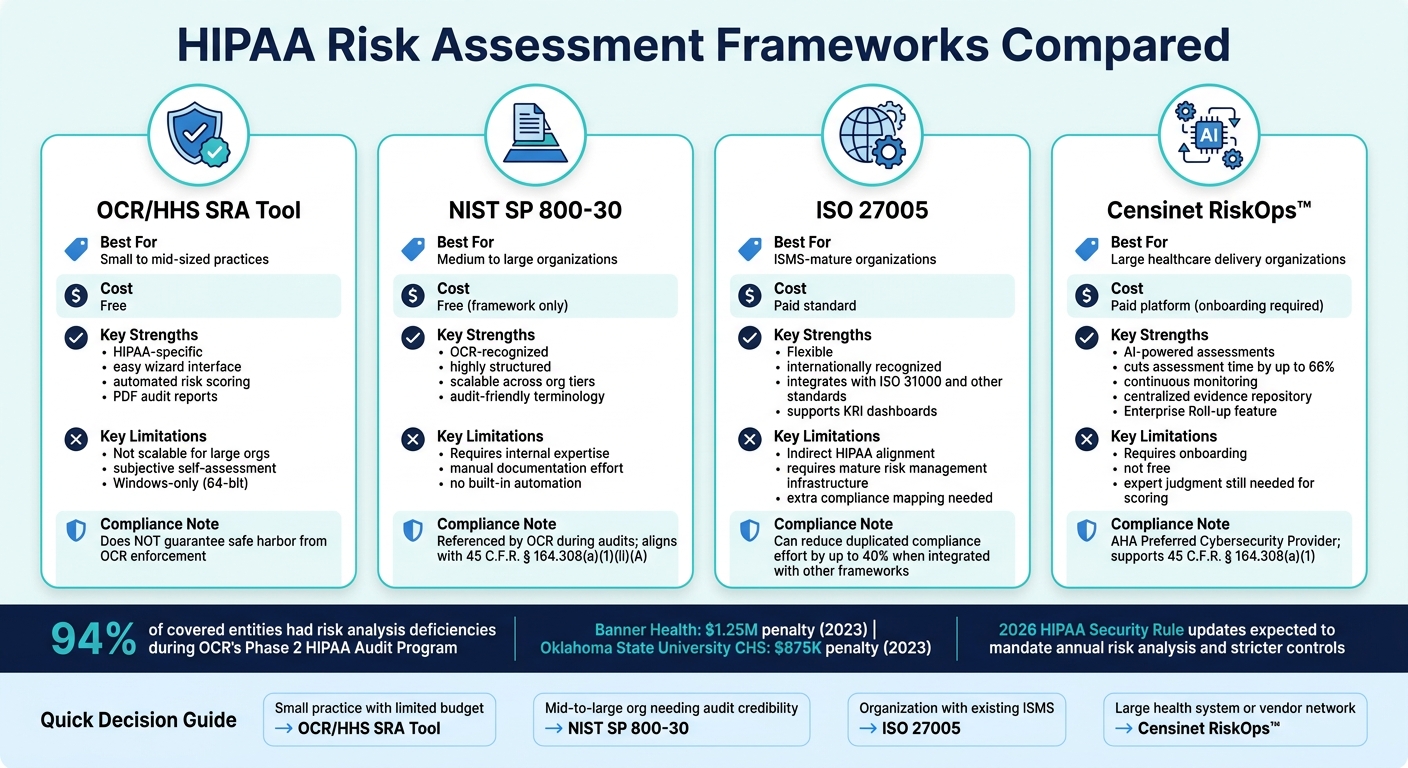
HIPAA Risk Assessment Frameworks Compared: Which One Is Right for You?
OCR Webinar: The HIPAA Security Rule Risk Analysis Requirement
sbb-itb-535baee
1. OCR/HHS Security Risk Assessment (SRA) Tool
The OCR/HHS SRA Tool serves as a practical starting point for smaller healthcare practices aiming to navigate compliance-focused risk assessments. While it offers a structured approach, its capabilities are somewhat limited for larger organizations.
This tool is a free resource developed by the Office of the National Coordinator for Health Information Technology (ONC) and the Office for Civil Rights (OCR). It’s available as a Windows desktop application or an Excel Workbook, and you can download it at no cost from HealthIT.gov [2].
Regulatory Alignment
The SRA Tool aligns its questions with the HIPAA Security Rule standards and implementation specifications under 45 C.F.R. § 164.308(a)(1)(ii)(A). It also uses the NIST SP 800-30 methodology to calculate risk scores [1][2]. In version 3.6, the tool updated its terminology, replacing "medium" with "moderate" to match current NIST standards [2]. However, it’s important to note that using the tool alone doesn’t ensure full compliance. OCR has clarified that a security questionnaire is not a substitute for a comprehensive risk analysis that identifies specific threats and vulnerabilities to ePHI assets. A 2023 enforcement action further emphasized this point [4].
Implementation Complexity
The tool features a wizard-style interface that walks users through multiple-choice questions on threat assessment and asset management, or use automated security questionnaires to streamline the process. This makes it approachable for smaller practices, though more technical guidance might be needed for addressing complex scenarios [2][5].
Scalability
The SRA Tool is primarily designed for smaller organizations. Official documentation highlights that it may not be suitable for larger entities managing ePHI across multiple locations, telehealth systems, medical devices, AI tools, or cloud platforms. These organizations may find the tool’s structured questionnaire format inadequate for capturing their broader risk landscape [2][6]. While it excels in helping smaller practices document risks, its limitations become apparent when applied to larger, more complex setups.
Automation and Documentation Support
The tool automates risk scoring and generates printable PDF audit reports [2]. In version 3.6, a "reviewed-by" feature was added, allowing users to log the date and username of the person approving each section, creating a clear audit trail for compliance [2]. Additionally, all data entered into the tool is stored locally on the user’s machine, ensuring that HHS does not collect, view, or store any submitted information [2].
"The tool's features make it useful in assisting small and medium-sized health care practices and business associates in complying with the Health Insurance Portability and Accountability Act (HIPAA) Security Rule." - HHS.gov [1]
2. NIST SP 800-30 Risk Assessment Framework
While the SRA Tool provides a straightforward starting point, NIST SP 800-30 offers a more detailed and structured approach. This framework serves as the backbone for many in-depth HIPAA risk assessments.
Regulatory Alignment
NIST SP 800-30 plays a key role in shaping HIPAA risk analysis practices. The HHS Office for Civil Rights (OCR) uses it as a foundational guide for securing electronic protected health information (e-PHI). It also meets the HIPAA Security Rule's requirement for Risk Analysis under 45 C.F.R. § 164.308(a)(1)(ii)(A) [1].
"Although only federal agencies are required to follow guidelines set by NIST, the guidelines represent the industry standard for good business practices with respect to standards for securing e-PHI." - HHS.gov [1]
One of the practical benefits of this framework is its precise definitions. Terms like "Vulnerability", "Threat", and "Risk" are clearly outlined, aligning with federal auditors' interpretations. This consistency helps reduce confusion during OCR reviews. Moreover, a published crosswalk connects broader security activities from the NIST Cybersecurity Framework to specific HIPAA Security Rule requirements, making compliance easier to navigate [3].
Implementation Complexity
The NIST SP 800-30 framework involves a detailed, step-by-step process: cataloging all e-PHI systems, identifying threats and vulnerabilities, assessing their likelihood and impact, and creating a prioritized remediation plan [9]. While this rigorous approach ensures thoroughness, it also demands careful documentation. Every aspect - from identifying threat-vulnerability combinations to assessing potential impacts - must be recorded to comply with HIPAA's documentation requirements under 45 C.F.R. § 164.316(b)(1) [1].
OCR enforcement trends highlight the importance of follow-through. Simply identifying risks isn't enough. Organizations must document remediation efforts, including assigning specific owners, allocating budgets, and setting clear deadlines [9].
Scalability
One of the strengths of NIST SP 800-30 is its ability to scale based on an organization's size and complexity [1]. This adaptability makes it suitable for a variety of healthcare entities, from small practices to expansive hospital networks. The framework supports a tiered approach, enabling assessments at different levels - organization-wide, mission/business processes, and individual information systems [7]. This is particularly useful for healthcare organizations that handle diverse data flows across electronic health records, cloud systems, and medical devices.
Automation and Documentation Support
As a guidance document, NIST SP 800-30 doesn't include built-in automation. However, its structured methodology forms the foundation for modern governance, risk, and compliance platforms. These platforms often include automated vendor risk solutions to streamline assessments. These tools can automate tasks like risk scoring, tracking remediation efforts, and generating audit-ready reports [8][9].
Looking ahead, proposed updates to the HIPAA Security Rule in 2026 suggest a shift toward quantitative risk ratings based on NIST methodology. This would replace the traditional "Low/Medium/High" labels with more precise numerical scoring [9]. Organizations that adopt this approach now will be better prepared for future regulatory changes.
This framework provides a solid foundation for further comparisons with alternative risk assessment methods.
3. ISO 27005 Risk Assessment Approach
ISO 27005 provides a structured approach to risk assessment, turning it into an ongoing process of identifying, evaluating, and addressing risks.
Regulatory Alignment
HIPAA’s regulation under 45 C.F.R. § 164.308(a)(1)(ii)(A) doesn’t demand a specific risk assessment method, giving organizations the flexibility to adopt ISO 27005 as long as they meet the essential requirements of the rule [1][11]. However, compliance goes beyond ticking boxes or conducting simple gap analyses. A proper risk assessment should quantify risks using a formula like Likelihood × Impact = Risk Score [10].
One of ISO 27005's strengths lies in its ability to integrate seamlessly with other standards. For instance, aligning it with frameworks like ISO 31000 and HIPAA’s Security Rule can streamline compliance efforts and cut down redundant work by nearly 40% [12]. As Chris Ekai, Content Manager at Risk Publishing, notes:
"Integrating ISO 31000, COSO ERM, and HIPAA into a single healthcare risk management framework eliminates siloed compliance and reduces duplicated effort by up to 40%." [12]
Implementation Complexity
The challenge with ISO 27005 isn’t the framework itself - it’s implementing it effectively. Viewing risk assessment as a once-a-year task is risky because threats can evolve quickly, leaving organizations vulnerable between reviews.
To make it work, organizations need clear accountability across three levels: clinical and operational leaders managing day-to-day risks, compliance officers overseeing the process, and internal audit teams providing independent validation [12].
Scalability
ISO 27005 is flexible enough to suit organizations of all sizes. Whether it’s a small 50-bed hospital or a sprawling multi-state health system, the framework adapts to varying scopes. This flexibility allows organizations to set risk boundaries based on their specific data environments and operational needs [12].
Automation and Documentation Support
Although ISO 27005 is a standard, not a software tool, its principles align well with modern risk management platforms. For example, it supports the use of Key Risk Indicator (KRI) dashboards that pull automated data from systems like EHRs, SIEMs, and financial tools [12]. This makes it easier to shift from periodic evaluations to continuous, real-time monitoring. This shift is often supported by real-time portfolio risk management tools that provide peer benchmarking. With recent OCR enforcement trends, this approach ensures organizations stay ready for an ever-changing risk landscape while complementing other detailed processes discussed earlier.
4. Censinet RiskOps™ Platform
Censinet RiskOps™ is a healthcare-focused software platform designed to simplify and scale HIPAA risk assessments. By incorporating frameworks like NIST SP 800-30 and ISO 27005, it helps execute, track, and document risk assessments efficiently. This platform takes these methodologies and adapts them to meet the unique challenges of healthcare organizations, making the process faster and more manageable.
Regulatory Alignment
Censinet RiskOps™ is tailored specifically for healthcare organizations, focusing on critical areas such as PHI (Protected Health Information), clinical applications, medical devices, and supply chains. It’s built to handle the recordkeeping and compliance requirements outlined in 45 C.F.R. § 164.308(a)(1). The platform provides structured workflows and centralized documentation to streamline compliance tasks. However, while it supports compliance efforts, it doesn’t replace the need for your organization’s legal and regulatory expertise.
Implementation Complexity
Adopting a risk management platform is only effective if it’s easy for your team to use. Censinet RiskOps™ offers three deployment models to fit different team sizes and needs:
- Self-Directed: Your internal team manages the entire process.
- Hybrid Support: Your team leads the process, with Censinet providing co-management.
- Fully Managed: Censinet handles everything from start to finish.
This flexibility ensures that even smaller teams can implement the platform without being locked into a rigid system. Additionally, the AI-powered Censinet Risk Assessor Agent significantly reduces workload, cutting assessment time by up to 66% [13][14].
Scalability
For healthcare organizations managing extensive vendor networks, devices, and business units, scalability is a must. Censinet RiskOps™ addresses this need with features like centralized assessment intake, standardized questionnaires, and an Enterprise Roll-up function. This feature consolidates compliance data from multiple locations - hospitals, clinics, or physician practices - into a single, unified view. This approach ensures consistency across large organizations while eliminating redundant efforts.
Automation and Documentation Support
Censinet RiskOps™ automates key processes to save time and improve accuracy. It generates findings and remediation recommendations based on questionnaire responses, identifies gaps in HIPAA Security Rule compliance, and assigns tasks to the appropriate experts for resolution. All evidence - such as policies, training records, and certifications - is stored in a centralized repository with a complete, time-stamped audit trail [13]. While automation streamlines workflows, expert judgment remains essential for tasks like risk scoring and prioritization. Recognized as an American Hospital Association (AHA) Preferred Cybersecurity Provider, Censinet has earned trust within the healthcare industry [13].
Pros and Cons of Each Framework
This section provides a concise comparison of the frameworks discussed earlier, highlighting their advantages and drawbacks. Each framework serves distinct needs, and the best fit depends on factors like your organization's size, resources, and level of compliance readiness.
The OCR/HHS SRA Tool, a free resource developed by the government, is tailored for small to medium-sized practices looking to simplify HIPAA compliance. However, it has its limits. It's built for 64-bit Windows systems, relies on subjective self-assessment, and isn't scalable for larger organizations. As noted by HealthIT.gov: "The target audience of this tool is medium and small providers; thus, use of this tool may not be appropriate for larger organizations." [2]. Importantly, completing the SRA Tool doesn't guarantee compliance or provide a "safe harbor" from OCR enforcement actions [2].
NIST SP 800-30 offers a structured, detailed methodology and is often referenced by OCR during audits [8][16]. It's suitable for organizations of varying sizes but demands significant expertise to implement effectively. Without that expertise, assessments can become inconsistent. ISO 27005 is another strong option, particularly for organizations already using an Information Security Management System (ISMS). However, it lacks direct alignment with HIPAA's specific requirements, potentially leading to extra work for compliance teams.
On the other hand, Censinet RiskOps™ fills gaps left by traditional frameworks, particularly in terms of speed, scalability, and continuous monitoring [13]. Unlike NIST and ISO, which typically involve periodic assessments, Censinet supports ongoing risk visibility. Its AI-powered Risk Assessor Agent reduces the workload, which is especially helpful for conducting effective third-party risk assessments for large vendor networks or multiple facilities [13][14]. However, it does require onboarding and isn't a free solution.
Here's a summary of the trade-offs:
| Framework | Best For | Key Strength | Key Limitation |
|---|---|---|---|
| OCR/HHS SRA Tool | Small to mid-sized practices | Free, HIPAA-specific, easy to use | Limited scalability and subjective self-assessment |
| NIST SP 800-30 | Medium and large organizations | OCR-recognized; highly structured | Requires internal expertise; manual effort |
| ISO 27005 | ISMS-mature organizations | Flexible; internationally recognized | Indirect connection to HIPAA specifics |
| Censinet RiskOps™ | Healthcare delivery organizations at scale | Continuous monitoring; AI-driven speed; centralized evidence | Requires platform onboarding; not a free tool |
As Colin J. Zick, Partner at Foley Hoag LLP, points out:
"The SRA Tool can be a practical starting point - particularly for resource-constrained practices that cannot justify a commercial governance-risk-and-compliance platform." [15]
This underscores the need for organizations to adapt their risk assessment strategies as they grow in size or complexity to meet evolving HIPAA demands effectively.
Conclusion
There’s no one-size-fits-all framework for healthcare organizations. The right option depends on factors like your organization’s size, available resources, and how far along you are in your compliance efforts.
For small to medium-sized practices, the HHS SRA Tool is a practical starting point. It’s free, user-friendly, and helps establish a solid compliance foundation without requiring advanced expertise or upfront costs. Larger health systems with dedicated IT and compliance teams might find NIST SP 800-30 more suitable, given its comprehensive and structured approach. Meanwhile, organizations managing complex environments or extensive vendor networks may turn to Censinet RiskOps™, which leverages automation and AI to provide continuous monitoring and streamline risk management tasks [13].
One thing is certain: the cost of getting risk management wrong is steep. During the OCR’s Phase 2 HIPAA Audit Program, 94% of covered entities were found to have risk analysis deficiencies. Financial penalties for these violations have reached millions - for example, in 2023, Banner Health paid $1.25 million, and Oklahoma State University Center for Health Sciences paid $875,000, both due to inadequate risk analyses [17].
With the 2026 Security Rule NPRM likely to mandate annual risk analysis updates and elevate controls like multi-factor authentication and encryption to required standards, there’s no better time to ensure your framework is up to the task [17]. Whichever approach you choose, make sure to document every review, perform regular updates, and include all electronic protected health information - from cloud storage to mobile devices and even shadow IT systems.
Ultimately, the best framework is the one your organization will use consistently, thoroughly, and with clear accountability for addressing every identified risk.
FAQs
How often should we update our HIPAA risk analysis?
The HIPAA Security Rule doesn’t specify an exact timeline for conducting risk analyses. However, it’s generally recommended to perform a formal review at least once a year. Additionally, you should reassess whenever there are major changes, like introducing new software, changing vendors, modifying remote work policies, or dealing with security incidents. Tools such as Censinet RiskOps can simplify these processes, helping maintain ongoing compliance and stay prepared for audits.
What documentation does OCR expect to see from a risk assessment?
The Office for Civil Rights (OCR) doesn’t mandate a particular approach for conducting risk analyses. However, it does expect organizations to provide accurate and comprehensive documentation. Key elements include:
- Detailed IT asset inventory and network diagrams that map out the flow of electronic protected health information (e-PHI).
- A comprehensive list of threats and vulnerabilities, along with the methodology used to assess and rate risks.
- Proof of remediation efforts and a well-structured risk management plan.
Additionally, all records must be kept for a minimum of six years.
How do we choose the right framework for our organization’s size and complexity?
When choosing a framework, think about your organization’s goals, available data, staffing levels, and how mature your governance processes are. If you're part of a larger organization with well-established governance, data-driven quantitative models might be a good fit. On the other hand, smaller organizations may find it more effective to prioritize practical, scalable methods.
Make sure the framework you select aligns seamlessly with your operational needs. Tools like Censinet RiskOps™ can help streamline the selection process and provide helpful benchmarks. For healthcare-specific scenarios, frameworks such as NIST CSF, HITRUST, or HICP can be adapted to meet the unique requirements of the industry.
