
Managing vendor risks in healthcare is no longer just about sending questionnaires or reviewing spreadsheets. With cyberattacks on the rise and regulations tightening, healthcare organizations face mounting challenges in protecting patient data and ensuring compliance. Traditional methods often fall short, delaying processes and leaving gaps in risk management.
AI-powered tools like Censinet RiskOps™ are changing the game. These solutions automate assessments, provide real-time risk insights, and help healthcare teams handle growing vendor networks efficiently. For example, organizations using AI report cutting incident detection time by 98 days and reducing attack success rates by 70%.
Key benefits of AI tools include:
1. Traditional Vendor Risk Assessments
Speed and Efficiency
Traditional vendor risk assessments tend to follow a sluggish and linear process, creating frequent bottlenecks. Security teams typically send out lengthy questionnaires via email, then wait for vendors to respond. Once responses come in, they manually review the answers, chase down missing documents like SOC 2 reports or Business Associate Agreements, and schedule follow-up meetings to clarify discrepancies. This back-and-forth can drag on for days or even weeks for each vendor, delaying critical contracts and system launches [2].
In the healthcare sector, this inefficiency is compounded by an 86% security staffing shortage [2]. Small teams are left drowning in the manual labor of managing spreadsheets and following up with vendors. Before the introduction of specialized tools, much of the effort went into administrative tasks rather than actual risk analysis [1].
Scalability
As the number of vendors grows into the hundreds or thousands, traditional methods struggle to keep up. Each assessment requires a hands-on review, limiting how much can be done based on the size of the team. Point-in-time questionnaires add to the workload, as teams often have to repeat the same process year after year. Many healthcare organizations even send slightly different but overlapping questionnaires to the same vendors, leading to redundant paperwork [1][2].
Without a centralized repository for previously collected data, teams are left juggling email threads, shared drives, and disconnected tools. This disorganization makes it nearly impossible to consistently identify high-risk vendors or monitor the progress of risk remediation efforts at scale [2].
Accuracy and Risk Mitigation
Traditional assessments lean heavily on self-reported data, with little to no technical validation [2]. Static risk matrices often oversimplify complex healthcare-specific risks by reducing them to basic low/medium/high scores. These matrices rarely consider critical factors, such as whether a vendor handles protected health information (PHI) versus administrative data, or how the failure of a critical system could disrupt clinical operations [2].
Even when a vendor passes an assessment and a contract is signed, follow-ups on remediation tasks are often inconsistent and rely on manual tracking [2]. This leaves room for vulnerabilities to go unnoticed, including supply chain risks and issues that could directly impact patient safety. These gaps also make it harder to meet healthcare-specific compliance requirements.
Healthcare-Specific Compliance
Generic tools often fall short when addressing the unique challenges of the healthcare industry. As Matt Christensen, Sr. Director GRC at Intermountain Health, put it:
"Healthcare is the most complex industry... You can't just take a tool and apply it to healthcare if it wasn't built specifically for healthcare"
.
Traditional assessments typically ask about compliance with HIPAA and HITECH, but vendors often respond with a simple "yes" without providing robust evidence of encryption, access controls, or incident detection capabilities [2].
For clinical applications and medical devices, standard questionnaires struggle to assess technical needs like integration requirements, network segmentation, or patching limitations on regulated devices [2]. Fragmented responsibilities across biomed, IT, and clinical teams further slow down assessments. Meanwhile, legacy systems that are difficult to update create ongoing risks that traditional methods acknowledge but rarely address effectively [2].
2. AI-Powered Tools (e.g., Censinet RiskOps™)
Speed and Efficiency
AI-powered platforms streamline processes and eliminate the bottlenecks of traditional workflows. Take Censinet RiskOps™, for example - a cloud-based platform designed for seamless cybersecurity data sharing. It connects a collaborative network of over 50,000 vendors and products, cutting out the need for endless email chains and spreadsheet exchanges. Instead of waiting days for responses, organizations can access a shared repository where vendors have already completed their assessments [1].
With Censinet AI™, the process speeds up even more. Vendors can complete security questionnaires in just seconds. The platform goes further by automatically summarizing evidence, capturing integration details and fourth-party risks, and generating detailed risk reports [1].
Scalability
The architecture of Censinet RiskOps™ is built to tackle the scalability issues that plague traditional methods. Through Censinet Connect™, vendors can share completed questionnaires and supporting evidence with potential customers early in the sales cycle. This eliminates the need for redundant assessments across hundreds of healthcare organizations.
"Not only did we get rid of spreadsheets, but we have that larger community [of hospitals] to partner and work with." - James Case, VP & CISO at Baptist Health
This approach not only scales effortlessly but also lays the groundwork for sharper, more effective risk management.
Accuracy and Risk Mitigation
AI-driven tools like Censinet RiskOps™ shift the focus from reactive questionnaire handling to proactive risk management. By leveraging collective intelligence, the platform helps healthcare organizations benchmark their cyber preparedness, maturity, and resilience against industry standards.
"Benchmarking against industry standards helps us advocate for the right resources and ensures we are leading where it matters." - Brian Sterud, CIO at Faith Regional Health
Automated evidence validation and real-time risk data updates reduce the chances of human error, delivering more accurate assessments than manual spreadsheet systems ever could. This network-based model provides the up-to-date insights organizations need to address the constantly changing cybersecurity threats in healthcare.
Healthcare-Specific Compliance
Beyond improving efficiency and accuracy, Censinet RiskOps™ is tailored to meet the unique compliance challenges of the healthcare industry. It’s specifically designed to manage risks tied to patient data, PHI, clinical applications, medical devices, and supply chains. The platform features AI-powered routing and orchestration, functioning like an "air traffic control" system for AI governance. This ensures critical findings and tasks are routed to the right stakeholders - such as AI governance committees - for timely action and review.
With workflows tailored for healthcare, the platform ensures compliance with regulations like HIPAA, HITRUST, and NIST without relying on generic questionnaires. Notably, Censinet was recognized by TIME Magazine as one of the World's Top HealthTech Companies of 2025 for its performance in Health Information & Management [1].
sbb-itb-535baee
Strengths and Weaknesses
Traditional vs AI-Powered
Methods in Healthcare
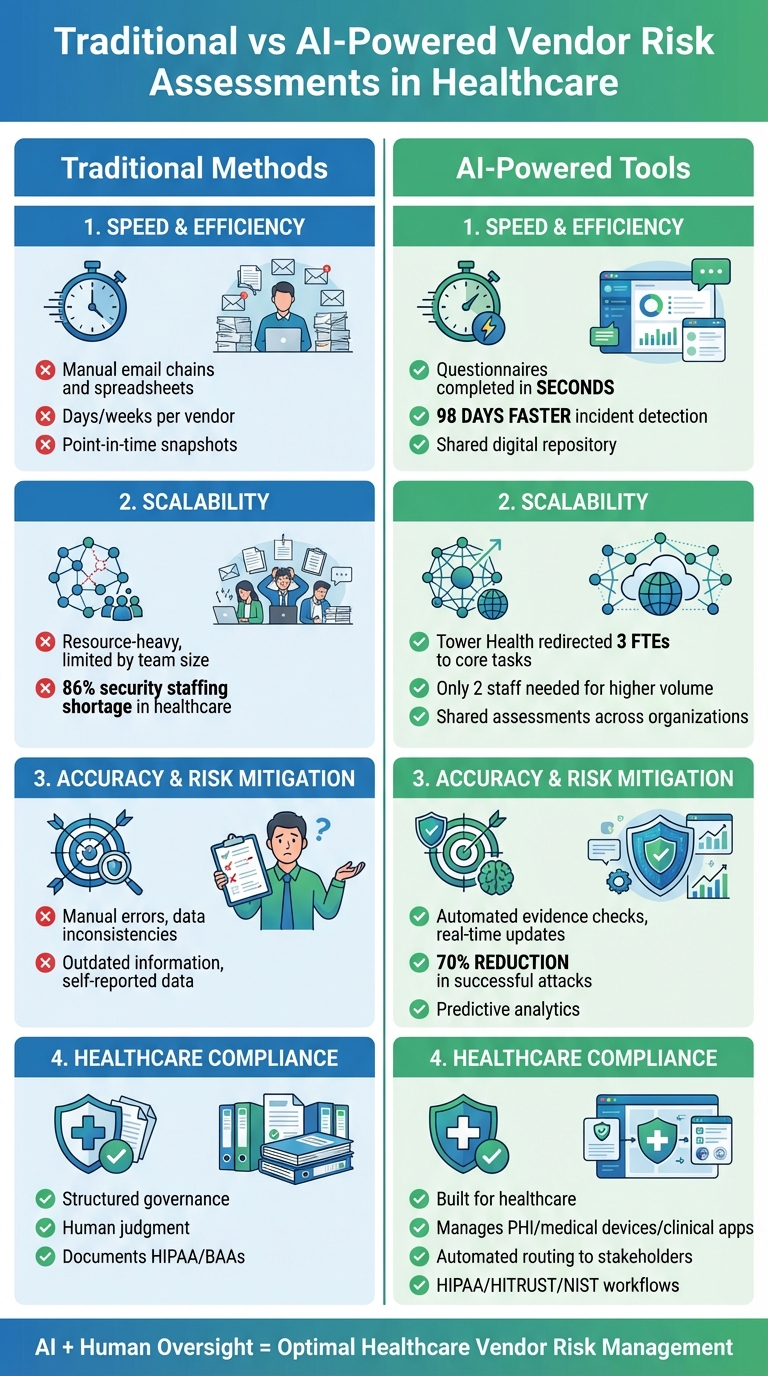
When healthcare organizations assess their vendor risk management strategies, it's vital to weigh the differences between traditional methods and AI-driven tools. The table below highlights how these approaches compare across critical areas: speed, scalability, accuracy, and healthcare compliance.
Risk assessments are often delayed due to manual processes like emailing and managing spreadsheets. These methods only provide a snapshot of risk at a single point in time.
With tools like
.
Resource-heavy processes make it tough to handle large vendor networks, especially with 86% of healthcare organizations facing security staffing shortages
.
also enables vendors to share completed assessments across multiple organizations, cutting down on duplicate efforts.
Manual workflows are prone to errors, data inconsistencies, and outdated information. They also fail to account for risks that evolve over time.
Automated evidence checks and real-time updates minimize errors. Predictive analytics further reduce successful attacks by 70%
.
Traditional methods maintain structured governance and document HIPAA and Business Associate Agreements. They rely heavily on human judgment to address patient safety and clinical risks.
Built specifically for healthcare, AI platforms manage risks tied to patient data, PHI, clinical applications, medical devices, and supply chains. Advanced routing ensures critical issues reach the right stakeholders, while workflows align with HIPAA, HITRUST, and NIST standards.
This comparison makes it clear that while traditional methods excel in governance and human oversight, they often fall short in meeting the demands of modern healthcare. AI-powered tools bring speed, scalability, and precision to the table, addressing gaps in traditional approaches. By combining AI automation with expert review, healthcare organizations can streamline repetitive tasks while ensuring critical decisions are handled strategically - ultimately improving vendor risk management.
Conclusion
The move from traditional vendor risk assessments to AI-powered tools is reshaping how healthcare organizations manage vendor risks. While traditional methods offer structured governance and the benefit of human oversight, they often fall short in handling the complexities of modern vendor networks and the rapidly evolving threat landscape. AI-powered platforms step in to fill these gaps with their speed, scalability, and ability to provide continuous monitoring - capabilities that are becoming essential in today’s fast-paced digital healthcare environment.
When considering AI-driven solutions like Censinet RiskOps™, healthcare organizations should focus on tools specifically designed to address the unique challenges of the healthcare sector. Beyond efficiency and automation, specialized solutions bring alignment with healthcare’s distinct needs. As industry experts emphasize, effective platforms must handle critical risks tied to patient safety, the protection of PHI, medical devices, and clinical applications. Unlike generic tools, these tailored solutions offer the continuous monitoring required to meet healthcare’s rigorous demands.
To implement AI tools effectively, organizations need to ensure consistent governance from the initial assessment phase through to incident response. Embedding risk assessment early in the process - by evaluating strategic alignment, executive sponsorship, and its impact on enterprise, clinical, and patient safety domains - is crucial. This ensures AI tools enhance decision-making rather than replace it, particularly for high-stakes risks like diagnostic errors or treatment delays. The blend of automated intelligence and human oversight strengthens performance and aligns with earlier discussions on AI’s role in healthcare risk management.
Platforms like Censinet RiskOps™ have shown measurable benefits, with some organizations reallocating the equivalent of three full-time employees to other priorities while conducting more assessments with fewer resources [1]. However, success hinges on selecting tools that integrate cybersecurity metrics with clinical safety, comply with HIPAA and HITRUST standards, and offer centralized governance for ongoing oversight.
FAQs
How does AI speed up vendor risk assessments in healthcare?
AI is transforming how vendor risk assessments are handled in healthcare by taking over tedious tasks such as data collection and analysis. This automation cuts out the need for manual follow-ups, making workflows smoother and enabling organizations to evaluate risks much faster.
By leveraging AI, healthcare providers can keep tabs on risks in real time and manage a larger number of assessments without overwhelming their teams. This not only speeds up decision-making but also maintains high standards of accuracy and security - critical factors when dealing with sensitive information like patient records and clinical systems.
How can AI help solve healthcare compliance challenges?
AI offers healthcare organizations a way to navigate compliance challenges more efficiently. It can automate tasks such as maintaining HIPAA compliance, protecting patient data privacy, and simplifying regulatory reporting processes. Additionally, AI tools enable continuous monitoring for cybersecurity threats, helping organizations stay aligned with industry standards and safeguard sensitive information.
By integrating AI, healthcare providers and vendors can cut down on manual work, enhance accuracy, and respond faster to compliance needs. This not only strengthens patient data protection but also boosts overall operational efficiency.
How does AI improve the accuracy of vendor risk assessments in healthcare?
AI-driven platforms such as Censinet RiskOps™ enhance vendor risk assessments by automating intricate tasks and delivering real-time insights. By using advanced algorithms, these tools can identify, evaluate, and address risks with a level of precision that surpasses traditional approaches.
Built with healthcare in mind, these solutions simplify the assessment process by tackling specific challenges like protecting patient information, securing clinical systems, and managing risks tied to medical devices and supply chains. This approach provides healthcare organizations with a more efficient and dependable way to handle risk management.
