
IoT penetration testing helps hospitals find device, app, API, and network gaps before they lead to PHI loss or care disruption. In U.S. healthcare, breaches grew from 216 in 2010 to 566 in 2024, and hacking-related cases rose from 4% to 81%. I’d sum up the article this way: if you only scan devices and check compliance boxes, you can still miss the attack path that lets someone move from a weak medical device to EHR, PACS, billing, or identity systems.
Here’s the short version:
- Healthcare IoT is bigger than most teams think: it includes bedside devices, imaging systems, remote monitors, mobile apps, gateways, cloud platforms, and APIs.
- Common weak points are simple: default passwords, old firmware, open ports, weak encryption, poor network separation, and bad update controls.
- The main risk is chain attacks: one compromised device can lead to PHI access, ransomware, or changes to device settings and service availability.
- Penetration testing goes past scanning: I’m looking at whether an attacker can use those weaknesses, move across the network, and reach sensitive systems.
- Good testing checks the full stack: firmware, wireless protocols, admin panels, mobile apps, cloud backends, APIs, and network controls.
- The fix is the point: results should lead to stronger authentication, TLS 1.2+, signed updates, least-privilege access, and tighter segmentation.
- Timing matters: testing should happen during procurement, before go-live, after major changes, at set review points, and after fixes.
A simple way to think about it: vulnerability scans tell you what is there; penetration testing shows you what an attacker can do with it. That difference matters when the average healthcare breach costs about $10 million to $11.45 million per incident.
If you want to cut breach risk, protect PHI, and limit device-based attack paths, IoT penetration testing needs to be part of your device and third-party vendor risk management process - not a one-off task.
Breaking Bad Stealing Patient Data Through Medical Devices
sbb-itb-535baee
The Problem: How IoT Weaknesses Lead to PHI Exposure and Operational Risk
Building on the exposed IoT attack surface, the main danger shows up after a device gets hit. Once an attacker gets into one connected device, the damage doesn’t stay neatly contained. It can spill into patient privacy, day-to-day care delivery, and HIPAA duties.
Common Vulnerabilities in Medical Devices and Connected Health Systems
The biggest weak spots in medical IoT go past simple setup mistakes. Cleartext traffic, weak encryption, and insecure firmware update mechanisms leave open gaps in device communications and integrity [2][8]. Exposed debug ports, insecure firmware updates, and weak logging can reveal device internals, allow malicious code to run, and make attacker activity harder to spot [2][3][4][6].
That matters because these aren’t small technical hiccups. They cut into the HIPAA Security Rule’s expectation that covered entities protect the confidentiality, integrity, and availability of PHI against reasonably anticipated threats [4][6][9].
How a Compromised Device Can Open a Path to Larger Systems
One compromised device can turn into a doorway for a much bigger breach. After getting a foothold, an attacker can map the local network and move laterally to radiology workstations, PACS servers, or domain controllers with standard tools [2][8][10]. From there, they may pull PHI from EHR or billing platforms, or launch ransomware that locks critical data stores and interrupts care [5][12].
A weak device doesn’t just put that device at risk. It can expose bigger failures tied to identity, data protection, and system recovery across the whole environment. HIPAA risk analysis under 45 CFR §164.308 has to account for that kind of lateral movement [4][6][9].
Why Compliance Alone Does Not Prove Real-World Resilience
Inventories, policies, and scans matter. But they don’t prove an attacker can’t exploit a device or pivot into other systems.
Scans usually catch known CVEs and basic misconfigurations. What they often miss are logic flaws in proprietary protocols, insecure cloud backends, or lateral movement paths into EHR, PACS, or billing systems under realistic conditions [2][8][10][11]. That’s the gap. On paper, things may look fine. In practice, one weak link can still let an attacker walk deeper into the network.
The FDA’s 2023 final guidance, Cybersecurity in Medical Devices: Quality System Considerations and Content of Premarket Submissions, treats cybersecurity as a core quality system issue. It expects manufacturers to maintain SBOMs, vulnerability management plans, and secure update mechanisms throughout a device’s lifecycle [13][14][15]. NIST resources, including NISTIR 8259 and 8259A, set a baseline for what buyers and operators should demand from IoT devices: secure updates, access control, logging, and encryption [7][9].
Penetration testing helps answer the part compliance paperwork can’t: whether those controls actually hold up when someone tries to break them.
The Solution: What IoT Penetration Testing Examines in Healthcare Environments
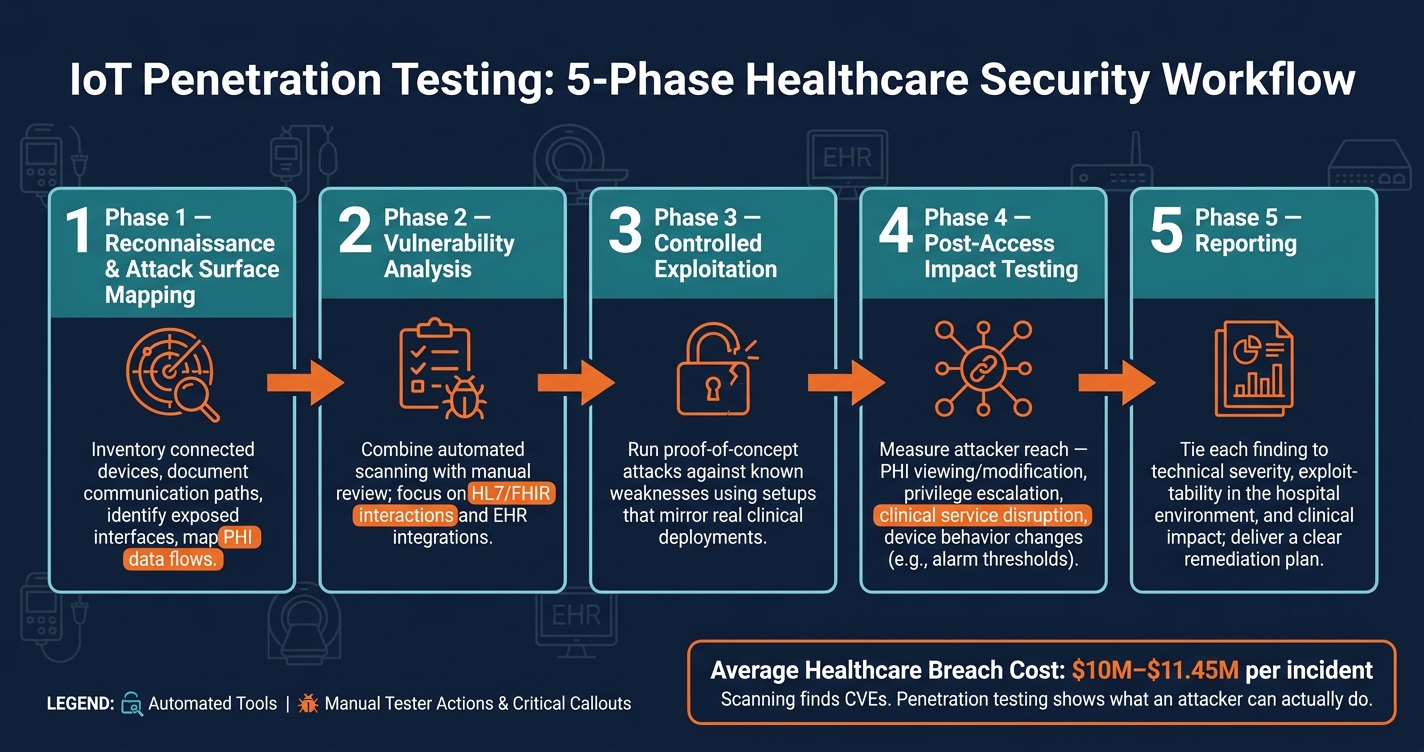
IoT Penetration Testing: 5-Phase Healthcare Security Workflow
When scans and compliance checks stop before they show a real path to attack, penetration testing picks up the slack. In healthcare, IoT penetration testing is a time-boxed, exploit-based test of production-like devices, apps, APIs, and network paths to prove whether an attacker could reach PHI or interrupt care. FDA guidance treats penetration testing as a core way to check whether security controls actually work [20][23].
Testing the Full IoT Ecosystem, Not Just the Device Itself
A good test looks at the whole chain: the device, the app, the backend, and the data path. That matters because many breaches don't stay in one layer. They move from the device to the app, then into the backend.
So the scope needs to include firmware, wireless protocols such as Wi-Fi, Bluetooth/BLE, Zigbee, and proprietary RF, plus admin consoles, companion mobile apps, cloud backends, and APIs. That also includes FHIR and REST endpoints used to exchange patient data [18][19][21].
Network boundaries matter just as much as the device itself. Testers check whether VLANs, firewalls, and NAC policies can stop movement between clinical IoT zones and core hospital systems like EHR platforms, PACS servers, and identity systems. That's what turns a device test into something that reflects how a hospital actually runs.
A Practical Testing Flow from Attack Surface Mapping to Impact Validation
In practice, the work moves from mapping to exploitation to impact. A well-run healthcare IoT penetration test usually follows five phases:
- Reconnaissance and attack surface mapping - inventory connected devices, document communication paths, identify exposed interfaces, and map where PHI moves [16][19][21].
- Vulnerability analysis - combine automated scanning with manual review, with close attention to healthcare-specific issues such as HL7/FHIR interactions and EHR integrations [16][19][21].
- Controlled exploitation - run proof-of-concept attacks against known weaknesses using setups that match real clinical deployments.
- Post-access impact testing - measure how far an attacker could go. Can they view or change PHI? Escalate privileges? Interrupt clinical services or change device behavior, such as alarm thresholds? This phase measures PHI exposure and service disruption [19][21][22].
- Reporting - tie each finding to technical severity, exploitability in the hospital's actual environment, and likely clinical impact, so security and operations teams get a clear fix plan [19][21][22].
What Penetration Testing Finds That Scanning Alone May Miss
Automated scanners are good at finding known CVEs and surface-level misconfigurations. What they don't do well is connect weak points the way an attacker would. A penetration tester can build a multi-step attack chain, such as using a default password on an admin console to get in, then abusing an unencrypted API to pull PHI, and then using that access to move into a backend database segment [2][17][21].
That kind of testing also shows whether segmentation, detection, and response hold up during an actual attack. The result is much more concrete: teams can see exactly where authentication, encryption, and segmentation need work.
How Penetration Testing Prevents Data Breaches in Practice
Finding a flaw is only half the battle. What matters is the fix that follows. That’s where penetration testing earns its keep.
Using Findings to Harden Authentication, Encryption, Updates, and Segmentation
The goal of testing isn’t to produce a long report that sits in someone’s inbox. It’s to push exact fixes.
Each finding should map to a control change. Shared or default credentials should be replaced with unique, role-based accounts tied to the hospital’s identity and access management system. Device-to-backend traffic should use TLS 1.2 or higher, and teams should remove hardcoded keys and old protocols. Vendors should support signed, encrypted remote updates with approval logging. High-risk functions should also be limited by least-privilege access, so one compromised account can’t wander into systems outside its assigned scope.
That shift matters. A test result becomes more than a warning. It becomes a to-do list with clear next steps.
Confirming That Attackers Cannot Pivot from IoT Devices to Critical Assets
Penetration testing also helps shut down the most direct attack routes by showing whether segmentation actually stops pivoting.
Testers start from the network position of a compromised device and try to reach EHR servers, PACS systems, pharmacy platforms, and domain controllers. They may use credential reuse, protocol tunneling, or firewall rule mistakes to do it. If those attempts work, the output is concrete: which ports were open, which rules broke down, and which accounts made the pivot possible.
If the attempts fail, that matters too. The organization now has documented proof that segmentation is doing its job.
Comparing Testing Approaches and Expected Outcomes
Not all testing answers the same question. Scope changes the result.
Vulnerability scanning finds known CVEs, but it doesn’t show whether an attacker can chain those issues into PHI access. In plain English, lateral movement paths may still be unknown. By contrast, exploit-driven, ecosystem-wide penetration testing looks across devices, networks, EHRs, PACS, APIs, and vendor channels. That shows which paths stop PHI exposure and which ones still let an attacker move from a compromised device into critical systems.[20][24]
Lifecycle-integrated testing keeps that proof current over time. As firmware changes, network settings shift, and vendor practices change, new weaknesses can appear. Testing at intervals helps catch them before an attacker does.
Censinet RiskOps™ brings device and vendor risk data into one place, tracks penetration test results over time, and ties remediation back to procurement and monitoring.
Conclusion: Making IoT Penetration Testing Part of Healthcare Risk Management
IoT penetration testing cuts breach risk by showing how attackers can get to PHI. It isn't a one-time check. It's a risk control that belongs inside the healthcare risk management cycle, where teams work to lower both the odds and the fallout of breaches tied to PHI and clinical systems. With average breach costs at $10–11.45 million per incident[25][1], skipping testing leaves risk on the table.
Build Testing into the Device and Vendor Risk Lifecycle
When testing finds a weak spot, timing matters. A gap caught at the right moment can become a fix. Caught too late, it can turn into a breach.
That’s why testing should connect to procurement, go-live, annual or risk-based reviews, major configuration changes, and post-remediation retesting. Putting testing at those points helps teams spot issues early and keep risk in view as devices, settings, and vendors shift over time.
Use Centralized Risk Operations to Turn Findings into Action
Findings only matter if teams follow them through to closure. Censinet RiskOps™ gives healthcare organizations one place to track test evidence, connect findings to devices and vendors, track remediation across medical devices, PHI systems, clinical applications, and supply chain services, and record retest results. That creates an audit trail that supports internal and regulatory reviews.
It also supports cybersecurity benchmarking, so organizations can rank vendor risk using exploit evidence, not questionnaires alone.
Key Takeaways for Healthcare Security Leaders
The point isn't just to do more testing. It's to reduce breach risk again and again in a way teams can repeat.
- Healthcare IoT expands the attack surface, and scanners alone miss exploitable attack chains - penetration testing mirrors attacker behavior to find chained exploits and lateral movement that automated tools may not catch.
- Remediating findings reduces both privacy risk and patient safety risk - connected devices often run legacy operating systems and connect straight to PHI, which makes them tempting entry points with direct clinical impact.
- Tracked remediation is what makes testing matter - findings need to flow into risk management, vendor oversight, remediation tracking, and audit-ready documentation to support stronger PHI protection and safer clinical operations.
FAQs
How is IoT pen testing different from a vulnerability scan?
Vulnerability scanning is an automated baseline check that spots known weaknesses, such as unpatched software, open ports, or outdated protocols.
Penetration testing goes a step further. It is an independent, adversarial process where testers try to chain weaknesses together, get around controls, and simulate attacks on a device or clinical workflow the way an attacker would.
Which healthcare systems should be included in IoT pen testing?
Healthcare systems should prioritize penetration testing based on risk, clinical criticality, and the chance of patient harm. High-risk devices - such as life-sustaining equipment, implanted systems, imaging systems, and infusion pumps - should get the deepest and most frequent testing.
The scope should cover the device’s full environment: hardware, firmware, mobile apps, APIs, and cloud interfaces. Put extra attention on devices that store or process patient data, connect to the internet, or tie into hospital networks.
How often should hospitals test IoT devices for security?
Hospitals should follow a risk-based testing schedule.
For broad coverage, run penetration tests at least quarterly. For high-risk or internet-facing IoT assets, test more often - up to monthly or even continuous testing. And any time there’s a major configuration change, a new device is added, or firmware is updated, test again.
Penetration testing should also be paired with ongoing vulnerability assessments and regular scans. That way, teams can catch issues that show up in the gaps between tests.
