
If your healthcare organization handles data from New York residents, SHIELD can add more work than HIPAA alone. I’d boil it down to three things: more data is in scope, the notice window is shorter, and vendor oversight matters more than many teams expect.
Here’s the short version:
- SHIELD applies beyond New York-based providers. If I handle computerized private information of New York residents, the law can apply even if my organization is elsewhere.
- It covers more than HIPAA-style health records. It can reach login credentials, biometric data, insurance details, billing data, and, starting March 21, 2025, medical and health insurance information.
- HIPAA alignment helps, but it doesn’t solve everything. A HIPAA security program may satisfy part of SHIELD, but breach notice duties still follow New York rules.
- The clock moves faster. HIPAA generally allows up to 60 days for notice, while New York requires notice within 30 days and may require notice to state agencies too.
- Access without clear permission can still trigger a review. You may need to investigate even when there’s no proof data was stolen.
- Vendors are a major risk point. In 2023, 60% of healthcare data breaches were tied to third parties, with an average cost of about $10 million per incident.
- Enforcement is active. The New York Attorney General has collected more than $6.4 million in SHIELD-related settlements since 2020.
What would I do first?
- Map where SHIELD-covered data lives
- Tighten access, logging, MFA, and encryption
- Test incident response against New York’s 30-day notice rule
- Review HIPAA-compliant vendor risk management and oversight
This means SHIELD is less about reading the statute and more about making sure security, privacy, legal, IT, and procurement can act fast together.
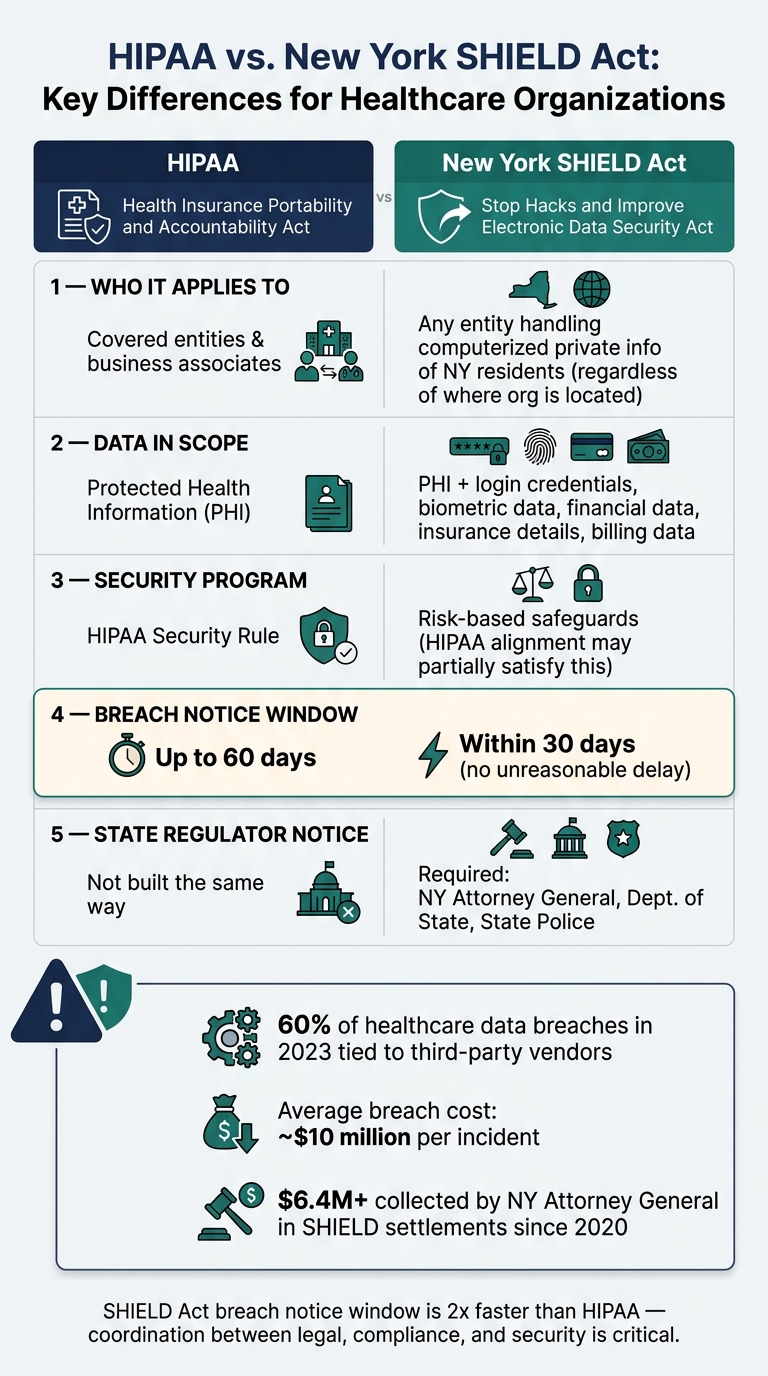
HIPAA vs. New York SHIELD Act: Key Differences for Healthcare Organizations
Quick Comparison
| Area | HIPAA | New York SHIELD Act |
|---|---|---|
| Who it can apply to | Covered entities and business associates | Any entity handling computerized private information of New York residents |
| Data in scope | PHI | PHI plus items like credentials, biometric data, financial data, and insurance data |
| Security program | HIPAA Security Rule | Risk-based safeguards; HIPAA alignment may help satisfy this part |
| Notice to individuals | Up to 60 days | Within 30 days |
| State regulator notice | Not built the same way | Notice may be required to NY agencies and the NY Attorney General |
If I were leading a healthcare security or compliance team, I’d treat SHIELD as a data inventory, access control, vendor risk management, and incident response problem all at once.
sbb-itb-535baee
How the SHIELD Act changes healthcare risk and compliance obligations
Broader definitions of private information increase the compliance surface
SHIELD pushes healthcare compliance past the EHR and into billing, telehealth, identity, and third-party systems. That means a patient portal username and password stored in a CRM, biometric access used to sign in to a clinical workstation, or insurance data sitting in a billing platform can all fall within scope.
Data mapping gets harder, and it can't wait. Sensitive data shows up in log files, exports, support tickets, and backups too. So inventories can't be a one-time project. They need to stay current. That takes steady discovery work, with input from IT, security, privacy, and application owners, so teams know where protected data moves and who can access it.
The result is pretty simple: a larger data footprint makes both control design and data discovery tougher.
Reasonable administrative, technical, and physical safeguards are now core
SHIELD requires a documented, risk-based security program that is implemented and maintained. Administrative, technical, and physical safeguards should cover ownership, training, risk assessments, least privilege, MFA, encryption, logging, monitoring, badge access, device protection, and secure disposal.
It's not enough to say controls exist on paper. Teams have to show they're active. Break-glass access should be logged, limited by time, and reviewed. Even a strong technical stack falls short if day-to-day execution varies across clinical and administrative workflows.
And that's the hard part. A policy may look solid in a binder, but if access reviews slip or badge controls aren't enforced, risk stays on the table.
Unauthorized access can trigger response duties even without confirmed data theft
Under SHIELD, unauthorized viewing can trigger response duties even without proof of copying or downloading. That changes the burden of investigation in a big way.
In practice, uncertainty is where the work starts. If a team doesn't yet know whether data was stolen, that isn't the end of the matter. It's the beginning. Security teams need to preserve logs, analyze account activity, review endpoint and cloud telemetry, and bring legal and compliance in early. In healthcare settings, that can get messy fast. Legacy systems, shared accounts, and partial logging make it much harder to piece together what happened.
Take a common example: an employee opens a patient file without a clear business reason. That may call for a full review of the user's role, the timing of the access, the scope of files viewed, and what happened next before the team can decide whether the event is reportable under New York law.
That puts the biggest pressure on legacy systems, third parties, and cross-team response coordination.
The biggest challenges healthcare organizations face under the SHIELD Act
Legacy systems, clinical workflows, and distributed data make safeguards harder to enforce
The hard part isn't reading the rule. It's making the rule work across messy systems, busy care teams, and outside vendors.
Most hospitals and health systems weren't built for SHIELD's broader compliance scope. Many still rely on older applications, connected medical devices, and a mix of on-premises and cloud systems spread across more than one care site. On paper, SHIELD requires safeguards. In practice, proving those safeguards exist - and stay in place - can be tough.
Medical devices show the problem pretty clearly. A lot of them still run unsupported operating systems, which limits patching and monitoring. Then add distributed care sites to the mix. All of a sudden, figuring out where private information lives, how it moves, and who accessed it becomes a daily operations issue, not just a policy problem.
Internal controls only solve part of it. Vendor controls can create the same weak spots.
Third-party and supply chain risk can undermine compliance
SHIELD explicitly requires organizations to select service providers capable of maintaining appropriate safeguards and to contractually require those safeguards.[6] That's a direct compliance duty, not just a nice-to-have.
The risk isn't small. In 2023, 60% of healthcare data breaches were caused by third-party vendors, at an average cost of about $10 million per incident.[11] Organizations can be held responsible for vendor breaches when safeguards are inadequate.[5]
That means vendor review can't stop after procurement signs the contract. Selection, contracting, and continued oversight are all part of the job. In plain English: third-party oversight becomes a standing governance task.
And when a breach does happen, those same gaps can slow down notice and escalation.
Breach notification coordination is difficult across legal, compliance, and security teams
SHIELD and HIPAA don't line up neatly. They use different definitions, different timelines, and different notification recipients. HIPAA generally allows 60 days from breach discovery to notify affected individuals and OCR. SHIELD now requires notice within 30 days, with no unreasonable delay.[4][9] That alone puts pressure on internal coordination.
SHIELD also requires notice to the New York Attorney General, Department of State, and State Police, and the required content doesn't match standard HIPAA templates.[1][9] So legal, compliance, and security teams need to move together on the investigation, the notice, and patient communications.
Without a shared playbook and a clear escalation path, delays are easy to imagine. One team waits on facts. Another waits on legal review. Meanwhile, the clock keeps ticking. That kind of misalignment can increase enforcement risk.
The state has shown it's willing to act. The NYAG has collected more than $6.4 million in settlements since 2020 for SHIELD Act-related violations, including several healthcare cases.[8] That's a pretty plain signal: enforcement is active, and coordination failures can get expensive fast.
Practical steps to strengthen SHIELD Act compliance and data security
The day-to-day response is pretty simple: know where the data lives, limit who can touch it, and bring vendors into the same control program.
Build a risk-based control program around data inventory, access, and monitoring
Start with a current map of where New York residents' private information is stored, processed, and transmitted across every system that handles SHIELD-covered data.[12][13][14]
That map can't be a one-and-done exercise. Systems change. New integrations get added. Older platforms get retired. Your inventory has to keep up with all of it.[6][7]
Once you have that inventory, use it to shape your control program. That means:
- Role-based access
- Least privilege
- MFA for remote and privileged access
- Encryption
- Centralized logging
- Routine testing[9][3][6][7]
Not every system needs the same level of attention on day one. Start with the highest-risk systems first, then test them with scans, penetration tests, and tabletop exercises.[3][6][7]
Formalize third-party risk management and contract oversight
Service providers need close review too. Vet them for security capability and manage third-party risk, then put clear terms into contracts for safeguards, breach notice, data handling, disposal, and subcontractors.[9][12][15]
It also helps to run security, compliance, and procurement through one shared workflow. That cuts down on gaps, back-and-forth, and last-minute surprises.
Use Censinet RiskOps™ to scale assessments, benchmarking, and remediation
Censinet RiskOps™ helps healthcare organizations manage SHIELD-related risk across vendors, clinical systems, and internal teams. It centralizes assessments, benchmarking, and remediation, while Censinet AI™ speeds questionnaires, summarizes evidence, and surfaces fourth-party risk.
Conclusion: What healthcare leaders should do next
SHIELD isn't a one-time checkbox. It calls for ongoing safeguards, faster action when unauthorized access happens, and steady alignment with New York notice rules.[2][10]
The pressure is hard to ignore. In 2024, U.S. healthcare organizations filed 592 reported hack cases with HHS OCR, affecting a record 259 million Americans.[17][19] And with roughly 30% of breaches happening at business associates, third-party risk stays near the top of the list.[18]
So the next move is simple: execute. These risks point to three near-term priorities:
- Refresh data inventories across all SHIELD-covered systems and vendors.[9][12]
- Test unauthorized-access response against SHIELD's trigger.[15]
- Tighten vendor oversight.[9][12][15]
For teams that need to put those steps into practice across a large environment, Censinet RiskOps™ brings third-party and enterprise risk assessments, control mapping, and remediation tracking into one place.[16]
Organizations that treat SHIELD as an ongoing risk program will be in a stronger position for the next breach or regulatory inquiry.
FAQs
Does SHIELD apply if my organization is not based in New York?
Yes. The SHIELD Act applies to any person or business that owns or licenses computerized data with the private information of a New York resident no matter where that person or business is based.
So if your healthcare organization handles that kind of data, it must comply with the law’s requirements.
What healthcare data counts as private information under SHIELD?
Under the SHIELD Act, private information generally means a person’s name linked to sensitive identifiers, such as:
- Social Security number
- Driver’s license or non-driver ID number
- Financial account number plus a security code, access code, or password
It also covers biometric data, including fingerprints, voiceprints, and retina images.
And it applies to login details too: an email address or username paired with a password or security question that gives access to an online account.
How should we prepare for SHIELD’s 30-day breach notice deadline?
Align your breach response playbooks for speed. The SHIELD Act requires notice without unreasonable delay, which often moves faster than HIPAA’s 60-day window.
Map overlapping federal and state reporting duties. That includes notifying the New York Attorney General within 5 business days of notifying HHS.
Run regular incident response drills to test readiness. On paper, a response plan can look solid. In the middle of an incident, though, timing, handoffs, and reporting gaps can trip teams up fast.
