
AI helps hospitals spot unsafe device behavior faster, but it does not solve IoMT security on its own. In healthcare, AI is mainly used to watch medical device traffic, learn what “normal” looks like, flag odd behavior, and sort alerts into likely attack types. That matters because over 50% of connected medical and IoT devices were found with at least one critical weakness, and ransomware attacks on U.S. healthcare groups more than doubled from 2016 to 2021.
If I boil the article down, the core points are simple:
- IoMT includes many connected care systems: bedside devices, imaging machines, wearables, lab tools, and vendor-connected apps
- AI looks for threats such as ransomware, malware, DDoS, lateral movement, spoofing, data theft, and falsified clinical data
- Rule-based tools miss too much in hospitals because device types, vendors, and traffic patterns vary so much
- Supervised ML works best when attack labels exist
- Deep learning is often used to spot new or unusual behavior
- Federated and privacy-focused methods let hospitals train models without sharing raw traffic
- Lab scores can look very high, but hospital deployment is harder because of encrypted traffic, device limits, and alert noise
- Recall, precision, detection time, and model drift matter more than one headline accuracy score
- AI alerts only matter when they feed risk, compliance, vendor review, and response workflows
Here’s the short version: AI is good at finding patterns people and static rules may miss, but people still have to decide what to do next. In U.S. hospitals, the job is not just detection. It is turning alerts into documented action tied to enterprise risk, patient care, and audit needs.
That’s the lens I’d use for the rest of the article: AI can help find IoMT threats, but governed response is what turns detection into risk control.
How AI Detects IoMT Cyber Threats in Practice
In day-to-day IoMT security, AI usually follows a four-stage pipeline: collect flow and log data, build a profile for each device, turn that data into features, and classify the traffic. Common features include bytes transferred, session length, protocol flags, connection counts, and odd destinations.
Supervised Models for Classifying Known Attacks
When security teams already know what an attack looks like, supervised machine learning is still the go-to option. Models like Random Forest, SVM, decision trees, k-NN, and gradient boosting are trained on healthcare datasets such as WUSTL-EHMS-2020 and CICIoMT2024, then scored with accuracy, precision, recall, and F1-score.[6][8][9]
Benchmark numbers look strong. But there’s a catch: most of them come from controlled datasets, not messy hospital networks.
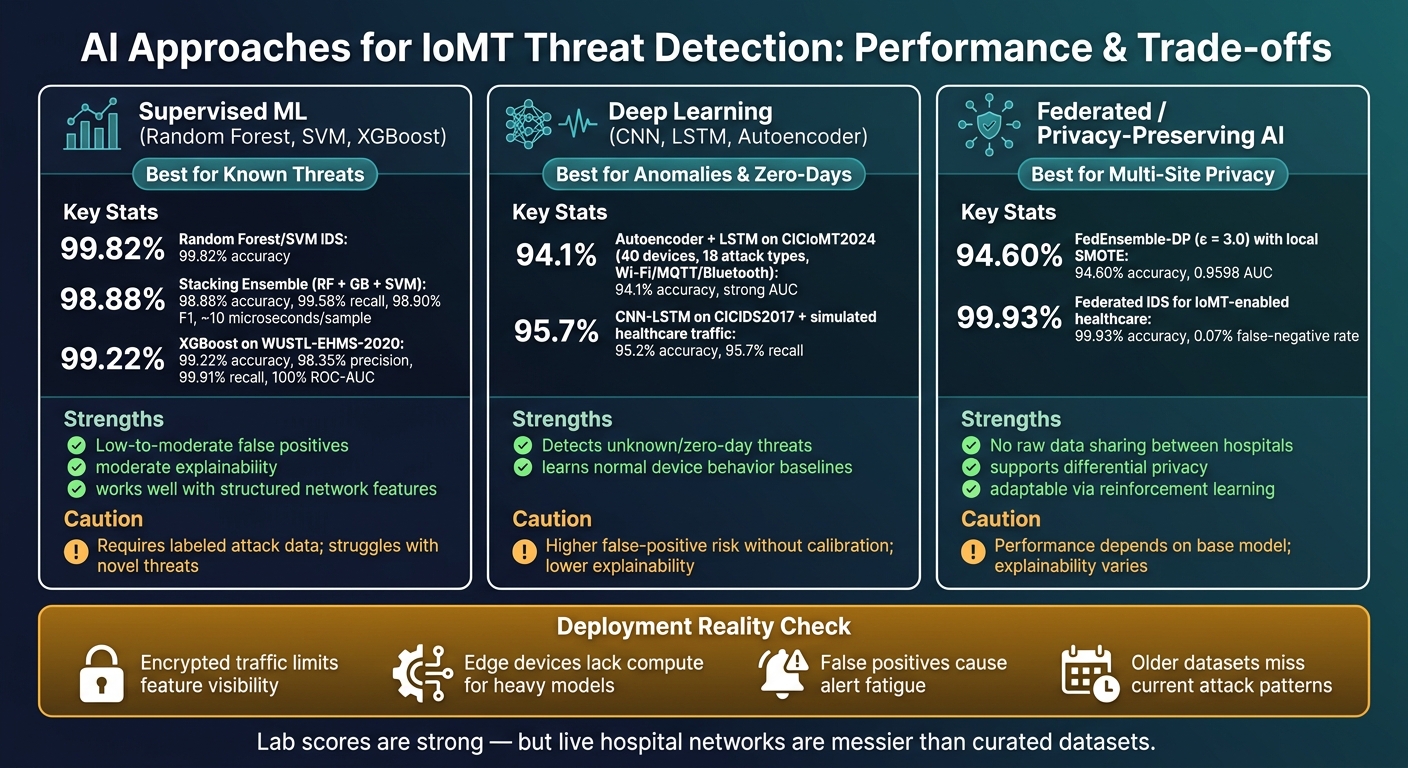
One Random Forest/SVM IDS reported 99.82% accuracy on healthcare network traffic.[9] A stacking ensemble that combined Random Forest, Gradient Boosting, and SVM reached 98.88% accuracy, 99.58% recall, and 98.90% F1-score, with about 10 microseconds per sample.[11] Random Forest often does well here because it works neatly with structured network features and can help keep false positives at a level teams can live with. That matters in clinical settings, where alert fatigue is a serious problem.[6][8]
Deep Learning for Anomaly and Zero-Day Detection
When labeled attack data is scarce, the goal shifts. Instead of matching traffic to known attacks, the model learns what normal IoMT behavior looks like and flags anything that drifts too far from it.
Autoencoders try to reconstruct benign traffic. If the reconstruction error is high, the model is likely seeing a pattern it never learned.[10] LSTM models look at sequences of device events, which helps them spot strange bursts of activity, new communication partners, or odd command patterns.[7] CNN-LSTM hybrids mix both ideas: CNN layers pull out local feature patterns, while LSTM layers track longer-term dependencies in device behavior.[7]
Recent benchmark results show why this approach gets so much attention. An Autoencoder + LSTM model tested on CICIoMT2024 data - covering 40 IoMT devices and 18 attack types across Wi-Fi, MQTT, and Bluetooth - hit 94.1% accuracy and strong AUC, beating the autoencoder-only baseline.[15][16] A CNN-LSTM framework using CICIDS2017 plus simulated healthcare traffic reached 95.2% accuracy and 95.7% recall, ahead of standalone Random Forest and SVM models on the same data.[17]
Privacy-Preserving and Adaptive AI Approaches
Hospitals also need ways to train models without passing around raw traffic data. Federated learning tackles that by letting each site train locally and share model updates instead of the underlying traffic.[4][5] Split learning pushes this idea further by dividing the model itself across devices and servers.
Differential privacy is often added on top to lower the chance that someone could reconstruct individual records. In one study, FedEnsemble-DP with differential privacy at ε = 3.0 reached 94.60% accuracy and 0.9598 AUC when paired with local SMOTE balancing, showing that privacy protection does not always mean a big drop in model performance.[5] A separate federated IDS for IoMT-enabled healthcare reported 99.93% accuracy and a 0.07% false-negative rate.[4][14] Reinforcement learning adds another layer by letting detection policies change over time, which can help cut false positives as network conditions shift.[12][13]
The table below sums up the trade-offs.
| Approach | Detection Focus | Data Needs | False-Positive Risk | Explainability |
|---|---|---|---|---|
| Supervised ML (RF, SVM, XGBoost) | Known, labeled attack types | Labeled IoMT datasets | Low to moderate with tuning | Moderate |
| Deep Learning (CNN, LSTM, Autoencoder) | Anomalies and zero-day threats | Large benign traffic samples | Can be higher without calibration | Lower, though attention and explainability methods can help |
| Federated / Privacy-Preserving | Supervised or anomaly models trained across sites without sharing raw data | Distributed site-level data | Depends on the base model | Varies |
sbb-itb-535baee
What Research Says About AI Performance and Deployment Limits
AI Approaches for IoMT Threat Detection: Performance & Trade-offs
After model choice comes the harder test: whether those models still work inside hospital networks. Research points to strong IoMT detection results in controlled tests. But once you move into a live hospital setting, the job gets much tougher.
Where Published Studies Show Strong Results
Published benchmark scores are strong. An explainable XGBoost-based IDS tested on the WUSTL-EHMS-2020 dataset reached 99.22% accuracy, 98.35% precision, 99.91% recall, and 100% ROC-AUC.[21] Ensemble methods also beat simpler baselines when they are tuned for medical traffic. That matters because these results come from medical-device data, not generic enterprise traffic.
Those numbers are promising. Still, they rely on conditions that almost never stay the same in a live hospital network.
Why Hospital Deployment Is Harder Than Lab Testing
This is where things get messy. Most published evaluations use synthetic, simulated, or limited datasets that don't match the full complexity of a live U.S. hospital network.[18][20][2][23]
Deployment gets harder for a few plain reasons:
- Encrypted traffic limits feature visibility
- Edge devices often don't have enough compute for heavy models
- False positives create alert fatigue and slow response[19][20][23]
Older benchmark datasets also miss current attack patterns seen in connected medical devices.[20][2][22]
So the issue isn't just picking a model with high test scores. It's making sure the model can handle traffic that changes by the hour, devices that weren't in the training data, and security teams that can't afford to chase noise all day.
Which Evaluation Metrics Matter Most for Healthcare Teams
Accuracy alone is a weak guide for healthcare teams. Use recall, precision, detection time, and drift checks. Accuracy by itself is not enough.
Recall matters most for patient-safety-related threats. If a model misses a real attack on a connected infusion pump or imaging system, the damage can be serious.[2][23] Precision matters almost as much, because low precision means analysts waste time on alerts that lead nowhere.
Hospital settings also change all the time - new devices come online, firmware gets updated, and network segmentation shifts. A model that isn't checked and retrained from time to time will slowly lose reliability.[21][22]
The best studies don't stop at a single headline score. They report recall, precision, detection time, and drift tolerance under traffic conditions that look much closer to day-to-day hospital use.
The next issue is how these alerts become actionable risk decisions.
Connecting AI Detection to Risk Management and Governance
After detection performance, the next step is governance: who does what when an alert fires?
Using AI Alerts in Device and Enterprise Risk Assessments
AI detection only matters if alerts make it into risk workflows. Anomaly and attack findings should feed updates to device criticality, third-party vendor risk, and escalation paths for the SOC, clinical engineering, compliance, and governance teams.
Not every alert drives the same call. Different findings support different risk decisions. Anomaly detections can guide residual risk reviews. Attack classifications tied to third-party-managed systems can feed vendor assessments. Behavioral drift signals can point to supply chain dependencies that need a closer look.
U.S. Frameworks and Regulatory Expectations for IoMT AI Detection
U.S. frameworks call for continuous cybersecurity monitoring, anomaly detection, evidence capture, and formal risk documentation for connected medical devices and digital health technologies.[25][3][26][27] The FDA's Cybersecurity in Medical Devices: Quality System Considerations and Content of Premarket Submissions guidance emphasizes that devices should detect anomalous behavior, log security events, and provide evidence to support risk management and postmarket investigations.[25][3][27] FDA guidance for AI-enabled medical device software also calls out data poisoning, model evasion, and data leakage, and highlights anomaly detection, adversarial training, and differential privacy as key controls.[24]
Put simply, these frameworks turn AI alerts into auditable risk evidence.
| Framework | Example IoMT Threat Categories | Expected Controls / Practices | How AI Detection Supports Evidence |
|---|---|---|---|
| HIPAA Security Rule | Unauthorized access and integrity issues | Integrity monitoring and intrusion detection | AI logs anomalous access patterns and supports integrity and intrusion detection reviews |
| NIST Cybersecurity Framework (CSF) | Compromise of networked medical devices | Identify, Protect, Detect, Respond, Recover; continuous monitoring | Supports Detect; documents response and recovery |
| NIST AI RMF | Model evasion and poisoning | AI risk governance, bias testing, transparency, human oversight | Detection outputs support model performance reviews and drift monitoring |
| FDA medical device cybersecurity expectations | Anomalous device behavior and postmarket issues | Detect anomalous conditions, log events in a forensically sound manner, and support postmarket investigations and corrective actions | AI-generated logs and alerts provide premarket and postmarket evidence |
AI-Enabled RiskOps for Scaled Healthcare Oversight
At scale, AI risk operations should send alerts, evidence, and tasks to the right owners. Automation deals with volume. People make the final calls.
That split matters. It keeps detection outputs tied to device, vendor, and enterprise risk decisions that healthcare governance teams are on the hook for.
Conclusion: What AI Can and Cannot Do for IoMT Security
The research points in one clear direction: AI helps, but it needs guardrails. Test results show strong threat detection, yet live hospital networks are messier than lab data. Mixed-vendor devices, changing clinical routines, and day-to-day network drift create conditions that curated datasets often miss.[1][2]
AI can spot threats. It cannot handle risk by itself. It won't patch a device, fix a vendor flaw, or decide what level of risk is acceptable. Those jobs still belong to people.[28]
And that human layer is where the work happens. An alert matters only if a team can do something with it. AI tends to work best when alerts connect directly to asset inventories, vendor risk reviews, and remediation workflows.
Censinet RiskOps™ uses this approach by tying detection data to third-party risk assessments, PHI and device asset data, and remediation tasks. For healthcare leaders, AI brings speed and scale. But turning alerts into action takes a governed risk program. In IoMT security, detection is the starting point; governed response is the outcome.
FAQs
How does AI know what normal device behavior looks like?
AI watches medical devices quietly in the background. It looks at normal behavior, like how often a device communicates, how large its data payloads usually are, and which systems it normally connects to. Over time, it builds a baseline for each device class, while leaving out maintenance windows and known incidents so those events don’t skew the profile.
Machine learning keeps tracking those patterns and device logs to separate routine clinical activity from anomalies. When a device starts acting outside its usual profile, the system sends real-time alerts.
Why do AI security models perform worse in real hospitals than in lab tests?
AI models often look stronger in lab tests than they do in actual hospitals. The reason is pretty simple: hospitals are messy, noisy places.
Routine clinical activity can set off false alarms. And once staff get hit with too many alerts, alert fatigue kicks in. That makes even a decent model harder to use in practice.
Accuracy also depends on stable baselines and device-level thresholds. Those details may be missing from simulated data or data pulled from just one site. So a model that seems sharp in training can struggle once it meets day-to-day hospital conditions.
There’s another problem too: model drift. Devices change, firmware gets updated, and workflows shift over time. On top of that, teams often run into interoperability issues and gaps in visibility across systems.
That’s why in-hospital validation matters. Triage rules matter too. Without them, strong offline results can turn into alerts that look good on paper but don’t help much on the hospital floor.
What should hospitals do after an AI alert fires?
Hospitals should put patient safety first. Start by checking the device’s status and reviewing logs so you can rule out planned maintenance, approved updates, or other expected activity.
Next, use your existing playbooks to send the alert to the right teams. If the device is in active use, line up a replacement before isolation. Require manual clinical sign-off before taking the device off the network, and document the incident for risk and compliance purposes.
