
IoT onboarding is where hospital device security starts or fails. If a connected device joins the network without inventory, identity checks, network limits, hardening, and monitoring, it can become a path to outages, data exposure, and patient-care disruption.
Here’s the short version:
- Onboarding is not just setup. It is the first security check for connected medical and facility devices.
- Common failures are simple: missing inventory, default passwords, flat network access, weak vendor remote access, and no logging.
- The impact can be severe. One weak device can help attackers move across pumps, monitors, workstations, or EHR-connected systems.
- The fix starts at first connect: register the device, assign ownership, verify identity, place it in the right network segment, lock down settings, and turn on monitoring.
- This takes more than one team. IT, security, clinical engineering, compliance, and procurement all need one review path and one remediation process.
- The work does not end after setup. Devices need repeat reviews, firmware checks, CVE tracking, and vendor follow-up over time.
A few numbers show why this matters:
- 63% of healthcare delivery groups reported an incident linked to unmanaged or IoT devices.
- Healthcare ransomware events were linked to a 33% increase in in-hospital mortality among Medicare patients in one cited study.
- HHS OCR received 663 large-breach notifications in 2024.
If I put the whole article into one sentence, it’s this: a hospital should treat first network connection as a security gate, not a routine install step.
That means:
- Review device risk before purchase
- Collect vendor security documents like MDS2 and SBOM data
- Map PHI and vendor connection paths
- Add the device to inventory with a named owner
- Use certificate-based access when the device supports it
- Put the device in a limited VLAN or micro-segment
- Change default settings and shut off unused services
- Send logs to the SIEM
- Reassess the device on a set schedule
In short: better onboarding cuts risk before a device ever gets near patient care.
How Improper Onboarding Creates Cybersecurity Risks
Skip one onboarding step, and a device can hit the network exposed from the start. Instead of joining under normal security controls, it arrives as a blind spot.
Unmanaged Assets, Weak Authentication, and Default Settings
When devices aren't properly registered, they often miss the basics: inventory, vulnerability management, patching, and scanning. That may sound like admin overhead, but it has a direct security cost. If a hospital uses one shared local admin account across pumps, ventilators, and monitors, a single stolen password can open the door to the whole fleet.
GE Healthcare models were reported to include hidden accounts using the same default credentials across more than 100 device models, illustrating how factory defaults can expose the entire fleet until onboarding resets them.[1]
Default setups can cause other problems too. Management ports may stay open. Telnet or FTP may still be enabled. SNMP community strings may never get changed. Those are the kinds of gaps botnets look for all day long. Once an attacker gets into one device, that device can become a stepping stone to EHR servers, nurse station workstations, or other medical devices.
Broad Connectivity and Unreviewed Vendor Dependencies
Some devices get internet access even when they don't need it. That often happens when teams skip a first-connect review. The result is extra outbound connections to vendor cloud dashboards, analytics platforms, and update servers that the security team may not even know are there. Every one of those links is a possible path for data loss or unauthorized access.
Flat network placement makes the problem worse. If a new device lands on the same VLAN as EHR workstations or pharmacy systems, ransomware can spread fast once it gets in. HC3 reported a 2023 incident in which an attacker abused a locally hosted ScreenConnect instance for initial access, then installed additional remote access tools to maintain persistence, showing how vendor support tooling can become a foothold when it isn't tightly governed.[2]
There's also a compliance angle here. Unreviewed vendor connections and fourth-party cloud dependencies can trigger HIPAA business associate duties if device telemetry includes ePHI or device identifiers.
Patient Safety, Downtime, and Compliance Consequences
The table below shows how onboarding failures turn into cyber risk and clinical damage:
| Onboarding Failure | Cyber Exposure | Clinical or Operational Impact |
|---|---|---|
| Missing asset inventory or ownership | Invisible endpoints; missed compromise | Blind spots for clinical engineering; difficulty isolating affected devices during incident response |
| Shared or default credentials | Credential reuse and lateral movement across the device fleet | Device tampering; simultaneous compromise of multiple critical devices |
| Broad, flat network placement | Rapid ransomware propagation; no containment boundary | Outages, diversion, EHR downtime |
| Unreviewed vendor remote access | Persistent third-party footholds; unmonitored data flows | Support-channel compromise; forced shutdown of remote maintenance |
| No baseline hardening or patch validation | Known vulnerabilities remain exploitable at first connect | Higher exploitation risk; malfunction mid-procedure; compliance findings |
| No logging or monitoring | Anomalous behavior goes undetected | Slow containment; poor forensics; prolonged clinical disruption |
These failures don't just create cyber risk on paper. They can disrupt care in very real ways. Research has linked healthcare ransomware incidents to a 33% increase in in-hospital mortality among Medicare patients, equal to an estimated 42–67 additional deaths over five years.[3] HHS OCR received 663 large-breach notifications in 2024 alone.[4]
FDA cybersecurity guidance makes the deployment piece clear: devices should be put into use in ways that keep their built-in security features in place. That includes changing default credentials, turning on logging, and applying available patches at initial deployment.[5] If onboarding is weak, known vulnerabilities can remain in place from day one.
The next section turns these failure modes into onboarding controls.
sbb-itb-535baee
Core Controls for Secure IoT Onboarding in Healthcare
Secure onboarding starts with identity, access, and governance controls before any device is trusted on the network. That cuts risk early, long before a device reaches patient care.
Identity, Authentication, and Least-Privilege Access
Every device that joins the network needs a verifiable identity. Each one should be tied to an asset record - serial number, MAC address, model, and firmware version - so teams can track it for maintenance, patching, recalls, and incident response.
Healthcare organizations should require 802.1X or a similar certificate-based method whenever possible. In plain terms, device certificates should replace shared passwords. If a device can't support 802.1X, use documented compensating controls like:
- MAC authentication bypass
- Dedicated VLANs
- Strict ACLs
Least-privilege access means each device type gets only the connections it needs to do its job. A connected infusion pump, for example, may need to talk to its medication management system, a time source, and approved update endpoints. It does not need broad internet access or extra east-west traffic.
NAC policies can enforce this automatically. Unknown or non-compliant devices can be placed into a quarantine VLAN until someone reviews them. Administrative interfaces should use individual accounts, strong authentication, and MFA. Shared logins and hardcoded credentials should be removed before deployment.
Segmentation, Secure Baselines, and Continuous Monitoring
Use tiered segmentation so life-critical devices, imaging systems, and building systems sit in separate VLANs with default-deny rules between them. Then add microsegmentation to block lateral movement inside each segment.
A secure configuration baseline should be applied at first connect, before the device reaches production systems. That baseline should include disabling Telnet, FTP, and unused management ports, changing default credentials, enabling TLS on supported devices, and forwarding authentication and configuration logs to a central SIEM. Configure NTP time sync to a trusted internal time source so log timestamps line up during an investigation.
Continuous monitoring should be passive and non-intrusive, with alerts ranked by device criticality. Once device placement is under control, monitoring checks whether the device stays within policy. A HIMSS medical device security survey found that 52% of respondents cited lack of continuous monitoring for lateral movement and segmentation failures as a major obstacle, and 54% cited policy management overhead.[6]
Cross-Functional Governance Across IT, Security, and Clinical Engineering
No single team can handle IoT onboarding on its own. IT runs the network. Cybersecurity owns policy and monitoring. Biomedical engineering knows which devices are safety-critical and which maintenance windows can work in practice. Compliance checks that data flows meet HIPAA rules. And procurement is where the process starts.
A cross-functional working group with clear decision rights and a RACI matrix helps close the gaps that create risk. One common example is a device getting connected before a security review is done. Another is a segmentation rule breaking a clinical integration.
Procurement should send every device purchase through security and clinical engineering review before a purchase order is issued. Structured questionnaires can help assess third-party vendor risk, support for secure protocols, and patch practices. Censinet RiskOps™ can centralize third-party risk assessments and team-based risk management for medical devices, clinical applications, and vendor dependencies. Teams should also review onboarding metrics with leadership on a regular basis, including standard-process rate, exception count, and time to onboard.
Once these controls are set, onboarding can follow the same sequence every time.
A Step-by-Step IoT Onboarding Workflow for Healthcare Organizations
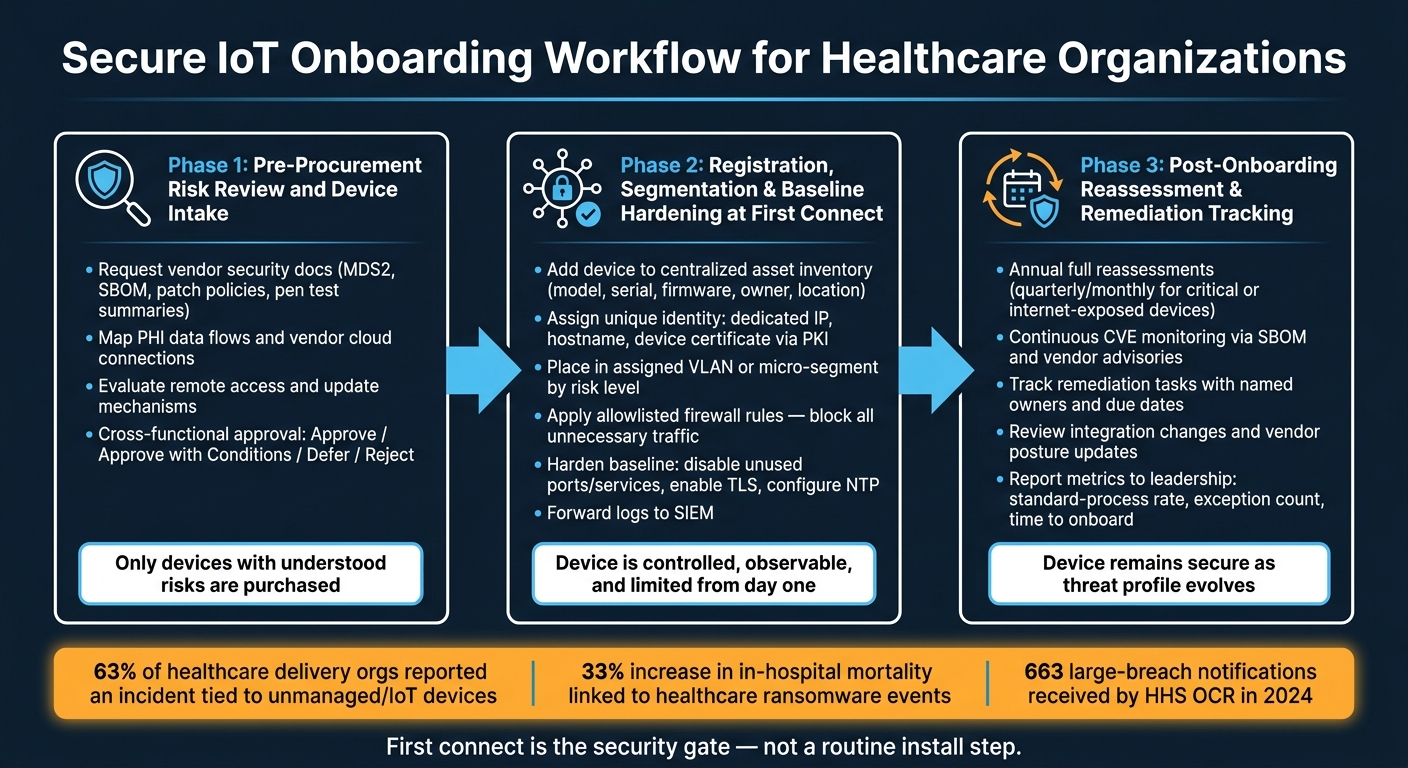
Secure IoT Onboarding Workflow for Healthcare Organizations
Once governance controls are in place, the onboarding process needs to follow the same path every single time - no shortcuts and no exceptions. That consistency is what turns policy into day-to-day practice.
Pre-Procurement Risk Review and Device Intake
Start the security review before the purchase order gets approved. Any device with network connectivity, PHI storage, or a link to a clinical system should go through a formal security intake.
Ask vendors for security documentation up front, including:
- MDS2 forms, where applicable
- SBOM data
- Patch and update policies
- Penetration test summaries
MDS2 disclosures show whether a device supports remote servicing, whether that access can be limited to specific IP addresses, and whether remote-service activity is logged. Those details shape segmentation and access decisions.[8][9][10] IMDRF guidance makes the same point. It recommends that healthcare providers request end-of-life dates, required ports and services, firewall rules, and security-scanning capabilities before purchase and installation.[7]
PHI data flows need a close look. Map where the device stores data, whether it sends anything to a vendor cloud, and whether a Business Associate Agreement is needed. Remote access should also line up with internal policy. That usually means avoiding direct inbound vendor connections and using brokered, monitored channels instead. And here's where the day-to-day risk shows up: devices that depend on manual USB updates or on-site engineer visits can create more security and operational strain than devices that support secure, centralized update workflows.
The approval decision should be made by a cross-functional group and clearly documented. The outcome may be approve, approve with conditions, defer, or reject. This step decides whether the device can join the network at all. Once approval is granted, the first connection should match the approved risk profile - nothing outside that plan.
Registration, Segmentation, and Baseline Hardening at First Connect
After approval, onboard the device right away. First connect is where control starts. This is the point when identity, segmentation, and logging become enforceable.
Add the device to the centralized asset inventory. Record the model, serial number, firmware version, owner department, location, clinical criticality, and support contacts. Then assign a clear network identity: a dedicated IP address, hostname, and, when supported, a device certificate from an internal PKI. Shared credentials and default hostnames shouldn't be used here.
Next, place the device in its assigned VLAN or micro-segment based on device type and risk level. Apply allowlisted firewall rules so it can reach only the systems it needs to function - nothing else. Then move through baseline hardening: change all default settings, disable unused services and ports, enable TLS where supported, configure NTP sync to a trusted internal source, and send logs to your SIEM. It's also smart to document expected communication paths, including destination IPs, ports, and protocols. That record gives security teams something to compare against later when traffic starts to look off.
After first connect, the process shifts from setup to review and follow-up.
Post-Onboarding Reassessment and Remediation Tracking
Onboarding does not stop at first connect. Devices drift. Firmware gets old, new vulnerabilities appear, system links change, and vendor support windows eventually run out.
Most organizations perform annual full reassessments for connected medical devices. Mission-critical assets and internet-exposed devices often need quarterly or monthly checks instead. Between those scheduled reviews, continuous vulnerability monitoring tied to SBOM data and vendor advisories helps fill the gaps. When a critical CVE is disclosed, teams need to know fast which devices are affected.
Censinet RiskOps™ can bring this work into one place by standardizing vendor reassessment questionnaires, tracking remediation tasks with clear owners and due dates, and producing reporting for leadership and auditors. That keeps onboarding tied to active risk management instead of treating it like a one-time setup task. It also closes the gap between device onboarding and patient-care exposure.
Workflow summary:
| Step | Key Controls | Primary Outcome |
|---|---|---|
| Pre-Procurement Risk Review and Device Intake | Vendor security docs, MDS2, SBOM, PHI/data flow mapping, remote access and update evaluation, cross-functional approval | Only devices with understood risks and documented requirements are purchased |
| Registration, Segmentation, and Baseline Hardening at First Connect | Asset inventory registration, unique identity assignment, VLAN or micro-segmentation, allowlisted firewall rules, baseline hardening, log forwarding to SIEM | Device is controlled, observable, and limited to necessary communications from day one |
| Post-Onboarding Reassessment and Remediation Tracking | Firmware status checks, CVE monitoring via SBOM and vendor advisories, integration change reviews, vendor posture updates, remediation tracking | Device remains secure as its threat profile and support status evolve over time |
Conclusion: Better Onboarding Reduces Cyber Risk Before Devices Reach Patient Care
IoT onboarding is the moment that determines what happens next. A device either enters the network as a governed asset or slips in as an unmanaged one.
And the risk isn't abstract. 63% of healthcare delivery organizations reported an incident tied to unmanaged or IoT devices [11]. In most cases, the problem starts at first connect: weak identity checks, poor segmentation, or missing medical device security risks.
That risk goes down only when onboarding controls are enforced right away. First connect is the window that matters. Verify identity at first connect, segment devices by risk, and harden baselines from day one. That's how teams close the gap before devices ever get near patient care.
But the technical side alone isn't enough. Control lasts only when ownership is shared. IT, security, and clinical engineering need one approval path and one remediation queue, not separate handoffs that leave issues sitting in limbo. Censinet RiskOps™ can centralize vendor assessments and remediation tracking across the device lifecycle.
No device should reach patient care without verified identity, a defined network boundary, and an active owner for its security posture.
FAQs
What is IoT onboarding in healthcare?
In healthcare, IoT onboarding is the process of setting up trust between a network and an IoT device before that device gets network access. Put simply, the network checks who the device is and whether it meets security requirements before letting it in.
That check helps confirm the device is allowed to join the environment.
Good onboarding also logs key details in a central configuration management database. This usually includes the device model, firmware version, IP and MAC addresses, clinical owner, and the network segment tied to the device.
Why is first connect risky?
The first network connection is a risky moment. Many IoT medical devices just can’t handle stronger security controls like modern authentication or encryption.
That creates a clear problem: if a device’s identity and security posture aren’t checked before it gets network credentials, an organization can end up putting unmanaged, vulnerable equipment on clinical networks. And sometimes devices get connected without IT even knowing, which skips basic security checks and increases the risk of unauthorized access and data breaches.
Who should own device onboarding?
Device onboarding should follow a federated governance model, with shared ownership across IT, cybersecurity, biomedical engineering, clinical teams, and procurement.
Here’s how that split usually works in practice:
- Biomedical engineering manages inventory and safety checks
- IT handles network visibility and segmentation
- Procurement builds security requirements into contracts
A unified platform like Censinet RiskOps™ can help streamline risk assessments and keep accountability clear across departments.
