
IoMT (Internet of Medical Things) devices are transforming healthcare by enabling real-time monitoring, remote diagnostics, and integration with electronic health records. However, these devices face serious cybersecurity threats, including ransomware, DDoS attacks, and data breaches. Many IoMT devices, especially older ones, lack modern security features, making them vulnerable. Log analysis tools are critical for detecting and mitigating these risks.
Key takeaways:
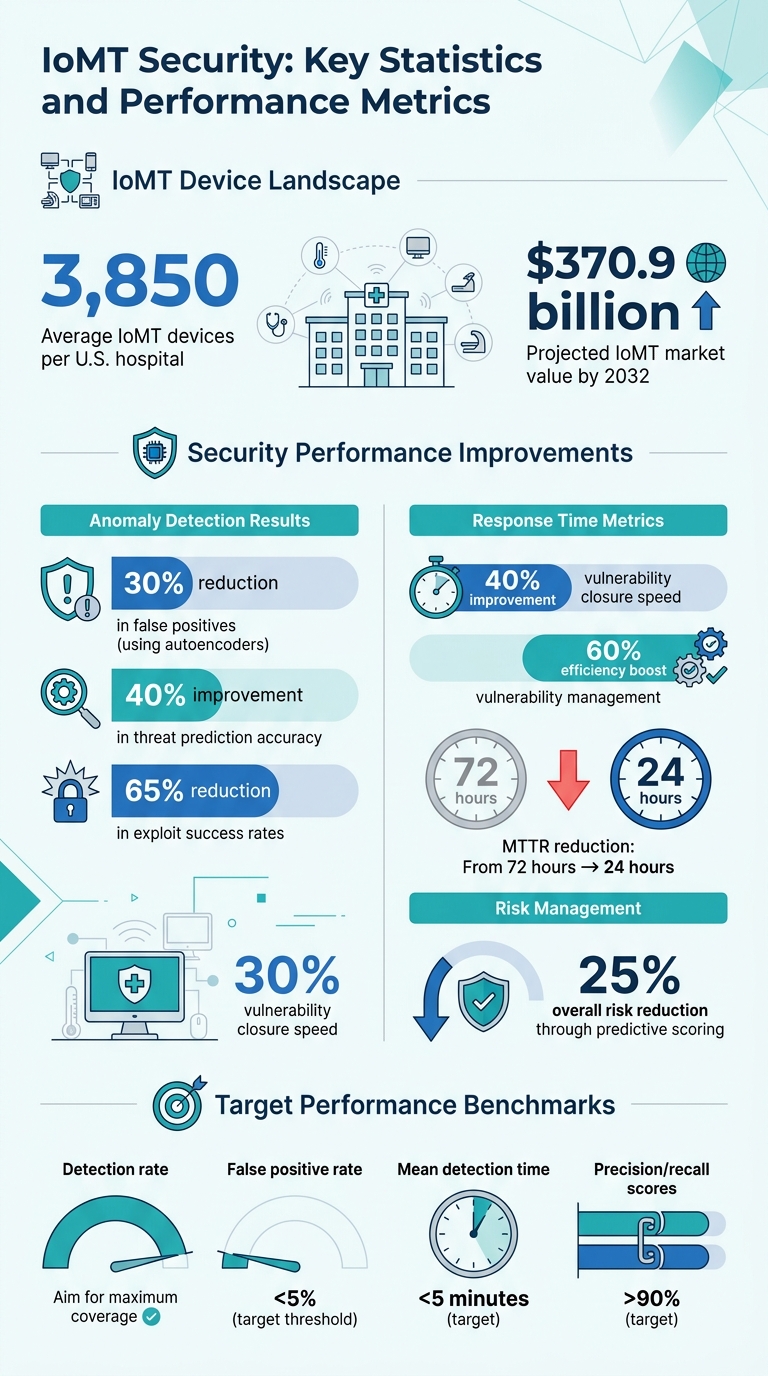
- IoMT devices in healthcare: Over 3,850 devices per hospital in the U.S., contributing to personalized care but increasing security risks.
- Cyber threats: Vulnerabilities in older systems and lack of encryption create entry points for attacks.
- Log analysis solutions: Tools like IoMT-CySAM, Chidroid, and Asimily help monitor, detect, and respond to threats efficiently while addressing storage and resource limitations.
- Compliance challenges: Ensuring HIPAA compliance while managing vast amounts of log data is a significant hurdle.
- Integrated security strategies: Combining log analysis with enterprise risk management improves detection rates and response times.
IoMT Security Statistics: Devices, Threats, and Detection Performance in Healthcare
7.2 - Conducting Logging & Monitoring Activities
sbb-itb-535baee
Challenges in IoMT Log Management
Managing logs effectively in Internet of Medical Things (IoMT) systems is essential for maintaining security. However, this task is complicated by a mix of diverse data sources, scalability concerns, and strict regulatory requirements.
Multiple IoMT Log Sources
IoMT ecosystems are incredibly diverse, featuring devices like wearables (smartwatches), implantables (pacemakers), environmental sensors, and fixed equipment (MRI machines) operating within a single healthcare facility [1][2]. These devices generate logs in a variety of formats and rely on different communication protocols such as Bluetooth, ZigBee, Wi-Fi, and Ethernet. This variety makes it challenging to integrate logs seamlessly, leaving gaps in visibility and making it harder to identify vulnerabilities specific to each device. To handle this complexity, automated tools are essential for consolidating and analyzing the data efficiently.
Scalability and Automation Requirements
The sheer number of IoMT devices makes manual log reviews impossible. Many of these devices are limited by low computing power, minimal memory, and restricted storage, which makes traditional logging methods impractical [1]. Researchers from NTU Singapore and Imperial Global Singapore highlight this limitation:
The limited computing and storage capacity of IoMT devices hinders their ability to process and analyze data [2].
Compounding the issue, these devices generate continuous streams of data that require real-time analysis to prevent critical incidents. This demand can overwhelm existing network infrastructures, especially when older systems are still in use, further emphasizing the need for scalable and automated solutions.
Compliance and Data Privacy Requirements
Healthcare log management must align with HIPAA regulations to safeguard patient health information (PHI) across all IoMT layers - Sensor/Actuator, Gateway, Cloud, and Visualization [1]. This involves encrypting data and ensuring strong authentication during the transmission and storage of Electronic Health Records (EHRs) and Electronic Medical Records (EMRs) [1]. However, legacy devices pose a significant hurdle. Hospitals often keep older medical equipment for decades due to high replacement costs, yet these devices frequently lack modern encryption capabilities or the ability to receive timely software updates [1]. Many were originally designed for offline use, and integrating them into networked systems introduces new vulnerabilities [1].
Healthcare providers also face the challenge of balancing security with usability. For instance, requiring complex passwords or biometric scans for access might delay the use of critical equipment, such as a ventilator, during emergencies [1]. These issues must be addressed to enable effective log analysis and enhance the overall security of IoMT systems.
Log Analysis Methods for IoMT Security
Researchers have designed frameworks and tools to address the unique challenges of analyzing logs from medical devices. These methods aim to automate processes, ease resource demands, and ensure compliance, all while focusing on risk assessments, forensic evidence collection, and threat detection. The key is achieving these goals without overburdening the limited resources of IoMT devices.
IoMT-CySAM Framework for Risk Assessment
The IoMT-CySAM framework, also referred to as the MLRA-Sec model, blends machine learning-based anomaly detection with a hybrid risk assessment approach. It evaluates cumulative security risks across various IoMT environments, making it especially useful in healthcare settings with diverse medical devices [3]. By combining data from multiple sources and leveraging adaptive algorithms, IoMT-CySAM simplifies the analysis process, enabling security teams to focus on the most pressing threats. To complement this high-level risk assessment, tools like Chidroid address device-specific logging limitations.
Chidroid for Mobile Log Collection
Chidroid offers a solution for memory-constrained devices that cannot store large volumes of logs. This Android-based tool uses a "detect-then-store" method, monitoring traffic in real time and saving logs only when anomalies are detected [4]. This approach ensures that critical forensic evidence is preserved during incidents while conserving device storage. While Chidroid focuses on selective log retention for devices with limited memory, Asimily provides a broader perspective by combining packet and flow analysis.
Asimily's Syslog and Packet Capture Features
Securing IoMT systems requires analyzing both packet capture (PCAP) and flow-based data. Packet capture provides raw communication data between devices, which is crucial for identifying malicious activities and conducting in-depth network analysis. However, fully inspecting packets can be resource-intensive and may expose sensitive patient information. Flow-based monitoring offers a more efficient alternative, summarizing key details like IP addresses, packet counts, and ports without delving into encrypted or sensitive payloads. Tools like tcpdump handle data collection, while utilities such as Tranalyzer transform packets into flows. This reduces the computational load on medical devices while still supporting forensic investigations.
Together, these tools and frameworks create a multi-layered security approach for IoMT environments. Each method plays a specific role, from prioritizing risks at a high level to collecting device-specific forensic evidence, strengthening cybersecurity defenses and enabling comprehensive risk management.
Combining Log Analysis with IoMT Security Strategies
Integrating log analysis with organization-wide security measures takes IoMT (Internet of Medical Things) protection to the next level. By linking device-specific insights to broader monitoring, vulnerability management, and risk mitigation efforts, healthcare organizations can turn raw log data into actionable intelligence. This approach not only safeguards patient safety but also ensures compliance with regulatory standards.
Using Data Analytics for Anomaly Detection
Machine learning tools like isolation forests, autoencoders, and time-series analysis can transform IoMT logs into an effective early warning system. For example, one study found that autoencoders reduced false positives by 30% [5]. Similarly, anomaly detection applied to syslog data from MRI machines flagged unusual packet volumes, stopping ransomware before it could spread [5][6]. Predictive log pattern analysis also proved valuable, forecasting DDoS attacks on pacemakers and enhancing threat prediction accuracy by 40% [5][6].
To measure success, healthcare organizations should focus on key metrics:
- Detection rate
- False positive rate (aiming for less than 5%)
- Mean detection time (targeting under 5 minutes)
- Precision/recall scores (above 90%) [5][7].
Continuous Monitoring and Vulnerability Management
When log analysis is integrated with SIEM (Security Information and Event Management) platforms and vulnerability management workflows, it enables real-time detection of exploit indicators. For example, identifying buffer overflows in insulin pumps led to faster responses. This integration has shown impressive results: a 40% improvement in vulnerability closure speed, a 60% efficiency boost, and a reduction in mean time to resolution (MTTR) from 72 hours to just 24 - all while maintaining HIPAA compliance [5].
Correlating firmware logs with known exploits in devices like ventilators has also enabled proactive patching. This approach reduced exploit success rates by 65%, demonstrating the power of combining log insights with vulnerability management [5].
Censinet RiskOps™ for Risk Management
Censinet RiskOps™ offers a centralized approach to merging device-level log data with enterprise risk management strategies. By feeding metrics - such as anomaly scores and unauthorized access attempts - into automated risk scoring dashboards, healthcare organizations can streamline risk assessments. This system has led to a 25% reduction in overall risk through predictive scoring [6].
The platform also allows organizations to:
- Visualize risk trends based on log data
- Benchmark cybersecurity performance against industry peers
- Manage risks across supply chains
Conclusion
Log analysis tools play a key role in securing the expanding IoMT networks in healthcare. With the average U.S. hospital deploying over 3,850 IoMT devices [1], consistent monitoring through intrusion detection systems and advanced analytics is essential to safeguard patient safety and sensitive data. These tools help close critical security gaps, especially when addressing vulnerabilities in older systems [1].
Their importance becomes even clearer when integrated into broader cybersecurity frameworks. As Suman Deb et al. pointed out:
A security or privacy breach in a consumer device can manifest itself as a safety hazard in a clinical device, both of which remain integrated within an IoMT [1].
This interconnected nature of risks demands a layered defense strategy. Combining real-time anomaly detection, proactive vulnerability management, and comprehensive risk assessments ensures that log analysis becomes a vital part of ongoing security efforts.
Healthcare providers face the dual challenge of securing IoMT devices while maintaining uninterrupted access to life-saving equipment. This balance can be achieved by implementing hardware isolation for older systems, prioritizing online intrusion detection systems for immediate threats, and leveraging offline analysis to detect hidden risks in historical data [1][2].
For instance, Censinet RiskOps™ uses log-derived metrics to automate risk scoring and visualization. This empowers healthcare organizations to address device-level threats within a broader enterprise risk framework. By linking anomaly scores with vulnerability data across supply chains and medical devices, organizations gain the insights needed to prioritize remediation effectively.
The stakes couldn't be higher: with the IoMT market expected to grow to $370.9 billion by 2032 [2], failing to secure these networks could lead to devastating consequences. Healthcare organizations that integrate log analysis into their risk management strategies are better equipped to protect both patient data and the critical systems that support care delivery.
FAQs
What IoMT logs matter most for detecting ransomware and DDoS?
Logs that record unusual network activity, authentication attempts, configuration changes, and device behavior play a critical role in spotting ransomware and DDoS attacks. By analyzing these logs, it's possible to pinpoint anomalies and suspicious patterns as they happen, allowing for faster detection and response to potential threats.
How can hospitals collect logs from legacy devices with limited storage?
Hospitals can handle logs from older devices with limited storage by focusing on critical events and minimizing unnecessary data. Using centralized log collection systems, such as SIEM platforms, helps gather and analyze logs more effectively. Cloud-based storage or external solutions can also store logs securely, ensuring compliance with regulations like HIPAA. Furthermore, targeting log collection from high-risk devices allows healthcare facilities to concentrate resources on identifying threats and managing risks efficiently.
How do you keep IoMT log analysis HIPAA-compliant while still useful?
To make IoMT log analysis both HIPAA-compliant and efficient, healthcare organizations should focus on a few key practices. Start by maintaining comprehensive asset inventories to track all devices. Use encryption to safeguard sensitive data, ensure logs are securely stored, and perform regular risk assessments to identify and address vulnerabilities.
Tools like Censinet RiskOps™ can simplify the process by combining compliance monitoring with effective risk management. This helps safeguard patient information and medical devices while staying aligned with regulatory standards.
