
Measuring the success of a cybersecurity framework boils down to tracking metrics that prove your efforts are paying off. In healthcare, this means more than protecting data - it’s about patient safety and operational stability. Here’s what to focus on:
- Track Maturity: Use the NIST Cybersecurity Framework (CSF) Implementation Tiers (1–4) to measure progress. Most organizations aim for Tier 3, which reflects standardized, monitored processes.
- Key Metrics: Focus on multi-factor authentication (MFA) coverage, patch compliance, incident response time, and breach detection/reporting time. For example, healthcare organizations report ransomware incidents in 3.7 months on average.
- Benchmarking: Compare your progress against industry standards, like the 70.7% NIST CSF functional area coverage achieved by U.S. hospitals in early 2024.
- Supply Chain Risks: Address gaps in areas like Supply Chain Risk Management, which has only 52% coverage in healthcare.
- Automation Tools: Tools like Censinet RiskOps™ simplify tracking, reporting, and improving cybersecurity practices.
A CISO’s Guide to an Effective Cybersecurity Metrics Program
Building a Measurement Framework
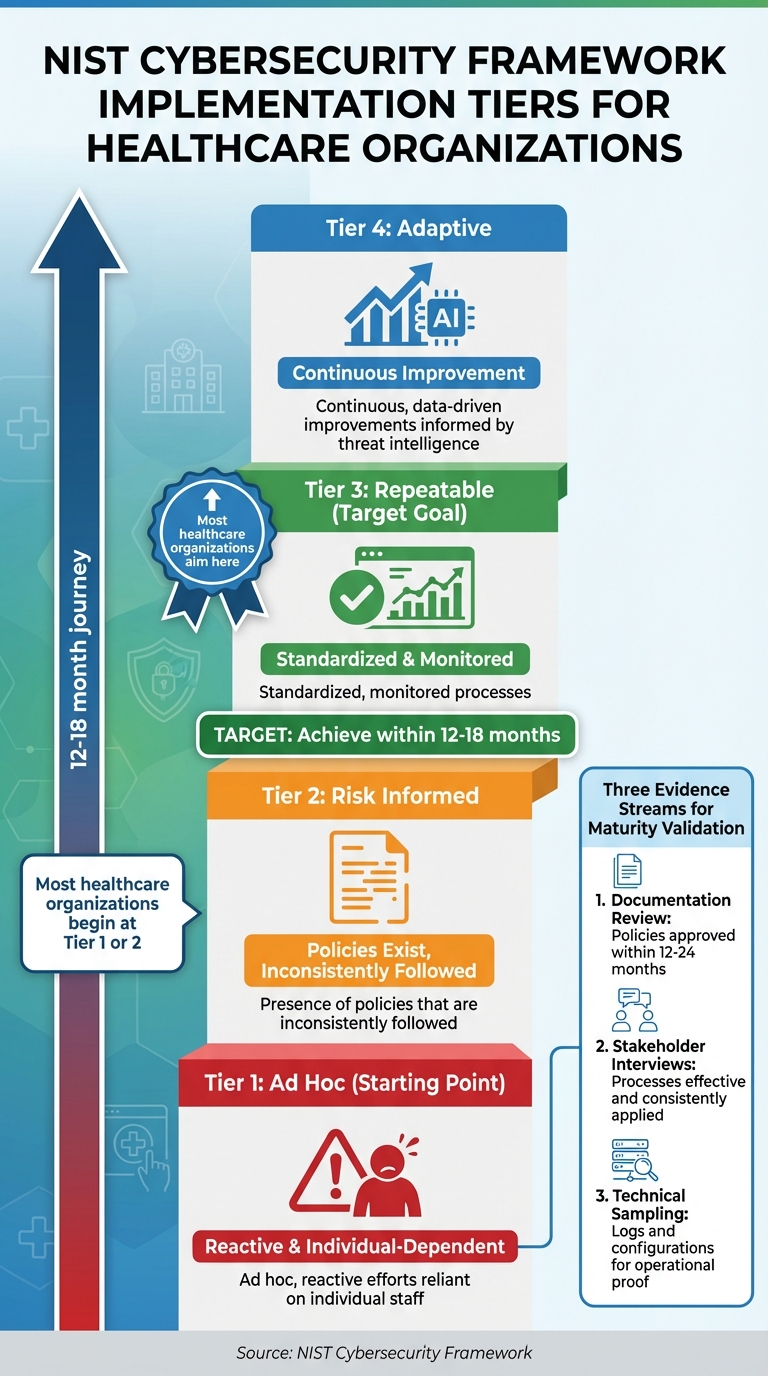
NIST Cybersecurity Framework Implementation Tiers: Healthcare Maturity Roadmap
Measuring the success of a cybersecurity framework requires a structured, thoughtful approach. It all begins with selecting frameworks tailored to healthcare's specific regulatory and operational needs. For most healthcare organizations, the NIST Cybersecurity Framework (CSF) serves as an effective foundation. By mapping the NIST CSF directly to the HIPAA Security Rule, organizations can ensure their security measures align with regulatory requirements while avoiding redundant efforts.
Choosing the Right Framework
No single framework can address all the unique challenges healthcare organizations face. A hybrid approach often works best - combining the NIST CSF with HHS 405(d) HICP to tackle practical concerns like managing medical device risks and accommodating staff limitations. This combination recognizes that healthcare environments go beyond traditional IT systems, encompassing electronic health record (EHR) platforms, imaging systems (PACS/VNA), telehealth tools, and partnerships with third-party business associates.
When integrating frameworks, map the five NIST CSF functions - Identify, Protect, Detect, Respond, and Recover - to HIPAA’s administrative, physical, and technical safeguards. This alignment not only strengthens regulatory compliance but also provides a clear structure for measuring progress. For older medical devices running legacy operating systems, prioritize compensating controls like network segmentation and passive monitoring instead of traditional patching methods, as updates often disrupt clinical workflows.
Once the hybrid framework is in place, focus on defining measurable success metrics to track and quantify progress effectively.
Defining Success Metrics
Success must be measurable to demonstrate meaningful progress. The NIST CSF Implementation Tiers (1–4) offer a clear way to track maturity:
- Tier 1 represents ad hoc, reactive efforts reliant on individual staff.
- Tier 2 indicates the presence of policies that are inconsistently followed.
- Tier 3 reflects standardized, monitored processes.
- Tier 4 signifies continuous, data-driven improvements informed by threat intelligence.
Most healthcare organizations begin at Tier 1 or 2 and aim to reach Tier 3 within 12–18 months.
To assess progress, create a scoring rubric for each control, evaluating factors like policy existence, implementation, operation, and key performance indicator (KPI) measurement. Focus on 8–12 core metrics - such as multi-factor authentication (MFA) coverage, critical patch compliance, and mean time to detect threats - and track enterprise-wide adoption to gauge control effectiveness.
Validate maturity through three evidence streams:
- Documentation review: Confirm policies have been approved within the last 12–24 months.
- Stakeholder interviews: Ensure processes are effective and consistently applied.
- Technical sampling: Analyze logs and configurations for operational proof.
This three-pronged validation approach minimizes inflated self-assessments and provides boards with concrete, actionable evidence of progress.
Key Performance Indicators for Cybersecurity
Core KPI Categories
Tracking KPIs transforms security efforts into measurable results. In healthcare, organizations prioritize four main categories: risk scorecard ratings, incident response time, system uptime, and breach detection/reporting time[6].
- Risk scorecard ratings evaluate the current state of cybersecurity by scoring practices and vulnerabilities, helping to pinpoint risks and areas that need attention.
- Incident response time measures how quickly teams detect and resolve security incidents - a critical factor when delays can have serious consequences.
- System uptime monitors the availability of clinical systems, which are essential for patient care.
- Breach detection and reporting time is particularly critical for healthcare, where the average reporting time for ransomware attacks is 3.7 months - the fastest across industries[6].
Other important metrics include MFA (multi-factor authentication) adoption, patch compliance, and phishing simulation results. For instance, password cracking succeeded in 46% of tests, highlighting the need for universal MFA adoption[8][7]. In patch management, organizations should focus on the percentage of systems receiving timely updates, as current efforts only cover 74% of known vulnerabilities in healthcare[4]. Additionally, monitoring network segmentation - especially for legacy medical devices that can’t be patched regularly - ensures critical systems are isolated to limit breach impact[3][7].
Healthcare organizations using NIST CSF 2.0 should also consider benchmarking data to identify areas for improvement. While the Respond function achieves 85% coverage and Recover reaches 78%, two key areas fall behind: Supply Chain Risk Management under the Govern function (52% coverage) and Asset Management under the Identify function (53% coverage)[4]. Addressing these gaps can reduce cybersecurity insurance premium increases year-over-year[4][3].
Setting Baselines and Tracking Trends
To effectively measure progress, establishing baselines is essential. Start by conducting initial assessments of frameworks like NIST CSF 2.0, Healthcare and Public Health Cybersecurity Performance Goals (HPH CPGs), and the HITRUST Common Security Framework. These assessments provide a clear snapshot of your current cybersecurity posture, whether you’re operating at an ad hoc level (Tier 1) or have a more mature, policy-driven approach. HITRUST, in particular, offers measurable insights into program maturity, making it easier to track progress or identify declines over time[5].
Once baselines are set, use historical data to uncover trends and spot emerging risks. Track 8–12 key metrics quarterly, comparing them against initial benchmarks and industry standards. For example, the 2025 Healthcare Cybersecurity Benchmarking Study, which analyzed data from 69 healthcare organizations and payers between September and December 2024, provides valuable peer comparisons[2]. Filtering benchmarks by attributes - such as distinguishing between Healthcare Delivery Organizations and Health Plans - ensures realistic and actionable insights. This data-driven approach not only supports decision-making but also demonstrates progress to leadership, boards, and insurers.
Finally, tools like integrated risk management platforms, such as Censinet RiskOps™, can simplify the process. These platforms automate data collection and reporting, enabling continuous improvement and ensuring your cybersecurity framework remains effective and adaptable.
sbb-itb-535baee
Turning Metrics into Action
Creating an Improvement Roadmap
Metrics are the foundation for progress. Once you've identified gaps in your KPIs, the next step is to craft a focused action plan that tackles your most pressing vulnerabilities. Start by comparing your metrics to industry benchmarks. For example, if your organization falls short in areas like Supply Chain Risk Management or Asset Management, use these insights to prioritize initiatives that deliver measurable results aligned with organizational goals [3].
Every initiative in your roadmap should have a clear connection to outcomes. For instance, if your breach detection time exceeds the healthcare average of 3.7 months, focus on enhancing monitoring and response systems [6]. Likewise, a high rate of password cracking might signal the urgent need to implement multi-factor authentication [8].
Assign ownership for each initiative to ensure accountability. Organizations with strong program ownership by CISOs consistently achieve better adherence to frameworks like NIST CSF and HICP [1]. Break down larger projects into quarterly milestones that align with your KPI review cycles. This approach not only keeps initiatives on track but also helps improve both measurement precision and framework maturity.
Lastly, embed these initiatives into your governance structure to maintain oversight and ensure consistent progress.
Connecting Measurement to Governance
After defining your improvement initiatives, the next step is to weave them into a structured governance process. Turning metrics into actionable insights requires regular oversight. Schedule quarterly governance meetings where leadership reviews key metrics - like risk scorecards, incident response times, and framework coverage - alongside financial and operational data. This integration ensures that cybersecurity is treated with the same priority as other critical business areas.
Frameworks like HITRUST can help demonstrate year-over-year progress in ways that resonate with executives and board members [5]. When presenting these metrics, tie them to tangible business benefits. For example, organizations that adopt NIST CSF 2.0 as their primary framework report slower increases in cybersecurity insurance premiums year over year [3]. This direct link between framework adoption and cost savings makes the case for investment clear.
Metrics should also guide resource allocation. Compare your cybersecurity spending and staffing ratios to industry averages to justify budget needs. If persistent gaps are uncovered - such as in medical device security, which consistently ranks lowest among HICP practice areas - use governance discussions to prioritize the necessary funding and staffing [3]. Tools like Censinet RiskOps™ can simplify this process by automating reports that feed directly into governance workflows, enabling collaborative risk management and ongoing improvement tracking.
Maintaining Long-Term Measurement
Building Accountability
Keeping cybersecurity measurement on track requires clear ownership and steady oversight. At its core, leadership commitment plays a key role. Organizations with strong CISO-led programs often achieve better alignment with frameworks like NIST CSF and HICP[1]. This means assigning specific people to monitor KPIs, setting up regular reporting schedules, and linking metrics directly to business outcomes - such as lowering insurance premium hikes or reducing audit-related burdens.
Transparency is essential for accountability. Leaders should share measurable insights into program performance, like year-over-year maturity improvements, with executives and boards. For instance, HITRUST's VP of Adoption highlights that regular audits help teams shift focus toward strategic goals while monitoring whether programs are improving or falling behind over time[5]. When security metrics are tied to real-world results, it becomes much easier to justify ongoing cybersecurity investments[3].
Embedding these reviews into governance processes ensures that cybersecurity is treated with the same importance as financial or operational metrics. Adding automated tools to this framework strengthens accountability further by enabling consistent and reliable measurement.
Using Tools to Automate Measurement
Automation tools simplify the process of tracking KPIs, assessing risks, and generating reports. Platforms like Censinet RiskOps™ are designed to automate third-party and enterprise risk assessments, benchmark cybersecurity efforts, and manage risks collaboratively - especially within healthcare environments. The platform focuses on critical areas like patient data, PHI, clinical applications, medical devices, and supply chains, all of which are crucial for maintaining reliable long-term measurement.
Automation helps organizations establish baselines, monitor trends for KPIs such as incident response times (with the average breach reporting time currently around 3.7 months[6]), and measure system uptime. It also enables benchmarking against peers to uncover gaps in areas like third-party risk management. By automating assessments and delivering prioritized remediation plans, tools like Censinet RiskOps™ reduce manual effort, keep organizations audit-ready, and ensure steady progress in cybersecurity maturity rather than stagnation between compliance cycles.
Conclusion
Measuring the success of a cybersecurity framework goes beyond meeting compliance standards - it's about creating a robust program that protects patient care and aligns with business goals. For healthcare organizations, linking metrics to outcomes like reduced insurance premiums can provide clear, measurable advantages.
To move forward, it's crucial to address ongoing gaps while building on existing strengths. Monitoring control maturity year after year helps organizations transition from reactive responses to proactive security strategies. As HITRUST VP Ryan Patrick explains:
"The HITRUST audit... gives a quantifiable breakdown of how strong your program is. Are you improving or getting worse year over year? The HITRUST framework reports tell you that while tracking metrics and KPIs" [5].
This drive for improvement naturally highlights the importance of automation.
Automation plays a key role in ensuring consistent and efficient measurement. Tools like Censinet RiskOps™ simplify the process of tracking KPIs, performing risk assessments, and generating reports. By reducing manual workload, these platforms help establish meaningful baselines and monitor trends critical to operational resilience. This is especially vital when healthcare organizations take, on average, 3.7 months to disclose ransomware incidents [6].
Integrate cybersecurity measurement into governance processes with the same diligence as financial metrics. Set baseline KPIs, review them quarterly in the context of business objectives, and update frameworks annually to ensure continuous improvement in security practices.
FAQs
What should we measure first when adopting NIST CSF in healthcare?
When applying the NIST Cybersecurity Framework (CSF) in healthcare, the first step is conducting a gap analysis. This helps you evaluate your current cybersecurity posture across the framework's five core functions: Identify, Protect, Detect, Respond, and Recover. Pay close attention to high-risk areas, such as safeguarding patient data and addressing vulnerabilities in medical devices. By identifying these gaps, you create a solid starting point for aligning your cybersecurity strategy with the NIST CSF.
How can we prove our NIST CSF maturity tier with evidence?
To demonstrate your NIST CSF maturity tier, start by conducting a structured assessment that aligns with the framework. Document your cybersecurity practices thoroughly. Perform a gap analysis to pinpoint areas where your practices align with or fall short of the framework's standards. Collect supporting evidence such as policies, risk assessments, and incident response plans to back up your claims. Tools like Censinet RiskOps™ can simplify this process by streamlining assessments and offering dashboards that present clear, actionable evidence of your maturity tier.
How can we track third-party and supply chain cyber risk over time?
Healthcare organizations can keep an eye on third-party and supply chain cyber risks by leveraging key performance indicators (KPIs) and continuous monitoring tools. Some crucial metrics to focus on include:
- Vendor risk ratings: Assess the risk levels associated with each third-party vendor.
- Compliance rates: Track how well vendors adhere to required standards and regulations.
- Mean time to risk resolution: Measure how quickly identified risks are addressed.
- Supply chain control coverage: Evaluate the extent of risk controls across the supply chain.
Automated tools, such as Censinet RiskOps™, simplify these tasks by streamlining assessments and automating workflows. These platforms also allow benchmarking against frameworks like NIST CSF 2.0, helping organizations pinpoint vulnerabilities and enhance their risk management strategies over time.
