
When managing complex incidents involving multiple vendors - like healthcare outages caused by cloud or DNS failures - quick, coordinated responses are essential. This article breaks down five tools that simplify collaboration, streamline communication, and ensure HIPAA-compliant vendor risk management. Here's a quick overview:
- Censinet RiskOps™: Centralized platform for healthcare risk and incident management, with role-based access and compliance workflows.
- Slack (Enterprise Grid): Secure, real-time communication with external organizations, supporting HIPAA compliance with proper configurations.
- Microsoft Teams: Integrated with Microsoft 365, it offers tools like digital incident plans and strong encryption for healthcare use.
- Splunk: Advanced monitoring and alerting, with shared dashboards and compliance-ready features for PHI handling.
- ServiceNow: Comprehensive workflow management with clinical context awareness and vendor risk tracking.
Each tool addresses specific challenges in healthcare incident response, from fragmented logs to regulatory requirements. Combining these solutions can improve response times, protect patient data, and maintain operational integrity.
Your blueprint for automated incident recovery
sbb-itb-535baee
1. Censinet RiskOps™
When a multi-party incident occurs, coordination becomes the biggest hurdle. Questions like “Who has access to what?” and “Which vendor manages which system?” take center stage, especially in healthcare settings where both patient safety and regulatory compliance are critical. That’s where this tool steps in, making collaboration more efficient - a key theme of this discussion.
RiskOps™ offers a shared, cloud-based workspace that allows healthcare delivery organization (HDO) security teams and cloud vendors to collaborate using a single, always up-to-date incident record. Teams can log technical indicators, attach forensic evidence, assign tasks with deadlines, and monitor resolution progress - all within one platform. Role-based access controls ensure vendors only see what’s relevant to their role during an incident, with access limited by both scope and time.
The tool models systems critical to protecting patient health information (PHI), such as electronic health records (EHRs), clinical apps, medical devices, and cloud services. This enables teams to assess incident severity based on its impact on patient safety, rather than solely on technical factors. RiskOps™ also keeps essential regulatory documentation easily accessible, while its compliance workflows create a detailed audit trail of every access event, status update, and decision. This supports HIPAA Security Rule requirements and simplifies regulatory reviews. Additionally, business associate agreements and vendor attestations are embedded directly into the incident record, allowing legal and compliance teams to quickly determine breach reportability without hunting across multiple tools.
To further streamline cross-vendor coordination, RiskOps™ integrates with SIEM and ITSM tools, ensuring alerts and tasks stay synchronized. It also connects with collaboration platforms to align real-time communication with the incident record. The Censinet Risk Assessor Agent speeds up post-incident assessments by automating document reviews and action-plan creation, cutting this process by up to 66% [3].
2. Slack (Enterprise Grid)
When a major incident strikes, managing communication through scattered emails can quickly become chaotic. Slack Enterprise Grid eliminates this confusion by offering dedicated channels where every message, file, and decision is logged. This setup ensures that new responders can review the channel history and get up to speed in no time, saving the team from spending hours drafting summaries. This centralized approach simplifies multi-vendor coordination, making healthcare incident management far more efficient.
Slack Connect takes this a step further, addressing healthcare's need for secure, cross-organization collaboration. With Slack Connect, a single channel can host communication with up to 250 external organizations at once [5]. This means your security team, cloud vendor, electronic health record (EHR) provider, and legal counsel can all collaborate in one shared space - without needing to add external users to your internal workspace. Unlike email, Slack Connect limits communication to verified members, significantly reducing phishing and spam risks. This is critical, as phishing and spam are responsible for 90% of data breaches [4].
For healthcare organizations, HIPAA compliance is available on the Enterprise Grid plan, but it requires a signed Business Associate Agreement (BAA) before any protected health information (PHI) can be shared [7]. Slack Enterprise Grid also offers strong security measures: Enterprise Key Management (EKM) allows organizations to control their own encryption keys through AWS KMS, while native Data Loss Prevention (DLP) enforces policies to prevent inappropriate sharing of sensitive data. Additionally, immutable audit logs track every access event and administrative action [4]. If you plan to use Slack AI features, ensure your BAA explicitly covers them for handling PHI or clinical workflows [7].
| HIPAA Technical Safeguard | Slack Enterprise Grid Implementation |
|---|---|
| Encryption in Transit | TLS 1.3 for all API connections and HTTPS for webhooks [7] |
| Encryption at Rest | AES 256-bit encryption; EKM for customer-controlled keys [4][7] |
| Access Control | RBAC, MFA requirements, and OAuth2 minimum-scope tokens [7] |
| Audit Controls | Detailed audit logs for message delivery, admin actions, and authentication [4][7] |
Slack also integrates seamlessly with tools like PagerDuty, Datadog, Splunk, and AWS Security Incident Response to enhance alerting and case management. For incident-specific workflows, tools like incident.io integrate directly with Slack, automating tasks like timeline documentation and role assignments. This automation is particularly valuable for post-incident reviews: while manually reconstructing events from Slack history can take 60–90 minutes, automated tools reduce this to 10–15 minutes [6]. These integrations further solidify Slack's ability to streamline incident management workflows.
As one user noted:
"The separation of functionality between Slack and the website is extremely powerful. This gives us the ability to have rich reporting and compliance controls in place without cluttering the experience and the workflow for the incident responders." - Joar S., G2 [6]
3. Microsoft Teams
For healthcare organizations already using Microsoft 365, Teams offers a seamless way to manage incident response without needing to juggle multiple platforms. It allows healthcare delivery organizations (HDOs) to handle communications, documentation, and decision-making in one familiar workspace. Microsoft emphasizes that digital tools like Teams provide timely updates, easy access, and real-time collaboration during critical moments [8]. With its user-friendly interface, Teams integrates key incident response tools and compliance features, which we'll delve into further.
One standout feature for managing multi-party incidents is the digital Major Incident Response Plan (MIRP), accessible via the Microsoft Engage Center. This tool consolidates up-to-date contact information for Azure, M365, and Dynamics 365, enabling quick access to the right individuals during a live outage. For large organizations, it even combines multiple environments into a unified view, streamlining coordination [8].
From a compliance perspective, Teams meets Tier D standards, including HIPAA, HITECH, HITRUST CSF, ISO 27001, ISO 27018, SOC 1, and SOC 2 [12][13]. Microsoft simplifies the process for covered entities by automatically including a HIPAA Business Associate Agreement (BAA) in its Online Services Terms [12]. To further safeguard Protected Health Information (PHI), Microsoft Purview DLP can detect and block improper sharing of sensitive data - like medical records or Social Security Numbers - within chats and channels [14]. Additionally, Teams supports Customer Key encryption, allowing organizations to use their own encryption keys to secure chat messages, media, and meeting recordings at the tenant level [14]. These features ensure PHI remains protected, even when collaborating across multiple vendors, which is crucial for healthcare vendor breach response.
Teams also stands out for its integration capabilities with ITSM and alerting tools, enhancing coordinated responses during crises. This coordination is vital to addressing systemic risk in healthcare caused by vendor outages. For example, PagerDuty integration allows responders to trigger incidents directly within Teams using simple commands [10]. ITSM platforms like ServiceNow can automatically create dedicated "war room" channels for critical incidents, while Adaptive Cards (v1.5) provide color-coded status updates - red for live incidents, amber for updates, and green for resolution - making triage faster and more efficient [11][15].
"Microsoft Teams empowers the DevOps community with secure collaboration and meeting experiences. With PagerDuty's integration for Microsoft Teams, DevOps practitioners can drive real-time operations all within the Teams platform." - Farhaz Karmali, Lead Product Manager, Teams - Microsoft [10]
Key Features of Microsoft Teams During an Incident
| Feature | What It Does During an Incident |
|---|---|
| Digital MIRP | Centralizes Azure/M365 stakeholder contacts for fast outreach [8] |
| Adaptive Cards | Provides color-coded, structured status updates in incident channels [11] |
| TEOC Template | Uses Microsoft Lists and SharePoint for streamlined field communications [9] |
| PagerDuty Integration | Enables quick incident triggering and automated diagnostics within Teams [10] |
| Purview DLP | Detects and blocks improper PHI sharing in chats and channels [14] |
4. Splunk
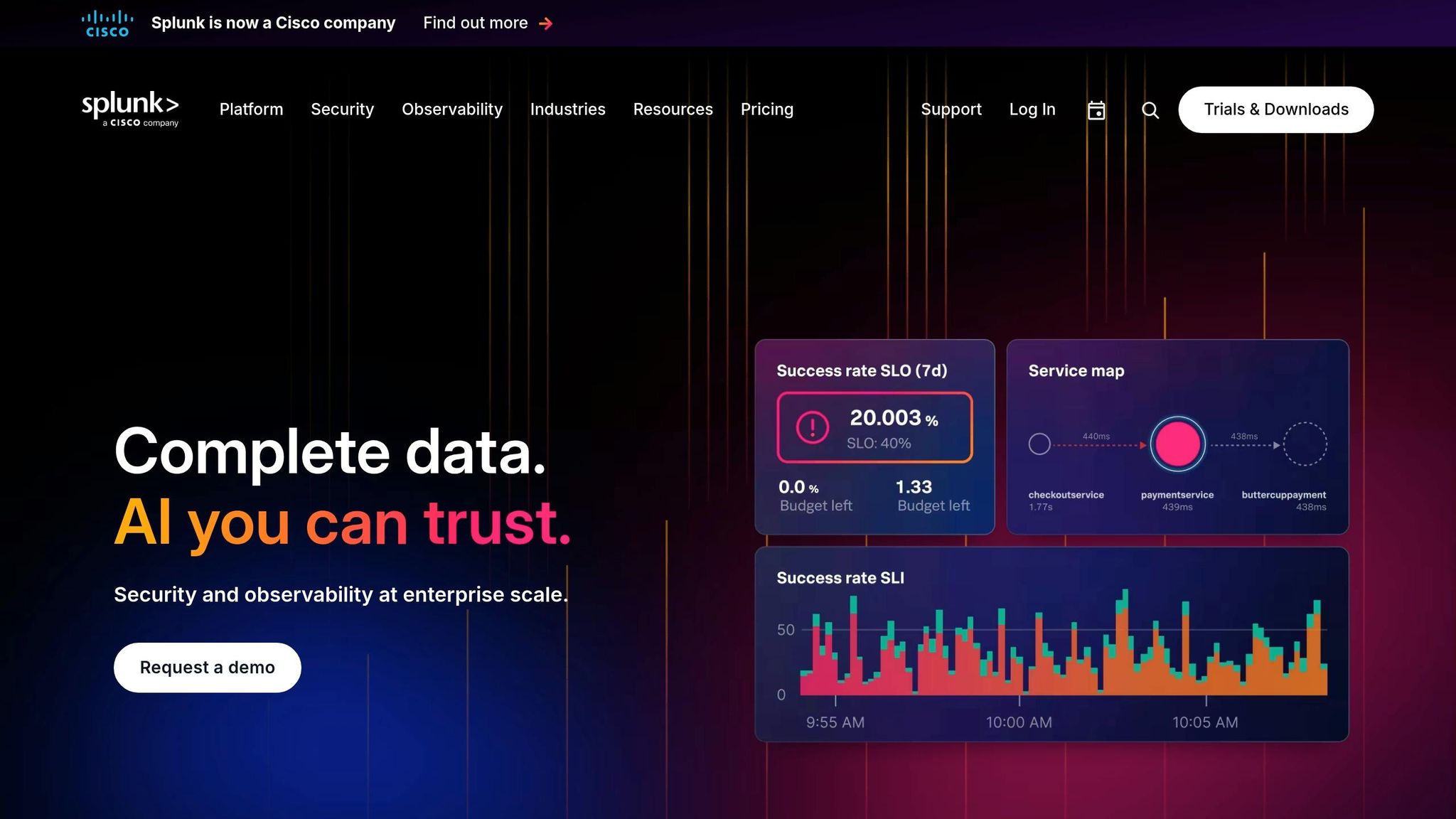
When a healthcare incident spans multiple teams - security, IT, privacy, compliance, and external cloud vendors - coordinating efforts can be a real challenge. Splunk tackles this issue with Mission Control, a centralized dashboard that lets analysts manage incidents from one screen. With this tool, teams can prioritize incidents by urgency, track their status, identify the owner, and categorize them by security domain. A timeline feature even shows when specific findings were generated, making it easier to follow the sequence of events [18]. This shared view minimizes delays caused by back-and-forth communication, creating a smoother response process.
Splunk also introduces a multi-responder incident model, ensuring an incident remains active until every designated team or individual acknowledges it. This is particularly important for healthcare scenarios involving PHI exposure, where IT, privacy officers, and legal teams all need to sign off before an incident is closed [16]. Using cascading escalation policies, a single alert can notify multiple specialized teams at once, eliminating the need for manual follow-ups.
"Splunk On-Call allows you to quickly mobilize teams around an incident... multi-responder incidents require responses from each user or escalation policy being paged." - Splunk Documentation [16]
Analysts can also share a unique investigation ID (e.g., ES-11005), attach evidence and notes, and upload files up to 4 MB, including records of phone calls or chats with external vendors [17]. This builds a defensible audit trail, which is critical for demonstrating to auditors how a PHI-related incident was handled. For example, Abacus Insights, a healthcare data unification company, revamped its incident response model in May 2026 using Splunk alerts. They transitioned from fragmented "tribal knowledge" to a repeatable, documented workflow that could be showcased to both customers and auditors [1]. This kind of structured approach is invaluable for handling complex, multi-vendor incidents.
On the compliance front, the Splunk Cloud Platform offers a Premium HIPAA environment, certified to meet the HIPAA Security Rule and HITECH Breach Notification Requirements. It also comes with a formal Business Associate Agreement (BAA). In healthcare, where meeting regulatory deadlines is non-negotiable, these compliance safeguards are indispensable. Data is secured with TLS 1.2+ during transit and AES-256 encryption at rest [20]. However, it’s crucial to note that Splunk On-Call (formerly VictorOps) is not HIPAA-eligible. PHI should not be included in its alert payloads; instead, clinical details should remain within the HIPAA-compliant Splunk Cloud environment [20].
Splunk's integration capabilities further enhance its utility. It connects effortlessly with ticketing and monitoring systems like ServiceNow, Jira, and Zendesk, as well as infrastructure monitoring tools such as AWS CloudWatch, Azure Monitor, and GCP Monitoring. One standout feature is the integration of Splunk Observability Cloud with AWS Incident Detection and Response via Amazon EventBridge. This allows AWS Incident Management Engineers to respond within 5 minutes of a critical alert [21]. Additionally, its communication bridges with Slack, Microsoft Teams, and Webex make Splunk a central hub that ties together the tools teams are already using.
| Feature | Multi-Party Collaboration Benefit |
|---|---|
| Mission Control | Shared analyst queue with unified triage views across teams [18] |
| Multi-Responder Paging | Ensures all designated teams acknowledge the incident [16] |
| Investigation IDs | Enables direct sharing of specific investigations for peer review [17] |
| SOAR Playbooks | Automates standardized response actions across departments [19] |
| AWS EventBridge Integration | Triggers AWS engineer response within 5 minutes of critical alerts [21] |
5. ServiceNow
ServiceNow integrates seamlessly with existing collaboration tools to improve coordination across IT, security, legal teams, and external vendors. In the healthcare sector, when incidents like ransomware attacks, PHI breaches, or critical EHR outages occur, quick alignment of these stakeholders is crucial. ServiceNow tackles this need with its Major Security Incident Management (MSIM) feature, acting as a centralized crisis command center. This tool ensures stakeholders have role-specific access to key data, addressing a significant challenge: 70% of security and IT professionals report difficulty in recruiting additional SOC staff, making effective orchestration more critical than ever [25].
One standout feature is ServiceNow's real-time bidirectional synchronization with cloud vendor environments, which eliminates manual handoffs and prevents version mismatches [26]. For instance, its integration with AWS Security Incident Response ensures that incident statuses, comments, and attachments stay synchronized between AWS tools and the healthcare delivery organization's (HDO) ServiceNow instance. This integration is secured using JWT OAuth, with tokens that expire hourly to minimize credential exposure [26]. Such real-time syncing enhances cross-functional incident management.
"For many organizations, ServiceNow operates as the system of record for governance, auditability, and compliance... ServiceNow remains your system of record while Datadog becomes your system of resolution." - Candace Shamieh, Technical Writer, Datadog [28]
ServiceNow's governance capabilities extend beyond IT and security into clinical operations. Its clinical context awareness makes it particularly valuable in healthcare. The "EMR Help" solution allows clinicians to submit support tickets directly from within Epic and other EHR platforms. These tickets automatically capture the active patient record or clinical workflow, enabling incidents to be prioritized based on their impact on patient safety rather than just technical severity [27]. As the Selah Digital Team explains, "Healthcare ITSM must account for these clinical dependencies in how incidents are classified, prioritized, and escalated" [27].
ServiceNow also simplifies vendor coordination through its Third-Party Risk Management (TPRM) module. This tool automates the entire vendor risk lifecycle, from onboarding to continuous compliance monitoring. Instead of relying on manual spreadsheets, it provides a secure portal where HDOs and vendors can exchange assessments, track issues, and manage escalations in compliance with HIPAA, GDPR, and HITRUST standards [23][24]. Organizations using this module have reported a threefold return on investment [24].
| Feature | Healthcare Benefit |
|---|---|
| MSIM Crisis Command Center | Brings together IT, security, legal, PR, and external vendors during high-stakes incidents [25]. |
| Bidirectional Cloud Sync | Ensures real-time alignment of incident data between HDOs and cloud vendor tools [26]. |
| EMR Help Integration | Captures clinical context from Epic, prioritizing incidents by their patient safety impact [27]. |
| TPRM Vendor Portal | Automates compliance tracking for HIPAA, GDPR, and HITRUST standards [23][24]. |
| On-Call Integrations (xMatters) | Triggers conference bridges and alerts responders directly from the incident record [22]. |
Tool Comparison Table

Top 5 Healthcare Incident Response Tools Compared
Each tool in this article serves a specific purpose. Some shine in real-time communication, others focus on compliance documentation, while certain tools specialize in healthcare-specific workflows. Here's a summary of how these tools contribute to healthcare incident coordination, highlighting their features in the context of patient safety and regulatory needs.
It’s worth noting that general-purpose tools like Slack and Microsoft Teams are excellent for instant communication but often don’t have the structured, PHI-specific workflows needed for a solid audit trail. As Abacus Insights aptly put it, "A document says the organization has thought about a response process, while a platform shows the organization is operationalizing a response program" [1].
| Tool | Collaboration Features | Compliance Support | Integration Options | Healthcare Relevance |
|---|---|---|---|---|
| Censinet RiskOps™ | Collaborative risk assessments, AI-powered routing across GRC teams, role-based task assignment | SOC 2 Type 2 (Feb 2026), HIPAA, HITRUST; automated audit trails for vendor risk workflows [29] | ServiceNow Workflow Connector, EHR/EMR systems, cloud vendor environments; AI reduces assessment time by up to 66% [3] | Designed for healthcare; supports PHI, medical devices, clinical apps, and supply chain risk management |
| Slack (Enterprise Grid) | Private channels, real-time messaging, automated Zoom/Webex bridges for incident communication [2] | Limited native HIPAA support; requires additional configuration to contain PHI in private channels [1] | Jira, SharePoint, Confluence, Splunk, ServiceNow; bi-directional sync available via third-party connectors [2] | Popular in healthcare IT, but lacks PHI-specific triage workflows [1] |
| Microsoft Teams | Persistent chat, video conferencing, shared workspaces for cross-functional incident teams | Supports HIPAA-eligible configurations under Microsoft's Business Associate Agreement (BAA) | Native Microsoft 365 ecosystem; integrates with ServiceNow, Splunk, and Azure Security tools | Strong choice for healthcare organizations already using Microsoft infrastructure; clinical workflow integrations via third-party apps |
| Splunk | Dashboards and alert-driven workflows; supports multi-team visibility into security events | HIPAA-aligned logging and audit capabilities; tamper-resistant log retention for ePHI access tracking [6] | AWS, Azure, GCP, ServiceNow, Slack, Jira; ingests data from EHR systems and medical device telemetry | Essential for identifying PHI-related exposures; provides alert data for downstream incident platforms [1] |
| ServiceNow | MSIM Crisis Command Center, on-call integrations (xMatters), role-specific access controls | HIPAA, GDPR, HITRUST; TPRM module automates compliance tracking | AWS Security Incident Response (JWT OAuth sync), Epic EMR Help, Slack, Microsoft Teams [26][27] | EMR Help captures clinical context from Epic; prioritizes incidents by patient safety impact over technical severity [27] |
No single tool can meet every need in healthcare incident response. Splunk excels at threat detection, Slack and Teams facilitate communication, ServiceNow manages workflows and vendor coordination, and Censinet RiskOps™ strengthens risk intelligence and third-party vendor risk management. Together, these tools create a comprehensive, layered approach that addresses both technical and regulatory challenges - helping healthcare organizations stay prepared for cybersecurity incidents.
Conclusion
When it comes to managing incident response in healthcare, the importance of timely collaboration can't be overstated. Choosing the right multi-party incident tools is a decision that directly impacts patient safety. In scenarios like a ransomware attack crippling an EHR system or a cloud vendor breach exposing PHI, the speed and organization of your response can significantly influence clinical outcomes.
Each tool brings something essential to the table: Splunk excels at identifying threats quickly, Slack and Microsoft Teams enhance communication, ServiceNow organizes workflows, and Censinet RiskOps™ keeps third-party risk data accurate and actionable. While no single tool can address every need, combining these technologies creates a layered defense strategy. This approach strengthens incident response efforts, protecting both patient data and clinical operations.
When assessing your tools, focus on a few key factors: HIPAA compliance with signed BAAs, seamless integrations for automatic alerts and ticketing, and a centralized system for tracking incident timelines.
As BreachRx aptly noted, "If one person runs an incident one way and another person runs it differently, the organization does not have a system. It has preferences." [1] The key to success lies in standardizing your tools and regularly testing them through collaborative tabletop exercises, including participation from cloud vendors. This ensures your plan evolves into a reliable, repeatable process.
The ultimate objective is to create a unified response framework with complete visibility, clear roles, and a comprehensive audit trail. By doing so, you not only improve efficiency but also reinforce trust and accountability in your healthcare operations.
FAQs
Which tool should be the system of record during a multi-vendor incident?
When managing a multi-vendor incident, healthcare organizations benefit greatly from using a centralized platform. This approach provides a single source of truth for coordination, documentation, and managing risks.
Tools like Censinet RiskOps™ simplify this process by bringing everything together in one place. It consolidates assessments, organizes tasks, and facilitates secure data sharing. By centralizing vendor profiles, contracts, and related records, it ensures that all stakeholders have access to accurate and up-to-date information. This eliminates the chaos of fragmented communication - no more juggling spreadsheets or scattered email threads.
Can we collaborate with vendors without sharing PHI in chat tools?
Yes, generic chat tools usually fall short when it comes to safeguarding Protected Health Information (PHI). Solutions like Censinet RiskOps™ provide a secure, centralized space for handling incident responses. This platform allows organizations and vendors to share cybersecurity and risk-related data securely. With its dedicated risk exchange, you can collaborate in a way that complies with HIPAA, manage tasks within an audited environment, and keep information current - all without resorting to non-compliant messaging tools.
What’s the minimum setup to be HIPAA-ready for incident collaboration?
To handle multi-party incident collaboration while staying HIPAA-compliant, it's essential to build a governance framework that aligns with NIST CSF 2.0 and the HHS 405(d) Cybersecurity Performance Goals. At a minimum, you should focus on these key areas:
- Strong Business Associate Agreements (BAAs): These agreements must outline clear breach notification timelines and establish protocols for evidence sharing.
- Defined Roles and Responsibilities: Implement a RACI matrix to clarify who is Responsible, Accountable, Consulted, and Informed during incident management.
Tools like Censinet RiskOps™ can simplify the process by managing vendor obligations, streamlining risk management, and organizing incident documentation, ensuring a secure and efficient collaboration environment.
