
If one vendor fails, your other systems can fail with it. In U.S. healthcare, that risk is no longer small: 77.3 million people were affected by healthcare breaches in 2023, and 58% of those breaches were linked to business associates. Following healthcare vendor breach response best practices is critical to mitigating these risks.
I see the main takeaway like this: a multi-vendor risk framework helps you track shared risk across cloud apps, EHR links, devices, MSPs, claims tools, and subcontractors. Instead of checking vendors one by one, you look at who has access, what data they touch, which workflows depend on them, and what happens next if one goes down.
If I had to boil the article down, I’d say you need to focus on:
- Clear ownership for vendor decisions, reviews, and incident escalation
- One vendor inventory with data flows, PHI use, connections, and subcontractors
- Risk tiers that set review depth and review timing
- Proof-based reviews using items like SOC 2, HITRUST, ISO 27001, pen test summaries, SBOMs, and BAAs
- Scoring and remediation based on patient care impact, PHI exposure, concentration risk, and control gaps
- Monitoring after onboarding, not just at contract start
- Alignment with HIPAA, HITECH, HITRUST, FDA device guidance, and BAA terms
- Metrics and incident playbooks so teams can act fast during outages, breaches, or device events
- Automation and AI to cut manual work while people keep final approval
A few numbers make the risk clear:
- 287% jump in business-associate-linked healthcare breaches from 2022 to 2023
- 278% increase in ransomware attacks against U.S. healthcare since 2020
- 18.71 days of average downtime per hospital from ransomware in 2023
- 54% of healthcare vendors had at least one PHI-related breach in one cited study
At a basic level, the article lays out a simple path: build governance, map vendors, tier risk, review controls, track fixes, monitor changes, and test incident response. That gives you a repeatable way to deal with many vendors without treating every vendor the same.
This guide is best read as a playbook for building a vendor risk program that is consistent, auditable, and tied to patient care risk.
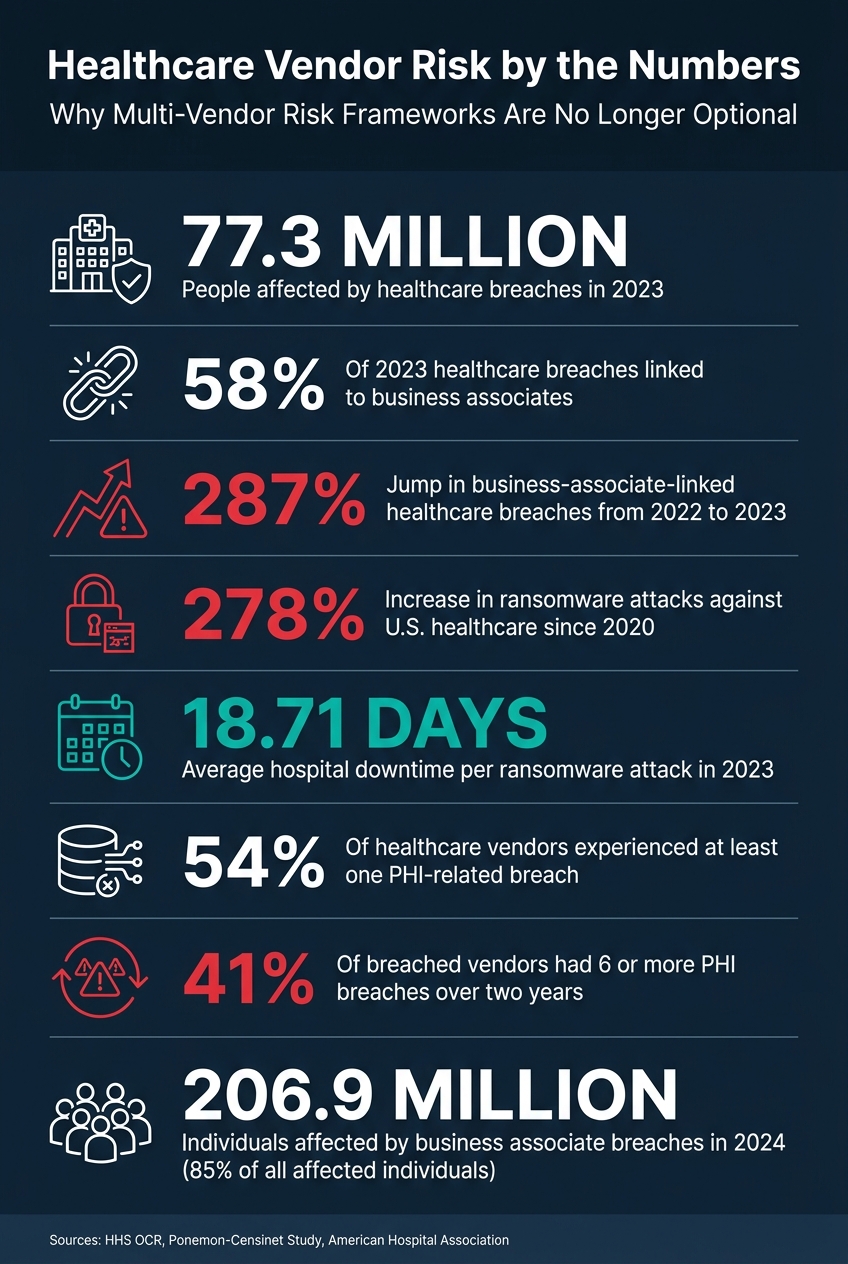
Healthcare Vendor Risk by the Numbers: 2023–2024 Breach & Ransomware Statistics
The Third Party Risk Management Lifecycle: Managing Vendor Risk From Start to Finish Webinar
sbb-itb-535baee
Core Components of a Healthcare Multi-Vendor Risk Framework
Once shared exposure is mapped, the next step is ownership.
Build the framework in four layers: governance, inventory, tiering, and controls. Each layer depends on the one before it.
Governance, Ownership, and Escalation Paths
Governance is the part that keeps the framework together. Without it, response efforts drift because no one clearly owns the next move.
Use a TPRM committee that includes security, privacy, compliance, legal, procurement, IT, and clinical leadership. Each group should own a defined decision, not just sit in the room.
The charter should spell out onboarding approval, exception authority, and escalation triggers. Those escalation thresholds matter most when time is tight. A confirmed PHI breach, a long outage that disrupts clinical workflows, or a cyber event tied to a network-connected medical device each calls for a different response than a routine finding. Escalation paths should state who gets notified, in what order, and within what timeframe. That shouldn't be left to judgment in the middle of an incident.
Assign every vendor three owners:
- a business owner
- a technical owner
- a risk owner
That three-part model helps keep accountability from slipping between departments. The committee's job isn't only to approve vendors. It also manages shared exposure across connected care systems.
| Governance Component | Primary Stakeholders | Key Responsibility |
|---|---|---|
| Risk Committee | Security, Privacy, Compliance, Clinical Leadership | Oversee risk posture; approve exceptions and high-risk vendor onboarding |
| Vendor Ownership | IT, Procurement, Clinical Leads | Manage day-to-day performance and initial risk intake |
| Escalation Paths | Legal, Security, Clinical Leadership | Define triggers and response timelines for patient safety or PHI events |
Vendor Inventory, Data Flows, and Risk Tiering
Once ownership is clear, build one source of truth for vendors and data flows.
A centralized vendor inventory is that source of truth. Without it, tiering turns into guesswork. With it, teams have a steady basis for deciding how much review each vendor needs.
At a minimum, each vendor record should include the services provided, systems and interfaces touched, PHI/ePHI volume and type, business associate status and BAA details, connectivity method such as VPN, API, or direct device connection, critical workflows supported, and any known third- or fourth-party dependencies. These data-flow fields make downstream impact easier to trace. Put simply, they help answer who gets hit next when a vendor fails.
Treat the inventory as a living record. Contract renewals, major product updates, and new integrations should all trigger a review of the vendor record.
Once the inventory is in place, risk tiering uses that data to classify vendors and set how deeply to assess them and how often to monitor them. The table below links each tier to the main factors behind those decisions:
| Vendor Tier | PHI Access | Connectivity Level | Clinical Impact | Assessment Depth | Monitoring Cadence |
|---|---|---|---|---|---|
| Tier 1 – Critical | Stores or processes large volumes of PHI; highly sensitive data | Direct network or EHR integration; connects to medical devices | Direct impact on patient care or safety; core clinical workflows | Full security and privacy assessment; technical architecture review; evidence validation | Continuous + at least annual full reassessment |
| Tier 2 – High | Handles moderate PHI volumes or limited sensitive data | Indirect or API-based integration with key systems | Significant impact on operations or compliance if unavailable | Targeted questionnaires; review of key certifications and reports | Quarterly to semi-annual monitoring; annual reassessment |
| Tier 3 – Medium | Minimal PHI or de-identified data | Limited integration; no direct clinical system access | Limited operational impact; no direct patient safety risk | Streamlined assessment; contract and basic control review | Annual or event-driven reviews |
| Tier 4 – Low | No PHI | No system connectivity | Little or no impact on clinical operations | Basic due diligence; standard contractual terms | Periodic spot checks or change-driven reviews |
High-risk vendors need deeper review. Low-risk vendors need less.
Standardized Controls and Assurance Evidence
After tiering, apply one control baseline to each vendor, then scale the depth based on risk.
Map vendor reviews to HIPAA's administrative, technical, and physical safeguards.
Administrative controls cover risk analysis, training, access policy, and contingency planning. Technical controls cover access controls, audit logging, encryption in transit and at rest, authentication, and secure software development. Physical controls look at data center security, workstation protections, and device and media handling. Higher-tier vendors, especially those tied to patient care, PHI, or network-connected devices, should show compliance across all three categories, not only the technical one.
Assurance evidence shows whether controls work the way the vendor says they do. In HIPAA-compliant vendor risk management, the most useful artifacts often include SOC 2 Type II reports, ISO 27001 certifications, HITRUST validated assessments, recent penetration test summaries, and incident response plan documentation. A Ponemon–Censinet study found that 54% of healthcare vendors had experienced at least one PHI-related breach, and 41% of those had six or more breaches over a two-year period. [4] That is exactly why teams should rely on independent, current evidence instead of self-attestation.
When reviewing assurance artifacts, scope and recency both matter. A SOC 2 Type II report only helps if it covers the systems that actually process PHI and is no more than 12–18 months old. Penetration test summaries should confirm that externally facing components and critical APIs were tested, list major findings, and show remediation status. Censinet RiskOps™ can centralize evidence, flag expiring reports, and route reviews through documented workflows.
How to Design Scalable Multi-Vendor Risk Processes
Scalable vendor risk management runs on repeatable workflows. In large U.S. health systems, the hard part isn't just setting policy. It's making the process work at scale. Once vendors are tiered, that framework needs to carry through intake, review, monitoring, renewal, and offboarding.
Use the same tier definitions to decide review depth, approval gates, and monitoring cadence. That keeps teams from reinventing the wheel for every vendor and helps the process move without bottlenecks.
| Lifecycle Phase | Key Activities | Required Evidence | Decision Outputs |
|---|---|---|---|
| Selection | Pre-screen for data types, clinical criticality, and integration needs; assign initial risk tier | Basic security attestation, service description, data flow summary | Proceed to full assessment / Reject / Defer |
| Onboarding | Run tiered questionnaires, BAA review, and technical integration checks in parallel with procurement and legal | SOC 2 report, HITRUST certification, network diagrams, incident response plan | Approve / Conditional approval with remediation plan / Block go-live |
| Monitoring | Continuous controls monitoring, breach alerts, performance SLA tracking; tier-based reassessment | Updated certifications, breach notifications, vulnerability advisories, attestations | Risk score update / Out-of-cycle review / Escalation |
| Renewal | Trigger review at least 90 days before contract end; assess changes to data flows, services, and incident history | Updated risk assessment, revised BAA, current assurance artifacts | Renew / Renegotiate / Exit |
| Offboarding | Verify access revocation, PHI return or destruction, inventory update, residual-risk closure | Certificate of destruction, access termination confirmation, updated vendor record | Close / Document retained dependencies |
Block go-live until the BAA, security addendum, and required evidence are complete.
Assessment Workflows, Questionnaires, and Evidence Review
Use one questionnaire framework built around five domains:
- network access
- PHI handling
- secure development
- remote support
- business continuity and disaster recovery
For network access, ask about inbound and outbound connections, VPN use, segmentation, and how vendor accounts are monitored. For PHI handling, capture data types, storage locations, encryption in transit and at rest, retention schedules, and deletion practices, aligned to HIPAA Security and Privacy Rule requirements.
For secure development, ask about SDLC practices, vulnerability management cadence, penetration testing, and software bill of materials (SBOM) for software components. For remote support, check session recording, time-bounded access, MFA, and emergency access procedures. For business continuity and disaster recovery, document RTO/RPO commitments, tested recovery plans, and dependencies on cloud providers or data centers.
If a vendor has medical device connectivity, go a step further. Ask about communication protocols, clinical network segmentation, patching policies, and support for cybersecurity advisories.
Keep answer scales consistent. Use yes/no with evidence, defined multiple-choice options, or maturity ratings so responses can be scored the same way every time. Each question should point to the artifact that proves the answer, whether that's a SOC 2 report, a penetration test summary, or an incident response plan. That's what makes the review auditable.
Every review decision - sufficient, partial, insufficient - should be logged with the rationale, reviewer name, and timestamp. Censinet RiskOps™ supports this type of structured workflow by centralizing evidence submission, automating security questionnaires, routing reviews to the right stakeholders based on issue type, and storing cross-referenced fourth-party disclosures across vendors.
Risk Scoring, Prioritization, and Remediation Tracking
Turn findings into two scores: inherent risk and residual risk. Inherent risk reflects exposure before controls. Residual risk reflects what remains after control effectiveness is factored in.
Inherent risk should draw from the same drivers used in tiering:
- PHI volume
- clinical impact
- connectivity level
- dependency concentration
Then layer in likelihood factors such as vendor incident history, control maturity, and internet-facing exposure.
Clinical criticality deserves its own weight. A vendor supporting real-time patient monitoring or diagnostic delivery carries more inherent risk than a back-office tool, even when the two have similar control gaps. Concentration risk matters too. If several critical services depend on the same infrastructure provider, one outage can hit multiple parts of the organization at once.
Remediation timelines should change based on severity and vendor tier. A critical vulnerability in a Tier 1 vendor tied to direct patient care - imaging systems, EHR, or real-time monitoring - calls for remediation or compensating controls within 7 to 14 days. A medium-severity documentation gap for a Tier 3 back-office vendor may be acceptable within 90 to 180 days. [6][9]
When an immediate fix isn't possible because of patch testing windows or clinical downtime limits, compensating controls such as tighter monitoring or temporary access restrictions should be documented in a formal way. Every open item needs an agreed action, an owner, a target date, and a verification method. A spreadsheet note alone doesn't cut it.
Continuous Monitoring and Subcontractor Visibility
The work doesn't stop at onboarding. Reassessment cadence should follow vendor tier. High-risk or clinically critical vendors - EHR providers, cloud-hosted PHI platforms, diagnostic systems - should get at least annual full reassessments, plus continuous monitoring feeds. Tier 2 vendors can be reassessed every 18 to 24 months. Tier 3 and Tier 4 vendors may only need review every two to three years, or when something major changes. [6][10]
Out-of-cycle reviews should trigger automatically after a publicly disclosed breach, a major product or architecture change, an ownership change such as a merger or acquisition, a material service outage, or a HIPAA enforcement action. In 2024, HHS OCR received 106 large-breach reports from business associates - about 16% of large-breach reports - and those incidents affected 206.9 million individuals, representing 85% of all affected individuals that year. [5] That's exactly why monitoring can't rely on the calendar alone.
Fourth-party visibility takes deliberate work. Vendor contracts and BAAs should require disclosure of key subcontractors and critical service providers that handle PHI or support clinical operations. Questionnaires should ask vendors to list major subprocessors, third-party APIs, and infrastructure dependencies. SBOMs and dependency scanning can uncover more components, especially for medical devices and cloud applications.
Use fourth-party data to sharpen concentration-risk scoring. When dependencies pile up around the same providers, that systemic exposure needs its own mitigation plan.
How to Align the Framework With Healthcare Regulations and Industry Guidance
Once the framework is built, the next step is to map each control to the regulation or guidance it meets. That traceability matters. A vendor risk framework is much easier to defend when every control, assessment question, and remediation action ties back to a known obligation. Put simply: each control should point to a named requirement.
Mapping Vendor Network Risks to HIPAA, HITECH, and BAAs
Every vendor connection type - remote access, VPNs, APIs, cloud integrations, and medical device interfaces - should map to HIPAA safeguard categories and HITECH breach preparedness requirements. Remote access and VPN sessions usually sit under technical safeguards, including access controls, audit controls, transmission security, and person or entity authentication.
Cloud integrations and APIs need that same technical coverage. They also pull in administrative safeguards, such as documented risk analysis and workforce training on secure integration practices. Connected device interfaces add another layer. They can also bring physical safeguards into scope, including workstation security and facility access controls for systems that process or transmit ePHI. The vendor tiers and evidence sets defined earlier should guide how deep each compliance review goes.
Cloud providers that store or process ePHI are business associates, even if they do not hold the decryption key. That means HIPAA-compliant BAAs are required for cloud, remote hosting, and similar services. [11][12][14][17]
HITECH makes the risk more direct by making business associates directly liable for certain Security and Privacy Rule provisions. It also imposes breach notification duties on vendors of personal health records and their third-party service providers. [13][15][16][18] Those BAA duties should flow straight into assessment criteria and remediation tracking. That includes specific terms like encryption requirements, breach notification timelines, and incident cooperation provisions. If an assessment finds a gap between what the BAA requires and what the vendor actually does, that gap should trigger escalation, not just a note in the file.
Using HITRUST and Technical Security Guidance in Assessments
Beyond HIPAA and BAAs, HITRUST can help standardize control depth. Its third-party risk management methodology gives healthcare organizations a structured way to tier vendors and decide how deep an assessment should go. The point isn't certification by itself. The point is using the same level of rigor for vendors with similar risk.
For Tier 1 and Tier 2 vendors, apply broader HITRUST control coverage across areas like:
- information protection
- identity and access management
- logging and monitoring
- incident management
- business continuity
For lower-tier vendors, use a narrower control set centered on core privacy and security requirements.
For connected clinical systems and medical devices, contract review alone isn't enough. Questionnaire responses aren't enough either. This is where technical validation needs to step in. That review should include network segmentation validation, firmware and configuration baseline checks, credential and authentication assessments, and log export capability testing.
For APIs and cloud-hosted clinical systems, the review should verify OAuth/OpenID Connect implementation, input validation practices, rate limiting, and encrypted transmission. FDA's cybersecurity guidance for medical devices requires a Software Bill of Materials (SBOM) covering commercial, open-source, and off-the-shelf components. That makes third-party software a formal regulatory issue that belongs in device assessments. [19][20][1][3]
The table below shows how framework controls and processes align across these regulatory and industry sources:
| Framework Element | HIPAA Safeguard Category | HITECH Expectation | HITRUST Domain | Technical Review Method |
|---|---|---|---|---|
| Remote access & VPN management | Technical safeguards (access control, audit control, transmission security) | Breach detection and unauthorized access monitoring | Remote access and privileged account management | MFA validation, session logging, timeout configuration |
| API & cloud integration security | Technical safeguards (authentication, encryption, integrity) + administrative safeguards (risk analysis, training) | Breach preparedness for exfiltration via integrations | Information protection, identity and access management | OAuth/OpenID Connect review, encrypted transmission testing, input validation |
| Medical device connectivity | Technical and physical safeguards | Incident response readiness for device-related breaches | Endpoint protection, vulnerability management | Network segmentation testing, firmware baseline review, SBOM review |
| Onboarding & BAA execution | Administrative safeguards (BAA, satisfactory assurances) | Direct BA liability and subcontractor flow-down requirements | Third-party risk initiation & qualification | BAA clause extraction, evidence mapping, contract gap analysis |
| Continuous monitoring | Administrative and technical safeguards | Timely breach notification expectations | Monitor step in the TPRM lifecycle | Automated alerts, reassessment triggers |
Censinet RiskOps™ can link each question and evidence item to its HIPAA, HITECH, HITRUST, or technical-guidance source.
Putting the Program Into Practice and Measuring Maturity
Implementation Roadmap for Healthcare Organizations
Once controls are set, the work shifts from planning to rollout.
A practical way to roll out the framework is to move through six phases: governance, inventory, tiering, assessment, remediation, and monitoring.[2][8][7] The order matters more than raw speed.
For smaller teams, including regional hospitals and specialty clinics, an 18–24 month timeline is a sensible target. Start with an executive sponsor, such as the CIO, CISO, or Chief Risk Officer, and set up a cross-functional committee with IT security, privacy, clinical engineering, and supply chain. From there, build a baseline inventory of vendors, integrations, and fourth-party dependencies that touch ePHI or support critical workflows. Then tier those vendors based on data sensitivity, connectivity to clinical networks, and patient safety impact before starting formal assessments.
Larger health systems can aim for 12–18 months by running governance, inventory, tiering, and assessment redesign at the same time. A common approach is to pilot the new process with a smaller group of high-risk vendors first, then expand after the kinks are worked out. Censinet RiskOps™ can help by centralizing vendor records, contract metadata, and assessment status.
After launch, keep the metric set small and focused. The goal is to show coverage, speed, and reduced dependency risk.
Metrics, Incident Response, and Dependency Management
Track both coverage and outcomes. And don’t stop at assessment volume. You also need to watch single points of failure and concentrated dependencies. The table below shows the core measures healthcare vendor risk programs often track, along with how often they’re reported.[21][22][23][25][24]
| Metric | Definition | Recommended Reporting Frequency |
|---|---|---|
| Critical Vendors Assessed (Tier 1/2) | Number and percentage of Tier 1/Tier 2 vendors with completed risk assessments in the past 12 months | Monthly to executives; quarterly to board |
| Open High-Risk Findings | Count and aging of unresolved findings rated "high" or "critical" across all vendors | Weekly to operational teams; monthly to executives |
| Average Remediation Time | Mean number of days from identification to closure of high-risk findings | Monthly to executives; quarterly trend review with board |
| Reassessment Coverage | Percentage of in-scope vendors reassessed within the defined cycle (e.g., annually for Tier 1) | Monthly internal; quarterly to executives |
| Vendor Incidents and Outages | Number and type of vendor-related security/privacy incidents and significant outages over time | Monthly to executives; quarterly to board |
| Single Points of Failure Identified/Mitigated | Count of vendors representing sole support for critical services and number with mitigation plans implemented | Quarterly to executives and board |
Metrics should drive response planning, not live in a separate lane. Vendors need to be part of incident response plans from the start. Contracts and BAAs should spell out notification timelines, often 24–48 hours from discovery, along with participation in joint investigations and support for forensic analysis.
Incident playbooks should name specific vendor contacts, set escalation criteria, define who can make decisions on clinical system shutdowns and integration disablement, and include pre-authorized actions such as disabling integrations or restricting access. Tabletop exercises should also test the ugly scenarios, like a Tier 1 vendor or cloud provider going dark. Censinet RiskOps™ can centralize incident data, connect events to specific vendors and control gaps, and feed lessons learned back into risk scoring and future assessments.
How Automation and AI Can Scale Oversight While Keeping Humans in Control
As vendor volume grows, automation should cut manual work without handing over decision ownership.
AI-enabled workflows can help by prepopulating questionnaires with known vendor data, summarizing dense evidence like SOC 2 reports and penetration test results, and drafting initial risk summaries tied to internal rating scales. But the final call still belongs to people. Security analysts, privacy officers, and clinical engineers should review AI-generated findings, adjust ratings based on context, and check alignment with HIPAA safeguards, HITECH breach notification requirements, and HITRUST control mappings.
Censinet AI, built into Censinet RiskOps™, supports that human-reviewed workflow for healthcare risk operations. It speeds up questionnaire review, evidence mapping, and dependency tracking across vendors while requiring explicit human approval and documentation before any action is taken. Governance teams can also set guardrails, such as blocking AI from making final risk acceptance decisions and logging all AI-assisted recommendations for audit. That way, teams can scale oversight without weakening accountability.
FAQs
How do we prioritize vendors by risk?
Start with an initial risk score: the vendor’s raw exposure before any security controls come into play. Look at PHI volume, network connectivity, the vendor’s role in clinical and business operations, and the possible patient safety impact if the service goes down.
Then use a weighted 0–100 scoring model to place vendors into tiers like Critical, High, Medium, or Low. Those tiers shape oversight, including how often you assess the vendor and how much evidence you ask for. Update those tiers over time based on residual risk.
What evidence should high-risk vendors provide?
High-risk vendors need to show proof, not just fill out a questionnaire.
That means sharing current audit reports like SOC 2 Type II, HITRUST CSF, or ISO 27001, along with documentation that covers encryption, key management, data classification, and endpoint security.
They should also provide:
- Signed BAAs
- Penetration test results
- Incident response drill records
- Security awareness training evidence
- Resilience documentation, including RTOs/RPOs, uptime commitments, and results from recent disaster recovery or tabletop exercises
For high-risk reviews, paperwork alone doesn’t cut it. You need records that can be checked and backed up.
How often should vendor risks be reassessed?
Reassessment frequency should line up with the vendor’s risk tier. It should also include continuous monitoring, not just point-in-time reviews.
- High-risk or critical vendors: annually, often with quarterly reviews
- Moderate-risk vendors: every 12–24 months
- Low-risk vendors: every 24–36 months or at contract renewal
You should also run off-cycle reassessments after major events. That includes things like data breaches, regulatory changes, or major shifts in the vendor’s security posture.
