
If your premarket and postmarket cybersecurity work lives in separate tracks, you waste time and slow patching. I’d treat them as one lifecycle: build security into design, carry the same evidence into the field, and review it on a set schedule.
Here’s the short version:
- I use one cybersecurity plan across design, release, field support, and retirement.
- I assign clear roles to engineering, security, regulatory, clinical teams, and HDO staff.
- I keep threat models, risk files, test results, and SBOMs active after launch.
- I generate one SBOM from production builds and use it for submissions, CVE checks, disclosure, and patching.
- I set patching, disclosure, and escalation paths before incidents happen.
- I review the process quarterly or semiannually and track simple metrics like time to triage, patch validation time, and SBOM match rate.
The article’s core point is simple: FDA lifecycle thinking links premarket work to field response, and the numbers show why that matters. In 2023, researchers found 993 vulnerabilities across 966 healthcare products, and ransomware attacks on U.S. healthcare groups went up 128%. That level of risk makes disconnected workflows hard to defend.
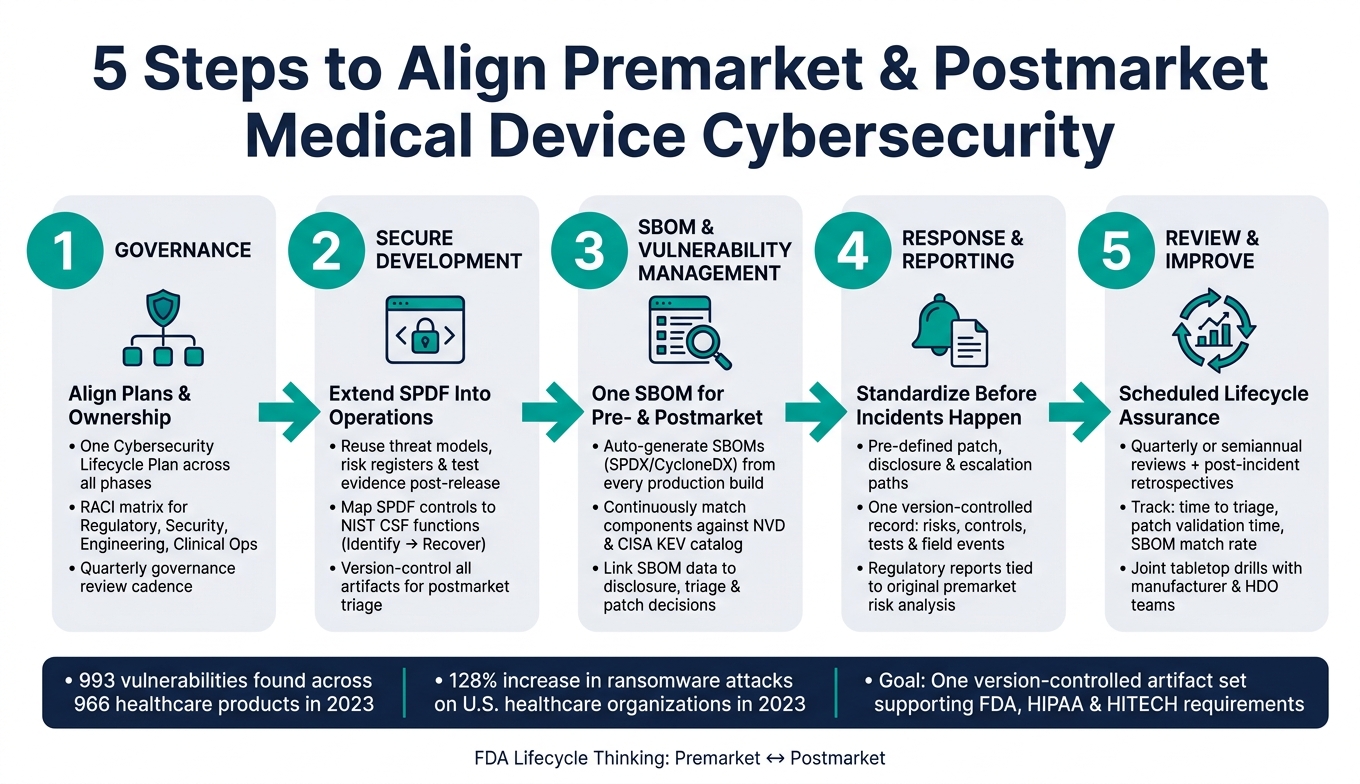
5 Steps to Align Premarket & Postmarket Medical Device Cybersecurity
Intro to Medical Device Cybersecurity (Premarket and Postmarket, FDA and EU)

sbb-itb-535baee
Quick comparison
| Step | What I focus on | What it fixes |
|---|---|---|
| 1. Governance | One plan, shared ownership, set review cadence | Confusion about who does what |
| 2. Development to field use | Reuse threat models, risk files, and test evidence | Rebuilding the same documents during incidents |
| 3. SBOM and vulnerability flow | One version-matched SBOM tied to production builds | Stale component lists and slow CVE checks |
| 4. Response and reporting | Set patch, disclosure, and escalation paths in advance | Ad hoc incident handling |
| 5. Review and improve | Scheduled reviews, drills, and metrics | Gaps that keep repeating |
In other words: one version-controlled set of records can support FDA work, field response, audits, and HDO coordination at the same time.
Step 1: Align Governance and Cybersecurity Plans Across the Lifecycle
When there isn’t one documented lifecycle plan, design-stage security and field response start to pull in different directions. This step brings the manufacturer and the HDO into one operating model.
Create One Cybersecurity Management Plan for Design, Release, and Field Support
A Cybersecurity Lifecycle Governance Plan should cover design, release, support, and decommissioning. It should sit inside the manufacturer's Quality Management System (QMS) and align with 21 CFR 820, so security updates, patches, and risk decisions move through the same change control and CAPA paths as other product changes.[1][3]
The plan should name each lifecycle phase directly:
- design and development
- premarket submission
- release and deployment
- postmarket monitoring
- field support
- decommissioning
Each phase needs a defined scope, required artifacts, decision criteria, and role-based owners. The plan should also set a cadence for quarterly governance reviews, post-release retrospectives, and post-incident reviews.
Put simply, the plan doesn’t do much unless each phase has clear owners and clear decision rights.
Define Shared Roles for Regulatory, Security, Engineering, and Clinical Operations
The failure point shows up most often after launch: nobody is fully sure who owns what. A RACI matrix tied to lifecycle phases makes that plain. It spells out who is Responsible, Accountable, Consulted, and Informed for each main activity, and it links back to the shared-responsibility model introduced earlier: manufacturers own product security, HDOs own deployment and environment, and governance sets the handoff.
In day-to-day work, that usually looks like this: regulatory teams own cybersecurity submission content and postmarket alignment. Security teams lead vulnerability intake, triage, and incident response. Engineering owns patch development and SBOM maintenance. Clinical operations owns deployment decisions and clinician communication. Procurement builds cybersecurity requirements into contracts and healthcare vendor risk assessments.
Misaligned vs. Aligned Governance Responsibilities
The table below shows what changes when lifecycle ownership is explicit.
| Lifecycle Phase | Primary Owner | Key Artifact | Operational Risk if Disconnected |
|---|---|---|---|
| Design & Engineering | Engineering (with Security) | Threat model, risk assessment | Bolt-on security; costly redesigns |
| Regulatory Submission | Regulatory (with Engineering) | Premarket cybersecurity documentation, SBOM | Artifacts go stale; delayed market entry |
| Deployment & Onboarding | HDO IT / Clinical Operations | Asset inventory, network segmentation plan | Misconfigured devices enter clinical environments |
| Postmarket Monitoring | Security (Manufacturer + HDO) | Vulnerability intake log, patch records | Exploitable vulnerabilities undetected; delayed HDO notification |
| Incident Response | Security + Regulatory + Clinical Ops | Incident report, escalation log | Ad hoc response; slow, inconsistent communication |
| Decommissioning | Clinical Operations / IT | Retirement plan, data sanitization record | Orphaned devices with PHI exposure or open network access |
With governance in place, the same structure can then carry into development and operations.
Step 2: Build a Secure Product Development Framework That Extends Into Operations
Treat the Secure Product Development Framework (SPDF) as a lifecycle process, not just something you hand over for submission. The FDA defines it as processes that reduce vulnerabilities across design, release, support, and decommissioning.[4][2] In plain terms, SPDF connects what your team built during development to what happens after the product is in the field.
Reuse Threat Models, Risk Assessments, and Test Evidence After Release
The materials created during development - threat models, risk registers, penetration test reports, and residual risk rationale - are the same materials postmarket teams rely on later. The key issue is whether those materials are version-controlled, searchable, and tied to risk IDs.
Threat models built with data-flow diagrams and STRIDE analysis, and stored in version-controlled tools instead of buried in static PDFs, are far more useful when a new vulnerability shows up. Security teams can answer fast:
- Which components handle PHI?
- What trust boundary does this vulnerable library sit behind?
- What controls were supposed to reduce this type of attack?
That kind of fast triage only happens when the threat model was built for reuse, not just for review.
The same idea applies to residual risk rationale. This is the documented reason a risk was accepted at release, what controls are in place, and the conditions under which that decision still holds. If the threat landscape shifts and a low risk turns into a more serious one, that rationale gives postmarket teams the context they need to make a fast, defensible call on emergency patching or compensating controls.
Security testing evidence - SAST/DAST reports, penetration test findings, and fuzzing results - should also be tagged to test cases and rerun during regression. When a patch is ready, teams can rerun the test cases linked to the affected component instead of starting from zero.
Map SPDF Controls to Detection and Response Workflows
One practical way to make sure SPDF outputs carry into operations is to map them directly to the NIST Cybersecurity Framework functions.[5] The table below shows how development artifacts connect to postmarket work.
| NIST CSF Function | SPDF Development Output | Postmarket Use |
|---|---|---|
| Identify | Asset inventories, threat models, component inventories, risk registers | Medical device inventories, CMDB inputs, SOC triage |
| Protect | Secure design decisions, authentication models, hardening baselines | HDO network segmentation, access control policies, configuration standards |
| Detect | Logging requirements, event taxonomies, anomaly definitions | SIEM alert rules, monitoring dashboards, anomaly baselines |
| Respond | Incident playbooks, escalation paths aligned with manufacturer support | HDO incident response runbooks, coordinated disclosure workflows |
| Recover | Tested backup, restore, and rollback procedures | Operational recovery procedures protecting safety and data integrity |
Design-time trust boundaries and traffic assumptions - like data-flow diagrams and documented expectations for normal traffic patterns - should also shape postmarket anomaly detection. If a device starts behaving outside those defined data flows, that deviation can trigger an alert. But that only works if the architecture documentation was written with operations in mind, not only for a design review.
Those same mapped artifacts feed the SBOM and vulnerability workflow in Step 3.
Step 3: Use One SBOM and Vulnerability Management Process for Premarket and Postmarket
SBOMs help keep SPDF inventories accurate after release. In practice, that means the SBOM can serve as the single inventory for both premarket review and postmarket response. But there’s a catch: this only works if the SBOM comes straight from the production build, not from a manual spreadsheet someone put together later.
Under Section 524B(b)(3) of the FD&C Act, the FDA requires machine-readable SBOMs for cyber devices in premarket submissions. That same inventory should also support postmarket monitoring, coordinated disclosure, and patch decisions across the full supported life of the device.
Generate and Maintain SBOMs From Production Builds
The most practical way to keep SBOMs accurate is to generate them automatically in the build pipeline. Every production build should create a new SBOM in a machine-readable format such as SPDX or CycloneDX. It should also be tied to the exact device model, firmware version, build date, and configuration.
Each SBOM entry should include:
- Component name
- Version
- Supplier
- Package URL or CPE identifier
- Dependency relationships
- License
- End-of-support (EOS) date or support status
That last item matters more than it may seem at first glance. If a component reaches end of support and an unpatched vulnerability shows up, the SBOM record helps explain why compensating controls may be needed while the team works on a longer-term replacement.
Store every SBOM version in a version-controlled repository next to build artifacts. That gives field support and incident responders a fast way to answer a very specific question: Which exact build is deployed in which environment, and does a newly disclosed CVE affect it? Once that’s clear, the SBOM becomes the input for disclosure, triage, and patch planning.
Link SBOM Data to Coordinated Disclosure and Patch Decisions
Versioned SBOMs should connect to live vulnerability feeds. When teams continuously match SBOM components against the National Vulnerability Database (NVD) and CISA's Known Exploited Vulnerabilities (KEV) catalog, the SBOM stops being a static inventory and starts working like an active monitoring tool.
When a CVE appears, the process should quickly identify affected products and deployed versions. From there, triage should be ranked by device criticality, exposure, and clinical impact. Security teams can then share security notices with healthcare delivery organizations, tied to the affected SBOM entries, along with recommended patches or compensating controls.
Patch decisions should blend SBOM-linked technical data with clinical context. That includes CVSS scores, known exploits, whether the component can still be patched, device criticality for patient care, and operating limits such as maintenance windows.
A radiology workstation with a vulnerable, network-exposed imaging library and an available patch calls for one kind of response. A life-support device running an unsupported OS with no patch available is a different situation entirely.
Fragmented vs. Unified SBOM Practices
The table below shows the operational difference.
| Practice Aspect | Fragmented SBOM Workflows | Unified Lifecycle SBOM Strategy |
|---|---|---|
| Visibility into components and vulnerabilities | Partial, inconsistent inventories; premarket SBOMs may not match deployed builds. | Single, authoritative inventory per product/version used across design, regulatory, and operations. |
| Update speed | Manual, often delayed; SBOMs quickly become stale after release. | Automated generation from production builds with each release; continuous correlation with vulnerability feeds. |
| Compliance and documentation burden | Separate documentation for submissions and operations; duplicated effort and evidence gaps. | One SBOM for both regulatory submissions and postmarket records, reducing duplication and audit friction. |
| Patient safety impact during incidents | Slower identification of affected devices; higher risk of inconsistent communication to clinicians. | Faster, more reliable assessment of which devices are impacted and what actions protect patients. |
Use the same SBOM record for field monitoring, disclosure, and patch decisions. That single record should also feed postmarket response and reporting.
Step 4: Standardize Postmarket Response, Documentation, and Reporting
When a vulnerability comes out after release, the team shouldn't be figuring out the process on the fly. The response path needs to be set ahead of time so messaging stays consistent, records stay intact, and regulatory review is easier to support.
Postmarket response should build on the work already done before release. That means reusing the threat model, risk file, test evidence, and SBOM. Use the SBOM-linked inventory from Step 3 to send each report to the right product and version.
Define Patching, Disclosure, and Escalation Paths Before Incidents Happen
After the affected build is confirmed, the workflow should already be in place. Publish a coordinated vulnerability disclosure policy that includes a dedicated intake channel, an acknowledgment deadline, severity tiers, and fixed timelines for triage, mitigation, escalation, and reporting.
Map the patch path before anything goes wrong:
- Fix the issue
- Test it
- Validate it in representative clinical environments
- Approve it
- Deploy it
- Verify the result
For medical devices or clinical applications that can't be restarted or updated right away, the process also needs to spell out how patch urgency will be weighed against patient safety and uptime limits. This balance is critical for taking the risk out of healthcare delivery.
If patching is delayed, record the compensating controls, residual risk, approval authority, and the trigger for escalation. That way, postmarket actions stay tied to the original premarket risk analysis.
Keep One Version-Controlled Record of Risks, Controls, Tests, and Field Events
Keep one version-controlled record that connects risk reports, threat models, SBOM data, test results, corrective actions, vulnerability disclosures, complaints, incident logs, and surveillance trends. Version control keeps the decision history for each risk, control, and change in one place.
Repeat complaints, recurring failures, and new attack paths should be linked back to the risk file and threat model. This helps teams tell the difference between an isolated field incident and a system-level control failure.
Regulatory reports should line up with internal records and clearly state the issue, affected versions, mitigation, open actions, and links to prior risk assessments and controls. Step 5 turns these records into scheduled reviews and metrics.
Step 5: Review, Test, and Improve the Process on a Set Schedule
Version-controlled records matter only if teams look at them on a fixed schedule. This step checks whether the premarket plan still lines up with the product in use and the current field setting. In practice, the Step 4 record set should become the agenda for each review.
Review the process quarterly or semiannually, and also after major releases, critical vulnerabilities, field incidents, supplier changes, or end-of-support notices. The review frequency should match device risk, update pace, and clinical criticality. The key is to keep that cadence consistent.
Keep these records up to date:
- disclosure logs
- patch validation reports
- end-of-support roadmaps
- field surveillance summaries
Run Joint Reviews After Releases, Major Vulnerabilities, and Field Incidents
Each review should compare the deployed environment against the threat model, risk file, SBOM, patch history, vulnerability intake, support notices, test evidence, incident logs, and change approvals. The point is simple: confirm that the device still matches what was cleared premarket and what is being used postmarket.
Use that same cadence for tabletop exercises and drills. Drills help test manufacturer-HDO coordination for critical vulnerabilities, delayed patches, supplier failures, and end-of-support events. When clinical, IT, biomedical engineering, security, and regulatory staff take part, teams tend to spot coordination gaps that a technical-only review can miss.
Use the same review cycle to update metrics, ownership, and escalation paths.
Track Simple Metrics That Show Whether Alignment Is Working
A small set of metrics can show whether the process is getting better:
- Time to triage a new vulnerability (mean time to acknowledge)
- Time to validate a patch in a representative clinical environment
- SBOM match rate - the percentage of deployed assets with a current, version-matched SBOM [6]
- Number of open end-of-support exceptions with documented compensating controls
- Number of overdue risk reviews
- Audit findings tied to missing traceability or stale documentation
Look at the metrics together, not one by one. If patch validation time goes down but open exceptions go up, the team may be moving faster without lowering risk. That kind of pattern is easy to miss if everyone stares at a single number.
These metrics also help with regulatory traceability. They link premarket design assumptions to postmarket performance in a format that's easy to review.
Ad Hoc Reviews vs. Scheduled Lifecycle Assurance
Scheduled reviews create traceability. Ad hoc reviews usually don't. The table below shows the day-to-day difference.
| Ad Hoc Reviews (Reactive) | Scheduled Lifecycle Assurance (Proactive) | |
|---|---|---|
| Trigger | Major security breach or urgent regulatory safety communication | Set intervals (e.g., quarterly or semiannually) or following major releases, critical vulnerabilities, significant field incidents, supplier changes, or end-of-support announcements |
| Evidence Reviewed | Specific exploit logs and immediate patch status | SBOMs, threat models, risk management files, and field surveillance data |
| Teams Involved | Security incident response and communications and legal | Regulatory, engineering, security, clinical operations, and biomedical engineering |
| Likely Outcome | Temporary fix; high organizational stress; potential regulatory findings | Continuous compliance; reduced technical debt; faster future premarket submissions |
Common warning signs include repeated surprise vulnerabilities, uneven patch timing across similar assets, outdated SBOMs, missing audit evidence, unclear ownership for disclosures, and repeated confusion about who approves mitigation decisions. When lessons from one incident don't carry into the next one, the process is running on memory instead of workflow.
Conclusion: Five Steps to Reduce Duplicate Work and Improve Resilience
In practice, these five steps connect premarket and postmarket cybersecurity into one shared lifecycle that manufacturers and HDOs both manage over time. Each step deals with a common point of friction - overlapping governance, duplicate documentation, inconsistent SBOMs, ad hoc incident response, and reactive reviews - and replaces it with one aligned workflow.
The stakes are high. This is why lifecycle alignment matters. These are patient-safety events, not IT issues.
Taken together, the five steps cut down ownership confusion, let teams reuse premarket evidence, speed up affected-device identification, standardize response, and surface gaps before they turn into incidents - for manufacturers and HDOs alike.
For teams putting this model into practice, one version-controlled set of artifacts - plans, SBOMs, risk registers, and incident logs - can support FDA cybersecurity expectations, HIPAA Security Rule obligations, and HITECH breach notification, while also serving regulators, auditors, and accreditors. Censinet RiskOps™ can support that shared workflow.
The IMDRF's SBOM guidance reinforces the same idea: cybersecurity is one continuous lifecycle. Align premarket and postmarket cybersecurity once, and you can cut duplicate work while improving resilience.
FAQs
How do we start aligning premarket and postmarket cybersecurity?
Start by setting a single regulatory baseline. Fold cybersecurity into your QMS and product design work from the start, instead of handling it as a separate checkbox.
Next, run a gap analysis that maps your current controls to FDA requirements and ISO standards. That way, premarket artifacts like threat models and SBOMs don’t just sit on a shelf. They stay live and useful for postmarket vulnerability management and incident response.
Who owns cybersecurity tasks across the device lifecycle?
Cybersecurity is a shared responsibility across the device lifecycle. It takes coordination among manufacturers, healthcare delivery organizations (HDOs), patients, and providers.
Manufacturers are responsible for building secure devices from the start. That includes following an SPDF, providing SBOMs, and issuing patches when issues come up.
HDOs play a different but equally important role. They need to integrate devices securely, keep accurate inventories, apply updates, and watch for threats.
Clear labeling helps everyone understand who owns what. That matters because less ambiguity usually means fewer gaps, fewer delays, and fewer security mistakes.
How often should we review SBOMs, risks, and patch processes?
Review SBOMs, risk assessments, and patch processes at least quarterly. Treat them as living parts of your quality management system, not files you create once and forget.
Review them sooner when new vulnerabilities show up, rules change, or audit findings come in. Automation can help keep SBOMs, risk rankings, and mitigation plans up to date across the product lifecycle.
