
If I buy healthcare AI with a one-time review, I leave patient risk in production. That is the core message here.
I’d sum it up like this: if a hospital wants AI to be safe, it needs a clear process from intake to retirement - not just a vendor check during procurement. The article shows why that matters with hard numbers: 71% of U.S. hospitals reported using predictive AI, but only 18% said they had a mature governance structure. It also points to common failure points: dataset shift, subgroup bias, PHI handling gaps, weak audit trails, and vendor model updates under the FDA’s PCCP.
If I were explaining the article in plain English, I’d say healthcare leaders need to do five things:
- Set ownership early with a cross-functional governance group
- Tier AI tools by risk so high-impact clinical tools get deeper review
- Validate locally instead of relying on vendor claims alone
- Monitor live use for drift, overrides, incidents, and version changes
- Write contract terms for notice, rollback, suspension, and PHI limits
A few details stand out:
- One admissions model dropped from 0.856 to 0.826 during COVID-19
- In a review of 903 FDA-cleared AI medical devices, 24.1% said no clinical performance studies were done
- Only 22% of hospitals said they were highly confident they could produce a full audit trail within 30 days
- OCR collected $4.3 million in HIPAA enforcement actions in Q1 2024
The article also makes a simple point that’s easy to miss: not every AI risk is the same. Drift, bias, privacy, cybersecurity, and vendor change each need a separate control. A single approval step does not cover all of that.
I also see a useful breakdown by use case:
- Ambient scribes: lower clinical risk, high PHI exposure, clinician sign-off required
- Diagnostic AI: high clinical risk, local validation and subgroup testing matter
- Triage/routing models: high monitoring burden because harm can show up slowly through delayed or uneven care
Here’s the big takeaway for me: AI governance in healthcare should work like a patient-safety system, not a procurement checklist. That means clear owners, written rules, local testing, traceable logs, and defined retirement triggers.
The rest of the article supports that point across policy, workflow, contracts, monitoring, and use-case controls.

Healthcare AI Governance Lifecycle: From Procurement to Patient Safety
How Health Systems Can Safely Adopt AI: A Proven 5‑Pillar Governance Framework
sbb-itb-535baee
1. Build the governance structure and policy foundation
Before any AI tool gets evaluated, someone has to own the decision. If nobody does, reviews slow down, accountability gets blurry, and unsafe tools can slip into patient care. Governance is what turns policy from a PDF into something people actually follow.
Create an AI governance committee with clear decision rights
Start with a multidisciplinary committee. In practice, that means bringing in clinical leadership like the CMO and CNIO, along with IT, the CISO, a Chief Privacy Officer, legal, compliance, procurement, informatics, data science, and operations [1][4]. The key point is simple: each group needs actual decision power, not just a seat in the room. Clinical, procurement, and cyber review should happen before a contract gets signed.
Each function should own a tight decision area.
| Role | Primary Governance Responsibility |
|---|---|
| Clinical Leadership | Clinical safety and workflow |
| IT / Informatics | Technical performance and integration |
| Security | Access control and auditability |
| Legal / Compliance | Regulatory alignment and liability |
| Procurement | Vendor due diligence and contracts |
| Privacy | Data minimization and BAA oversight |
| Operations | Budgeting and executive sponsorship |
This setup keeps clinical safety, privacy, security, and procurement aligned before any tool reaches production. Duke Health put this kind of model in place in 2021 with a multidisciplinary AI governance committee built around defined decision rights and specialized subcommittees [1]. It also helps to name a senior executive who reports to the CEO to coordinate governance and keep senior leadership informed [1].
Once ownership is set, the next job is to decide which tools need review and how much scrutiny each one gets.
Define the policies that trigger AI review and human oversight
The committee matters, but the trigger rules matter just as much. Every AI tool, no matter the vendor or use case, should be registered with the governance committee early in the review process. That registration should feed a risk register that tracks intended use, data provenance, validation methods, and rollback plans [4].
After that, use a tiered review path. Clinical decision tools should go through full review. Administrative tools can take a lighter route. That risk-based split helps the committee spend time where the stakes are highest [1][3].
Policy also needs to spell out change control. The FDA finalized the Predetermined Change Control Plan (PCCP) framework in December 2024. That means vendors can update cleared algorithms without filing a new submission, so contracts should require notice of material changes [3]. In plain English, a material change is any update that could affect intended use, performance, workflow, or safety.
Clinician review rules should also be written down, not left to guesswork. For any tool that affects care delivery, policy should state the minimum level of clinician review needed before an AI output leads to a clinical action. That matters even more when only 22% of hospitals say they are highly confident they could produce a complete audit trail within 30 days for regulators [2].
With roles and review triggers in place, the workflow can move from intake to validation, monitoring, and retirement.
2. Use a standard lifecycle from intake to retirement
The committee sets the rules. The lifecycle is what makes those rules stick.
Intake and vendor due diligence
Start with a written use-case definition. It should spell out the intended outcome, the workflow involved, and the patient-safety goal. That same document should also assign the risk tier.
Here’s the basic split:
- Tier 1: tools that directly process PHI and can affect diagnosis, treatment, or escalation decisions, such as ambient documentation or diagnostic AI
- Tier 2: tools with indirect PHI exposure, such as scheduling optimizers
- Tier 3: tools with no PHI access
That tier drives the level of review that follows.
Once the use case is clear, vendor due diligence begins. A good first step is to require vendors to complete a CHAI (Coalition for Health AI) Applied Model Card. That document covers training data provenance, demographic subgroup performance, and known failure modes [3].
Why does that matter? Because vendor claims can be thin. In an analysis of 903 FDA-approved AI medical devices, 24.1% explicitly stated that no clinical performance studies were conducted [2]. So if a vendor gives you one big accuracy number and skips subgroup data, that should not be enough. From a contract standpoint, it’s incomplete.
Contracts also need language for AI risks that normal software agreements often miss. BAAs should clearly ban the use of patient data for vendor model training unless there is explicit consent. Rollback rights should let the organization return to a prior model version if an update performs worse. Suspension rights should let the health system stop using the tool without financial penalty if live performance falls short of what the vendor promised [3].
Once that vendor package is done, the next step is clinical, data, and cybersecurity review.
Clinical, data, and cybersecurity risk assessment
After due diligence, the assessment phase looks at three tracks at the same time: clinical risk, data governance, and cybersecurity. About 90% of governance friction comes from missing evidence, not poor model quality [4].
The clinical review should map likely failure modes, define when a clinician must override the system, and set emergency stop conditions. If a tool can affect care delivery, the team should document the minimum level of clinician review needed before an AI output leads to a clinical action.
On the data and security side, the team should map PHI data flows and confirm alignment with the HIPAA Security Rule. The focus should be plain and direct: unsafe data flows, weak access controls, and missing audit logs. That work is not just paperwork. The Office for Civil Rights collected $4.3 million in HIPAA enforcement actions in Q1 2024 alone [5]. Data governance gaps can cost real money.
Validation, deployment, monitoring, and retirement
Before any tool goes live, it needs local validation. In 2024, Emory Healthcare put in place a protocol to build its own de-identified test datasets so it could benchmark vendor algorithms on its own instead of leaning on vendor-supplied performance summaries [3].
One smart way to do this is a shadow deployment. The AI runs alongside current workflows, but no one acts on its outputs. That gives the team a clean way to compare the tool’s recommendations to the standard of care without putting patients at risk.
After validation and deployment, that same evidence pack becomes the baseline for monitoring. Real-time telemetry should track model drift, clinician override rates, usage volume, and incident logs. Every inference should be logged with the exact model version, the input data snapshot, and whether a clinician overrode the output. That’s what creates a usable audit trail.
A tool should be formally retired when performance drops below preset thresholds, when the clinical workflow changes in a major way, or when a model update fails to meet the specs the vendor originally warranted. The retirement record should include a final performance audit plus confirmation of data retention or destruction.
The table below shows what each lifecycle stage should produce.
| Lifecycle Stage | Key Evidence / Artifacts Produced |
|---|---|
| Intake | Use case definition, risk classification (Tier 1–3), intended clinical outcome |
| Due Diligence | CHAI Applied Model Card, demographic subgroup performance, BAA with AI-specific language |
| Assessment | HIPAA Security Rule mapping, PHI data flow diagrams, clinician override protocols |
| Validation | Local validation report, shadow deployment logs, comparison to standard of care |
| Monitoring | Drift indicators, override rates, incident logs, usage volume telemetry |
| Retirement | Decommissioning record, final performance audit, data retention/destruction confirmation |
"If you cannot trace a prediction back to a versioned model, dataset, and approver, you do not have governance - you have a memo." - Nadeem Khadim, Healthcare Compliance, AST [4]
3. Apply the framework to common healthcare AI use cases
The controls stay the same. What changes is where the risk sits.
One use case puts the pressure on audio accuracy. Another puts it on diagnosis. Another turns the main issue into fair and safe routing. That’s the point where procurement controls stop being paperwork and start acting like patient-safety controls, because the tool is now inside real clinical workflow.
Ambient clinical documentation and scribe tools
Ambient scribes usually carry lower clinical risk, but they handle highly sensitive PHI because they process full audio streams. The main danger is simple and serious: a transcription mistake makes its way into the EHR without clinician review. This use case shows why the intake and post-deployment monitoring stages matter so much.
The one control that cannot be skipped is a "Pending Review" queue. The draft must not enter the patient record unless a licensed clinician signs it [6].
Validation testing should also focus on look-alike, sound-alike terms. That includes phrases like "hypo-" versus "hyper-" and "fifteen milligrams" versus "fifty milligrams" [6]. Small wording errors can snowball fast in a chart.
Data controls need to be tight too. Use a BAA plus strict limits on data use: no audio retention and no training on patient-physician interactions [6]. After rollout, track manual edit rates, run quarterly spot-audits that compare random notes against the original audio, and log the exact model version along with any clinician edits made to each AI-generated draft [6].
Once note capture is under control, the next issue is whether the model’s output holds up clinically for your patient population.
Diagnostic decision support and imaging AI
Diagnostic AI brings high clinical risk because a wrong output can directly affect diagnosis or treatment. This is where the validation and change control stages of the lifecycle do the heavy lifting.
If a vendor’s validation data comes from a different patient mix, require local validation before full deployment [3]. Don’t settle for one headline accuracy figure, either. Ask for performance data broken out by race, ethnicity, age, and sex [3]. A single top-line number can hide weak performance in groups that matter.
There’s also a regulatory gap that buyers need to close themselves. The FDA's Predetermined Change Control Plan (PCCP) lets vendors update FDA-cleared algorithms without filing a new submission [3]. So the contract should require at least 14 days' advance notice before any material change goes live [6].
Routing tools create a different kind of harm. It’s often less obvious at first, and it shows up through delayed care or care sent in the wrong direction.
Triage, prioritization, and routing models
Triage models also carry high clinical risk, but their failure mode is tougher to spot than a single bad diagnostic result. This use case brings the monitoring and retirement trigger stages into focus.
These models often fail slowly. As live data shifts, acuity scores can drift with it. A 2024 external validation study of the Epic Sepsis Model found it predicted sepsis with an AUC of 0.63, well below the 0.76–0.83 range the developer originally reported [2].
Bias is an even sharper issue here than in many other categories. Audits matter because proxy measures like cost can systematically understate need for Black patients [2]. For triage tools, bias auditing across demographic subgroups is not optional. It is a patient safety requirement.
The table below shows where governance should tighten most for each use case.
| Ambient Scribe | Diagnostic AI | Triage / Routing | |
|---|---|---|---|
| Clinical Risk | Low | High | Moderate/High |
| Data Sensitivity | High (Audio/PHI) | Moderate (Images) | Moderate (EHR) |
| Bias Concern | Moderate (Accents) | High (Demographics) | High (Equity) |
| Regulatory Scrutiny | Moderate | High (FDA/SaMD) | Moderate |
| Monitoring Intensity | Moderate (Spot-audits) | High (Continuous) | High (Drift/Outcomes) |
4. Put governance into practice with Censinet across the AI lifecycle
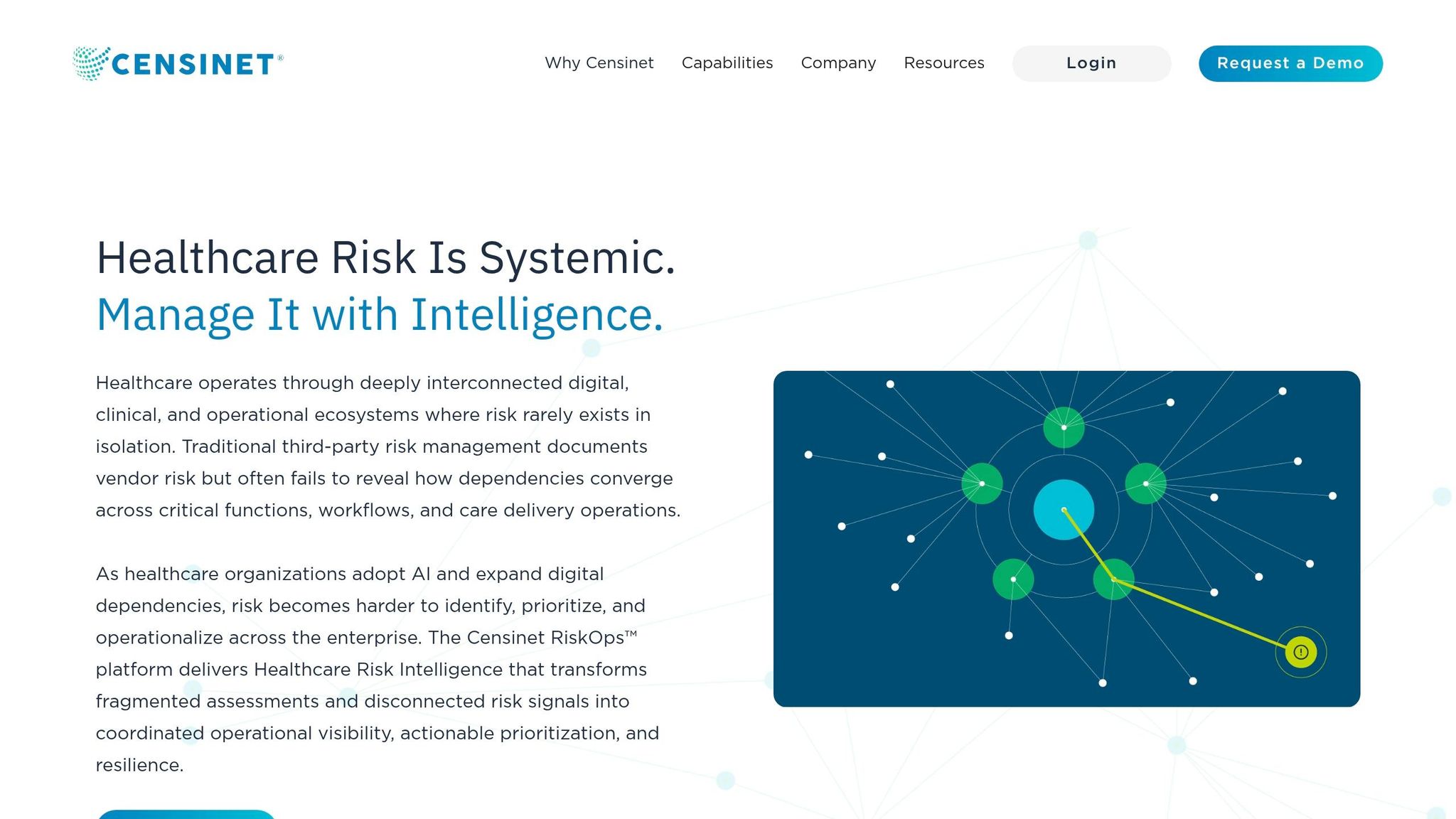
Governance only works when it becomes part of the day-to-day process. Once the governance model is set, the next step is to run it inside one system. The gap between a polished AI governance policy and what happens during procurement is often where patient risk starts to build. To close that gap, teams need a system that turns governance decisions into repeatable, trackable workflows, not spreadsheets or scattered PDFs.
Centralize AI vendor assessments and governance workflows in Censinet RiskOps™
Censinet RiskOps™ acts as the central hub for AI risk records, workflows, and evidence across each review step. When a clinical department submits a new AI tool for review - whether it's an ambient scribe, a diagnostic imaging model, or a triage algorithm - that request moves into a structured workflow instead of an informal email chain.
Routing follows preassigned risk tiers. Low-risk tools move through a narrower governance path. High-risk clinical tools, such as diagnostic decision support or triage models, trigger full governance: vendor due diligence, clinical validation review, cybersecurity assessment, and legal, compliance, and ethics review by the multidisciplinary committee.
Evidence like Model Cards, validation results, bias assessments, and vendor documentation stays in one place and is tied to the specific AI product record. That central record makes each review traceable from intake through retirement.
The same workflow continues through review, monitoring, and retirement.
Use Censinet AI and Censinet AI™ to speed up review without removing human control
AI adoption accelerated sharply in 2024, and manual review no longer scales. That's where Censinet AI helps cut the workload without loosening oversight.
Censinet AI automates the slow, repetitive parts: questionnaire completion, evidence summarization, upstream service dependency mapping, and draft risk reports. Then it routes those findings to the right stakeholders. Clinical leads get clinical risk summaries. Security teams get cybersecurity findings. The AI governance committee gets a concise review summary ready for a decision. Human sign-off still remains required at each defined checkpoint for high-stakes tools.
Build dashboards and decision views that support safe AI adoption
Once a tool is live, governance shifts to monitoring. The platform's dashboards give risk teams and governance committee members a real-time view of which AI tools are approved, which have open remediation items, and which are getting close to thresholds that could trigger a review or retirement decision.
The table below maps each lifecycle stage to the specific outputs the platform produces, showing how governance decisions turn into tracked actions.
| Lifecycle Stage | Censinet RiskOps™ & Censinet AI™ Output |
|---|---|
| Intake | Automated intake routing with risk-tier assignment |
| Due Diligence | Compiled evidence packet with completed vendor questionnaires |
| Assessment | Decision-ready review summary routed to specialized committees |
| Monitoring | Live monitoring alerts for drift, overrides, and compliance obligations |
| Retirement | Decommissioning archive with final audit record |
This view helps teams spot drift before performance falls below threshold. That's what turns AI governance into a repeatable operating model.
Conclusion: A governance model that makes AI safer, more accountable, and easier to scale
Healthcare AI governance isn't a compliance checkbox. It's the operating model that ties procurement directly to patient safety.
The framework in this article connects each stage - from procurement to retirement - into one traceable, repeatable process. That matters because AI risk can't be sorted out after a contract is signed or after a tool goes live. Procurement has to assign risk before signature, not after deployment.
When that step gets missed, gaps show up fast. That's why a formal cross-functional committee, risk-tiered intake, local validation, and continuous monitoring matter so much. They turn governance from a loose set of good intentions into a system people can follow.
The practical answer is simple: this isn't about slowing adoption. It's about making AI dependable in day-to-day care. A governance model that covers procurement through monitoring gives U.S. healthcare leaders something they can count on - lower vendor risk, stronger compliance readiness, and AI that protects patients instead of exposing them to avoidable harm. That's how health systems scale AI without losing control of safety, compliance, or accountability.
FAQs
Who should own healthcare AI governance?
Healthcare AI governance should sit with a cross-functional AI governance board that works as one unified model, not a set of separate workstreams.
That board should bring together clinical leadership, cybersecurity, privacy, compliance, legal, procurement, data science, product, and IT. And it can’t be just a discussion group. It needs the authority to approve, monitor, and retire AI tools, classify risk, validate performance, and pause a tool if it starts behaving in ways no one expected.
How often should hospitals re-evaluate AI tools?
Hospitals should re-evaluate AI tools on a fixed schedule instead of relying on ad hoc reviews.
After deployment, they should track production metrics continuously, check performance on a set cadence, and escalate issues if the tool crosses predefined risk or performance thresholds. They also need to watch for material updates to the underlying models and get advance notice of changes so they can keep oversight across the full lifecycle.
What should an AI vendor contract include?
AI vendor contracts need to do more than cover standard software terms. In healthcare, the stakes are higher. A weak clause doesn’t just create IT headaches - it can create clinical and operational risk.
That means the contract should spell out clear liability for AI-related errors, along with measurable performance guarantees. It should also require local validation on the organization’s own patient population, not just test results from somewhere else. And if something goes wrong, the organization needs audit rights so it can reconstruct predictions and check how the model performed.
The contract should also require plain, usable documentation. At a minimum, the vendor should provide:
- Intended use
- Training data demographics
- Known limits
- Validation results
On top of that, the agreement should define what counts as a material model change. Vendors should have to give advance written notice before making those changes, and the organization should have rollback rights if the update creates problems.
One more point matters a lot: the contract should restrict how the vendor can use patient data. In plain English, patient data should not quietly become training fuel for the vendor’s model.
