
A vendor review done once a year is not enough for healthcare. If a vendor changes its cloud setup, gets hit by ransomware, adds a subcontractor, or lets a control lapse, your old questionnaire will not show it. And in healthcare, that gap matters: business associates are a leading source of reportable breaches, and a vendor incident can become your HIPAA problem.
Here’s the short version:
- Questionnaires are snapshots. They show what a vendor said at one point in time.
- Risk changes between reviews. Ownership changes, PHI data flows shift, and exposed systems appear on the vendor’s schedule, not yours.
- A BAA is not proof of control performance. It shows agreement, not day-to-day control status.
- Continuous assurance means checking for change all the time. That includes technical signals, compliance records, breach alerts, and remediation status.
- Healthcare teams should track who owns each signal, where the proof comes from, and how often it is checked.
- Risk tiering matters. A cloud EHR needs tighter review than a shredding vendor.
- Automation helps move reviews from weeks to a day when current evidence is already in place.
What I’d take from this article is simple: stop treating vendor trust as a yearly document exercise. Move to a model built on live evidence, risk-based review cycles, and tracked follow-up.
A few points stand out fast:
- More than 55% of healthcare organizations have had a third-party breach since 2022
- Only about 32% of critical and high-risk third parties are assessed each year
- The biggest vendor risks often show up between formal assessments
If I were putting this into practice, I’d focus on three things first:
- Build a full vendor inventory
- Tier vendors by PHI exposure and business impact
- Connect monitoring to action with an owner, due date, and review path for each gap
Below that, the article makes the case for replacing stale trust with a system that keeps checking whether vendor controls still work.
Creating Cyber Resilience: Your Guide to Healthcare Vendor Risk Management [On-Demand Webinar]
sbb-itb-535baee
Why Point-in-Time Questionnaires Fail in Healthcare
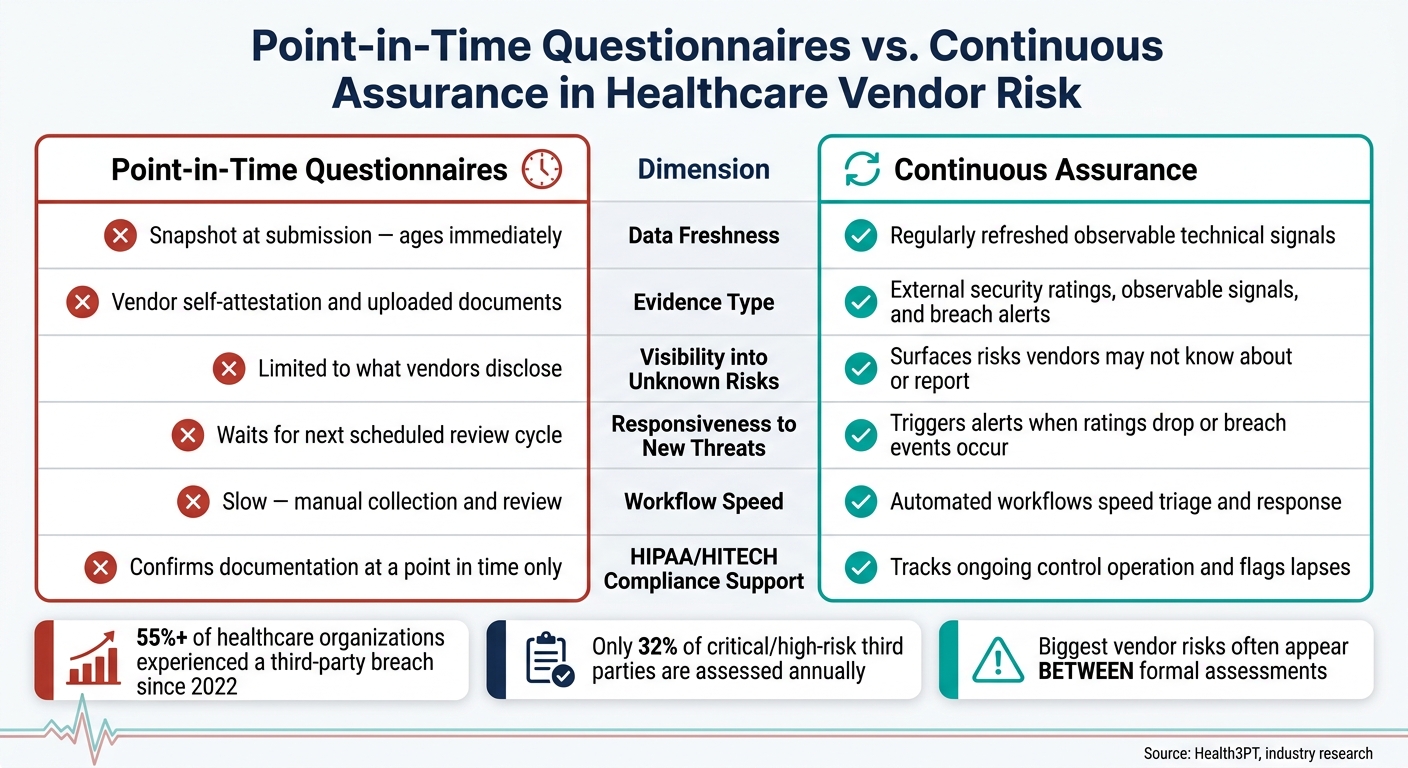
Point-in-Time Questionnaires vs. Continuous Assurance in Healthcare Vendor Risk
A questionnaire shows a vendor’s posture on a single day. The problem is simple: by the next day, that picture is already getting stale. That’s why a one-time questionnaire is a weak control in a risk setting that keeps moving. Health3PT found that questionnaire-based methods do not adequately address patient privacy, patient safety, and oversight expectations.[3][7]
A lot of healthcare organizations handle vendor intake, approve the vendor, and then mostly leave things alone until the next scheduled review.[8] That gap matters. It’s the stretch where risk starts to pile up, often without anyone noticing.
How Self-Attestation Creates Blind Spots
A questionnaire measures what a vendor says about itself. It does not measure what is actually running in production. And self-attestation can’t reveal risk that is unknown, undisclosed, or simply missed.
Those blind spots aren’t limited to cybersecurity controls. In practice, questionnaires often miss changes like these:
- A revenue cycle management vendor shifts PHI storage from a U.S.-only data center to a global cloud provider that replicates data across multiple regions - some with different privacy rules and data-handling requirements - changing HIPAA/HITECH and state privacy obligations without triggering a new assessment.[3]
- A small AI radiology startup gets acquired by a larger technology company. Ownership changes can alter data governance, data sharing practices, and incident response policies, but unless a new questionnaire is triggered, the healthcare customer may not learn of these changes for a year.[2][3]
- Subcontractor concentration risk builds quietly when many vendors rely on a single cloud or payments provider. Questionnaires typically collect subcontractor information in free-text formats, making it nearly impossible to aggregate and monitor concentration risk across an entire vendor portfolio.[2]
Any one of these shifts can change how PHI is handled, how incidents are managed, or even how patient safety is affected before the next review starts. That’s the hard part: the blind spots get bigger between reviews, and that’s often when the worst vendor changes happen.
Why Annual Reviews Cannot Keep Up with Active Threats
The vendor events that matter most - ransomware, sub-processor changes, ownership changes - usually happen between scheduled assessments.[8]
A telehealth vendor might pass its initial review with strong controls, then later expose a secondary domain or storage bucket without the health system knowing until the next annual cycle.[4][6] Zero-day vulnerabilities, architecture re-platforming, and newly exposed internet-facing services show up on the vendor’s timeline, not the health system’s.
Point-in-Time Questionnaires vs. Continuous Assurance: A Side-by-Side Comparison
The gap becomes easier to see when you compare both approaches side by side. One waits for the next review. The other keeps watch as conditions change.
| Dimension | Point-in-Time Questionnaires | Continuous Assurance |
|---|---|---|
| Data freshness | Snapshot at submission; ages immediately | Regularly refreshed observable technical signals |
| Evidence type | Vendor self-attestation and uploaded documents | External security ratings based on observable technical signals and breach alerts[4][6] |
| Visibility into unknown risks | Limited to what vendors disclose | Surfaces risks vendors may not know about or report |
| Responsiveness to new threats | Waits for next scheduled review cycle | Triggers alerts when ratings drop or breach events occur[5] |
| Workflow speed | Slow; manual collection and review | Automated workflows speed triage and response[4][5] |
| HIPAA/HITECH compliance support | Confirms documentation at a point in time; not ongoing controls | Tracks ongoing control operation and flags lapses[3][9] |
The main issue is exposure. One model waits for the next review cycle. The other looks for change while it’s happening. To close that gap, healthcare organizations need continuous monitoring of vendor signals, controls, and compliance evidence.
What Continuous Assurance Means and How It Works
Continuous assurance turns that gap into an operating model. Instead of checking controls only when a questionnaire goes out, it checks whether those controls are in place, working, and still holding up over time. The comparison table in the prior section showed the output. This section gets into the mechanics: live signals linked to specific evidence types, each with a set refresh pattern, so control status stays visible between reviews.
A BAA shows that a vendor agreed by contract to protect PHI. Continuous assurance looks at the harder part: whether the vendor is actually protecting PHI well, and whether that control keeps working over time.[1]
Core Elements of a Continuous Assurance Model
A working model runs through five connected stages as one flow. It starts by inventorying every vendor with PHI access. Then it tiers vendors by exposure, so a cloud EHR ranks above a transcription tool or shredding service.[1] After that, teams map controls to evidence sources and verify them on a continuous basis. Each evidence source gets a set refresh cadence, with automated alerts if a BAA expires or a safeguard slips. Finally, every gap needs a clear owner, a due date, and a remediation path.[1]
In healthcare, the evidence has to tie back to PHI risk in plain terms. That can include:
- PHI access logs
- Backup validation
- Encryption-at-rest verification
- Staff training logs
- Breach history
- Ransomware recovery plans
These inputs feed straight into the organization's risk-ranked control view.[1] And that's the catch: the model only works if the inputs stay current.
How Continuous Assurance Speeds Up Vendor Decisions
Continuous assurance also cuts procurement delays. If security and compliance teams already have current evidence on a vendor, they don't have to sit around for weeks waiting on another questionnaire cycle to finish. AI-assisted tools can cut vendor review time from weeks to a day.[1]
When evidence is current and workflows are automated, teams can move on remediation the moment a risk appears, not at the next annual review. That only works if the organization keeps tracking the right vendor signals, evidence, and refresh cycles all the time.
What to Track Continuously Across Vendors, Controls, and Compliance
Continuous assurance only works when teams know exactly what to watch across vendors, controls, and compliance. It becomes usable when every risk signal has three things tied to it: a source, an owner, and a refresh cadence. So the next move is simple: map each signal to where it comes from, who owns it, and how often it should be checked as part of effective third-party risk assessments.
Vendor and Supply Chain Signals Worth Monitoring
Track the signals that shift risk before a vendor says anything. A vendor gets acquired. A new subcontractor shows up. A vendor moves data into a multi-region setup that now includes non-U.S. regions. Those changes can alter your risk profile fast.
Data flow changes need immediate attention. That’s especially true when a vendor starts processing new PHI types, adds a direct EHR interface, or begins handling financial or claims data. Each change affects HIPAA exposure and can expand incident response scope. A hosting region change can also affect jurisdictional controls and add latency to real-time clinical workflows.
Concentration risk is another big one. If several critical systems - EHR, PACS, revenue cycle, and clinical communications - all depend on one cloud provider or payment processor, you’ve got a single point of failure for care delivery and business operations. More than 55% of healthcare organizations have experienced a third-party breach since 2022.[11] That’s why fourth-party dependencies should be monitored all the time, not just when the contract is signed.
Adverse media and regulatory actions matter too. OCR enforcement, FTC investigations, and state AG actions often hint at governance problems before a formal breach report appears. These signals belong in the same monitoring stack as outage history and breach disclosures.
Technical and Compliance Evidence to Validate Controls
Track artifacts, not claims: MFA enrollment coverage, EDR deployment coverage, and dated restore-test logs.[12] If you want to know whether a control is working, look for proof.
The technical signals worth watching all the time include IAM anomalies, such as failed logins, access from new geolocations, and privilege escalation events. Patch latency and vulnerability aging also matter - especially the number of high and critical vulnerabilities left open for more than 30, 60, or 90 days. EDR/XDR telemetry helps confirm whether endpoint coverage is still in place across clinical systems, not just office laptops and desktops.
On the compliance side, the most useful evidence is a live register of open exceptions. That means tracking which safeguards are missing, who owns the fix, when the exception expires, and what compensating controls are in place for the gap. SOC 2, HITRUST, and ISO 27001 currency checks still help, but static attestations don’t show the current state of control health. And only about 32% of critical and high-risk third parties are assessed annually.[10] These controls help protect PHI and keep critical services up and running.
Table: Signals, Evidence Sources, Owners, and Refresh Cadence
Use one register to connect each signal to evidence, ownership, and review frequency.
| Category | Signal | Evidence Source | Owner | Refresh Cadence |
|---|---|---|---|---|
| Vendor / Supply Chain | Data flow or PHI scope change | Contract amendments, API integration logs, vendor portal | Vendor Risk Manager | Trigger-based (on change) |
| Vendor / Supply Chain | Hosting region or CSP migration | Provider dashboards, API metadata, vendor notifications | Vendor Risk Manager | Daily / Trigger-based |
| Vendor / Supply Chain | Merger, acquisition, or ownership change | Adverse media feeds, regulatory filings, vendor disclosures | Vendor Risk Manager | Near-real-time |
| Vendor / Supply Chain | Outage history and service degradation | SLA reports, uptime monitoring tools, incident logs | IT Operations | Near-real-time |
| Vendor / Supply Chain | Breach disclosures and security incidents | Vendor notifications, adverse media, regulatory disclosures | Security Operations | Near-real-time |
| Vendor / Supply Chain | Concentration risk and fourth-party dependencies | Vendor dependency maps, contract reviews, CMDB | Vendor Risk Manager | Monthly |
| Technical Controls | MFA coverage and enforcement rate | Identity provider enrollment reports, admin portal exports | Identity & Access Team | Weekly |
| Technical Controls | IAM anomalies and privileged access events | SIEM, IAM platform logs, break-glass access logs | Security Operations | Near-real-time |
| Technical Controls | EDR/XDR coverage and unresolved alerts | EDR platform exports, endpoint management dashboards | Security Operations | Daily |
| Technical Controls | Vulnerability aging (30/60/90-day thresholds) | Vulnerability scanner reports, asset inventory | Security Engineering | Weekly |
| Technical Controls | Patch latency for critical security updates | Patch management platform, OS and app update logs | Security Engineering | Weekly |
| Technical Controls | Backup success rates and restore test results | Backup platform logs, dated restore-test records | IT Operations | Daily (backups) / Monthly (restore tests) |
| Compliance / Governance | Open exceptions with expiry dates | GRC platform, risk register | Compliance Officer | Monthly (high-risk: weekly) |
| Compliance / Governance | HIPAA/HITECH and state privacy law control mapping and gap status | Regulatory mapping tool, control framework dashboard | Compliance Officer | Monthly |
| Compliance / Governance | Vendor certification currency (SOC 2, HITRUST, ISO 27001) | Certification portals, vendor-provided artifacts | Vendor Risk Manager | Monthly |
| Compliance / Governance | Policy adherence and training completion | LMS reports, policy acknowledgment logs | Compliance Officer | Monthly |
| Compliance / Governance | Incident and corrective action tracking | Incident management platform, root cause analysis records | Security Operations | Ongoing / Monthly review |
With the signal set defined, these inputs can feed automated vendor workflows and continuous compliance tracking.
How Healthcare Organizations Can Build Continuous Assurance with Censinet
A Phased Transition from Static Assessments to Continuous Monitoring
Once signals and evidence are mapped, the next move is simple in theory and harder in practice: put them to work. That means shifting from static assessments to continuous monitoring in planned phases, not tearing up current processes all at once.
Start with a complete vendor inventory. List every vendor with PHI access, then sort each one by the kind of data it touches and how critical it is to day-to-day operations. After that, tier vendors by exposure. A cloud EHR that stores a full patient database needs much closer monitoring than a document shredding service.
That tiering shows you who should move first into continuous monitoring. Begin with the highest-risk vendors, especially those handling large volumes of PHI. Then make sure every finding moves into a corrective action plan with a clear owner, due date, and renewal workflow. A signed BAA shows there’s an agreement in place. It does not prove day-to-day diligence.
Where Censinet RiskOps™ and Censinet AI™ Fit In
The signals, evidence, and review cadences above only become useful when they move through one connected workflow.
Censinet RiskOps™ serves as the operational backbone. It includes standardized, healthcare-specific risk assessments, shared risk data exchange across vendor networks, automated workflows, cybersecurity benchmarking, and a command-center view of vendor risk across the full portfolio. In practice, teams get one prioritized register for vendor gaps, owners, and remediation.
Those capabilities line up directly with intake, monitoring, and remediation.
Censinet AI™ speeds up the assessment layer. It helps teams move through questionnaire intake and evidence review faster, summarizes vendor evidence and documentation, captures key product integration details and fourth-party risk exposures, and builds risk summary reports from the assessment data that matters. The payoff is faster vendor reviews without losing depth.
Censinet AI™ also routes findings to GRC and oversight reviewers through configurable, human-reviewed workflows. Risk teams stay in control through configurable rules and human-in-the-loop review, so automation helps decision-making instead of taking it over.
| Phase | Focus | Censinet Component |
|---|---|---|
| Inventory & Tiering | Build vendor list; tier by PHI exposure and criticality | Censinet RiskOps™ |
| Assessment | Standardized questionnaires, evidence collection, scoring | Censinet RiskOps™ + Censinet AI™ |
| Continuous Monitoring | Live evidence validation and automated workflow triggers | Censinet RiskOps™ + Censinet AI™ |
| Remediation & Governance | Route findings, assign owners, track corrective actions | Censinet AI™ + Censinet RiskOps™ |
Conclusion: The Questionnaire Alone Is No Longer Enough
Point-in-time questionnaires create stale trust. Continuous assurance replaces that old snapshot with live evidence and accountable workflows. Under HIPAA, a vendor incident can become reportable for the covered entity. That makes ongoing diligence a compliance requirement, not just a good habit.
For U.S. healthcare organizations, the path is straightforward: build the inventory, tier vendors by exposure, connect monitoring to remediation, and use healthcare-built workflows to close the loop. Questionnaires begin the review. Continuous assurance keeps it alive.
FAQs
What replaces the annual vendor questionnaire?
Continuous assurance replaces the annual vendor questionnaire with ongoing, real-time oversight.
Instead of leaning on a one-time, self-reported assessment, it uses live signals like telemetry, threat intelligence, and automated control checks to follow security posture, incidents, and operational changes as they happen.
What should we monitor continuously for high-risk vendors?
Move beyond once-a-year reviews and keep a close eye on vendors all year. Watch for:
- Security posture and vulnerabilities
- Incident activity and service disruptions
- Compliance lapses and structural changes
- Access drift, including stale or orphaned accounts
- Signs of financial distress
This gives you a steadier way to check critical vendors, instead of judging them from a single moment in time.
How do we start continuous assurance without overloading the team?
Start by moving away from manual, spreadsheet-heavy work and into a risk-tiered, automated workflow. Group vendors by criticality so the level of effort matches the level of exposure.
A centralized platform can take repetitive work off the team’s plate, like evidence collection and questionnaire distribution. AI-powered tools can prefill responses, summarize documents, and route critical findings to the right people. That gives your team more time to focus on risk analysis and high-stakes decisions.
