
If I had to say it in one line: RTO is how long a system can be down, and RPO is how much recent data can be lost. In healthcare, both numbers affect patient care, chart accuracy, and recovery planning.
A few facts make this plain:
- Ransomware can cut hospital volume by 17% to 24% in the first week.
- It can increase in-hospital mortality for admitted patients by 34% to 38%.
- In one 2024 report, 56% of healthcare groups hit by cyberattacks said delayed tests and procedures led to poor patient outcomes, and 28% said mortality went up.
If I were explaining the article fast, I’d put it this way:
- RTO = maximum acceptable downtime
- RPO = maximum acceptable data loss
- You need to set them separately for each system
- Clinical systems like EHR, pharmacy, lab, PACS, and identity/SSO usually need tighter targets
- HIPAA requires contingency planning, but it does not set fixed RTO or RPO numbers
- A target only matters if testing shows your team can hit it during an outage
Quick comparison
| Measure | RTO | RPO |
|---|---|---|
| What it answers | How fast must the system return? | How much recent data can be lost? |
| Focus | Downtime | Data loss |
| Time direction | Forward from the outage | Backward from the failure point |
| Healthcare effect | Loss of access to care systems | Missing orders, notes, meds, or results |
| Main driver | Failover, restore steps, runbooks | Backups, replication, journaling |
Here’s the short version of the full piece: healthcare teams should set targets by system tier, tie them to patient care risk, check vendor and infrastructure limits, and test recovery often. A fast restore without clean data is a problem. And good data with hours of downtime is also a problem.
That’s the point of using RTO and RPO together.
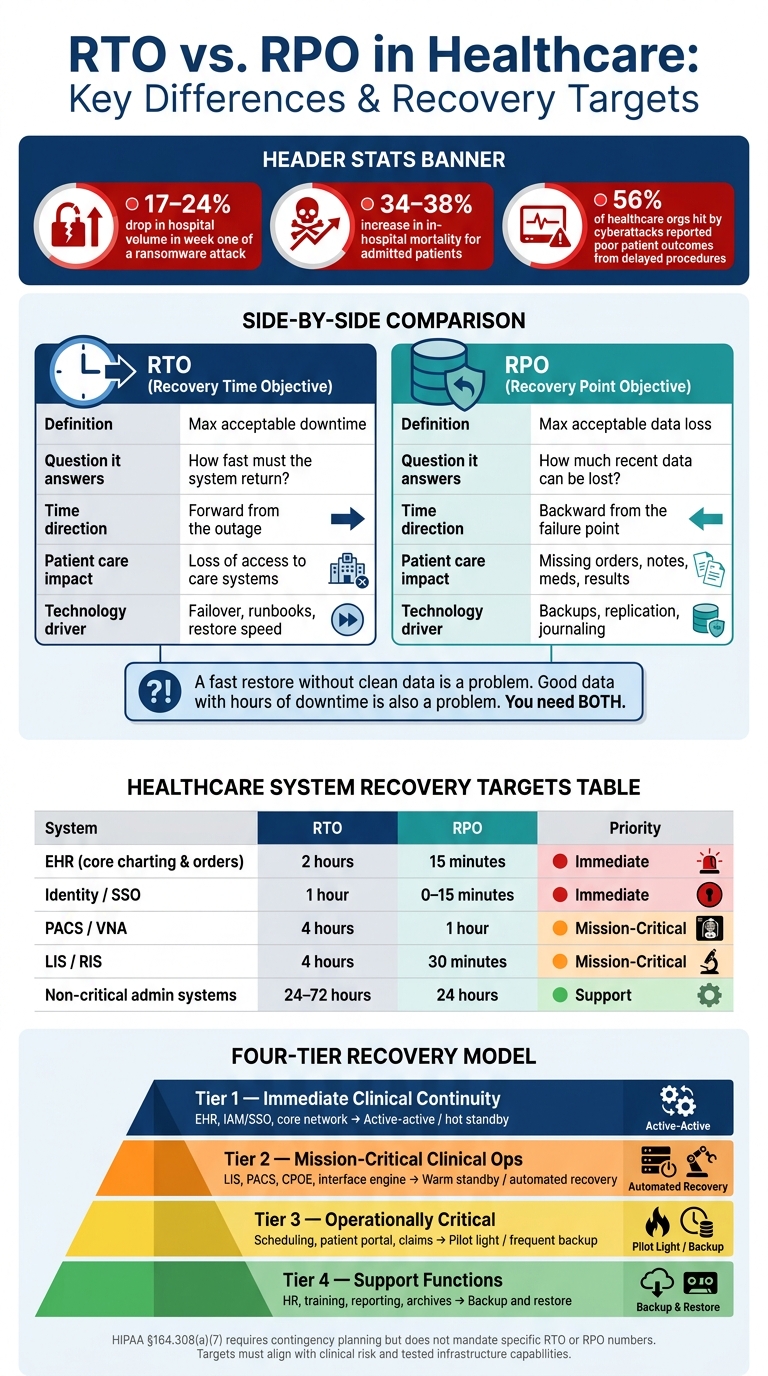
RTO vs. RPO in Healthcare: Key Differences & Recovery Targets
RTO vs. RPO: Definitions and Key Differences
What Is Recovery Time Objective?
RTO and RPO answer two different recovery questions: how fast systems must come back and how much data loss is acceptable.
Recovery Time Objective (RTO) is the maximum time a healthcare system can stay unavailable before patient care or daily operations face an unacceptable safety risk. This risk is often exacerbated by ransomware impacts on healthcare, which can paralyze critical systems for extended periods. Put simply, it sets the time limit for restoring services so clinicians can keep delivering care with as little interruption as possible.
RTO has a direct effect on care continuity. If an EHR, pharmacy system, or lab platform goes down, staff may have to switch to downtime procedures. Those workarounds can slow treatment and increase the chance of mistakes. So the shorter the RTO, the less time the organization spends in that risky mode.
What Is Recovery Point Objective?
Recovery Point Objective (RPO) is the maximum amount of recent data a healthcare organization can lose during recovery. In healthcare, that includes charting, orders, imaging metadata, and other patient data that cannot disappear without causing documentation gaps, safety problems, or billing and compliance trouble.
A long RPO affects more than the IT team. Lost medication orders, missing vital signs, or incomplete progress notes can leave holes in the legal medical record and interrupt continuity of care. That makes RPO as much a patient safety and documentation issue as a technical one.
How RTO and RPO Differ in Practice
These two metrics are separate. A system might come back online fast but still lose recent data. Or it might keep almost every recent data point and still take hours to return.
| Dimension | RTO | RPO |
|---|---|---|
| What it measures | Maximum acceptable downtime | Maximum acceptable data loss (in time) |
| Time orientation | Forward from the disruption | Backward from the disruption |
| Patient care impact | Affects care continuity and clinician access | Affects chart accuracy, orders, and patient data integrity |
| Technology driver | Recovery orchestration, failover speed, restore time | Backup frequency, replication intervals, journaling |
Tighter targets usually cost more. Very short RPOs often need near-real-time replication, which adds storage and network complexity. Short RTOs may call for automated failover infrastructure and tested runbooks. Healthcare organizations should set these targets based on clinical criticality instead of using one blanket standard for every system.
In practice, RPO usually shapes backup and replication frequency, while RTO shapes how restoration is built and how fast it works, including failover architectures and recovery playbooks.[5][6][7]
That distinction is why teams need to set RTO and RPO separately and test each one against actual recovery performance.
sbb-itb-535baee
🔥 The Ultimate Guide to Disaster Recovery: RTO, RPO, & Failover!
How Healthcare Organizations Set RTO and RPO Targets
Once the definitions are clear, the next step is to set targets for each system. The usual place to start is a business impact analysis (BIA), which ranks systems based on the clinical and operational effect of downtime and data loss.[9][11] From there, teams set separate RTO and RPO targets based on how critical each system is.
Match Targets to Clinical and Business Impact
A BIA helps turn clinical risk into specific recovery targets. Systems tied directly to diagnosis or treatment need the tightest targets. That includes the EHR, pharmacy dispensing, CPOE, and the LIS used for urgent lab results, because even a short loss of access or missing data can affect patient safety right away.[3][13]
By contrast, administrative systems like HR, revenue cycle, and payroll can often come back later. In many cases, staff can use temporary workarounds, which lowers the short-term risk.[3][13]
Guidance often begins with targets like these:
| System | Suggested RTO | Suggested RPO |
|---|---|---|
| EHR (core charting & orders) | 2 hours | 15 minutes |
| Identity / SSO | 1 hour | 0–15 minutes |
| PACS / VNA | 4 hours | 1 hour |
| LIS / RIS | 4 hours | 30 minutes |
| Non-critical admin systems | 24–72 hours | 24 hours |
These numbers are a starting point, not a fixed rule for every organization.[3][1]
Account for U.S. Regulatory and Risk Requirements
Those targets also need to line up with U.S. healthcare compliance and risk rules. HIPAA's Security Rule requires contingency plans to protect the availability and integrity of ePHI under §164.308(a)(7), but it does not give numeric RTO or RPO targets.[14][15]
NIST SP 800-34 adds the recovery framework. It uses Maximum Tolerable Downtime (MTD) as the outer limit for disruption, which means RTO plus reprocessing time must stay within that window.[8][9][10] RPO is different: it defines how much data loss is acceptable at the time recovery happens.[8][9] So if medication administration can't pause for more than 2 hours, the pharmacy and EHR targets need to sit below that mark.[9]
Check That Targets Match Real Technical Capabilities
A target on paper doesn't mean much if the stack can't hit it. Backup systems, replication, failover, network resilience, cloud architecture, and vendor service-level agreements (SLAs) all shape whether the target is possible.[11][12][13]
For the tightest targets, organizations usually need near-real-time replication, geographically separate data centers or cloud regions, and automated failover. Less critical systems can often rely on nightly backups and warm standby environments.[3][13]
Vendor contracts need a close look too. If a hosted EHR or PACS platform can't meet the RTO your team needs under its SLA, that's a problem to solve before an incident happens. Medical device dependencies matter as well. If bedside monitors depend on EHR connectivity, they should be part of recovery planning and testing.[3][12][13]
If testing shows a target can't be met, the organization has two choices: improve the infrastructure or revise the target and document the remaining risk.[11][12]
Applying RTO and RPO to Healthcare Recovery Planning
Use System Tiers to Set Recovery Priorities
Targets start to matter when teams map them to system tiers. Once those targets are in place, the next step is to group systems into recovery tiers so teams know what to restore first and in what order. That’s where RTO and RPO become practical: they show which systems need to come back first and how much data loss each one can live with.
A practical four-tier model looks like this:[2][3]
| Recovery Tier | Example Systems | Recovery Approach |
|---|---|---|
| Immediate clinical continuity | EHR, IAM/SSO, core network services | Active-active, hot standby, replicated data |
| Mission-critical clinical operations | LIS, PACS viewer, CPOE, interface engine | Warm standby, replication, automated recovery |
| Operationally critical | Scheduling, patient portal, claims, supply chain | Pilot light, frequent backup, vendor continuity plan |
| Support functions | HR, training, reporting, archives | Backup and restore |
Identity and access management belongs in the top tier because even a recovered system is useless if clinicians can’t sign in and use it.[2][16]
Test Whether Recovery Objectives Can Be Met
Those tiers are only as good as the testing behind them. Teams need to check whether the targets can hold up in the real world, not just on paper. That usually means a mix of tabletop exercises, backup-and-restore tests, and failover drills for top-tier systems.
Expert practice is to test the highest-priority systems at least once a year, and many organizations do it twice a year. On top of that, more frequent automated checks on replication and backup job status help catch problems before a crisis hits.[16]
After any disruption, teams should record the RTO and RPO they actually achieved, note where things fell short, and update runbooks or infrastructure. Those records also help with HIPAA compliance and broader governance reviews.[16][17]
Align Recovery Objectives With Healthcare Risk Management
Recovery objectives should feed into the broader cyber risk program. RTO and RPO don’t stand alone. They need to connect with the organization’s full view of cyber and operational risk, including third-party vendor risk, medical devices, clinical apps, and supply chains.[17]
Censinet RiskOps™ can link recovery objectives to enterprise and third-party risk findings, which helps leaders spot when gaps tied to vendors, devices, or the supply chain may put RTO or RPO at risk.[17]
Conclusion: Use RTO and RPO Together to Protect Care Delivery
The main point is simple: RTO and RPO only work when you use them together and keep them tested and up to date. Each one covers a different part of recovery. RTO puts a limit on downtime. RPO puts a limit on data loss. Healthcare organizations need both at the same time because care depends on system access and accurate data.
A 2024 Proofpoint/Ponemon report found that 56% of healthcare organizations hit by cyberattacks reported poor patient outcomes from delayed procedures and tests, and 28% said mortality rose.[19] That puts recovery targets in plain terms. They are not just IT numbers. They connect directly to patient safety and continuity of care.
That is why recovery targets should begin with clinical impact and then be checked against what the tech stack can actually support. Systems tied to patient care usually need the tightest targets. And those targets have to line up with the underlying setup. A 15-minute objective calls for real-time replication, not tape.[18]
After targets are set, testing shows whether they can hold up in practice. On paper is one thing. In the middle of an outage is another. Tabletop exercises, failover drills, and restore tests show whether the plan works under realistic conditions.[4] ASPR TRACIE recommends starting with just one or two compromised systems before scaling up, so teams can verify targets against realistic scenarios.[20]
Recovery planning also cannot stop after a test cycle. Systems change. Vendors change. Risk changes. Recovery objectives should be reviewed on a regular basis after major application upgrades, mergers, cloud migrations, new clinical services, or shifts in the threat landscape. Censinet RiskOps™ can help healthcare organizations connect recovery priorities to a broader enterprise and third-party risk picture, so changes in vendors, devices, or supply chains do not erode recovery targets.
FAQs
How do I choose RTO and RPO for each healthcare system?
Start with a formal business impact analysis and application criticality review. The goal is simple: rank systems based on their effect on patient safety, clinical operations, and compliance.
From there, assign recovery targets by tier. Tier 0 systems, such as the EHR, need the fastest recovery because downtime hits care delivery right away. Tier 1 systems, like PACS and LIS, come next. Lower-tier systems, such as billing or HR, can usually handle a longer recovery window.
Those targets shouldn’t live only on paper. Test them on a regular basis, make sure they line up with vendor SLAs, and set them according to clinical need - not guesswork.
Which healthcare systems need the tightest recovery targets?
Systems whose downtime can put patient safety or clinical care at risk need the strictest recovery targets.
These Tier 0 systems include EHR, CPOE, pharmacy systems, and identity services. In most cases, they need an RTO of 1 hour or less and an RPO of 15 minutes or less. If something goes wrong, restoring these systems comes before billing or scheduling.
How often should we test RTO and RPO?
At a minimum, test disaster recovery procedures and recovery metrics once a year.
For high-criticality Tier 1 systems, patient-care applications, or environments with large amounts of PHI, a more frequent, risk-based schedule is often the better call. In many cases, that means testing quarterly.
Testing should also happen after major changes, such as infrastructure updates, vendor shifts, or major workflow changes.
After any test or real incident, complete a formal after-action review within one to two weeks.
