
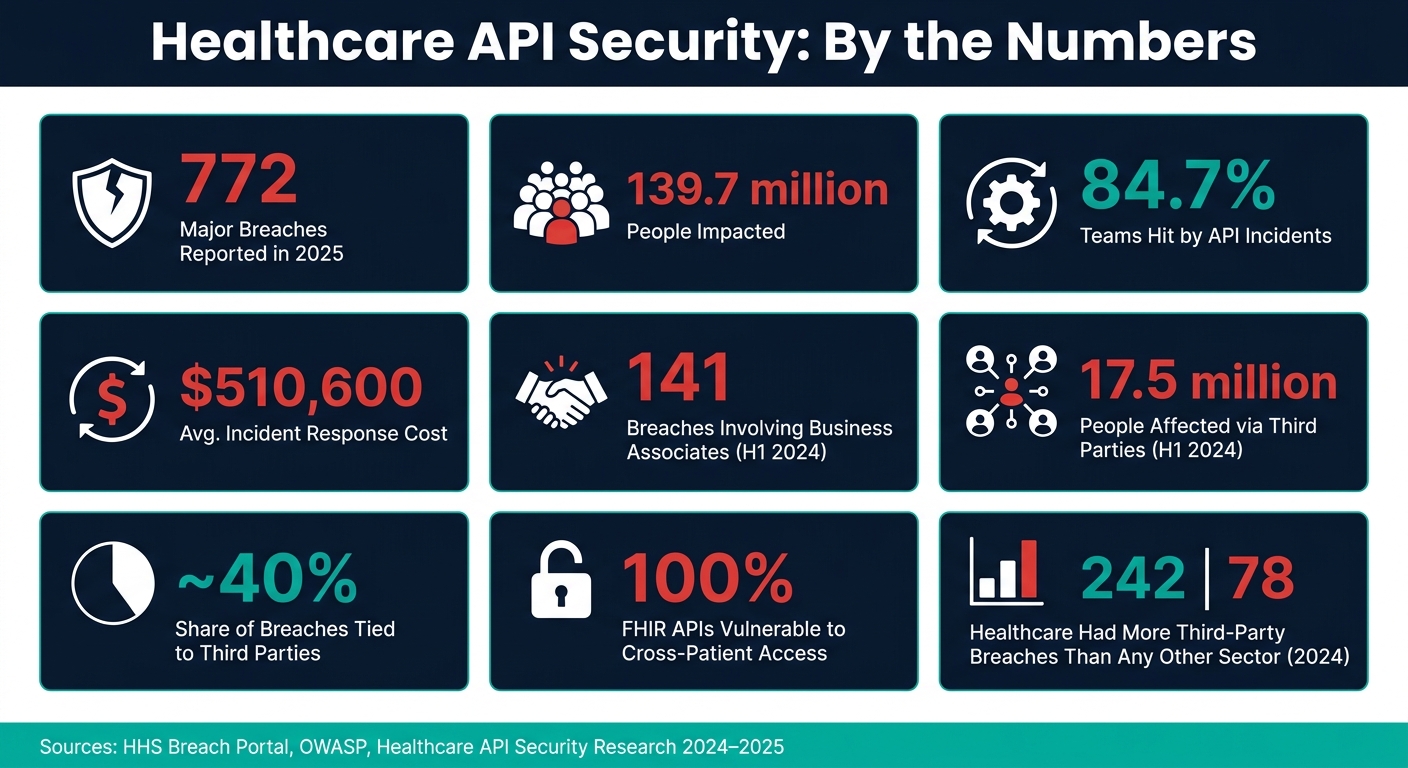
Healthcare API security comes down to a short list: know every API, limit PHI access, lock down third-party apps, encrypt traffic, protect secrets, and watch for odd behavior. That matters because 772 large healthcare breaches in 2025 affected about 139.7 million people, and one survey found 84.7% of healthcare teams dealt with an API security incident in the prior year, at an average response cost of $510,600 per incident.
If I had to boil the article down, I’d say this:
- Inventory every API and mark which ones touch PHI
- Map PHI flows before any vendor or app goes live
- Limit access to the minimum data and actions needed
- Use OAuth 2.0, OIDC, and SMART on FHIR correctly
- Validate every request server-side, not just at login
- Encrypt data in transit with TLS 1.2+, with TLS 1.3 as the default for new APIs
- Protect API keys, client secrets, and signing keys in a secret manager
- Use gateways for token checks, schema validation, rate limits, and logging
- Review third-party vendor risk before and after launch, not just at contract signing
- Log high-risk API activity and act fast on token theft, bulk exports, and unusual access patterns
Third-party connections are the main pressure point. When outside apps, service providers, and data aggregators touch PHI, you lose direct control over how that data is stored, shared, and protected. That’s why minimum necessary access, vendor review, and tight runtime checks matter so much in healthcare.
Put simply: if you want safer healthcare APIs, you need clear governance, strict identity and encryption controls, and steady monitoring working together from day one.
Healthcare API Security: Key Threats, Costs & Breach Statistics 2024–2025
Security on FHIR - API Security in the Digital Healthcare Ecosystem, WSO2 Webinar
sbb-itb-535baee
Governance and Risk Management for API Integrations
Before you get into technical controls, you need a clear, written API inventory. That inventory should list each endpoint’s owner, business purpose, data types, environment, and authentication model. It should also flag which endpoints handle PHI before any vendor integration goes live. HHS guidance calls for a risk analysis across all systems where ePHI is created, received, maintained, or transmitted, including connected third-party apps and APIs.[6][9]
A living inventory makes day-to-day security work much easier. It gives teams a better handle on access control, monitoring, and incident response. It should also feed PHI flow mapping, so teams can tighten access scopes before launch.
Map PHI Flows and Apply Minimum Necessary Access
PHI flow mapping starts with a simple step: identify every system that stores or exposes PHI, then trace each API connection between those systems and outside vendors.[2][4][1] Once that map is in place, use it to limit each integration to the minimum scope it needs.
HIPAA’s minimum necessary standard requires reasonable efforts to limit PHI use, disclosure, and requests to what is needed for the approved purpose.[5][7] In plain terms, if a vendor only needs a slice of the data, don’t hand over the whole pie. An appointment-reminder vendor, for example, should get contact information and appointment dates, not full clinical histories.[3][1]
Some endpoints call for much closer review than others, especially those tied to:
- Bulk export
- Write access
- Identity changes
- Claims submission
It also helps to classify endpoints by a few basic factors: whether they handle PHI, de-identified data, or non-PHI; whether they are read-only, write/update, or delete; and whether they allow bulk operations. That gives security teams a clearer, risk-based view of where controls matter most.[2][4][1]
Assess Third-Party API Risk Before and After Go-Live
A pre-go-live risk review should look at the vendor’s security posture through a structured security questionnaire and an evidence review. A BAA matters, but it’s not enough on its own. It does not show whether the vendor actually has the controls needed to protect the data.[8][10]
What happens after launch matters just as much. HIPAA risk analysis is not a one-and-done task. It should be revisited after major version changes, new endpoints, scope expansions, or security incidents.[6][8][10] Vendors should notify the organization when they update or retire API versions, add new data access capabilities, or go through a security event. Those expectations belong in the contract, along with incident-response timelines and change-notification rules.
The numbers make the risk hard to ignore. In the first half of 2024, business associates were present in 141 breaches affecting 17.5 million people - about 40% of all major breaches reported in that period.[11] That’s why vendor review before and after go-live can’t be treated like a paperwork exercise. These governance choices set the access boundaries and trust lines that authentication, authorization, and encryption need to enforce.
Identity, Authorization, and Encryption Controls
Once PHI flows and third-party risk from vendor access are mapped, the next step is simple in theory and strict in practice: every third-party API call should be authenticated, authorized, and encrypted.
How to Use OAuth 2.0, OpenID Connect, and SMART on FHIR Correctly
The right OAuth 2.0 flow depends on who, or what, is making the API call.
Authorization Code with PKCE fits user-facing apps like patient portals, clinician tools, and mobile apps. It helps block authorization code interception on devices and networks you don't fully trust.
Client Credentials works for backend, service-to-service integrations where no end user is involved. Think of an integration engine pulling FHIR resources into a data warehouse, or a scheduled job sending claims to a clearinghouse.
OpenID Connect (OIDC) adds verified user identity through ID tokens. That matters when SMART on FHIR apps need a confirmed identity before role-based access is applied.
SMART on FHIR scopes should stay as narrow as possible. For example, a patient medication reconciliation app should get only patient/MedicationRequest.read and patient/AllergyIntolerance.read rather than a broad patient/*.read scope that opens the full chart. Scope requests should move through a formal app review process tied to the app's documented clinical purpose.
That level of discipline matters. Research into production FHIR APIs found that 100% of tested APIs allowed cross-patient data access from a single patient login[17][16]. That finding puts a spotlight on scope control and token handling.
Server-side authorization checks on every request are a must. Checking token scope at login alone doesn't cut it. The API also needs to confirm that the caller can access the requested resource based on role and care relationship. This is a direct defense against Broken Object Level Authorization (BOLA), which OWASP lists as a top API security risk[14][15]. Using random, non-sequential identifiers like UUIDs for patient records also makes enumeration attacks harder[15][14].
Access tokens should be short-lived. For high-risk PHI access, 5 to 15 minutes is the target, and they should rarely last more than 60 minutes[12][13]. Resource servers should validate tokens on every call by checking iss, aud, exp, nbf, and scope claims[12][13]. Refresh tokens should be limited to confidential clients, such as backend services, and stored in secure, audited locations. They should never be exposed to front-end JavaScript. For higher-risk integrations, sender-constrained tokens through mTLS or DPoP can cut replay risk by binding the token to the client[13][18][19].
Encrypt Data in Transit and Protect Secrets
TLS 1.2 is the minimum. TLS 1.3 should be the default for any new healthcare API.
TLS 1.3 drops legacy cipher suites, simplifies the handshake, and lowers latency. For high-volume FHIR traffic, that matters. If a legacy system still needs TLS 1.2, keep cipher suites limited to strong options like AES-GCM, and disable SSL and early TLS versions entirely. All web-facing endpoints should enforce HSTS, and APIs should be scanned on a regular basis to confirm that only approved protocol versions and cipher suites are active.
For service-to-service traffic that carries large amounts of PHI or supports critical clinical workflows, mutual TLS (mTLS) gives more protection than one-way TLS because both sides present and validate certificates. Certificate lifecycle management, including automated issuance, rotation, and revocation, should be built into DevOps work. mTLS should also be paired with OAuth-based authorization for defense in depth.
Secrets need the same level of care. API keys, OAuth client secrets, and signing keys, including hard-coded credentials buried in integration scripts or vendor tools, should live in centralized, audited secret management systems. They do not belong in source code, config files, or shared drives.
Each integration should use its own credentials in each environment. Those credentials should be rotated on a set schedule or at once after any suspected compromise. Encryption key management should include:
- clear separation of duties
- strict audit logging
- rotation planned around maintenance windows for critical interfaces like medication ordering or lab result delivery
That last point is easy to overlook, but it matters. A key rotation should not break patient care workflows.
Use field-level encryption or tokenization for the most sensitive data elements.
These controls work only if gateways and runtime checks enforce them at the edge.
Architecture and Operations for Secure Third-Party API Communication
Use Gateways, Validation, and Resource Limits to Reduce Exposure
In a healthcare API setup, the API gateway should enforce policy on every third-party call that touches PHI. Each request should be authenticated and authorized at the gateway. The gateway should validate tokens, enforce policy, apply rate limits, and log each request and response before traffic reaches backend systems.[20][22][23]
That lines up with zero-trust thinking. Traffic doesn't get a free pass just because it comes from a known network segment. The gateway is the last control point before PHI reaches external systems.
Gateway validation also helps stop excessive data exposure and mass assignment.[21][26] Inbound requests should be checked against strict contracts, such as FHIR profiles, OpenAPI specs, or JSON schemas, so unexpected fields get rejected before they reach downstream services. On the way back out, responses should return only the data the client needs.
Rate limiting and resource quotas should be tiered by integration type and clinical priority.[26] A research data pull should have tighter throughput limits than a clinical decision support service. Circuit breakers add another layer of protection by letting non-critical services fail safely instead of slowing or blocking care delivery.
Error responses should include only a status code and correlation ID.[20][25] Stack traces, internal object structures, database names, configuration details, and PHI should never appear in API responses. Detailed diagnostics belong in protected server-side logs that only authorized security and operations staff can access.
IP allowlisting works best for steady integrations with vendors that use fixed IP ranges or private connectivity, but it should not be the main trust mechanism. Cloud vendors with dynamic IPs and patient-facing apps need token-based identity and strong authentication as the main control. To handle denial-of-service threats, combine IP controls with rate limiting, anomaly detection, and DDoS protections at the network edge and gateway layer.[20]
Build Continuous Assurance Into Vendor API Onboarding
Once gateway controls are in place, vendor onboarding needs to confirm the integration can keep meeting those controls after launch.
Vendor API security is not a one-time checkbox. It needs structured review before go-live and periodic reassessment after launch.
Before production, reviews should look at the vendor's API specs, authentication model, data flow diagrams, downstream vendor dependencies, and compliance documentation. That includes SOC 2 reports, ISO certifications, HIPAA attestations, and signed BAAs.[24][25] For high-risk or high-impact integrations, penetration testing should happen before any PHI is exchanged.
Automated contract tests in CI/CD can check that endpoints stay authenticated, responses remain within data minimization rules, and encryption settings meet policy standards.[24][25] If a test fails - for instance, if a schema change exposes extra patient fields - the pipeline should block deployment and alert the team.
After go-live, periodic reassessments help confirm that infrastructure changes or API version updates have not introduced new risk. Old versions should be retired fast. Outdated API versions should be formally retired, credentials rotated, and routing updated so legacy endpoints do not stay active.[24][25]
Censinet RiskOps™ supports structured vendor API assessments and ongoing risk review.
Assess identity, encryption, logging, incident response, data minimization, and API lifecycle controls before go-live and after changes.
Monitoring, Incident Response, and Key Takeaways
Log High-Risk API Activity and Detect Anomalies Early
When preventive controls fail, logs are often the first sign that something is off. For every request that touches PHI, especially from vendor apps, service accounts, and SMART on FHIR clients, log the actor, client app ID, UTC timestamp, resource, action, source metadata, and outcome.[2][28][29][32][33]
That source metadata should include:
- IP address
- Device ID
- User agent
- Origin
Log metadata only. Do not log clinical content. Audit logs should be kept for six years.[2][28][29]
To make those logs useful, tie together gateway, identity, application, network, and database logs in one SIEM with shared request IDs and client IDs. That makes it much easier to catch token theft, overreach, and bulk access before the damage spreads.[27][30][32]
These are the anomaly patterns security teams should watch first:
| Anomaly Type | Key Detection Signals | Recommended Response Actions |
|---|---|---|
| Stolen or reused OAuth token | Valid token from unexpected IP/geography; concurrent sessions | Revoke token; force MFA; block client ID; investigate account/device |
| Abnormal geography | API calls originating from countries with no organizational presence; traffic bypassing VPN or gateway controls | Geo-block or require step-up authentication; verify BAA and data residency terms |
| Excessive record access | Single account or app accessing thousands of records in a short window | Throttle or suspend client; review role and scope assignments; notify privacy and compliance team |
| Bulk export or mass download | Large _export jobs or repeated bulk pulls; unusually large response sizes |
Confirm justification; halt export if suspicious; rotate credentials |
| Suspicious device or client behavior | Unapproved device types; rooted devices; outdated app versions; shift from occasional queries to intensive scraping | Enforce device attestation; block non-compliant clients; coordinate vendor updates |
| Unauthorized admin or config change | Unexpected RBAC changes, new scopes, or redirect URI modifications outside change windows | Roll back change; lock admin accounts; review change-management logs; investigate |
Triage matters. Suspected bulk PHI exfiltration through third-party APIs needs immediate escalation and containment. A small rate-limit breach is different and can wait for daily review. Your playbooks should spell out containment steps that limit care disruption. In practice, that can mean tightening scopes or switching a suspicious app to read-only mode instead of shutting down the full FHIR service. Bring in clinical leadership before taking any step that could affect EHR availability.[27][1][31]
A 2024 summary found that healthcare had more third-party breaches than any other sector, with 242 breaches total and 78 tied to third parties.[36] The HHS breach portal tracks HIPAA breaches affecting 500 or more people that were under active investigation in the last 24 months, and it notes whether a business associate was involved.[34][35] That’s one reason structured vendor onboarding and steady monitoring of vendor API behavior make sense as day-to-day risk controls.
Once playbooks are written, test them in conditions that feel real. Run tabletop exercises with clinicians, compliance staff, and vendor reps. The goal is simple: pressure-test detection rules and escalation paths before a live incident hits, with a sharp focus on vendor API misuse and failure scenarios.[27][1][31]
Conclusion: API Security Controls Healthcare Leaders Should Prioritize
Secure API communication in U.S. healthcare depends on two things working together: technical controls and disciplined third-party risk management. One without the other leaves gaps.
The priority controls are straightforward:
- A complete API inventory with mapped PHI flows
- Minimum necessary access
- OAuth 2.0 and SMART on FHIR authorization
- Encrypted transit
- Secrets protection
- Vendor assessments before and after go-live
- Continuous monitoring for anomalies in third-party API communication
Censinet RiskOps™ supports healthcare organizations with structured third-party and enterprise risk assessments, cybersecurity benchmarking, and collaborative risk management across risks involving patient data, PHI, clinical applications, medical devices, and supply chains.
FAQs
How do we prioritize which APIs to secure first?
Use a risk-based, phased approach.
Start by cataloging all internal and third-party APIs that handle PHI. Then assign each one a criticality score based on two things: how much data it processes and how important it is to the clinical workflow it supports.
From there, focus on the highest-risk integrations first. That usually means real-time EHR systems, telehealth platforms, and life-safety medical devices. These APIs should be first in line for immediate security hardening and regular risk assessment.
When should a vendor API integration require extra review?
A vendor API integration needs extra review when PHI is being exchanged or when the vendor is high risk because of the sensitivity of the data it handles and the role it plays in your operations.
That review shouldn't be a one-time thing. Revisit it when new APIs are added, when the integration changes in a major way, or when the vendor gets access to more data.
It also helps to review these integrations on a regular, risk-based schedule. For high-risk vendors, that can mean annual audits.
What should we do first if an API token is stolen?
Revoke the token at once. Then follow your incident response plan to contain the breach.
Tighten gateway rules, disable compromised endpoints, and use audit logs plus real-time monitoring to figure out the scope. Look for unusual query patterns and any data access that happened while the token was active.
