
Most health systems have AI rules. Far fewer know which AI tools staff and vendors are already using. That gap is the problem.
I see the article’s main point like this: if you want to control shadow AI, you need to find it first, check what data it touches, and decide what stays, what gets limited, what needs fixes, and what has to go.
Here’s the short version:
- 70% of healthcare groups have AI governance committees, but only 30% keep an enterprise-wide AI inventory.
- Shadow AI usually comes from staff using unapproved tools or vendors adding AI features to approved products later.
- The main risks are PHI exposure, HIPAA trouble, bad clinical output, and agentic systems acting with too much access.
- The best way to spot hidden AI is to combine:
- SaaS discovery and logs
- endpoint and browser data
- purchasing and contract review
- staff interviews tied to daily work
- Once tools are found, each one should be sorted into a simple action path: approve, restrict, remediate, or retire.
- After that, the work shifts to a living inventory, named owners, vendor checks, BAA review, and controls for tools that can act on their own.
What stood out to me most is this: the issue is not just weak policy. It’s the gap between policy and what people and vendors are doing every day.
If I were summarizing the article in one line, I’d say this: AI governance fails when your inventory is incomplete.
The article then walks through where hidden AI tends to show up, why governance teams miss it, how to find it, how to score risk, and how to pull those tools into a standing governance process.
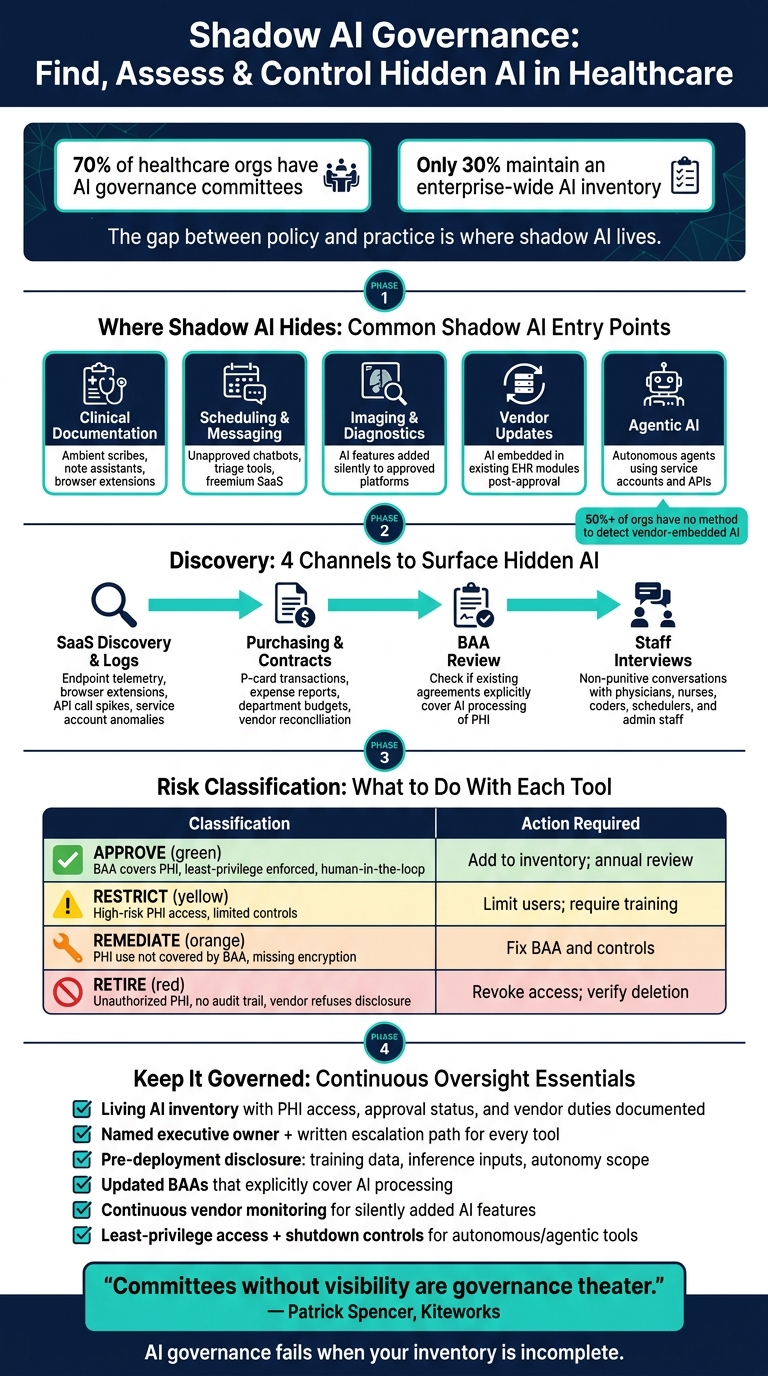
Shadow AI Governance: Find, Assess & Control Hidden AI in Healthcare
Clinical AI on Trial Shadow Tools and Governance Gaps | Newsday with Yaw Fellin and Matt Troup
sbb-itb-535baee
Where Shadow AI Hides and Why Governance Misses It
Shadow AI usually shows up quietly. Staff pick up tools to save time, shave off admin work, or move faster through a packed day. That’s why the hiding place often matters more than the tool type.
The Workflows Most Likely to Contain Unapproved AI
Clinical documentation is one of the most common entry points. Clinicians start using ambient scribe apps, generative note assistants, and browser extensions through personal or unapproved accounts.
Scheduling, messaging, and revenue cycle work also pull in unapproved chatbots, triage tools, and freemium SaaS add-ons. It happens the way many workarounds happen: one team finds something useful, then it spreads.
Imaging and diagnostics can hide shadow AI too. An approved viewing platform may later add AI-assisted analysis features, and that change can slip by without much notice.
These tools spread because governance teams rarely track day-to-day workflow changes in real time. A tool doesn’t need to arrive through a big rollout to create risk. Sometimes it just slips into the workday and stays there.
The Blind Spots That Let Hidden AI Spread
Many healthcare governance processes still depend on one-time approval. That falls apart when vendors add AI through routine product updates. More than 50% of healthcare organizations have no documented method for detecting when vendors embed AI into existing products [1]. So a clinician-facing tool that got approved months ago may be using AI-driven features today, with no one in governance aware of it.
Ownership gaps make this worse. 38% of organizations lack clear AI risk ownership or escalation paths [1]. When no one clearly owns the issue, problems tend to bounce around until they become someone else’s emergency.
The table below shows where these blind spots tend to appear, what shadow AI can look like in practice, and the risk that follows:
| Blind Spot | Typical Shadow AI Example | Resulting Risk |
|---|---|---|
| Vendor Updates | AI added to an approved EHR module | Undocumented PHI exposure; HIPAA violations |
| Decentralized Procurement | Department-bought transcription tool | Data leakage to third-party model trainers; no BAA |
| Browser/Personal Use | Personal ChatGPT accounts or extensions | Unreviewed AI output entering clinical documentation |
| Agentic AI | Autonomous agents using APIs | Unauthorized privilege escalation; no audit trail |
| Fragmented Ownership | No named owner for revenue cycle AI | No escalation path when a data or bias incident occurs |
"Committees without visibility are governance theater." - Patrick Spencer, Kiteworks [1]
The next step is to find these tools in procurement records, endpoint telemetry, browser data, and staff workflows.
How to Find the AI Tools Your Program Missed
If you want to find AI tools that slipped past review, you need to look in more than one place. No single source tells the whole story. Logs show technical footprints. Purchasing records show what the company paid for. Staff conversations show what people use to get their work done. The trick is to pull clues from all three and cross-check them.
Use SaaS Discovery, Endpoint Telemetry, and Browser Data
Start with the data you already have. Endpoint logs, browser activity, access logs, and SaaS discovery tools can all help surface AI products that never went through formal review. Browser extension data can help too, especially when teams install add-ons tied to AI use.
Pay close attention to service accounts. Agentic AI often signs in through them, and odd spikes in authentication volume or API call patterns can point to an AI feature that was switched on quietly [1].
Review Purchasing Records and Reconcile Vendor Inventories
Procurement records are one of the most overlooked ways to find hidden AI use. Check contracts, expense reports, P-card transactions, and department budgets for tools that don't show up in your approved inventory.
An incomplete inventory is the main governance problem here. After you build a list of active vendors, compare each vendor's current product features with the original procurement paperwork. That step matters because products change fast, and the tool you bought last year may now include AI functions no one reviewed.
Also review existing Business Associate Agreements and make sure they clearly cover AI processing of PHI. Many of those agreements were signed before AI features were part of the product at all.
Interview Clinicians and Staff to Surface Workflow-Level Use
Technical checks won't catch everything. Staff may use personal accounts or browser-based tools that leave little or no trace in company logs. That's why structured, non-punitive interviews with physicians, nurses, coders, schedulers, and administrative staff matter so much. Those talks can bring out tools that never appear in purchasing records or endpoint data.
Keep the conversation tied to day-to-day work, not just the approved process. Ask what helps people finish documentation faster or handle routine tasks. That's usually where hidden AI use shows up.
The table below maps each role to the shadow AI patterns most likely to come up in those conversations:
| Role | Likely Shadow AI Usage Pattern | Typical Data Handled | Main Associated Risk |
|---|---|---|---|
| Physicians | AI scribes, clinical decision support | Patient encounter notes, vitals | PHI exposure to unapproved LLMs; diagnostic bias |
| Nurses | Documentation assistants, shift handoff tools | Patient care plans, medication lists | Data residency violations; inaccurate care summaries |
| Medical Coders | Automated coding assistants, revenue cycle AI | Billing codes, diagnostic records | Financial data leakage; "hallucinated" billing codes |
| Schedulers | Patient engagement chatbots, auto-responders | PII (names, DOB, phone numbers) | Unauthorized data scraping; HIPAA non-compliance |
| Admin Staff | Meeting summarizers, email drafting tools | Operational data, internal strategy | Intellectual property loss; credential theft via extensions |
Use all three channels to build one inventory. Then score each tool by risk.
How to Assess and Prioritize Risk Once Tools Are Found
Once you've finished discovery, the next step is simple in theory and messy in practice: score each tool the same way every time.
Use the evidence you gathered from logs, contracts, interviews, and vendor lists to sort each discovered tool into the right next step. That could mean immediate action, close monitoring, or a formal review. The key point is that not every tool needs the same response.
Evaluate Data Exposure, Security Controls, and Care Impact
Start with the basics.
For each tool, ask:
- Does it touch PHI?
- Does a current BAA explicitly cover AI processing?
- Where are prompts and outputs stored?
- How does it connect: EHR module, imaging system, API, service account, or database access?
Then look at care impact. A tool that answers general questions is one thing. A tool that writes to the EHR or shapes a triage decision is in a very different class. That line matters.
Tools with autonomous behavior deserve the most scrutiny. If a system can take action without step-by-step human review, the risk goes up fast.
"Inventory and asset management still lag adoption." - Ed Gaudet, CEO and Founder, Censinet [1]
Classify Each Tool as Approve, Restrict, Remediate, or Retire
Now turn those findings into one clear decision for each tool. Use the same standard every time so teams aren't making judgment calls on the fly.
| Classification | PHI Exposure | Security Posture | Patient Safety Impact | Action |
|---|---|---|---|---|
| Approve | Covered by BAA; minimal or controlled PHI | Least-privilege enforced; full audit trails | Human-in-the-loop; low automation bias | Add to inventory; review annually. |
| Restrict | PHI access is necessary but high-risk | Limited to specific users or network segments | Potential for bias; requires strict oversight | Limit users; require training. |
| Remediate | PHI used in ways not covered by the current BAA | Missing encryption or continuous verification | High hallucination risk in clinical outputs | Fix BAA and controls. |
| Retire | Undocumented or unauthorized PHI processing | No audit trails; vendor refuses disclosure | High risk to care delivery; autonomous without oversight | Revoke access; verify deletion. |
If a tool lands in Remediate, the problem often isn't the AI by itself. More often, it's the contract setup and the control environment around it. A lot of vendors added AI features after the first BAA was signed, so those agreements need a close read.
If a tool belongs in Retire, don't let it sit. When you can't confirm PHI handling, check controls, or point to one accountable owner, that's a red flag. Revoke access, verify deletion, and push it into governance review.
Those classifications should feed straight into your inventory and your day-to-day oversight process.
Bring Shadow AI Into Governance and Keep It There
Discovery matters only when it turns into a standing control process. Once you’ve found shadow AI and scored the risk, the next step is making governance part of day-to-day operations.
Build a Repeatable AI Inventory and Oversight Process
Finding tools through SaaS discovery, procurement review, telemetry, and staff interviews only helps if it leads to a process that sticks. If your organization doesn’t change how it tracks, approves, and watches AI tools, the same blind spots will come back.
A useful inventory is more than a basic tool list. It should show:
- what PHI each system can access
- who approved it
- the vendor’s contract duties
- whether the system acts on its own or works with human review
That detail is what lets teams enforce policy instead of just talking about it.
Each tool in the inventory should also have one named executive owner and a written escalation path. If no one clearly owns it, accountability tends to disappear the minute something breaks.
Before any tool goes live, require teams to disclose training data, inference inputs, how far the tool can act on its own, and any changes to its AI features. Update BAAs so they clearly cover AI processing. Keep watching vendors for AI added to approved products without review. That helps stop an approved tool from quietly becoming new shadow AI after deployment.
Use Censinet to manage third-party AI risk at scale
Censinet AI™ can help speed up vendor assessments by summarizing integrations and evidence for human review. That means reviewers can spend less time gathering data and more time making risk calls.
"Healthcare has built the governance scaffolding for AI, but the operational muscle - inventory, asset management, detection methods, and clear accountability - is not keeping pace with adoption." - Ed Gaudet, CEO and Founder, Censinet [1]
Conclusion: A Practical Roadmap for Finding and Governing Hidden AI
The organizations that handle this well move from ad hoc discovery to continuous AI governance. They build a living inventory, standard intake, steady vendor monitoring, and executive-level accountability into the process.
For autonomous tools, add least-privilege access, limit them to approved tasks, and include a shutdown control. That gives your organization a clear process for finding, scoring, and governing hidden AI - and for making sure it stays governed.
FAQs
How can we find shadow AI already in use?
Move beyond policy to active discovery. Check network traffic, DNS queries, and API connections tied to known AI services. Look at encrypted traffic metadata and URI patterns too, so you can spot unauthorized model access even when the full payload isn't visible.
Audit endpoints for browser extensions and integrated apps as well. Use DLP and CASB to flag sensitive data sent to unapproved platforms, then verify what you find through staff surveys. Keep those results in a living AI inventory.
Which shadow AI tools pose the highest risk?
The highest-risk shadow AI tools are the ones tied to clinical decision-making and patient-impacting documentation. That includes diagnostic decision support tools, ambient AI scribes, and generative AI note assistants.
Tools used for triage and patient-facing recommendations or automation also sit in the high-risk category. When these tools get something wrong, the fallout can hit diagnosis, treatment, escalation, billing, or coding integrity in direct ways.
What should we do first after finding a hidden AI tool?
Immediately stop any PHI or clinical use and start containment while you assess the risk.
Run the tool through your AI use policy and governance intake so you can document its intended use, who will use it, and what data it can access. Give higher-risk tools a deeper review. Make sure audit logging, least-privilege access, and MFA are in place. And if a vendor won’t sign a BAA, keep that tool out of PHI workflows.
