
SOC 2 compliance is a must-have for healthcare vendors working with hospitals and health systems. Meeting both SOC 2 and HIPAA requirements is challenging, especially with growing demands for continuous monitoring of sensitive data like Protected Health Information (PHI). Manual compliance methods, such as using spreadsheets and email threads, are time-consuming, error-prone, and costly.
Switching to cloud-based SOC 2 automation offers faster evidence collection, 24/7 control monitoring, and reduced costs. Automation cuts compliance preparation time from months to just weeks, lowers labor expenses, and improves security by centralizing data and ensuring consistent monitoring. Vendors using automation are more prepared for audits and better equipped to handle customer security reviews, which often include third-party risk assessment questions regarding data protection, giving them a competitive edge in the healthcare market.
Key Takeaways:
- Manual compliance costs $5.5M on average, while non-compliance costs $14.8M.
- Automation reduces compliance prep time from 6–12 months to 30 days.
- Continuous monitoring ensures readiness for audits and strengthens security.
- Automated platforms like Censinet RiskOps™ simplify SOC 2 and HIPAA compliance, helping vendors meet healthcare delivery organizations' expectations.
For healthcare vendors aiming to grow and meet strict compliance standards, automation is a smarter, more efficient solution than manual processes.
1. Manual SOC 2 Compliance
Handling SOC 2 compliance manually means relying on spreadsheets, shared drives, and email threads. While these tools might feel familiar, they’re far from efficient. For healthcare vendors managing both HIPAA and SOC 2 requirements, this approach can quickly turn into a logistical headache, draining resources and pulling focus from core operations.
Efficiency and Cost
Manual compliance often creates a mad scramble for evidence, with teams rushing to prepare for audits in just a few chaotic weeks. On average, this process takes around three weeks [1]. Engineers spend valuable time hunting down encryption logs, access records, and policy documents scattered across different systems. And when overlapping controls for HIPAA and SOC 2 are involved, the workload doubles. This recurring effort, often referred to as an "operational tax," adds up over time - yet rarely gets a dedicated budget.
The financial impact is hard to ignore. Maintaining compliance costs an average of $5.5 million, but the cost of non-compliance skyrockets to $14.8 million, which is about 2.71 times higher [1]. Beyond fines and penalties, failing to produce a timely SOC 2 Type II report can delay hospital contracts during third-party risk reviews for six months or more [2]. Even worse, achieving SOC 2 Type II compliance manually can take 18 months or longer [2], giving competitors with automated systems a clear advantage in securing contracts.
"For a CISO running a lean team across HIPAA, HITRUST, and SOC 2, the cost of manual compliance isn't a line item. It's a liability." - ZenGRC [1]
Security and Risk Management
When systems are scattered and disconnected, policy inconsistencies emerge. These gaps can lead to risk analysis failures, which were flagged in 13 out of 20 recent OCR cases [1]. Without a centralized system, maintaining a consistent and accurate risk management strategy becomes nearly impossible.
Audit Readiness and Evidence Quality
A manual SOC 2 program tends to be reactive by nature. Evidence is gathered in spurts rather than continuously, leaving organizations with an incomplete compliance picture at any given moment. Healthcare-specific requirements, such as Business Associate Agreement (BAA) documentation and OCR breach notification workflows, are often overlooked because they fall outside the standard SOC 2 checklist [3].
"Pursuing SOC 2 without explicit HIPAA Security Rule mapping - produces a SOC 2 report that doesn't satisfy covered entity diligence." - Stefan Efros, CEO & Founder, EFROS [3]
These inefficiencies highlight the need for a more streamlined approach. Cloud-based SOC 2 automation offers a way to address these challenges directly, providing a stark contrast to the cumbersome manual process.
sbb-itb-535baee
2. Cloud-Based SOC 2 Automation
Cloud-based SOC 2 automation takes the headaches out of compliance by automating tasks like evidence collection, control monitoring, and audit artifact management. Instead of spending hours chasing down screenshots or digging through email threads, automation ensures these processes happen seamlessly. Your team gets instant access to the evidence and monitoring data they need, saving time and reducing stress.
Efficiency and Cost
Manual compliance efforts can be a serious drain on time and money - requiring 300–500 person-hours over 6–12 months. Automation changes the game, cutting that timeline down to just 30 days. The financial impact is equally impressive: internal labor costs drop from $45,000–$75,000 to $9,000–$18,000, and total first-year costs shrink from $70,000–$135,000 with manual methods to $46,000–$104,000 with automation [4].
Automation achieves this efficiency by integrating directly with APIs for tools like identity providers, cloud accounts, CI/CD pipelines, and vulnerability scanners. For example, connecting to GitHub or GitLab allows pull requests and merge events to automatically generate change management evidence - no manual ticketing required [4]. These streamlined processes not only save time and money but also improve your organization’s overall security posture.
Security and Risk Management
Continuous monitoring is a game-changer for healthcare vendors. Instead of relying on quarterly or periodic reviews, cloud-based platforms keep an eye on critical configurations - like encryption settings, firewall rules, and access controls - around the clock. This proactive approach ensures compliance issues are flagged immediately, reducing the risk of vulnerabilities slipping through the cracks [4].
Audit Readiness and Evidence Quality
Continuous monitoring is just one piece of the puzzle. Automated evidence collection ensures that documentation is always available for any day during the audit observation period. This means every audit day is backed by verified, consistently gathered evidence, meeting the requirements for SOC 2 and HIPAA in one unified compliance record. The collected evidence is normalized, securely timestamped, and stored in a centralized repository to maintain its accuracy and integrity [4].
"Strong SOC 2 readiness comes from repeatable operations. The report is the output, not the system." - Peter Korpak, Founder, soc2auditors.org [5]
For healthcare vendors juggling SOC 2 and HIPAA requirements, these automation benefits are particularly meaningful. Organizations that prepare adequately with automation see a 40% higher success rate in achieving compliance on their first try [4]. On the flip side, vendors without a SOC 2 Type II report face rejection rates that are 2–3 times higher during procurement due diligence [5]. Platforms like Censinet RiskOps™ take it a step further by enabling automated workflows for third-party risk assessments and vendor oversight, helping healthcare organizations manage BAA obligations and PHI-related risks within a single compliance framework.
Pros and Cons
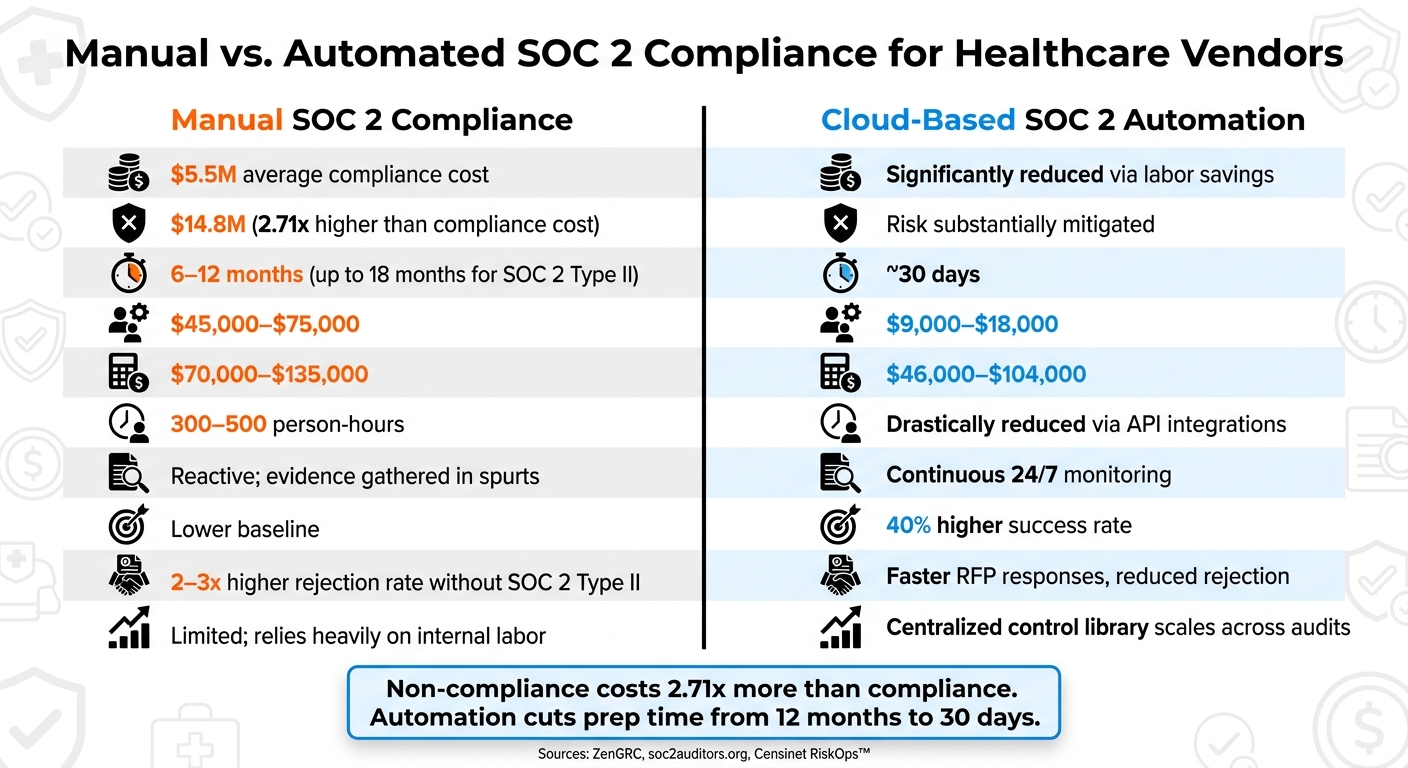
Manual vs. Automated SOC 2 Compliance: Cost, Time & Risk for Healthcare Vendors
Let's break down the differences between manual and automated approaches to SOC 2 compliance. Each has its advantages depending on the size and needs of the vendor. While manual processes allow for complete control over evidence preparation and crafting narratives, they can quickly become unmanageable as complexity increases.
For smaller vendors, manual compliance can be appealing due to the absence of platform costs. However, this method relies on gathering evidence from various sources, which can create bottlenecks as Protected Health Information (PHI) data grows and more health systems demand security reviews.
On the other hand, automation tackles these challenges by simplifying evidence collection and control management. Automated, cloud-based platforms continuously gather evidence, monitor controls 24/7, and store audit artifacts in a centralized, secure repository. Although these platforms require an upfront investment, the long-term savings in labor and the ability to handle multiple customer assessments simultaneously make them worthwhile. However, healthcare organizations must carefully assess automation vendors, ensuring they have SOC 2 certifications, proper data residency practices, and a Business Associate Agreement (BAA) in place before adoption.
Here’s a quick comparison of the two approaches:
| Dimension | Manual SOC 2 Compliance | Cloud-Based SOC 2 Automation |
|---|---|---|
| Efficiency | Requires significant person-hours to gather and manage evidence from multiple systems. | Streamlined workflows save time by automating evidence collection. |
| Security | Evidence stored in various locations increases risks like version drift and inconsistent access. | Centralized storage with encryption, access controls, and audit logs improves security. |
| Audit Readiness | Evidence is prepared at specific points in time, risking outdated information when auditors arrive. | Continuous evidence collection ensures the organization is always ready for an audit. |
| Scalability | Lower software costs but heavily reliant on internal labor, making scaling difficult. | Automation supports faster responses to RFPs and due diligence requests, enabling scalability. |
| Cost Structure | Low tool costs but higher internal labor and consulting expenses. | Subscription-based model reduces labor costs over time. |
For healthcare vendors managing PHI, automation not only simplifies SOC 2 compliance but also supports broader risk management strategies. Platforms like Censinet RiskOps™ integrate SOC 2 workflows with enterprise and third-party risk management processes. This integration minimizes redundant tasks and strengthens overall security, aligning control evidence with the security assessments that health systems often require during procurement.
Conclusion
Deciding between manual and automated SOC 2 compliance depends largely on where your organization is headed. For small vendors with minimal infrastructure and a limited number of customers, manual processes might suffice - at least initially. But as your product offerings expand and your customer base grows, especially with healthcare delivery organizations (HDOs) requiring more frequent and detailed security evaluations, manual methods can quickly become inadequate.
This is where cloud-based SOC 2 automation steps in, offering three core advantages. First, it makes your compliance efforts scalable by using a centralized control library that can be applied across multiple audits and customer assessments. Second, it improves your security readiness by enabling continuous control monitoring, helping you avoid the chaos of last-minute audit preparations. Third, it enhances your collaboration with HDOs by providing their security teams with faster and more consistent access to the evidence they need during procurement processes.
HDOs are increasingly under pressure to thoroughly vet their technology partners. Vendors who can respond to security questionnaires within hours - armed with up-to-date, well-organized evidence - stand out from those who take weeks to compile spreadsheets. Tools like Censinet RiskOps™ are designed for this exact challenge, offering streamlined third-party vendor risk management, cybersecurity benchmarking, and collaborative risk management tailored to sensitive areas like PHI, clinical applications, and medical devices.
To take advantage of these benefits, start by identifying the weak points in your manual processes - whether it’s in evidence collection, tracking controls, or responding to HDO requests. Then, choose an automation platform that integrates seamlessly with your existing cloud infrastructure and supports both HIPAA and SOC 2 frameworks. A phased approach, focusing on a single audit cycle or a core system, can help demonstrate the value of automation before scaling further.
The takeaway? Manual SOC 2 compliance is just the beginning - it’s not a sustainable solution. For healthcare vendors aiming to grow, secure their operations, and build trust with health systems, cloud-based automation is the way forward. It directly addresses the challenges of scalability, risk management, and the rigorous compliance standards that define today’s healthcare ecosystem.
FAQs
Which SOC 2 controls overlap most with HIPAA for healthcare vendors?
Around 60–70% of the controls in SOC 2 and HIPAA overlap. Key shared areas include access reviews, incident response, and data encryption. The SOC 2 Security and Confidentiality criteria align closely with HIPAA's safeguards for protecting PHI. Similarly, SOC 2 Privacy criteria support the standards set by the HIPAA Privacy Rule. Additionally, the Availability and Processing Integrity criteria in SOC 2 correspond to system reliability and accurate data processing requirements. This overlap allows vendors to simplify compliance efforts by using a unified set of controls.
What integrations should a SOC 2 automation platform support for my stack?
To streamline SOC 2 compliance, your platform needs to connect with tools that handle Protected Health Information (PHI) and manage security configurations effectively. Here's a breakdown of the essential integrations to prioritize:
- Cloud Providers: Ensure compatibility with platforms like AWS, Azure, and GCP to monitor and secure your cloud infrastructure.
- Identity Management Tools: Integrate with solutions such as Okta and Google Workspace to manage user access and authentication securely.
- EHR Systems: Platforms like Epic and Cerner are crucial for handling PHI within healthcare organizations.
- HR Platforms: Tools like Workday and Gusto help manage employee data and ensure compliance with workforce-related controls.
- Developer Tools: GitHub integration ensures secure code management and version control.
- SIEM Platforms: Real-time monitoring with tools like Splunk enhances your ability to detect and respond to security threats quickly.
By connecting with these tools, you can simplify workflows and maintain continuous compliance without the usual headaches.
Do I need a BAA to use SOC 2 automation for PHI-related evidence?
Yes, a Business Associate Agreement (BAA) is mandatory under HIPAA for healthcare vendors that handle Protected Health Information (PHI). SOC 2 automation platforms, such as Censinet RiskOps™, help ensure compliance by pinpointing vendors who deal with PHI and highlighting any missing or required BAAs. These agreements must be established before any data is shared, ensuring compliance with HIPAA and safeguarding sensitive information.
