
STRIDE Framework for Healthcare IT Threat Modeling
Post Summary
STRIDE is a threat modeling framework developed by Microsoft in 1999 that categorizes security threats into six types: Spoofing, Tampering, Repudiation, Information Disclosure, Denial of Service, and Elevation of Privilege. Unlike the standard CIA triad of Confidentiality, Integrity, and Availability, STRIDE adds Authentication, Non-repudiation, and Authorization — properties essential for healthcare accountability and legal compliance. In healthcare, STRIDE's additional properties matter because clinicians disputing responsibility for clinical actions, medical devices accepting data from unverified sources, and unauthorized users escalating access to clinical systems represent failure modes that the CIA triad alone cannot capture. The FDA's 2025 cybersecurity guidance requires systematic threat identification for medical device manufacturers, and STRIDE's traceability and documentation make it a compliance-aligned choice for satisfying these requirements and ISO 14971.
Spoofing involves an attacker impersonating a legitimate user, device, or service — such as stealing a clinician's credentials to access EHRs or sending false glucose readings to an insulin pump. Tampering involves unauthorized modification of data or code — such as altering dosage calculations in infusion pump software or modifying patient records. Repudiation involves denial of an action due to insufficient evidence — such as a clinician disputing responsibility for changing a medication setting without a tamper-evident audit trail. Information Disclosure involves exposure of PHI to unauthorized parties — such as unencrypted Bluetooth vitals intercepted by nearby devices. Denial of Service involves disrupting system availability — such as network flooding blocking critical patient alerts or battery draining rendering a portable medical device non-functional. Elevation of Privilege involves gaining higher access than authorized — such as a patient exploiting a vulnerability to view other patients' records or an attacker gaining admin access to a device management system.
A Data Flow Diagram maps four elements: external entities including patients, physicians, and third-party APIs; processes including authentication services, dosage calculators, and data synchronization tools; data stores including EHR databases, audit logs, and cloud storage; and data flows including HL7/FHIR feeds and Bluetooth sensor transmissions. Trust boundaries — points where data crosses different security zones — are the highest-priority focus areas because they represent the interfaces most frequently exploited by attackers. The interface between a patient-facing portal and a hospital's internal network is a critical trust boundary requiring explicit threat analysis. DFD creation requires collaboration across developers, architects, and clinical staff to ensure the diagram reflects both technical architecture and actual clinical workflows rather than an idealized system model.
The STRIDE-per-element method applies specific STRIDE categories to each DFD component type: external entities are primarily vulnerable to Spoofing and Repudiation; processes are exposed to all six STRIDE categories; data stores and data flows are at risk for Tampering, Information Disclosure, and Denial of Service. DREAD scoring — covering Damage potential, Reproducibility, Exploitability, Affected users, and Discoverability — provides a risk prioritization framework that accounts for healthcare-specific severity weighting. In healthcare IT, availability frequently takes precedence because system downtime can be life-threatening — a DoS attack blocking critical patient alerts should rank higher than a minor information disclosure incident regardless of CVSS severity scores. A risk matrix plotting likelihood against severity enables visual prioritization that guides resource allocation toward the most critical threats.
Spoofing is addressed through multi-factor authentication for clinician access and digital certificates for IoT device authentication — phishing attacks that increase click-through rates by 3 to 5 times make MFA a minimum required control for EHR access. Tampering is addressed through code signing for software and firmware updates, digital signatures for prescription data, HTTPS/TLS for data in transit, and cryptographic integrity checks. Repudiation is addressed through tamper-evident centralized audit logs and digital signatures for key clinical actions — recording who did what, when, and from where for patient safety investigations and regulatory compliance. Information Disclosure is addressed through AES-256 encryption at rest, TLS 1.3 in transit, and strict role-based access controls. Denial of Service is addressed through rate limiting, traffic filtering, fault-tolerant system design, and automatic recovery mechanisms. Elevation of Privilege is addressed through least-privilege access enforcement, application sandboxing for sensitive functions, and regular security audits.
STRIDE identifies threats but cannot on its own manage, track, and remediate them at the portfolio scale healthcare organizations require. Censinet RiskOps™ operationalizes STRIDE findings through automated risk detection using the Digital Risk Catalog™ of 50,000-plus vendor and product risk profiles — flagging missing BAAs and known exploits such as Log4j vulnerabilities that represent Information Disclosure risks. The Cybersecurity Data Room™ maintains an immutable record of all remediation efforts, directly addressing STRIDE's Repudiation category by ensuring audit trails cannot be disputed. Risk tiering categorizes third parties by business impact, clinical outcome risk, and PHI exposure — prioritizing the DoS and Tampering risks that STRIDE identifies as highest-consequence in clinical environments. Automated Corrective Action Plans identify security gaps and recommend fixes tailored to specific STRIDE vulnerabilities. Breach and ransomware alerts provide real-time notifications for active exploitation of threats that STRIDE modeling identifies as high-risk.
The STRIDE framework is a powerful tool for identifying and addressing security threats in healthcare IT systems. Created by Microsoft in 1999, STRIDE categorizes threats into six types: Spoofing, Tampering, Repudiation, Information Disclosure, Denial of Service, and Elevation of Privilege. It helps healthcare organizations systematically analyze vulnerabilities, prioritize risks, and implement safeguards, ensuring patient safety and compliance with regulations like the FDA’s 2025 cybersecurity guidelines.
Key Takeaways:
By focusing on structured threat identification and mitigation, STRIDE ensures healthcare IT systems remain secure, functional, and compliant.
STRIDE Framework Explained: How Cybersecurity Threats Impact Health IT
sbb-itb-535baee
What Is the STRIDE Framework?
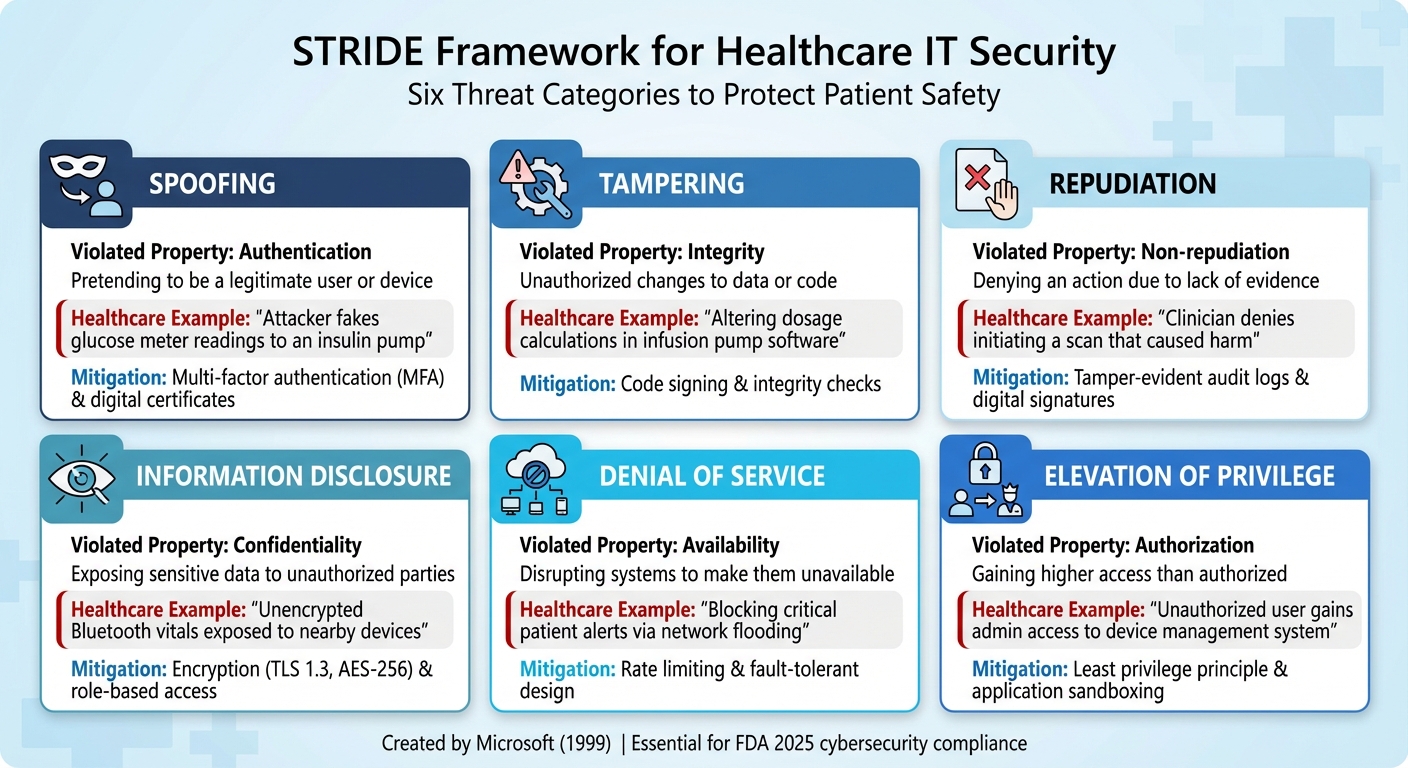
STRIDE Framework: Six Healthcare IT Threat Categories with Examples
STRIDE stands for six categories of security threats: Spoofing, Tampering, Repudiation, Information Disclosure, Denial of Service, and Elevation of Privilege. Each one targets a specific security property, giving healthcare IT teams a structured way to identify and address vulnerabilities in their systems. Here's a quick overview of what each category represents:
"STRIDE for medical devices differs from traditional IT threat modeling because it addresses unique healthcare challenges... where security failures can directly impact patient safety." - Cybermed.ai
Unlike the traditional CIA triad (Confidentiality, Integrity, Availability), STRIDE also includes Authentication, Non-repudiation, and Authorization - key elements for ensuring accountability and meeting legal standards in healthcare. By understanding these categories, teams can map threats to individual system components and prioritize their responses effectively.
STRIDE Category
Violated Property
Healthcare IT Example
Authentication
An attacker fakes glucose meter readings to an insulin pump
Integrity
Altering dosage calculations in infusion pump software
Non-repudiation
A clinician denies initiating a scan that caused harm
Confidentiality
Unencrypted Bluetooth vitals exposed to nearby devices
Availability
Blocking critical patient alerts via network flooding
Authorization
Unauthorized user gains admin access to a management system
Let’s dive into each threat category with examples specific to healthcare.
Spoofing
Spoofing happens when someone pretends to be a legitimate user, device, or service to gain access. In healthcare, this could mean stealing a clinician's login credentials to access Electronic Health Records (EHRs) or tricking a medical device into accepting fake data. For instance, an attacker might send false glucose readings to an insulin pump, leading to incorrect dosages.
Spoofing risks are growing, especially with phishing attacks that increase user click-through rates by 3–5 times [1]. To combat this, healthcare organizations should implement multi-factor authentication (MFA) and use digital certificates for secure device communication.
Tampering
Tampering refers to unauthorized changes to data or code, which can compromise the integrity of healthcare systems. This might involve altering patient records or modifying infusion pump instructions, potentially leading to dangerous outcomes.
To guard against tampering, organizations should use code signing for software updates and add integrity checks for patient data. Digital signatures can detect unauthorized changes to critical files or firmware, offering protection against both external and insider threats.
Repudiation
Repudiation arises when someone denies performing an action due to a lack of evidence. In healthcare, this could involve a clinician disputing responsibility for changing a medication setting or initiating a scan that caused harm. These situations highlight the need for robust audit trails.
"Repudiation threats in healthcare should focus on areas with 'monetary or legal impact to subverting the process.'" - MITRE Playbook for Threat Modeling Medical Devices
To mitigate these risks, healthcare systems should maintain tamper-evident, centralized audit logs and use digital signatures for key clinical actions. These logs ensure there’s a clear record of who did what, when, and from where - critical for patient safety investigations and regulatory compliance.
Information Disclosure
Information Disclosure happens when sensitive data, like Protected Health Information (PHI), is exposed to unauthorized parties. This could occur through unencrypted Bluetooth communications, insecure APIs, or poorly configured access controls.
Given the high value of healthcare data, attackers frequently exploit these vulnerabilities. To counter this, organizations should encrypt PHI both at rest and in transit using protocols like TLS 1.3. Strict role-based access controls can also minimize exposure risks, as even a single unencrypted Bluetooth connection can compromise patient confidentiality.
Denial of Service
Denial of Service (DoS) attacks disrupt systems, making them unavailable to legitimate users. In healthcare, this can have life-threatening consequences. For example, flooding a wireless network could block critical patient alerts, or draining the battery of a portable medical device could render it useless.
DoS attacks have become increasingly powerful - one attack in 2017 reached 167 million packets-per-second [1]. To reduce the impact, healthcare organizations should deploy rate limiting, traffic filtering, and design systems with fault-tolerance and automatic recovery. Unlike typical software outages, a DoS attack in healthcare can directly endanger lives.
Elevation of Privilege
Elevation of Privilege occurs when someone gains higher access than they’re supposed to have, violating authorization controls. For instance, a patient might exploit a vulnerability to view all records, or an attacker could gain admin access to a device management system. Such breaches are particularly dangerous because they can grant full control over critical systems.
To prevent this, healthcare organizations should enforce the principle of least privilege - giving users only the access they need - and use application sandboxing to isolate sensitive functions. Regular security audits can also help identify and fix vulnerabilities, ensuring attackers can’t escalate their access.
How to Apply STRIDE to Healthcare IT Systems
To effectively incorporate STRIDE into healthcare IT systems, a step-by-step approach is essential. Instead of attempting to model entire infrastructures at once, focus on specific workflows. This method ensures a manageable and actionable implementation process.
Step 1: Break Down Your System
Start by creating a Data Flow Diagram (DFD) to map how information moves through your system. Highlight four key elements:
Pay close attention to trust boundaries - points where data crosses different security zones. These are often high-risk areas. For instance, the interface between a patient-facing portal and a hospital's internal network is a critical trust boundary. Collaboration with developers, architects, and clinical staff is crucial to ensure the DFD reflects both the technical setup and actual clinical workflows.
Step 2: Map Threats to System Components
Use the STRIDE-per-element method to focus your analysis on relevant threats. Here's how it applies:
For example, when analyzing an EHR login process, evaluate the authentication service (a process) against all STRIDE categories. Meanwhile, the patient database (a data store) should be examined for risks like tampering, unauthorized access, and availability issues. This targeted approach minimizes unnecessary alarms and keeps attention on real vulnerabilities.
Step 3: Prioritize Risks
Once you've identified threats, rank them using the DREAD scoring model. In healthcare IT, availability often takes precedence since downtime can result in life-threatening situations. Use a risk matrix to weigh likelihood against severity. For instance, a denial-of-service attack that disrupts critical patient alerts should rank higher than a minor information disclosure incident. Proactive management is essential to taking the risk out of healthcare delivery.
Step 4: Implement Security Controls
Address identified vulnerabilities with specific security measures:
Keep your threat model up to date as new features are introduced, architectures evolve, or regulations change. For example, the FDA's 2025 cybersecurity guidance requires systematic threat identification for medical device manufacturers [3]. STRIDE's traceability and documentation make it an excellent choice for meeting these regulatory demands.
STRIDE Examples in Healthcare IT
Let’s take a closer look at how the STRIDE threat model applies to specific healthcare systems, highlighting the challenges and risks they face.
Electronic Health Records (EHRs)
EHR systems are particularly vulnerable to various STRIDE threats due to their complexity and sensitivity. Spoofing often targets login portals, where attackers use stolen credentials to gain unauthorized access to patient records. Phishing schemes are a common tactic, tricking users with fake login pages designed to steal usernames and passwords. Additionally, credentials can be intercepted on internal networks, exposing sensitive data.
"Medical data is extremely confidential, and subject to various regulations (i.e., HIPAA). There is a threat that users may access medical data of other users, through lack of access controls." - Nick, Author, Threat-Modeling.com
Information Disclosure is another major concern. Employees may inappropriately access records they aren’t authorized to view, or flawed access controls might allow patients to see data belonging to others via online portals. Attackers who infiltrate these systems can extract entire databases of patient information. Poorly configured third-party APIs further increase the risk by leaving communication channels unsecured. To address these issues, healthcare providers should implement strict role-based access controls and enforce multi-factor authentication across all access points. Since EHR vulnerabilities directly impact both data integrity and privacy, these measures are essential for protecting patient information.
IoT Medical Devices
IoT medical devices, such as insulin pumps and cardiac telemetry systems, bring their own set of challenges under STRIDE.
Tampering is a major risk for these devices. Attackers might modify firmware, alter software code, or change critical settings like dosage calculations in infusion pumps or alarm thresholds in monitoring systems. Wireless communication, particularly through Bluetooth Low Energy, is especially vulnerable. Intercepted data can be altered, leading to incorrect treatments or device malfunctions.
"A single failure can jeopardize patient safety and expose their confidential data." - Antoine Béland and Yanik Magnan, Tech Lead software developers, CLEIO
The FDA’s upcoming 2025 cybersecurity guidance requires medical device manufacturers to demonstrate thorough threat identification and risk management processes [3]. STRIDE plays a critical role here, helping teams identify tampering risks across devices, data flows, and system processes. Mitigation strategies include using code signing for firmware updates, performing cryptographic integrity checks on data in transit, and employing real-time monitoring to detect unauthorized changes. These threats not only endanger patient safety through compromised device functionality but also expose personal health data when connections like Bluetooth remain unencrypted, leaking information such as glucose levels or vital signs to nearby attackers.
Using Censinet RiskOps for STRIDE Threat Modeling
STRIDE offers a structured way to identify threats in healthcare IT systems, but Censinet RiskOps™ takes it a step further by providing the tools to manage, track, and address those threats efficiently. By replacing manual processes with automation tailored for healthcare, Censinet RiskOps ensures STRIDE's framework operates seamlessly in real-time environments [5].
RiskOps enhances STRIDE's systematic threat categorization with automated risk detection and management. For instance, during the threat-mapping process, Censinet's Digital Risk Catalog™ steps in with risk profiles for over 50,000 vendors and products. It even flags missing documentation, like Business Associate Agreements (BAAs), making it easier to spot vulnerabilities. This aligns perfectly with STRIDE's focus on targeted threat identification. Portfolio-wide filters further simplify the process by identifying known exploits, such as log4j vulnerabilities, which could lead to information disclosure. Additionally, the Cybersecurity Data Room™ keeps a comprehensive, unchangeable record of all remediation efforts, addressing concerns like repudiation by maintaining a clear audit trail.
"Censinet makes the entire risk assessment process significantly faster and easier for both HDOs and healthcare vendors." - Censinet
When it comes to prioritizing risks identified through STRIDE, the platform's risk tiering feature is invaluable. It categorizes third parties based on their potential impact on business operations, clinical outcomes, and patient health information (PHI) exposure. This approach ensures that resources are directed toward the most critical threats, such as denial-of-service attacks or tampering with medical devices. A 2022 Ponemon Institute report, sponsored by Censinet, highlighted the severe consequences of ransomware in healthcare, including higher patient mortality rates, delays in treatment, and longer hospital stays [5]. To combat such threats, Censinet provides breach and ransomware alerts that deliver real-time notifications, enabling healthcare organizations to respond swiftly.
Collaboration is another key strength of the platform. The collaborative risk network simplifies communication between healthcare organizations and their vendors during threat modeling. Vendors can complete risk assessments with a single click, and automated Corrective Action Plans (CAPs) identify security gaps while recommending fixes tailored to specific STRIDE vulnerabilities, such as tampering or privilege escalation. With over 100 healthcare providers and payers already using the Censinet Risk Network, delta-based reassessments now take less than a day [6]. This enables continuous monitoring of medical devices and supports compliance with FDA guidelines, reinforcing STRIDE's proactive approach to cybersecurity in healthcare.
Conclusion
The STRIDE framework redefines healthcare cybersecurity by moving the focus from reactive measures to a more structured, proactive approach. By breaking threats into six categories - Spoofing, Tampering, Repudiation, Information Disclosure, Denial of Service, and Elevation of Privilege - healthcare organizations can better safeguard patient data and clinical operations. Security breaches in this field aren't just about data loss; they can lead to serious consequences, like altered sensor readings on glucose meters or unauthorized changes to medication dosages in infusion pumps [3].
Implementing STRIDE early not only cuts down on costly fixes but also ensures compliance with critical regulations, including the FDA's upcoming 2025/2026 cybersecurity guidelines and ISO 14971 [1][3]. What makes STRIDE particularly impactful is its ability to turn the abstract question of "what could go wrong?" into a structured, actionable process.
Tools like Censinet RiskOps™ bring STRIDE to life by automating risk management tasks. The platform handles everything from risk assessments to vendor oversight while aligning with compliance standards such as HITRUST, SOC 2, and ISO 27001. Features like AI-driven risk scoring, automated incident detection, and immutable audit logs allow healthcare organizations to maintain ongoing threat monitoring. This aligns with FDA requirements and simplifies supply chain risk management.
FAQs
How do I pick the right workflow to model with STRIDE first?
Start by collecting detailed background information about the system. This includes understanding its architecture, data flows, and key components. Having a clear picture of how the system operates is crucial.
Next, create a Data Flow Diagram (DFD). This will help you visualize how data moves through the system, making it easier to identify potential vulnerabilities. A DFD provides a clear representation of the relationships between components and the paths data takes.
Once the system is mapped out, evaluate each component using the six STRIDE threat categories:
By using STRIDE, you can focus on the most critical workflows and prioritize addressing the most significant risks.
What’s the fastest way to build a Data Flow Diagram (DFD) for a healthcare system?
To quickly create a Data Flow Diagram (DFD) for a healthcare system using the STRIDE framework, start by gathering detailed background information about the system. This step is crucial to understand how data moves through the system. Once you have this information, construct the DFD to map out data flows. This visualization not only clarifies the system's structure but also helps pinpoint potential vulnerabilities, making the threat analysis with STRIDE more effective.
How can we keep STRIDE threat modeling current as devices, vendors, and regulations change?
To keep STRIDE threat modeling relevant, it’s important to take a flexible, ongoing approach. Regularly assess risks as new devices, vendors, and regulations come into play. Incorporate tools like Data Flow Diagrams (DFDs) during the design phase, and revisit your models to account for updates - whether it’s changes to HIPAA guidelines or advancements in IoT technology. Bringing together IT, clinical, and compliance teams ensures your models stay in sync with both operational goals and regulatory demands.
Related Blog Posts
- Best Practices for DevSecOps in Healthcare IT
- Best Practices for Simulating Medical Device Cyber Incidents
- STRIDE Threat Model for Clinical Applications
- Best Practices for Threat Modeling in Healthcare IT
{"@context":"https://schema.org","@type":"FAQPage","mainEntity":[{"@type":"Question","name":"How do I pick the right workflow to model with STRIDE first?","acceptedAnswer":{"@type":"Answer","text":"<p>Start by collecting detailed background information about the system. This includes understanding its <strong>architecture</strong>, <strong>data flows</strong>, and <strong>key components</strong>. Having a clear picture of how the system operates is crucial.</p> <p>Next, create a <strong>Data Flow Diagram (DFD)</strong>. This will help you visualize how data moves through the system, making it easier to identify potential vulnerabilities. A DFD provides a clear representation of the relationships between components and the paths data takes.</p> <p>Once the system is mapped out, evaluate each component using the <strong>six STRIDE threat categories</strong>:</p> <ul> <li><strong>Spoofing</strong>: Could an attacker impersonate someone else?</li> <li><strong>Tampering</strong>: Is the data or system at risk of unauthorized changes?</li> <li><strong>Repudiation</strong>: Can actions be falsely denied due to a lack of proper tracking?</li> <li><strong>Information Disclosure</strong>: Is sensitive data exposed to unauthorized parties?</li> <li><strong>Denial of Service</strong>: Could the system be overwhelmed or rendered unavailable?</li> <li><strong>Elevation of Privilege</strong>: Can a user gain unauthorized access to higher-level functions?</li> </ul> <p>By using STRIDE, you can focus on the most critical workflows and prioritize addressing the most significant risks.</p>"}},{"@type":"Question","name":"What’s the fastest way to build a Data Flow Diagram (DFD) for a healthcare system?","acceptedAnswer":{"@type":"Answer","text":"<p>To quickly create a Data Flow Diagram (DFD) for a healthcare system using the STRIDE framework, start by gathering detailed background information about the system. This step is crucial to understand how data moves through the system. Once you have this information, construct the DFD to map out data flows. This visualization not only clarifies the system's structure but also helps pinpoint potential vulnerabilities, making the threat analysis with STRIDE more effective.</p>"}},{"@type":"Question","name":"How can we keep STRIDE threat modeling current as devices, vendors, and regulations change?","acceptedAnswer":{"@type":"Answer","text":"<p>To keep STRIDE threat modeling relevant, it’s important to take a flexible, ongoing approach. Regularly assess risks as new devices, vendors, and regulations come into play. Incorporate tools like <strong>Data Flow Diagrams (DFDs)</strong> during the design phase, and revisit your models to account for updates - whether it’s changes to <strong>HIPAA</strong> guidelines or advancements in IoT technology. Bringing together IT, clinical, and compliance teams ensures your models stay in sync with both operational goals and regulatory demands.</p>"}}]}
Key Points:
Why does healthcare IT require STRIDE's extended threat categorization beyond the CIA triad and what makes security failures in this domain uniquely life-threatening?
- Healthcare security failures translate directly to patient harm — STRIDE for medical devices differs fundamentally from traditional IT threat modeling because security failures can directly impact patient safety. A Spoofing attack that sends false glucose readings to an insulin pump, a Tampering attack that alters dosage calculations in infusion pump software, or a Denial of Service attack that blocks critical patient monitoring alerts are not data protection failures — they are direct clinical safety failures with potential lethal consequences.
- CIA triad missing Authentication, Non-repudiation, and Authorization required for healthcare — The standard CIA triad of Confidentiality, Integrity, and Availability addresses data protection properties but does not capture the accountability properties — Authentication, Non-repudiation, and Authorization — that healthcare regulatory compliance and clinical accountability require. A clinician who denies initiating a scan that caused patient harm, a medical device that accepts data from an unauthenticated source, or an unauthorized user who accesses patient records through insufficient authorization controls represent failure modes that CIA triad analysis would not identify.
- Regulatory mandates requiring systematic STRIDE-aligned threat identification — The FDA's 2025 cybersecurity guidance requires medical device manufacturers to demonstrate thorough, systematic threat identification and risk management processes. ISO 14971 requires risk management throughout the medical device product lifecycle. STRIDE's structured documentation and traceability — mapping each identified threat to a specific system component, the security property it violates, and the controls addressing it — directly satisfies these regulatory evidence requirements in a way that ad hoc threat identification cannot.
- Proactive identification preventing costly post-market remediation — Implementing STRIDE during design and development identifies vulnerabilities when they are least expensive to address. Post-market discovery of security vulnerabilities in medical devices can require regulatory submissions, field corrections, and recall processes that cost orders of magnitude more than design-phase remediation. The FDA's emphasis on the Secure Product Development Framework reflects this economic reality — security embedded during design is fundamentally cheaper than security retrofitted after market release.
- 2017 DoS attack reaching 167 million packets-per-second establishing clinical availability stakes — The 2017 DoS attack that reached 167 million packets-per-second — in the same year that WannaCry disrupted 81 NHS hospitals — establishes that availability threats against healthcare infrastructure are not theoretical. STRIDE's explicit inclusion of Denial of Service as a threat category ensures that clinical availability risks receive the structured analysis that general security frameworks may weight less heavily than confidentiality threats.
- Phishing attacks increasing click-through rates 3 to 5 times establishing spoofing scale — The documented 3 to 5 times increase in user click-through rates from healthcare-targeted phishing attacks establishes that Spoofing threats — particularly credential theft enabling EHR access — represent one of the most actively exploited threat categories in healthcare IT. STRIDE's Spoofing category ensures these social engineering vectors receive explicit analysis rather than being absorbed into generic access control considerations.
How do the six STRIDE threat categories apply specifically to EHR systems and what controls address each?
- Spoofing in EHR systems: credential theft and phishing targeting login portals — EHR login portals are primary Spoofing targets because stolen clinician credentials provide access to complete patient record databases. Phishing attacks use fake login pages to steal usernames and passwords; credential interception on internal networks creates parallel exposure. MFA enforcement across all EHR access points is the minimum required Spoofing control, with digital certificates providing additional authentication assurance for system-to-system integrations.
- Tampering in EHR systems: record modification and API manipulation — Unauthorized modification of EHR records — altering diagnoses, medications, or clinical notes — represents a Tampering threat with both patient safety and medico-legal consequences. Poorly configured third-party APIs create Tampering exposure by leaving data modification pathways without integrity validation. Code signing for system updates and digital signatures for clinical documentation provide the integrity verification controls that address EHR Tampering risks.
- Repudiation in EHR systems: clinical action disputes requiring immutable audit trails — MITRE's Playbook for Threat Modeling Medical Devices recommends focusing Repudiation threat analysis on areas with monetary or legal impact to subverting the process — a standard that clinical documentation clearly meets. Tamper-evident, centralized audit logs recording who accessed or modified each record, when, and from where are the required Repudiation control, enabling patient safety investigations and regulatory compliance without dependence on individual recollection.
- Information Disclosure in EHR systems: inappropriate access and API misconfiguration — EHR Information Disclosure threats include employees accessing records they are not authorized to view, flawed access controls allowing patients to see other patients' data through online portals, and poorly configured third-party APIs creating unsecured communication channels. Role-based access controls enforcing the minimum necessary standard and AES-256 encryption for data at rest address the primary EHR Information Disclosure vectors.
- Denial of Service in EHR systems: availability disruption during clinical operations — EHR availability disruption during clinical operations forces healthcare providers to revert to paper-based fallback procedures that are slower, error-prone, and clinically risky. Rate limiting and traffic filtering provide the availability controls that STRIDE's DoS category identifies as required for EHR systems where downtime directly affects clinical operations.
- Elevation of Privilege in EHR systems: portal vulnerabilities and admin access exploitation — Patient portal vulnerabilities that allow a patient to escalate access and view other patients' records represent Elevation of Privilege threats with both clinical and regulatory consequences. Principle of least privilege enforcement — ensuring users have only the access their specific role requires — and application sandboxing for sensitive administrative functions address the EHR privilege escalation risks that STRIDE's analysis identifies.
How do the six STRIDE threat categories apply specifically to IoT medical devices and what makes these threats uniquely dangerous?
- Tampering in IoT devices: firmware modification and wireless communication interception — IoT medical device Tampering includes firmware modification, altered dosage calculations in infusion pumps, changed alarm thresholds in monitoring systems, and interception and alteration of Bluetooth Low Energy communication. A single Tampering failure can jeopardize patient safety and expose confidential data simultaneously — making Tampering the highest-consequence STRIDE category for connected medical devices. Code signing for firmware updates and cryptographic integrity checks on data in transit are the primary Tampering mitigations.
- Spoofing in IoT devices: false sensor readings and device identity attacks — Spoofing attacks against medical IoT devices can send false sensor readings — such as falsified glucose meter data to an insulin pump — causing incorrect clinical decisions or automated dosing responses. Digital certificates for device authentication and verification of data source authenticity before clinical action are required Spoofing controls for IoT medical devices whose outputs directly influence clinical treatment.
- Information Disclosure in IoT devices: unencrypted wireless communications — Unencrypted Bluetooth connections between medical devices and data aggregators create Information Disclosure exposure for any data in transmission range — including glucose levels, vital signs, and other clinically sensitive metrics that nearby attackers can intercept. TLS 1.3 for all device communications and elimination of unencrypted Bluetooth data transmission address the Information Disclosure risks that STRIDE analysis identifies in IoT medical device architectures.
- Denial of Service in IoT devices: battery draining and wireless flooding — DoS attacks against portable medical devices can drain battery power through continuous false wake requests, rendering devices non-functional at the moment they are needed. Network flooding attacks can block the wireless communications through which device alerts reach clinical monitoring systems. Fault-tolerant design, automatic recovery mechanisms, and battery management controls address the IoT-specific DoS attack vectors that STRIDE analysis surfaces.
- Elevation of Privilege in IoT devices: device management system compromise — Gaining admin access to a medical device management system enables an attacker to modify device configurations, disable security controls, or push malicious firmware updates across entire device fleets — a Privilege Escalation threat with fleet-wide clinical impact. Application sandboxing isolating device management functions and least-privilege enforcement for all device administration activities address the most consequential IoT Elevation of Privilege risks.
- FDA 2025 guidance requiring STRIDE-aligned threat identification for device manufacturers — The FDA's 2025 cybersecurity guidance requirement for medical device manufacturers to demonstrate thorough threat identification and risk management directly aligns with STRIDE's structured, component-by-component threat analysis methodology. Manufacturers using STRIDE can map each identified threat to the FDA's documentation requirements through STRIDE's built-in traceability — connecting threat identification to security property violation, affected component, risk score, and implemented control in a format that FDA reviewers and ISO 14971 assessors can evaluate.
How should organizations implement STRIDE threat modeling step-by-step and what common errors undermine the process?
- Step 1 — DFD construction requiring clinical workflow accuracy, not just technical accuracy — Creating an accurate Data Flow Diagram requires collaboration across developers, architects, and clinical staff to ensure that the diagram reflects how the system actually operates in clinical practice rather than how it was designed to operate. EHR systems frequently have access paths, data flows, and trust boundary crossings that clinical staff use routinely but that technical documentation does not reflect — and these undocumented flows are precisely the paths that Spoofing and Information Disclosure threats exploit.
- Step 2 — STRIDE-per-element method applying relevant categories to each component type — The STRIDE-per-element method prevents analysis paralysis by focusing threat identification on the categories most relevant to each component type: external entities for Spoofing and Repudiation; processes for all six categories; data stores and flows for Tampering, Information Disclosure, and DoS. Applying all six categories uniformly to every component without this filtering generates unmanageable threat lists that cannot be prioritized effectively.
- Step 3 — DREAD scoring with healthcare-specific availability weighting — DREAD scoring must weight availability risks more heavily in healthcare than in general IT environments because clinical downtime is life-threatening. A Denial of Service threat that interrupts critical patient monitoring for ten minutes has higher actual healthcare impact than a moderate information disclosure incident affecting non-emergency administrative data regardless of their equivalent DREAD scores under generic weighting.
- Step 4 — Security control specificity rather than generic recommendations — STRIDE threat models that identify threats precisely but specify controls only generically — "implement access controls" rather than "enforce MFA with hardware tokens for all EHR administrative access" — provide insufficient guidance for implementation teams and insufficient evidence for regulatory reviewers. Control specificity to the individual component and threat category identified is required for a STRIDE analysis that satisfies FDA and ISO 14971 documentation standards.
- Keeping threat models current as systems evolve — A STRIDE threat model created at initial system design that is never updated becomes a historical document rather than an active security management tool as new devices are integrated, vendors change, cloud architectures evolve, and regulations are updated. Threat models must be reviewed and updated whenever significant system changes occur — including new feature introductions, architectural changes, new vendor integrations, and regulatory updates — to remain accurate representations of current risk.
- Collaboration across IT, clinical, and compliance teams as the implementation prerequisite — STRIDE threat modeling in healthcare requires input from IT security teams who understand the technical attack surface, clinical staff who understand how systems are actually used, and compliance teams who understand which regulatory properties must be protected. Threat models developed by IT security alone will miss the clinical workflow insights that surface the most exploitable Spoofing and Tampering paths; those developed without compliance input will miss the Non-repudiation and Authorization properties that HIPAA and FDA regulations specifically require.
How does Censinet RiskOps™ extend STRIDE threat modeling from identification to continuous management at healthcare portfolio scale?
- Digital Risk Catalog™ surfacing vendor-specific STRIDE threats at intake — The Digital Risk Catalog™ of 50,000-plus vendor and product risk profiles enables healthcare organizations to identify STRIDE-relevant threats in third-party products before deployment — surfacing known exploits, missing security controls, and undocumented BAA gaps that manual vendor assessment would not detect at the speed that modern healthcare vendor portfolios require. Portfolio-wide filters identifying known exploits such as Log4j vulnerabilities directly surface Information Disclosure risks that STRIDE analysis would otherwise require manual discovery.
- Cybersecurity Data Room™ providing the immutable audit trail that Repudiation threats require — STRIDE's Repudiation category requires tamper-evident audit logs as its primary control — and the Cybersecurity Data Room™'s immutable record of all assessment and remediation activities directly satisfies this requirement at the organizational level. Clinical-level Repudiation controls address individual action disputes; the Cybersecurity Data Room™ addresses the organizational-level Repudiation risk of disputed vendor compliance assessments and remediation histories.
- Risk tiering prioritizing STRIDE findings by clinical impact — Censinet RiskOps™'s risk tiering categorizes third parties by business impact, clinical outcome risk, and PHI exposure level — translating STRIDE's threat categorization into the patient safety-weighted prioritization that healthcare availability requirements demand. DoS and Tampering threats affecting clinical systems receive higher priority than equivalent-severity threats affecting administrative systems, reflecting the availability weighting that STRIDE's healthcare application requires.
- Automated Corrective Action Plans converting STRIDE findings into tracked remediation — Automated CAPs generated from STRIDE-identified vulnerabilities assign specific remediation actions to responsible owners with documented timelines — converting the threat identification output of a STRIDE analysis into the actively managed remediation program that both patient safety and regulatory compliance require. Without this conversion, STRIDE analyses produce documentation that satisfies regulatory reviewers but does not reliably result in control implementation.
- Breach and ransomware alerts providing real-time response to DoS and Spoofing threats — Real-time breach and ransomware alerts address the active exploitation of DoS and Spoofing threats — the two STRIDE categories where time-to-detection most directly determines patient safety impact. A ransomware attack exploiting Elevation of Privilege to gain admin access before launching a DoS attack against clinical systems represents the highest-consequence combined STRIDE threat scenario in healthcare; real-time alerting provides the fastest possible response activation.
- Collaborative risk network enabling vendor STRIDE assessments at scale — The Censinet Risk Network of 100-plus healthcare providers and payers with delta-based reassessments taking less than a day enables STRIDE-aligned vendor assessments at the scale that healthcare vendor portfolios require. Single-click vendor risk assessments and automated CAPs for identified STRIDE vulnerabilities convert the continuous STRIDE monitoring requirement — keeping threat models current as vendors change — from a resource-intensive manual process into an automated operational function.
