
When healthcare supply chains fail, patient safety is at risk. Hospitals face unique challenges when ensuring critical supplies are delivered without disruption. This article highlights key metrics to measure and improve supply chain resilience, helping healthcare systems maintain operations during crises.
Key Takeaways:
- Time to Recovery (TTR): Tracks how quickly operations stabilize after disruptions.
- Inventory Stability: Focuses on maintaining safety stock and preventing shortages.
- Supplier Diversification: Reduces risks by relying on multiple suppliers.
- Order Fulfillment Continuity: Ensures consistent delivery of essential supplies.
- Visibility and Compliance: Real-time tracking and regulatory readiness are vital.
These metrics help healthcare organizations prepare for, respond to, and recover from supply chain disruptions while prioritizing patient care. Effective use of these tools can prevent delays in treatment and improve overall system reliability.
Summit on Resilient U.S. Medical Supply Chains
Key Metrics for Measuring Supply Chain Resilience
To effectively manage disruptions, it's essential to track metrics that offer insight into recovery and continuity. Resilience in supply chains isn't just about meeting delivery schedules - it's about how quickly operations bounce back, how well disruptions are absorbed, and what lessons are learned for future preparedness. Here's a closer look at the key metrics that help organizations navigate challenges.
Time to Recovery
Time to Recovery (TTR) measures how long it takes for operations to return to normal after a disruption, whether it's a supplier shutdown, a logistics bottleneck, or an unexpected spike in demand [4]. This works hand in hand with Time to Survive (TTS), which estimates how long operations can continue before reaching a critical failure point. Together, these metrics define the window for recovery efforts [3].
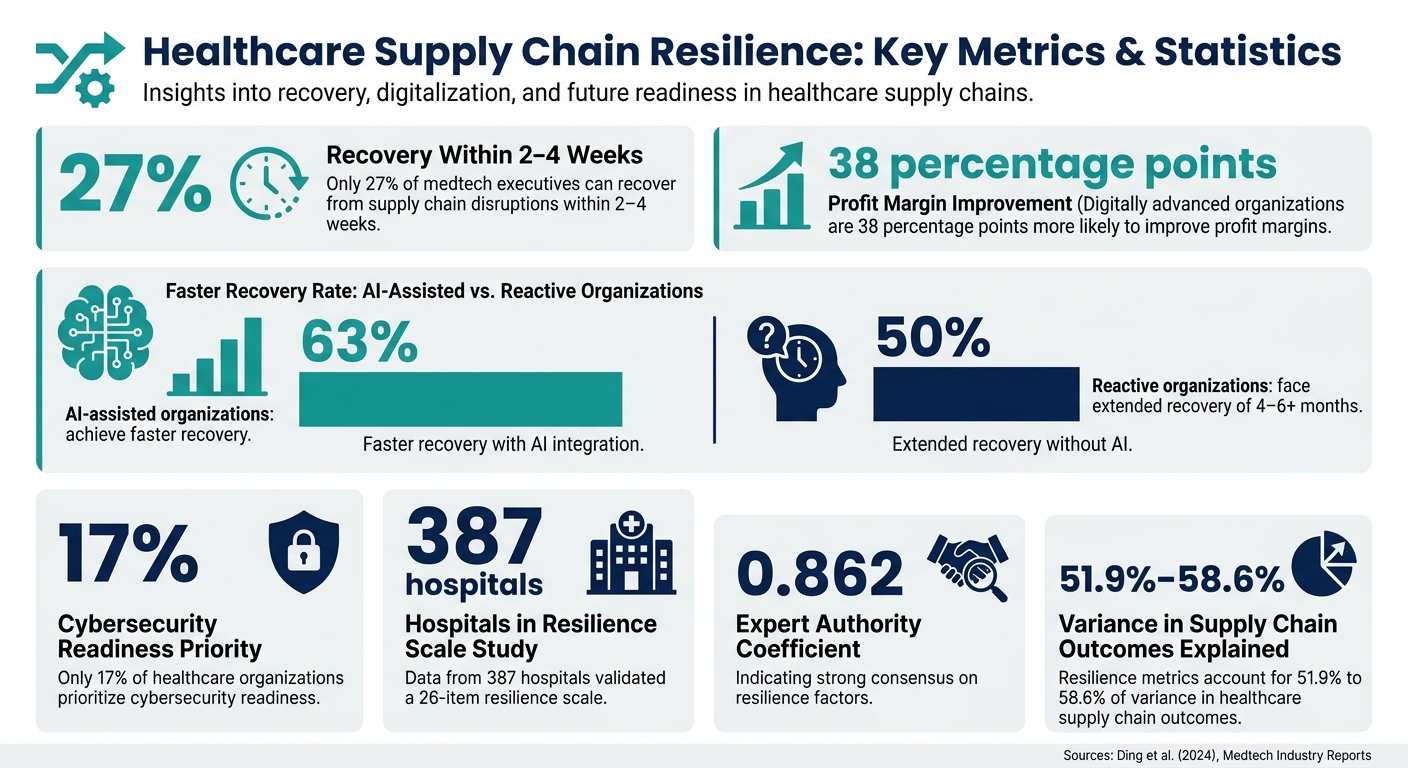
Interestingly, only 27% of medtech executives report being able to recover within two to four weeks. For most, recovery spans several months, underscoring the need for better preparation and faster response strategies [3].
Inventory Stability and Stockout Duration
Inventory stability hinges on maintaining redundancy. This includes Inventory Redundancy - having enough safety stock to handle disruptions - and Equipment Redundancy, which ensures backup resources are available for emergencies [1]. For example, hospitals often keep higher stock levels to cushion against supply chain shocks.
Stockout duration, on the other hand, reflects an organization's ability to identify vulnerabilities and prevent shortages. While inventory helps mitigate immediate risks, it’s the broader strategy, including supplier planning, that strengthens long-term resilience [1].
Supplier Diversification and Network Robustness
Supplier diversification is all about flexibility - how easily an organization can switch to alternative products or activate backup supply channels when needed [1]. Relying on a single supplier poses significant risks, especially during disruptions.
Network robustness takes this a step further, evaluating the stability of the entire supplier network. Even a seemingly diverse network can be fragile if key suppliers are concentrated in the same geographic area or share similar resource dependencies [1].
Order Fulfillment Continuity
Order fulfillment continuity measures an organization's ability to meet demand accurately and consistently under stress [2]. This metric is particularly critical in healthcare, where any lapse in fulfillment can directly affect patient care.
"Healthcare supply chain reliability and responsiveness are antecedents to healthcare supply chain costs and agility, which are antecedents to healthcare supply chain quality." - Pedro Senna et al., Production Journal [2]
By monitoring fulfillment rates during and after disruptions, hospital managers can pinpoint which parts of the recovery process are working well and which need attention.
Visibility and Compliance Indicators
Real-time visibility, enabled by integrated systems, is a cornerstone of supply chain resilience [1]. Two additional compliance indicators play a crucial role:
- Regulatory Readiness: The ability to adapt to changing legal requirements.
- Cybersecurity Readiness: Protecting the digital infrastructure that supports modern supply chains [3].
However, there's a glaring gap - only 17% of healthcare organizations currently prioritize cybersecurity readiness, leaving many exposed to potential threats [3]. This highlights a critical area for improvement in ensuring supply chain resilience.
Recent Findings from Healthcare Studies
Healthcare Supply Chain Resilience: Key Metrics & Statistics
Patterns and Trends in Supply Chain Resilience
A 2024 study by Baoyang Ding and colleagues introduced a 26-item scale designed to measure hospital supply chain resilience. This scale spans five dimensions: anticipation, adaptation, response, recovery, and learning. Data from 387 hospitals supported its development, with an expert authority coefficient of 0.862, indicating a strong agreement on the factors driving resilience [1].
The study highlights a shift from engineering resilience - focused on returning to pre-disruption conditions - to transformative resilience, which emphasizes using disruptions as opportunities for system improvement rather than simple restoration [6].
Digital maturity plays a key role in differentiating resilient supply chains. Digitally advanced organizations are 38 percentage points more likely to improve their profit margins. Additionally, those utilizing AI-assisted decision-making recover faster, with 63% achieving quicker recovery compared to 50% of reactive organizations, which often face extended recovery timelines of four to six months or more [3].
"AI's value is noise cancellation. You've got all these thousands of transactions going on in the world, but which are the critical few that my team needs to act on today?" - Peter Smith, Vice President for Global Supply Chain, Terumo Blood and Cell Technologies [3]
These insights provide a foundation for validating resilience strategies and pinpointing key operational factors.
Validation Approaches and Operational Factors
Researchers are leveraging these findings to validate resilience models and explore operational drivers of supply chain performance. Using Dynamic Capability Theory (DCT), they evaluate how organizations identify threats, seize opportunities, and reallocate resources effectively [1]. Studies employing PLS-SEM (Partial Least Squares Structural Equation Modeling) reveal that resilience metrics account for 51.9% to 58.6% of the variance in healthcare supply chain outcomes [5]. These figures highlight the practical relevance of resilience benchmarks.
On the operational front, two factors consistently stand out: supplier collaboration and technology integration. Research shows that reliability and responsiveness are critical to achieving supply chain agility and controlling costs. Together, these elements shape the overall quality of healthcare supply chains [5]. Organizations that formalize risk-sharing agreements and invest in integrated systems demonstrate a stronger ability to absorb disruptions and recover more efficiently [1].
"The pursuit of enhancing resilience within hospitals necessitates a thorough examination of their vulnerabilities and the identification of weaknesses in their resilience capabilities." - Baoyang Ding et al., Shandong University [1]
sbb-itb-535baee
Practical Applications of Resilience Metrics
Building a Post-Recovery Measurement Framework
Resilience metrics can be applied effectively using a five-dimension framework: Anticipation, Adaptation, Response, Recovery, and Learning. This framework helps track performance across all stages of a disruption - before, during, and after [1].
| Resilience Dimension | What to Measure |
|---|---|
| Anticipate | Vulnerability mapping, demand forecasting, risk-sharing agreements |
| Adapt | Supplier flexibility, inventory redundancy, personnel cross-training |
| Respond | Emergency response speed, real-time information sharing |
| Recover | Resource reconfiguration time, supply chain restructuring efficiency |
| Learn | Post-event review completion rate, training updates, process innovations |
The validated 26-item scale provides a solid foundation for benchmarking and tracking progress over time [1]. These insights feed directly into creating stronger continuity plans.
Using Metrics to Strengthen Continuity Plans
By integrating resilience metrics into continuity planning, organizations can focus on reliability and responsiveness, which are essential for managing costs and maintaining agility.
"Healthcare supply chain reliability and responsiveness are antecedents to healthcare supply chain costs and agility, which are antecedents to healthcare supply chain quality." - Santos et al. [5]
Structured post-event reviews are an effective way to identify and address gaps after disruptions or stockouts. These reviews should pinpoint failure points - such as supplier communication issues, insufficient inventory buffers, or flawed decision-making processes. Findings from these reviews can then be incorporated into updated emergency plans and staff training programs [1]. Additionally, formalizing risk-sharing agreements with suppliers, fostering inter-organizational learning, and setting clear escalation protocols can significantly enhance the network's ability to handle future challenges.
Leveraging Technology for Risk Management
Digital tools play a key role in making resilience metrics actionable. By integrating these metrics into real-time dashboards, teams can respond quickly and make informed decisions during disruptions. Dashboards that visualize KPIs allow managers to differentiate between proactive readiness and reactive recovery performance, eliminating the need to interpret complex data models [7].
Cybersecurity is another critical aspect of supply chain resilience. Solutions like Censinet help healthcare organizations evaluate vulnerabilities through cybersecurity benchmarking and collaborative risk management. Censinet RiskOps™ enables healthcare organizations to conduct third-party risk assessments, evaluate vendor security, and manage risks tied to medical devices, clinical applications, and supply chain partners. This supports quicker, more informed decisions during disruptions and strengthens overall risk management.
Conclusion: Strengthening Healthcare Supply Chain Resilience
Metrics for supply chain resilience provide a clear way to evaluate preparedness and recovery efforts. Instead of waiting for disruptions to reveal weaknesses, these metrics - spanning anticipation, adaptation, response, recovery, and learning - help managers identify potential issues before they escalate. This shift toward proactive tracking ensures vulnerabilities are addressed early.
A validated 26-item scale highlights how multi-dimensional resilience models can uncover critical gaps [1]. These metrics also enable hospitals to compare their performance with industry peers, turning abstract concepts into actionable insights. As Baoyang Ding and colleagues from the Centre for Health Management and Policy Research explain:
"The multi-dimensional scale offers hospital managers a valuable tool to identify areas needing attention and improvement, benchmark resilience against their counterparts, and ultimately strengthen their supply chains against unexpected risks." [1]
This approach is especially crucial for the learning dimension, which focuses on using post-event feedback and targeted training to improve how organizations respond to future disruptions. Together, anticipation, adaptation, response, recovery, and learning form the foundation of a strong healthcare supply chain strategy.
Operational inefficiencies in healthcare don't just affect logistics - they can directly impact patient safety. By adopting these focused and practical metrics, healthcare organizations can refine their recovery processes and better protect patient care.
FAQs
How do I calculate Time to Recovery (TTR) for a hospital supply chain?
Time to Recovery (TTR) refers to the amount of time it takes to completely restore operations after a disruption in the supply chain. Calculating TTR involves tracking the period from when the disruption is first detected to when all affected systems are fully operational again.
To make this metric meaningful, it’s important to focus on critical supplies - such as life-saving medications - and measure TTR at the SKU level. Tools like Censinet RiskOps™ can assist in evaluating risks and enhancing your supply chain’s ability to recover and adapt more effectively.
What’s the best safety-stock level to prevent stockouts without overspending?
To effectively manage clinical needs while keeping costs in check, it's essential to set safety-stock levels based on how critical an item is. For instance, higher stock levels should be maintained for indispensable supplies like medications to prevent any interruptions in care.
Here’s how to approach this:
- Rank items by importance: Prioritize supplies based on their impact on patient safety.
- Monitor key supplies daily: Keep a close eye on critical inventory to avoid shortages.
- Adapt to trends: Adjust stock levels by considering supplier reliability and recent demand patterns.
Using tools such as Censinet RiskOps™ can streamline this process by evaluating vendor performance, ensuring your inventory strategy stays aligned with clinical priorities.
Which resilience metrics should be on a real-time dashboard during a disruption?
A real-time dashboard during a disruption should zero in on metrics that highlight operational stability and recovery progress. Key indicators to watch include Time-to-Recover (how quickly operations return to full capacity) and Time-to-Survive (how long inventory can sustain operations).
Other critical metrics to track are:
- Canceled procedures: The number of operations or services halted due to disruptions.
- Stockouts: Instances where inventory runs out.
- Delivery delays: How often and by how much shipments are delayed.
- Emergency costs: Unexpected expenses incurred to address the disruption.
- Revenue loss: Financial impact due to the interruption.
Additionally, keeping an eye on Mean Time to Remediate, System Recovery Time, and Business Continuity Plan Activation Success Rate can provide a clear picture of how well the system is handling and recovering from the disruption. These metrics collectively offer valuable insights into the overall resilience and efficiency of recovery efforts.
