
If a hospital can’t get vendors moving after an outage, recovery slows down, PHI stays at risk longer, and care can take a direct hit.
I’d sum up the article like this: post-incident recovery depends on clear vendor ownership, fast reporting, safe system restore, and contracts that set hard recovery targets. In healthcare, that means business associates, cloud providers, EHR vendors, MSSPs, device makers, clearinghouses, and supply chain partners all need assigned jobs before an event happens.
Here’s the short version:
- Know which vendors are in scope for PHI, clinical systems, billing, devices, and supply chain
- Set duties in advance so teams don’t lose time sorting out ownership mid-crisis
- Require incident notice fast, even though HIPAA allows up to 60 days for breach notice after discovery in some cases
- Preserve evidence before restore, including logs, system images, access records, and backup checks
- Restore safely, with clean images, patches, credential resets, certificate updates, malware scans, and integrity checks
- Bring vendors into incident command, downtime procedures, and offline communications
- Plan for backlog cleanup, including paper orders, claims, lab results, and handwritten records
- Put RTOs, RPOs, drills, and log-retention rules into contracts
- Score vendor performance with metrics like time to notify, MTTR, RTO hit rate, restore validation pass rate, and corrective action closure
- Review results after every major event, because ransomware can cut hospital volume by 17% to 26% in the first week and downtime can cost about $1.9 million per day
A quick way to think about it: vendors don’t just help after an incident - they often control the systems you need to bring back first. So if you want recovery to move with less confusion, you need roles, contacts, backup rules, test plans, and reporting terms written down ahead of time.
That’s the core of the article, and the rest explains who does what, what they should deliver, and how I’d track whether they did the job well.
After the Breach Navigating the Fallout of Healthcare Data Compromises
sbb-itb-535baee
Third-party responsibilities during post-incident recovery
Once responsibilities are clear, third-party vendor risk management moves from planning into action. After containment, vendors need to do three things well: report what happened, preserve evidence, and bring services back in a safe state.
Incident reporting, PHI breach notice, and evidence sharing
Under HIPAA, business associates must notify the covered entity of a security incident without unreasonable delay and, if the event involves a breach of unsecured PHI, no later than 60 days after discovery.[9][10]
A useful notice isn't vague. It should spell out:
- the scope of the incident
- the systems affected
- the known or likely impact on PHI or clinical operations
- the actions already taken
- the current limits of the investigation[9][12]
Not every incident turns into a breach. That's why vendors need to keep the covered entity updated as the facts change.
Evidence preservation matters just as much. Vendors should keep logs, system images, indicators of compromise, access records, backup integrity details, and any configuration changes made during response. If a system is deleted or reimaged before that evidence is preserved, it can hurt legal review, compliance work, and insurance follow-up.[12]
Only after the evidence is secured should restoration start.
Restoring systems, integrations, and secure configurations
Technical recovery has to be safe, not just fast. Vendors are responsible for rebuilding from clean images, reapplying patches, rotating credentials, reissuing certificates, and checking security baselines before any service reconnects to production. The point is simple: don't bring a risky system back online and create more trouble for clinical workflows.[2][5]
Medical devices need extra care. Coordinate with the manufacturer before applying patches or changing configurations, and document every restoration step that could affect device performance or patient safety.[6][7]
A system can look functional and still be unsafe to reconnect. Before business-owner signoff, vendors should complete malware scanning, integrity checks, interface testing, and access verification.[2][5] Backup validation and routine restore testing also support this work.
Table: Recovery duties by vendor type
| Vendor Type | Reporting | Technical Recovery Tasks | Restore Support | Root-Cause Review |
|---|---|---|---|---|
| EHR/cloud vendor | Notify the covered entity of breaches and security incidents promptly[9] | Restore hosted environments, application access, integrations, and secure configurations[2][5] | Validate backup integrity; restore data and interfaces[2][11] | Provide logs, timelines, and remediation details[12] |
| MSSP | Report detections, containment actions, and indicators of compromise; escalate quickly[12][13] | Assist with containment, monitoring, eradication, and hardening[11] | Support forensic verification of restored systems[12] | Contribute telemetry, alerts, and lessons learned[12] |
| Medical device vendor | Coordinate incident and vulnerability reporting; support safe remediation[6][7] | Verify device connectivity, firmware, and safe operation before reuse[6][7] | Restore device-related data or interfaces when applicable[3][6] | Explain device-specific root causes and remediation limits[3][7] |
| Supply chain partner | Report disruptions affecting delivery, logistics, or connected systems[12] | Verify order fulfillment, inventory status, and continuity of consumables or replacement parts[5] | Reconcile disrupted records and transactions[12] | Help identify downstream service disruptions[12] |
These duties work best when they line up with clinical downtime procedures and supply chain recovery workflows.
Coordinating recovery across clinical operations and the supply chain
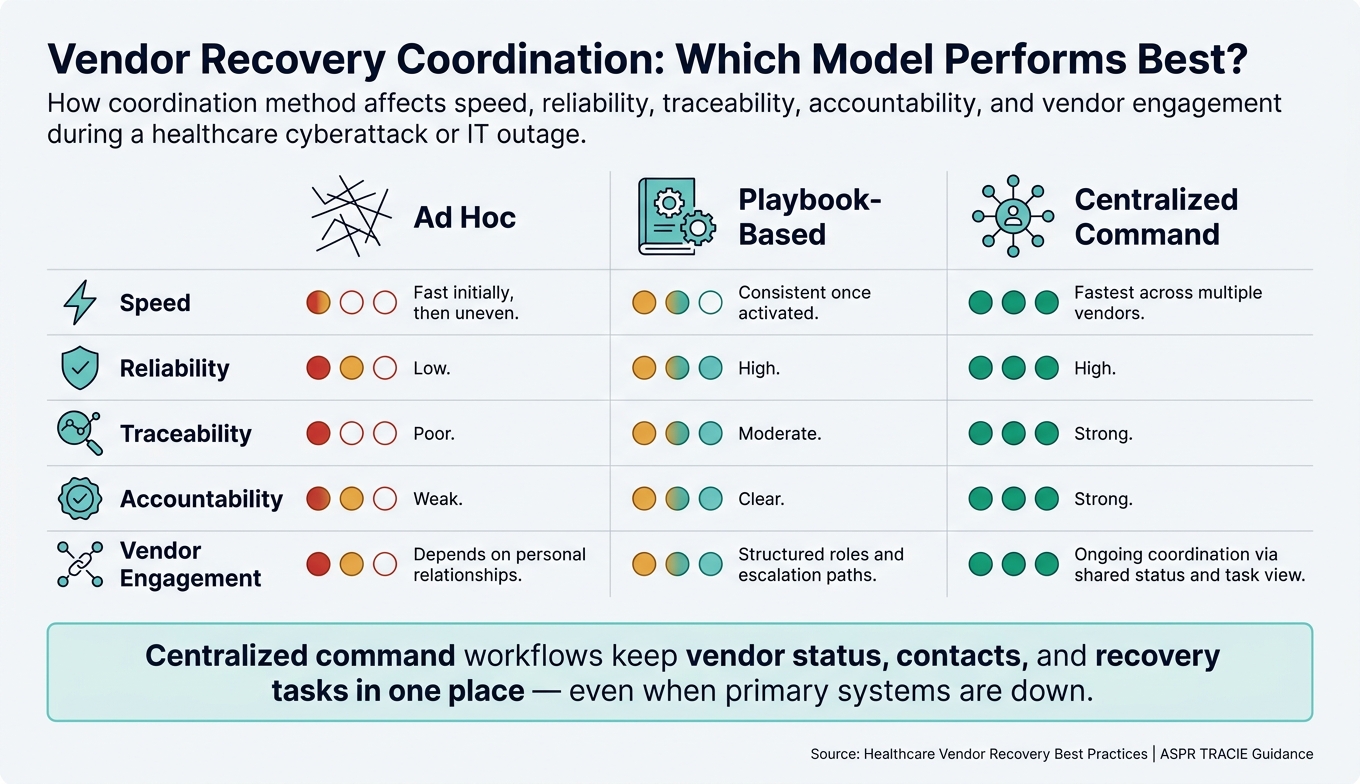
Vendor Recovery Coordination Methods: Speed, Reliability & Accountability Compared
When a cyberattack or major IT outage hits, the damage doesn’t stay in one lane for long. Pharmacy, lab, imaging, scheduling, procurement, and bed management can all get hit at the same time. And once that happens, one of the toughest parts of recovery is keeping vendors lined up across all of those functions while patient care stays safe.
Aligning vendors with downtime procedures and incident command
Third-party vendors can’t sit on the sidelines during an incident. They need a clear place inside the incident command structure. In practice, that means assigning a vendor liaison or downtime coordinator who reports into incident command and handles vendor communication during the event.[1][19][21] That role becomes even more important when downtime procedures have to work across several vendors at once.
Each critical clinical workflow should have a written downtime procedure that spells out which vendors it depends on. That includes medication ordering and dispensing, lab results, imaging, surgical scheduling, and patient registration.[1][15] Vendors help keep those workflows moving by supplying downtime reports or static exports, such as patient lists, active orders, and medication administration records.[14][1][18]
The procedure alone isn’t enough. You also need a communication plan that still works if your main email system is down. That can include:
ASPR TRACIE recommends storing vendor contact details and on-call schedules outside affected systems.[22] It also helps to preassign authority for isolation, downtime activation, restoration, and return to service.[1]
Drills matter here. A lot. Vendors should join exercises built around multi-day or multi-week outages, not just brief interruptions. HHS ASPR TRACIE guidance recommends planning to operate without technology for up to 4 weeks.[24]
Managing supply chain disruption and backlogs
That same command structure also needs to cover procurement, deliveries, and backlog recovery. When the Change Healthcare cyberattack hit in February 2024, providers and pharmacies had to fall back on paper transactions and alternate clearinghouses while systems were offline.[26] One provider manually posted more than $40 million in cash during recovery before claims processing was restored through a new clearinghouse in 8 days.[25]
Then comes the next hard part: the backlog. Once systems are back, paper orders, handwritten medication administrations, and lab results written on forms all have to be checked, matched, and entered into the EHR the right way. Vendors have a direct role in that work. They help confirm that each entry is linked to the correct encounter, timestamped properly, and visible in downstream systems.[1][19]
Table: Vendor recovery coordination methods compared
Different coordination models lead to very different recovery outcomes.
| Coordination Method | Speed | Reliability | Traceability | Accountability | Vendor Engagement |
|---|---|---|---|---|---|
| Ad hoc | Fast initially, then uneven | Low | Poor | Weak | Depends on personal relationships[4][17][20] |
| Playbook-based | Consistent once activated | High | Moderate | Clear | Structured, with defined roles and escalation paths[1][15][21] |
| Centralized command | Faster to coordinate across multiple vendors | High | Strong | Strong | Ongoing coordination through a shared status and task view[22][23] |
Centralized workflows make it easier to keep vendor status, contacts, and recovery tasks in one place, even when primary systems are down.[22][23] The next step is to put those duties into contracts and tie them to measurable recovery targets.
Contracts, governance, and metrics for vendor recovery readiness
After recovery roles are assigned, the next step is simple: put them into contracts and measure them. That’s what turns a vendor’s recovery role from a nice idea into something the HDO can enforce.
Recovery terms to define in BAAs and service agreements
HIPAA requires business associates to notify a covered entity of a breach of unsecured PHI without unreasonable delay and no later than 60 calendar days after discovery.[30][9] Many organizations shorten that window in their BAAs by requiring an initial notice within 24 hours and a more detailed follow-up within 72 hours, in line with HIPAA and any state-law rules that apply.[27][29][28] Shorter notice windows give the HDO more time to meet its own reporting duties.
The contract should also state exactly what the vendor has to include in that notice. At a minimum, that usually means:
- The date the incident happened
- The date it was discovered
- The types of PHI involved
- The number of people affected
- Steps already taken to limit harm
- A contact person for follow-up[30][27][32]
This is where vague wording causes trouble. Terms like "undefined notice language" leave too much room for delay and confusion.
Contracts should also define RTOs and RPOs based on system criticality. Core EHR functions may need much faster recovery targets than nonclinical tools.[31][33] On top of that, vendors should be required to maintain immutable or geographically redundant backups, validate restores, and take part in joint disaster recovery exercises before full production use.[27][34][37] It also helps to require log preservation, root-cause support, and timely completion of corrective actions.[27][38]
Once those terms are on paper, the next job is to check whether vendors are living up to them.
Measuring vendor recovery performance with practical metrics
Good metrics show whether a vendor can restore clinical operations on time without adding new risk. Mean Time to Recovery (MTTR) is a common starting point.[36] But MTTR alone doesn’t tell the whole story.
Organizations should also track time to notify, outage duration from the HDO’s point of view, and whether actual data loss stayed inside the contracted RPO.[33][35] Those numbers show not just how long the vendor was down, but what the outage meant for care delivery and business operations.
It also makes sense to track overtime, delayed revenue, and workaround costs. That ties vendor recovery performance to day-to-day operational impact instead of keeping the discussion stuck in IT-only terms.
Table: Key metrics for scoring vendor recovery performance
Use the metrics below in scorecards and renewal reviews.
| Metric | What It Measures | Target Benchmark |
|---|---|---|
| Time to Notify | Interval from vendor incident discovery to HDO notification | ≤24 hours (initial); ≤72 hours (detailed follow-up)[27][29][28] |
| Time to Restore (MTTR) | Average time from failure detection to full service restoration | Aligned to contracted RTO per system tier |
| RTO Achievement Rate | % of incidents/tests meeting the contracted RTO | Track against contracted RTO per system tier |
| Recovery Point Achievement | Actual data loss vs. contracted RPO | Within contracted RPO |
| Validation Pass Rate | % of restorations passing integrity checks | Flag recurring failures; track trend |
| Exercise Participation Rate | % of scheduled DR drills and tabletops vendor attended | 100% for critical vendors |
| Corrective Action Completion | % of post-incident remediation items closed within agreed timelines | Track to closure; escalate overdue items |
Risk committees, cybersecurity councils, and IT steering groups should review these metrics on a set cadence, not only after something goes wrong. Missed RTOs, skipped exercises, and overdue corrective actions should feed into scorecards and renewal decisions.
Using Censinet to strengthen third-party recovery oversight
Those recovery scorecards need a clear home after an incident ends. Spreadsheets and email make follow-up slow and messy. Once vendor recovery metrics are set, teams need one place to handle reassessment, remediation, and follow-up.
Using Censinet RiskOps™ to assess and track vendor recovery readiness
Censinet RiskOps™ brings third-party recovery assessments into one workflow, documents vendor obligations before an incident, and tracks readiness gaps across clinical applications, PHI systems, medical devices, and supply chain vendors.
One health system cut assessment cycle time from more than 40 days to fewer than 5 days.[42] That kind of speed matters when a vendor needs to be reassessed fast after an incident.
Once readiness is assessed, the next step is moving findings into incident follow-up.
Using monitoring and workflow data to improve post-incident response
After restoration, the work shifts to reassessment and follow-up. Censinet AI™ helps move that process along by letting vendors complete security questionnaires in seconds, automatically summarizing vendor evidence and documentation, capturing product integrations and downstream dependencies, and writing risk summary reports based on assessment data.[43][44] Automated workflows then send findings straight into a risk register, where ownership, timelines, and remediation steps are tracked through resolution.[41]
Vendor questionnaires in the Censinet network are often pre-completed, with response times as fast as one day.[45][43] In the middle of an active disruption, that speed can make a big difference when you're trying to confirm a vendor's recovery readiness.
Conclusion: Defined vendor roles reduce recovery delays and patient care risk
When recovery data, ownership, and remediation sit in one workflow, vendors are easier to manage under pressure. The main point is simple: define vendor roles before an incident so recovery can move faster after one.
That means a few things:
- Third-party roles should be clearly defined
- Recovery duties should be written into contracts
- Vendors should take part in drills
- Performance should be measured after every major event
The stakes are high. Ransomware attacks can reduce hospital volume by 17–26% in the first week[39][40] and drive average downtime costs of $1.9 million per day.[8] When vendor recovery obligations are vague, patient safety is on the line. Organizations with structured vendor recovery programs, backed by steady assessment and monitoring, are in a much better spot to restore clinical services faster and protect the patients who depend on them.
