
Supply chain disruptions in healthcare can directly impact patient safety and clinical operations. Clear and timely communication is essential to manage these crises effectively. Here’s what you need to know:
Start by forming a crisis communication team, creating scenario-based playbooks, and testing your plans through tabletop exercises. Proactive planning and clear communication can help protect patients and maintain trust during disruptions.
Principles of Supply Chain Crisis Communication
5 Key Principles of Healthcare Supply Chain Crisis Communication
Crisis Communication Principles
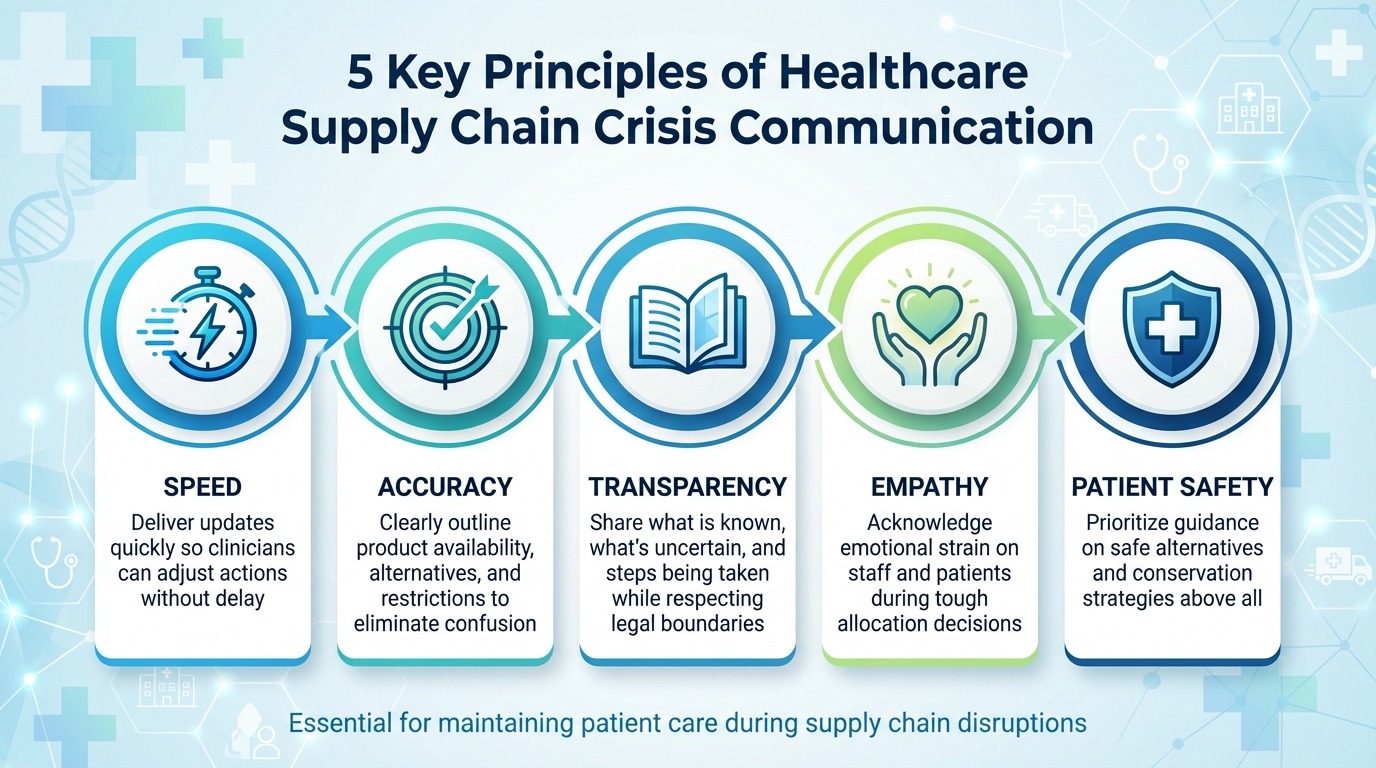
Clear and timely communication is essential to maintaining patient care during supply chain disruptions. In healthcare, effective crisis communication relies on five key principles: speed, accuracy, transparency, empathy, and patient safety. Speed ensures clinicians receive updates quickly, allowing them to adjust their actions without delay. Accuracy eliminates confusion by clearly outlining product availability, alternative options, and any restrictions. Transparency fosters trust by sharing what is known, what remains uncertain, and the steps being taken - while respecting legal and contractual boundaries. Empathy acknowledges the emotional strain on staff and patients during tough allocation decisions, helping to preserve morale and trust. Above all, every communication must prioritize patient safety by providing guidance on safe alternatives and conservation strategies.
Balancing transparency with confidentiality requires clear protocols to distinguish operational information that can be shared from protected data. For instance, it’s appropriate to inform stakeholders that a specific product type, like a certain model of N95 respirators, is on backorder and provide conservation steps. However, this should exclude sensitive details such as patient identifiers or proprietary data. Internal communications to care teams should only include the minimum necessary protected health information and must be shared through secure, HIPAA-compliant channels. Meanwhile, external communications - whether to the public or media - should be carefully reviewed by legal, compliance, and supply chain leadership to avoid breaching business agreements while remaining honest about the situation and mitigation efforts. Many U.S. health systems embed these practices into their Emergency Operations Plans, using pre-approved language vetted by legal and privacy teams.
Hospitals can operationalize these principles by establishing predefined communication channels and assigning specific roles within their Emergency Operations Plans. This includes setting clear triggers for alerts, identifying message approvers, and using tools like email, SMS, intranet systems, paging, or incident command platforms to reach targeted audiences. Keeping updated contact lists for key stakeholders - both internal and external, such as distributors, group purchasing organizations, and local emergency management agencies - ensures swift coordination. Standardized message templates for common supply chain issues can be quickly tailored to specific scenarios, reducing response time and minimizing errors. Leveraging real-time data from inventory and logistics systems helps ensure that communications reflect accurate stock levels, burn rates, and delivery timelines. Regular drills and tabletop exercises simulating supply shortages allow organizations to test and refine their communication strategies, incorporating lessons learned from after-action reviews.
These operational procedures must align with federal standards and governance protocols to ensure compliance and effectiveness.
Regulatory and Governance Requirements
Effective crisis communication during supply chain disruptions must also adhere to federal guidance and governance standards. U.S. healthcare organizations are guided by several federal entities, including the Department of Health and Human Services (HHS) and the Assistant Secretary for Preparedness and Response (ASPR). These agencies provide frameworks for healthcare system preparedness, emphasizing coordination with Healthcare Coalitions and outlining expectations for communicating shortages, conservation measures, and crisis standards of care across facilities and with distributors. The Food and Drug Administration (FDA) also plays a critical role, issuing notifications about drug and device shortages, Emergency Use Authorizations, and safety advisories. Hospitals must quickly translate these directives into actionable internal guidance for clinicians and clear external messaging when patient care is impacted. Referencing official federal directives in communications enhances both credibility and compliance.
Emergency Operations Plans should clearly define when and how to activate supply chain incident protocols. Triggers might include critical stock levels falling below a set threshold, vendor outages, or FDA recalls. These plans should also establish the structure of the Incident Command System, with roles like Public Information Officer and Supply/Logistics Chief clearly outlined. Communication objectives should be tailored to each phase of the crisis, with audience-specific plans and backup communication methods in case primary systems fail. Additionally, these plans must align with supply chain contracts, vendor communication protocols, and IT downtime procedures, ensuring that roles and message pathways are pre-established and well-practiced.
Integrating crisis communication with third-party risk management is essential for addressing disruptions caused by vendors, logistics partners, or cyber incidents. Maintaining an up-to-date vendor inventory that maps critical supplies and services to specific vendors, contract terms, geographic risks, and vulnerabilities allows teams to quickly identify affected products, sites, and services. Risk management frameworks should define expectations for information sharing during incidents, such as timely updates, root-cause analyses, and recovery timelines, and outline how this information is translated into internal alerts and external statements. Platforms like Censinet RiskOps™ can centralize third-party and cyber risk data, enabling crisis teams to assess risks, prioritize communication, and coordinate with vendors on recovery efforts - all while maintaining security and compliance standards.
Building a Crisis Communication Framework
When supply chain disruptions threaten patient care, having an effective crisis communication framework in place is not just helpful - it's essential. To navigate these challenges, healthcare organizations need a well-defined structure integrated into their existing systems. One way to achieve this is by incorporating supply chain crisis communication into the Hospital Incident Command System (HICS). This ensures that supply chain issues are escalated and managed alongside clinical and operational incidents, creating a unified response.
The framework should include clear ownership of responsibilities, decision-making protocols, activation criteria, and step-by-step workflows. It should also document procedures and identify the communication tools to be used. By aligning supply chain communications with incident action plans, situation reports, and briefing schedules, organizations can ensure that their responses are both timely and effective. A strong framework, combined with a focused team and communication strategy, lays the foundation for managing crises effectively.
Assembling the Crisis Communication Team
With the framework in place, the next step is to assemble a skilled and prepared team. A multidisciplinary approach works best, with roles and backups pre-assigned to ensure seamless operations. Key team members typically include:
Additionally, appoint a vendor liaison to manage communication with distributors, group purchasing organizations, and manufacturers. This ensures that external partners are kept in the loop and can support the organization’s needs during a crisis.
Developing Stakeholder Communication Plans
A strong communication strategy starts with a comprehensive stakeholder registry. This should include primary contacts, preferred communication channels, and key details for both internal and external stakeholders. Internally, this might involve clinicians, perioperative teams, emergency departments, materials management, IT, finance, and executive leadership. Externally, it should cover distributors, manufacturers, regulatory agencies, partner hospitals, payers, patients and families, and even community organizations. Don’t forget less obvious groups like home health providers, ambulatory clinics, environmental services, and contracted service vendors.
For each stakeholder group, outline what information they need, how often they need updates, and the best channels to reach them. For instance, clinicians may require detailed instructions on product substitutions, while patients and families need clear, reassuring updates about how changes might affect their care. Vendors and distributors may need data on demand forecasts, while regulators often expect concise summaries paired with mitigation plans. Using standardized templates - for clinician bulletins, vendor updates, or patient FAQs - can help streamline communication and maintain consistency as the situation evolves.
Creating Scenario-Based Communication Playbooks
Scenario-based playbooks are a practical tool for ensuring a quick and coordinated response to various crises, such as drug shortages, product recalls, logistics issues, or cyberattacks. These playbooks provide step-by-step guidance tailored to specific situations, helping teams act decisively and consistently.
For example, during a shortage, triggers like low inventory levels or backorder notices should prompt early notifications to stakeholders. This helps prevent panic buying, encourages resource conservation, and provides clinically validated alternatives. In product recall situations, notifications from manufacturers or the FDA might trigger actions like halting product use, conducting inventory checks, quarantining affected items, and communicating risks clearly to both clinicians and patients. A cyberattack, such as ransomware or a system outage, would require activating offline procurement methods, coordinating with cybersecurity teams, and managing public and regulatory messaging with transparency.
Tools like Censinet RiskOps™ can enhance these efforts by centralizing risk data, automating alerts, and triggering the appropriate playbooks. This integrated approach helps teams prioritize tasks, streamline communication, and coordinate recovery efforts - all while maintaining security and compliance standards.
Executing Crisis Communication During Supply Chain Disruptions
Activation and Initial Response
The first 60–120 minutes during a crisis are critical for setting the tone and ensuring control. Start by activating your Incident Command System, appointing a Supply Chain Branch Director and a Communications Lead (often a Public Information Officer). If Tier-1 clinical supplies drop below a five-day threshold, the Supply Chain Lead must notify the Incident Commander within 30 minutes. The Incident Commander then decides on full activation within the hour.
Quickly gather real-time data on inventory levels, burn rates, vendor statuses, and any alerts from distributors, group purchasing organizations, or Healthcare Coalitions. Collaborate with clinical leaders from pharmacy, perioperative services, and the ICU to evaluate the clinical risk posed by shortages. Determine which procedures need to be delayed, identify safe substitutions, and adjust workflows as needed. Summarize the situation in a concise, one-page internal report, covering known facts, uncertainties, immediate risks, and next steps. Share this internally with key groups - clinical units, materials management, and executive leadership - and externally with partners and regulators if necessary. During this early phase, prioritize speed and accuracy over exhaustive detail, committing to regular updates (e.g., "Next update in two hours").
Once roles are in place and data is collected, focus on crafting clear, audience-specific messages.
Crafting Clear Messages
Effective crisis communication must answer five key questions: What is happening? Who is affected? What actions are needed? How is the organization responding? What are the next steps? Use a structured format, starting with a one-sentence headline, such as: "Significant shortage of 10 mL saline flush syringes expected within 48 hours." Follow this with bullet points that separate confirmed facts from uncertainties, explain the clinical impact, provide unit-level instructions, estimate the shortage duration, and include the next review time.
Be transparent about uncertainties. For example, you might say, "As of 10:00 a.m. on December 13, 2025, we know…" and note that plans may change as new data arrives. Avoid overpromising by giving realistic ranges and scenarios, such as: "We expect the shortage to last five to ten days, depending on deliveries." Commit to predictable update intervals, even if there’s little new to report. Research shows that consistent, transparent updates help reduce rumors and build trust, even when the news is challenging.
Tailor your communication to the needs of different audiences:
Once these messages are clear, align them with coordinated efforts across teams and external partners.
Coordinating Across Teams and Vendors
Coordination is essential to ensure crisis communication supports patient safety and operational stability. Establish a centralized communication cell within your Incident Command structure. Hold daily or twice-daily briefings with leads from supply chain, pharmacy, nursing, medical staff, IT, finance, risk/legal, and communications to align on the current situation and messaging. Use a shared, version-controlled message log to track all approved messages, their audiences, senders, and distribution times. Assign a Message Owner - typically the Public Information Officer or Communications Lead - to finalize wording, select communication channels, and schedule distribution. Pre-approved governance processes should enable critical messages to go from draft to delivery within 30 to 60 minutes.
For external coordination, set up regular status calls with distributors, group purchasing organizations, and key manufacturers to discuss demand, substitutions, and allocation policies. Actively participate in Healthcare Coalitions, which facilitate information sharing and mutual aid during shortages. Maintain documented primary and backup communication channels - such as phone trees, secure portals, and email lists - for use if regular systems fail.
Tools like Censinet RiskOps™ can streamline coordination by centralizing supply chain risk data. These platforms allow healthcare organizations and vendors to share a unified view of risks and statuses, automate alerts when thresholds are crossed, and activate predefined response plans.
"Not only did we get rid of spreadsheets, but we have that larger community [of hospitals] to partner and work with."
sbb-itb-535baee
Post-Crisis Evaluation and Improvement
Measuring Communication Effectiveness
In the aftermath of a crisis, it's essential to evaluate how well communication efforts protected patient safety and maintained care continuity. Start by tracking key metrics, such as how quickly disruptions were detected and alerts were issued internally, the time it took to notify critical areas, acknowledgment rates from stakeholders, and message open rates. Compare these data points with operational outcomes like the duration of supply stockouts, the number of canceled procedures, and whether crisis standards were activated. This analysis helps determine if timely communication played a role in reducing shortages and preventing service disruptions [1][2][6].
Qualitative feedback is equally important. Gather input from frontline staff and vendors through surveys that focus on the clarity and timeliness of messages. Hold debrief meetings within 24–72 hours of the incident to capture fresh insights [7][4]. Include reviews by supply chain teams and safety committees to uncover additional lessons learned [3][5]. Externally, organize post-event discussions with distributors, group purchasing organizations, and key manufacturers. These conversations can reveal information gaps and highlight opportunities to improve data sharing for future crises [2][3]. Centralize all feedback, analyze recurring themes, and prioritize actionable steps that enhance both patient safety and operational resilience.
The findings from these evaluations should directly inform structured reviews aimed at improving future communication strategies.
After Action Reviews and Playbook Updates
Conduct an After Action Review (AAR) within 30–60 days of the incident to answer critical questions: What was planned? What actually happened? What worked well? What needs improvement? What changes should be made for the future? [2] Include representatives from diverse areas such as supply chain, pharmacy, nursing, medical staff, IT, emergency management, risk and compliance, and communications. Where possible, involve liaisons from major suppliers and healthcare coalitions [1][2][3].
Examine communication plans, message logs, channel analytics, feedback data, and operational results to identify weaknesses like delayed notifications, conflicting guidance, or overdependence on a single communication channel [1][2][5]. Use these insights to refine your playbooks, ensuring they align with updated crisis procedures. Adjust activation criteria, clarify roles and escalation paths, diversify communication channels, and update checklists for both internal and external notifications. Tailor message templates for different scenarios - whether it’s a national shortage or a local logistics failure - to ensure they convey the right tone, level of detail, and language for clinicians, patients, and vendors [7][4].
Additionally, revise governance documents, such as communication approval workflows and on-call rosters, to remove bottlenecks in decision-making. Make sure all updates are version-controlled, shared with stakeholders, and incorporated into future training and exercises. Review playbooks annually and test significant updates within three to six months to confirm their effectiveness [7][2].
Leveraging platforms like Censinet RiskOps™ can further enhance post-crisis evaluations. These tools centralize vendor and risk data, tracking vendor performance, risk assessments, and incident histories. They also provide insights into how quickly and effectively suppliers communicated during disruptions or cyber incidents affecting supply visibility [1]. By benchmarking vendors on communication responsiveness and risk, healthcare organizations can make more informed updates to their crisis communication strategies, ultimately strengthening their supply chain resilience.
Conclusion
Managing supply chain crises in healthcare is an ongoing process of preparation, action, and refinement. It’s a critical effort that protects patient safety, boosts staff confidence, and ensures smooth operations. Leading healthcare organizations in the U.S. prioritize proactive planning long before any disruption strikes. They establish clear governance structures, define roles, map out escalation paths, and set up reliable communication channels. Regular drills and tabletop exercises are conducted to test these plans, while up-to-date vendor and distributor contact lists are maintained. By aligning these efforts with regulatory standards, they ensure that responses to challenges like drug shortages, PPE delays, or vendor cyberattacks are swift and grounded in evidence - not reactive guesswork.
When a crisis hits, execution becomes key. Immediate, coordinated action is essential. Organizations must deliver clear and concise messages across multiple channels and maintain open, two-way communication with frontline teams and partners. Those who collaborate closely with distributors, group purchasing organizations, and regional coalitions to share updates and manage scarce resources often face fewer shortages, less confusion among staff, and smoother patient care. After every disruption, even minor ones, conducting After Action Reviews is crucial. These reviews help refine strategies by analyzing hard data - such as response times, costs, and recovery durations - and gathering qualitative insights from surveys and debriefs. Each incident becomes an opportunity to improve and strengthen the system for future challenges.
Technology plays a vital role in this process. Tools like Censinet RiskOps™ help healthcare organizations centralize risk data, streamline vendor assessments, and enhance collaboration with suppliers. As Matt Christensen, Sr. Director GRC at Intermountain Health, explains:
"Healthcare is the most complex industry... You can't just take a tool and apply it to healthcare if it wasn't built specifically for healthcare."
Censinet RiskOps™ provides a unified view of risks, enabling faster and more informed decisions when disruptions arise. These technological solutions empower organizations to act decisively and with precision during crises.
To get started, evaluate your current preparedness, formalize your crisis response team, and select a high-priority scenario - such as a critical drug shortage or a vendor cyberattack - for a tabletop exercise within the next 30–90 days. Strengthen your technology infrastructure to centralize vendor risk management and streamline communication. Make sure expectations are clear with key partners. With thoughtful planning, disciplined execution, and a commitment to learning from every incident, your organization can turn supply chain crisis communication into a strategic strength. This approach not only protects patients and supports staff but also ensures operational resilience in the face of any disruption.
FAQs
How can healthcare organizations communicate transparently during supply chain disruptions while protecting sensitive information?
Healthcare organizations can navigate the tricky balance between being transparent and maintaining confidentiality during supply chain disruptions by offering clear, honest updates without revealing sensitive or proprietary information. This thoughtful approach helps build trust with stakeholders while keeping critical details secure.
To achieve this, prioritize regular updates that outline the steps being taken to address the issue, all while adhering to strict security and privacy standards. Tools like Censinet RiskOps™ can simplify this process by enabling efficient risk management. They ensure patient data and supply chain integrity remain protected, all while reinforcing confidence among stakeholders.
Who are the key members of a crisis communication team for addressing supply chain disruptions?
A strong crisis communication team is essential for navigating supply chain disruptions effectively. The team usually includes the following key roles:
These roles work together to maintain clear communication, reduce disruption, and prioritize patient care during challenging times.
How does Censinet RiskOps™ improve crisis communication during healthcare supply chain disruptions?
Censinet RiskOps™ transforms how healthcare supply chains handle crises by simplifying risk management and delivering real-time insights through a centralized platform. This system allows organizations to swiftly pinpoint disruptions, evaluate risks, and communicate essential updates to stakeholders.
With advanced analytics and collaborative tools built into the platform, healthcare teams can make quicker, data-informed decisions and enhance coordination when emergencies strike. The result? A more efficient and timely approach to tackling supply chain issues, ensuring operations run smoothly and patient care remains uninterrupted.
