
The AI Risk Maturity Model is a framework designed to help healthcare organizations evaluate their ability to manage AI-related risks. It focuses on key areas like governance, compliance, and risk management, offering a structured way to identify gaps and improve readiness. With AI increasingly shaping healthcare, this model ensures organizations can safely, ethically, and effectively deploy AI tools.
Key Takeaways:
This model aligns with standards like the NIST AI Risk Management Framework and addresses critical issues like bias mitigation and patient safety. By understanding their maturity level, healthcare organizations can take actionable steps to strengthen AI oversight and align with regulatory requirements.
Core Components of AI Risk Maturity
Establishing a solid AI risk maturity framework means focusing on interconnected pillars that address the challenges of deploying clinical and operational AI systems. Let’s break down the key components essential for strengthening your AI risk management program.
AI System Inventory and Classification
Keeping a thorough inventory of all AI tools, algorithms, and predictive models is critical - whether they’re part of electronic health records, diagnostic imaging, or operational systems. This step ensures you’re equipped to manage risks effectively.
The NIST AI Risk Management Framework provides guidance through its "MAP" function, which helps organizations identify and understand the context of each AI system [5]. A systematic classification process is the first step toward prioritizing risk management. When classifying systems, focus on these four dimensions:
Systems handling sensitive data, like personally identifiable information (PII), or those directly impacting patient care, should be prioritized. For example, an AI tool guiding cancer treatment protocols carries far greater risk than one managing appointment schedules [5].
Governance Across the AI Lifecycle
AI governance isn’t a one-time task - it’s an ongoing process that spans every phase, from strategy and procurement to monitoring and improvement [1]. Securing executive oversight ensures alignment between AI initiatives, enterprise strategy, and patient safety [1].
"Strong AI governance is crucial for safeguarding patients, investments, and reputation, providing the strategic, ethical, and regulatory backbone needed for responsible AI scaling in healthcare."
To build effective governance, organizations need to establish clear accountability, assign roles, and implement processes for ethical reviews, bias evaluations, and performance monitoring. Protocols for approvals, retraining, and even system shutdowns should be clearly defined. This requires collaboration across clinical leaders, IT, compliance, and legal teams.
Integration with Existing Frameworks
AI risk management should seamlessly integrate into your broader enterprise risk strategies [5]. This approach allows healthcare organizations to evaluate AI risks alongside other concerns like cybersecurity, regulatory compliance, and operational challenges.
Frameworks such as the NIST Cybersecurity Framework (CSF) and HITRUST offer reliable structures for managing technology risks. By aligning AI-specific controls with these established standards, organizations can utilize existing processes, reporting mechanisms, and audit trails. When an AI system poses an unacceptable risk, clear protocols should be in place to pause its development or deployment until the risks are addressed [5].
For more specialized applications, tools like the NIST Generative Artificial Intelligence Profile (NIST-AI-600-1) can help identify risks specific to generative AI. These resources can guide organizations in aligning risk management actions with their strategic priorities [6].
The 5 Levels of AI Risk Maturity
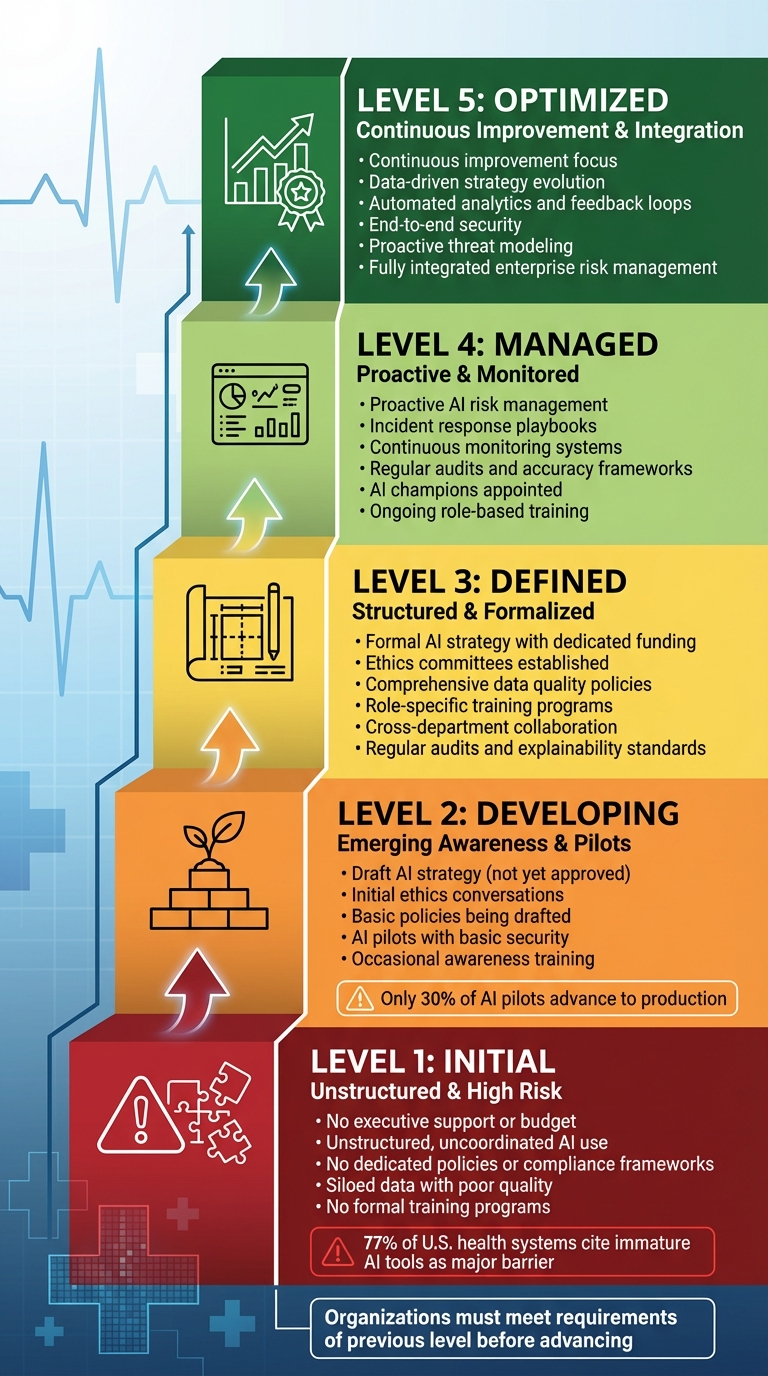
5 Levels of AI Risk Maturity in Healthcare Organizations
Understanding where your organization stands on the AI risk maturity spectrum is key to deploying AI more safely and effectively. This model outlines five levels - Initial, Developing, Defined, Managed, and Optimized - with each stage reflecting a higher degree of capability and control. To progress, organizations must meet the requirements of the previous level, creating a step-by-step path toward stronger AI oversight.
Level 1: Initial
At this starting point, AI use is unstructured and lacks coordination. There’s no executive support, budget allocation, or clear vision guiding AI efforts. Ethical considerations are handled on an as-needed basis, and there are no dedicated policies or compliance frameworks for AI. Data tends to be siloed, with its quality often unknown or poor, and AI tools function independently without integration into core workflows. Staff typically have limited knowledge of AI, and there’s no formal training or change management strategy.
The risks here are substantial. Without oversight, organizations may encounter issues like biased or corrupted data influencing outcomes, as well as unclear accountability when problems occur. Alarmingly, 77% of U.S. health systems cite immature AI tools as a major barrier to adoption. Staying at this level can severely hinder an organization’s ability to use AI safely and effectively [3]. Moving beyond this stage is critical to address these risks.
Level 2: Developing
At this stage, organizations begin taking structured steps toward AI implementation. A draft AI strategy is introduced, though it might lack formal approval or funding. Initial conversations around AI ethics start to take shape, and basic policies are being drafted. Efforts to integrate data are underway, and security measures are applied to AI pilots, though AI-specific vulnerabilities are not yet systematically managed.
Key activities include cataloging AI systems, conducting preliminary risk assessments for third-party tools, and offering occasional AI awareness training. However, challenges remain - only 30% of AI pilots advance to production, and over a third of health system leaders admit they lack a formal process for prioritizing AI initiatives [2]. Without further progress, organizations risk wasting resources on pilots that fail to scale.
Level 3: Defined
At Level 3, organizations adopt a more formalized approach to AI governance. A clearly defined AI strategy, supported by dedicated funding, is in place. Ethics committees or review boards are established, and comprehensive policies ensure data quality, security, and responsible AI use. Role-specific training programs are introduced, and AI tools are integrated into workflows with mechanisms for ongoing feedback.
Collaboration across departments becomes standard practice. Clinical leaders, IT teams, compliance specialists, and legal experts work together to address challenges like model drift - where an AI system’s accuracy declines over time due to changing data patterns. Regular audits, explainability standards, and human-in-the-loop processes help maintain control and accountability [2].
Level 4: Managed
Organizations at this level take a proactive stance on AI risk. They implement incident response playbooks tailored to AI and establish continuous monitoring systems to track performance, detect model drift, and measure impact in real time. Regular audits and a structured framework for accuracy ensure that AI systems meet quality standards. Additionally, organizations evaluate AI use cases against industry benchmarks before deployment.
Governance becomes ingrained in the organization’s culture. AI champions are appointed, role-based training is ongoing, and teams actively work to anticipate and address risks before they escalate. This marks a shift from reacting to problems to preventing them.
Level 5: Optimized
At the highest level, organizations focus on continuous improvement and end-to-end security. AI strategies evolve based on data-driven insights, with automated analytics and feedback loops ensuring ongoing refinement. Advanced tools enable scalable oversight, maintaining high standards for security, compliance, and performance across all AI systems. At this stage, AI is fully integrated into enterprise risk management, with proactive threat modeling and scenario planning as standard practices.
Reaching this level allows organizations to align their AI capabilities with their strategic goals. By building a sustainable, risk-aware AI program, they can protect patients, safeguard investments, and maintain their reputation while driving forward innovation.
How to Assess Your Organization's AI Risk Maturity
Understanding your organization's AI risk maturity starts with a thorough evaluation of governance, cybersecurity, compliance, and operational practices. Identifying gaps in these areas will help you determine your next steps. This process sets the stage for improving your AI risk readiness and aligning with industry benchmarks.
Self-Assessment Tools and Checklists
Kick off the process by conducting a dual assessment: one for your organization's readiness and another for the maturity of your AI tools [3]. For readiness, use checklists that cover strategy, design, implementation, operations, and governance. These tools will help you assess whether you have key elements in place, like executive sponsorship, cross-functional AI governance teams, documented decision-making protocols, and compliance with regulations such as HIPAA, FDA guidelines, and state privacy laws [1].
When it comes to cybersecurity, your checklist should confirm the presence of critical safeguards, including dedicated cloud infrastructure, AI-specific security policies, threat detection systems, data encryption, regular penetration testing, vulnerability assessments, and advanced measures like adversarial attack detection [1]. On the compliance side, check if your organization has finalized and communicated comprehensive AI policies addressing data privacy, security, and intended use, particularly in healthcare settings [1].
Don't overlook ethical oversight. Ensure your organization has a dedicated ethics committee or review board for AI, formal ethical guidelines, and regular ethics audits and risk assessments [1]. Frameworks like the NIST AI Risk Management Framework and ISO 42001 can provide helpful guidance in establishing these safeguards [7][2].
Scoring Your Capabilities
Once you've gathered data, evaluate each domain using a five-level maturity scale. For governance, consider whether your organization is at Level 1 (isolated interest in AI), Level 2 (executive champions with a draft strategy), Level 3 (approved AI strategy with a dedicated budget), Level 4 (integrated strategic planning), or Level 5 (data-driven strategy evolution supported by automated analytics) [1].
For cybersecurity, assess whether you are at Level 1 (no dedicated infrastructure), Level 2 (exploring cloud services for pilots), Level 3 (secure, scalable infrastructure with AI-specific policies), Level 4 (regular penetration testing and vulnerability assessments), or Level 5 (advanced threat modeling and proactive security measures) [1]. Document these scores to create a full maturity profile, highlighting strengths and areas that need attention. This profile will guide you in prioritizing improvement efforts.
Using Censinet RiskOps™ for Benchmarking
While checklists help identify gaps, tools like Censinet RiskOps™ can automate the process for continuous benchmarking. This platform acts as a centralized hub for managing AI risks, offering real-time data and a comprehensive AI risk dashboard. It consolidates policies, risks, and tasks into a unified view across your organization.
Powered by Censinet AI™, the platform streamlines risk assessments for healthcare organizations. It routes critical findings and identified risks to relevant stakeholders, such as members of the AI governance committee, for review and approval. By centralizing control over AI risk oversight, this system allows organizations to scale their risk management processes, measure their maturity against industry standards, and pinpoint areas for improvement - all while maintaining the focus on patient safety and informed decision-making.
sbb-itb-535baee
How to Improve AI Risk Maturity
Once you've assessed your AI risk maturity, the next step is to weave AI governance into your daily risk and compliance routines [8]. The idea is to make managing AI risks a natural part of how your organization operates. By building on your current assessments, you can create a stronger framework for handling AI-related challenges.
Implementing AI Risk Playbooks
AI risk playbooks are a great way to evaluate use cases before rolling out new AI solutions. These playbooks should act as a guide to ensure AI systems are solving the right problems, aligning with your organization's goals, and prioritizing patient safety [2]. Make sure they include policies addressing data privacy, security, and proper usage, especially in line with healthcare regulations [8].
Improving Governance and Collaboration
Strengthening AI governance starts with collaboration. Bring together IT, compliance, and clinical teams to create a cross-functional governance body. This group should be established before any AI tools are procured, ensuring that ethical and clinical considerations are part of the process from the beginning [1]. Executive sponsorship is critical here, along with a well-defined AI strategy that ties directly to both organizational and clinical goals [1].
To maintain oversight, use centralized AI monitoring tools. These tools can present real-time data through dashboards, helping teams keep track of policies, risks, and tasks in a single, easy-to-navigate view. This ensures accountability and continuous monitoring.
Aligning with Regulatory Standards
Staying aligned with regulatory standards is a key part of improving AI risk maturity. Start with the NIST AI Risk Management Framework (AI RMF), which is a voluntary, risk-based framework aimed at managing AI risks and building trust. The 2025 updates broaden its focus to include generative AI, supply chain risks, and emerging attack methods, while also offering guidance on maturity models [9][7].
Compliance with HIPAA is also non-negotiable when it comes to protecting patient data [9]. Your policies should thoroughly address privacy, security, and the intended use of data, as required by healthcare regulations [8]. By integrating these practices into your overall risk and compliance strategies, you can protect patients while fostering innovation.
Conclusion
Managing AI risks in healthcare calls for a well-organized strategy. Maturity models offer a step-by-step method to evaluate current capabilities and determine areas for improvement. Over a third of healthcare organizations have conducted AI-specific risk assessments in the past year [8], signaling a move away from general digital maturity scores toward frameworks tailored for AI readiness [3]. These self-assessments help uncover vulnerabilities in areas like governance, data security, workforce preparedness, and ethical oversight - allowing organizations to address issues before they grow. Regular self-assessment ensures continuous progress and adaptation.
Tools like Censinet RiskOps™ can simplify and scale this process. By centralizing AI-related policies, risks, and tasks, and offering real-time dashboards, Censinet RiskOps™ ensures that issues are quickly directed to the right people. This fosters accountability and keeps AI oversight efficient as your organization grows.
The transition from broad digital transformation to focused AI readiness is already underway [3]. Healthcare leaders are leveraging AI-powered analytics to monitor and address risks in real time, turning risk management into a strategic advantage [4]. By adopting a structured approach, you’re not only safeguarding patients but also creating a solid foundation for responsible AI adoption. This strategy, built on strong governance and cybersecurity practices, helps protect against emerging AI risks while supporting innovation.
Start with a thorough assessment, track your progress with clear benchmarks, and continuously refine your AI approach to stay ahead.
FAQs
How can healthcare organizations evaluate their AI risk maturity?
Healthcare organizations can gauge their readiness to manage AI-related risks by thoroughly examining several critical areas: governance, cybersecurity, data quality, ethical oversight, and operational readiness. This assessment not only highlights areas of strength but also pinpoints gaps that may need attention.
To streamline this process, organizations can use structured tools like AI maturity models or governance assessments tailored for the healthcare sector. These frameworks offer valuable insights into essential domains such as leadership, data infrastructure, and clinical integration. By leveraging these tools, healthcare providers can set priorities, address weaknesses, and outline specific, actionable steps for improvement.
What are the main advantages of reaching higher levels of AI risk maturity?
Reaching advanced stages of AI risk readiness offers numerous advantages for healthcare organizations. It bolsters AI governance, ensures better alignment with regulatory requirements, and minimizes risks like bias and cybersecurity weaknesses. These steps contribute to safer and more responsible AI use.
On top of that, improving AI maturity builds trust with patients and stakeholders, sharpens risk identification and management, and aids in streamlining decision-making processes. By focusing on AI risk readiness, organizations can harness the power of AI to achieve improved results while keeping potential pitfalls in check.
How does the AI Risk Maturity Model work with existing risk management frameworks?
The AI Risk Maturity Model works alongside established risk management frameworks, providing a clear structure to assess and improve your organization's AI governance practices. It emphasizes key areas like governance, data security, technology, and continuous monitoring, aligning with recognized standards such as NIST AI RMF and ISO/IEC 42001.
Tailored for the healthcare sector, this model tackles the specific challenges of implementing AI in this field. It helps organizations ensure their AI systems are deployed responsibly, safely, and effectively while staying compliant and meeting risk management objectives.
Related Blog Posts
- The AI-Augmented Risk Assessor: How Technology is Redefining Professional Roles in 2025
- Risk Revolution: How AI is Rewriting the Rules of Enterprise Risk Management
- The Great AI Risk Miscalculation: Why 90% of Companies Are Unprepared
- The AI Risk Professional: New Skills for a New Era of Risk Management
