
Healthcare AI can reduce gaps in care - or lock them in. My main takeaway is simple: vendors do not fix bias with one model tweak. They deal with it through data checks, model changes, subgroup testing, clear documentation, and post-launch review.
If I were reviewing this topic fast, I’d focus on five points:
- Bias often starts in the data. Skewed EHR records, missing data, and weak proxy choices can hurt some patient groups more than others.
- Vendors use several methods to cut gaps. Common steps include resampling, reweighting, synthetic data methods, group-based loss functions, adversarial debiasing, and subgroup threshold tuning.
- These steps can help, but they do not solve everything. Research in the article shows disparity gaps sometimes drop by 30% to 70%, and one review found some level of reduction in 85% of studies.
- Governance matters as much as model design. Buyers need model cards, subgroup results, intended-use limits, staged rollout plans, and post-launch drift checks.
- Healthcare organizations still carry the third-party vendor risk. A vendor claim is not enough. You need local validation, contract terms, audit rights, and a plan to watch results over time.
A well-known case made this issue hard to ignore: a commercial risk model used healthcare cost as a stand-in for illness severity. That choice led the tool to rank Black patients lower than White patients with similar health needs. In plain English: the proxy was wrong, so the output was wrong.
Here’s the short version of what the article shows:
| Area | What vendors say they do | What buyers should check |
|---|---|---|
| Data | Resampling, reweighting, imputation, linked datasets | Who was in training data, who was missing, and how gaps were handled |
| Model design | Group-weighted loss, adversarial debiasing, subgroup calibration | Subgroup sensitivity, false positives, false negatives, and calibration |
| Validation | Testing on outside datasets | Whether results hold up on populations like yours |
| Documentation | Model cards, validation summaries, use limits | Dated evidence, not broad claims |
| After launch | Drift checks, staged rollout, incident review | Monitoring reports, update notices, and corrective actions |
So if you’re choosing a healthcare AI tool, the right question is not “Does the vendor say they address bias?” It’s: “Can they show, in writing, what they tested, on whom, with what results, and what happens if performance shifts?”
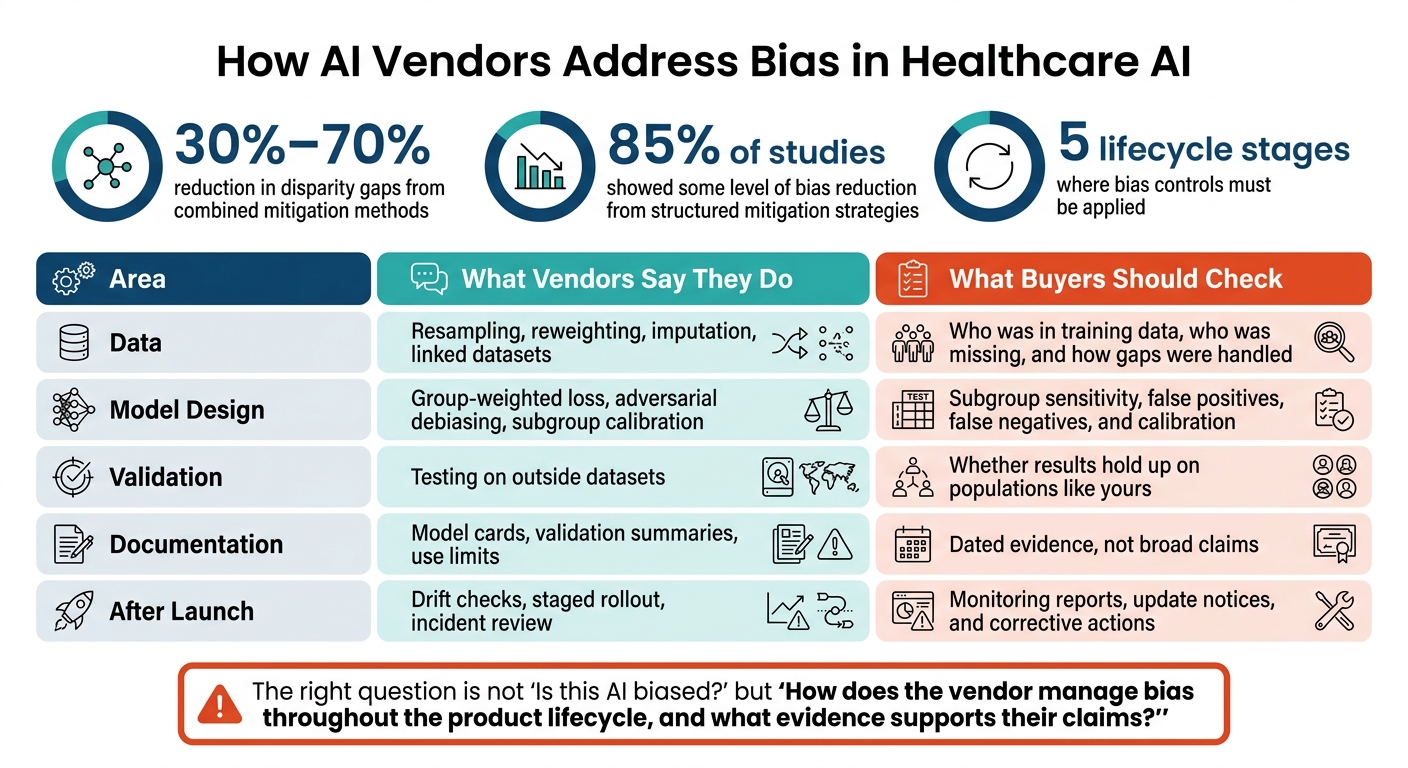
How AI Vendors Address Bias in Healthcare: What to Ask vs. What to Check
Is AI (Still) Biased?
sbb-itb-535baee
How Vendors Reduce Bias in Data and Model Design
Vendors use pre-, in-, and post-processing to reduce bias. It starts with the data used to train the model.
Data Curation Methods That Address Underrepresentation and Missing Data
U.S. EHR datasets often include too many non-Hispanic White patients and too few patients from racial and ethnic minority groups. When that imbalance goes unchecked, the model can learn and repeat the same gaps.[1][17]
To deal with this, vendors use methods like resampling and reweighting.[3][4][10] Resampling can mean oversampling minority groups or undersampling majority groups. Reweighting puts a bigger penalty on mistakes made for underrepresented groups. The idea is simple: if the training data is uneven, the learning process has to make up for that.
Synthetic methods like SMOTE and ADASYN add minority-class examples by combining similar minority cases, which can help without collecting much new PHI.[2][1]
Missing data creates a different problem. It can skew risk estimates, especially for patients with incomplete records.[1][16][17] Better practice means checking why data is missing across demographic groups, using multiple imputation to fill in likely values, and linking EHRs to claims data or registries to improve completeness.[1][15][19] By contrast, deleting incomplete records or filling gaps with a single value can add bias of its own, especially if those records are more common among underserved groups.[1]
After data quality, the next step is how the model learns from that data.
Fairness-Aware Modeling and Subgroup Calibration
Vendors also build fairness into training itself. Cost-sensitive learning and group-weighted loss functions increase the penalty for misclassifying patients from underrepresented groups.[2][1][12] In practice, that can help cut false negatives in cases like sepsis detection.[2][1][12]
Another method, adversarial debiasing, trains the main model so that an auxiliary network cannot predict sensitive traits like race or sex from the model’s internal representations.[2][8][12] Put plainly, the model is pushed to rely less on patterns tied to protected traits.
After training, vendors can calibrate thresholds by subgroup. That means using different decision cutoffs for different groups so metrics like sensitivity, false positive rate, and positive predictive value stay more consistent across populations.[2][7][9] Vendors are also reporting fairness measures more often, including demographic parity, equalized odds, equal opportunity, and calibration error by group.[14][13]
Those steps sound good on paper, but the key question is whether they still work when tested somewhere else.
What Studies Show About Measured Effectiveness
Reviews show that resampling, reweighting, adversarial debiasing, and cost-sensitive learning can reduce disparity gaps, sometimes by 30% to 70%.[3][4][8][10][12] Using pre-, in-, and post-processing together tends to lead to bigger fairness gains, often with only small losses in accuracy.[5][6]
But there’s no magic fix here. Some methods improve one fairness measure while making another worse.[8][11][13] Bias can also remain for intersectional groups, where the research base is still limited.[8][11][13] And results from one hospital often do not carry over cleanly to another.[8][11][13]
That’s why buyers should ask vendors for external validation on independent, diverse datasets before any clinical deployment.[2][1][18]
Vendor Governance Practices Beyond the Model
Technical fixes alone don't solve bias in healthcare AI. A model can look solid in testing and still cause harm if it's used in the wrong clinical setting, applied to patients outside the group it was checked on, or left alone after launch. WHO, FDA, and NIST all treat bias mitigation as a lifecycle process. That means technical controls, documentation, and human oversight working together.[22][26][20] The key issue is simple: do those controls hold up once the tool hits day-to-day clinical use?
That case shows that bias often comes from proxy choice and deployment context, not model code alone.
Documentation, Transparency, and Intended-Use Disclosures
When vendors spell out what a model was built and tested to do, buyers can judge whether the evidence holds up. Vendors should provide model cards, data sheets, validation summaries, subgroup performance tables, and known limitations. Those materials should show exactly which populations were included in training and testing, which metrics were used, and where performance gaps still exist. This gives buyers a way to check vendor claims instead of taking them on faith.
Intended-use disclosures matter just as much. A vendor should clearly state:
- the clinical task
- the target population
- the data inputs the model needs
- the care setting
- whether the tool is meant for decision support, triage, or automation
- which uses the model was not designed for
A lot of fairness failures happen when a model gets used outside its checked population, setting, or workflow. A scoping review of FDA-approved AI medical devices found systematic reporting gaps. It recommended that submissions include full demographic breakdowns for training, validation, and deployment datasets, along with clear subgroup performance results.[26]
Multidisciplinary Review and Participatory Development
Bias review shouldn't sit only with data scientists. Clinicians can tell whether model outputs make sense in practice. Compliance and legal teams can judge whether vendor claims match regulatory duties and patient safety needs. Ethicists and operational leaders can catch risks that technical testing may miss.
Patients and affected communities should be involved early, especially when tools affect access, prioritization, or recommendations. Their input matters most when it shapes product requirements and validation criteria, not when it's tacked on at the end as a box-checking step. The WHO's 2024 guidance for large multimodal models in health explicitly requires engagement of patients and providers from early design stages, with outcomes disaggregated by characteristics such as age, race, and disability.[21]
Post-Deployment Monitoring and Staged Rollout Controls
Even strong premarket testing can fall apart after deployment. Bias doesn't freeze at go-live. Patient mix changes. Documentation habits change. Upstream systems change. And once those things shift, model performance can shift with them, including for different demographic groups. The FDA's AI/ML-based SaMD lifecycle guidance stresses real-world performance monitoring, including drift detection and demographic subgroup analyses after deployment.[23][25][24] Strong monitoring programs also include subgroup reviews, feedback loops, incident reporting, and periodic revalidation.
Shadow deployments and staged rollouts are practical ways to catch issues early. In a shadow deployment, the model runs without affecting care decisions. That lets an organization compare AI recommendations with actual clinical outcomes before moving to full use. A staged rollout starts small, such as with one unit or service line, so exposure stays limited and subgroup disparities can surface sooner.
These controls matter even more when a vendor has thin external validation evidence or when fairness performance may change from one site or population to another. Vendors should document audits, monitoring reports, governance charters, escalation paths, and corrective actions. Those records should be available during procurement and throughout oversight.
How Healthcare Organizations Can Evaluate Vendor Bias Controls
Once vendors describe their bias controls, the next step is verification. After reviewing vendor claims, buyers need proof, not promises. Healthcare teams need dated evidence showing what was tested, which data was used, and which patient groups were included.
Key Evidence to Request During Procurement and Risk Review
Claims are not evidence, so ask for dated documentation. That includes model cards, bias testing protocols, subgroup results, validation cohort details, and monitoring plans.
Subgroup results should break out sensitivity, false positives, false negatives, and calibration by:
- race
- ethnicity
- sex
- age
- language
- payer status
- disability
- care setting
That level of detail matters. Aggregate accuracy can look fine on paper while hiding harm inside subgroups, especially in triage, diagnosis, and risk scoring.
Cohort match matters just as much as performance. Compare the vendor’s validation population with your own patient mix. If the match is weak, require local validation or a staged pilot before full deployment.
It also helps to ask for version-level testing, advance notice of updates, and the right to review bias risk before go-live.
Those same measures should show up as direct request items in the RFP.
How to Embed Bias Requirements Into Governance and Contracting
Put bias requirements directly into the RFP and contract. RFPs should require vendors to submit fairness test results, subgroup metrics, validation evidence, and monitoring plans as mandatory responses.
After vendor selection, carry those requirements into contract language. Useful contract terms include reporting intervals for subgroup performance, audit rights, incident escalation timelines, and remediation duties with clear deadlines. Contracts should also require advance notice of major model changes and give the organization the right to reassess bias risk before those changes go live.[27][28]
Require sign-off from clinical, compliance, privacy, security, and data governance teams before deployment.[29][30][31]
If a vendor will not commit to these controls in writing, the risk is still open.
Where Censinet Supports AI Vendor Risk Oversight
Managing bias documentation across a growing portfolio of AI vendors is a real operational challenge. Evidence gets scattered. Reviewers work in silos. Follow-up tasks slip.
Censinet RiskOps™ helps healthcare delivery organizations handle this by centralizing vendor evidence, standardizing assessment questions, and routing AI-related risk findings to the right governance stakeholders through its governance workflow support. Censinet RiskOps™ centralizes vendor evidence, standardizes assessment questions, and maintains an audit trail for AI risk reviews.
That gives teams a more consistent way to manage oversight as vendors, models, and use cases change.
Conclusion: What the Evidence Shows About Vendor Bias Mitigation
The evidence points in the same direction: bias mitigation helps, but it almost never fixes the whole problem by itself. One recent systematic review found that structured mitigation strategies led to some level of bias reduction in 85% of studies [32]. That sounds encouraging, and it is. But residual gaps still show up often, especially for smaller subgroups and more complex cases.
The strongest results tend to come from layered controls, not one-off fixes. Representative data curation, fairness-aware modeling, subgroup calibration, transparent documentation, and post-deployment monitoring do more together than any single step can do alone. Each one targets a different stage in the lifecycle where bias can slip in or stick around.
That technical pattern also has a clear governance lesson. Vendors set the technical base, but healthcare organizations carry the day-to-day risk in practice. Local patient populations and workflow differences can expose issues that never appeared during vendor development. In plain terms, oversight doesn’t stop once the contract is signed.
For U.S. healthcare buyers, the practical takeaway is simple: treat vendor bias controls as risk-reduction measures, not promises. Ask for current subgroup-level evidence, test it against your own patient mix, put bias-related requirements into contracts, and keep monitoring as models and care settings shift.
FAQs
How can we verify a vendor’s bias claims?
Ask for hard proof, not broad promises. You want bias audit reports that show false positive and false negative rates across patient groups, along with performance reports and validation studies based on independent, representative datasets.
You should also ask for Model Cards or Fact Sheets. These documents should spell out training data demographics, known limits, and key algorithm details. On top of that, confirm that the vendor uses interpretability tools and regular human review to spot and check bias.
Which fairness metrics matter most in healthcare AI?
Key metrics include demographic parity, equalized odds, predictive parity, and counterfactual fairness. Together, they show whether outcomes and error rates stay consistent across groups.
Healthcare organizations should ask for bias audit reports that break out these metrics, along with sensitivity and specificity, by race, age, and gender.
Why is local validation necessary before deployment?
Vendor performance summaries often lean on outside datasets. The problem? Those datasets may not match your patient population or the way care happens inside your organization. Local validation checks whether the model performs well in your own day-to-day workflows.
It also helps surface hidden bias that one accuracy number can easily gloss over. That gives organizations a clearer way to compare model performance against their own standard of care and cut patient safety risk.
Related Blog Posts
- Radiology AI Vendor Risk Management: Diagnostic Accuracy and Liability Considerations
- Clinical AI Bias Testing: How to Assess and Mitigate Algorithmic Risks in Healthcare
- The Third-Party AI Problem: Vendor Risk in an Algorithm-Driven World
- The Bias Blind Spot: Ensuring AI Equity Across Patient Populations
