
Top Cybersecurity Frameworks for Healthcare Organizations
Post Summary
Healthcare organizations face increasing cybersecurity threats, from ransomware to insider breaches, while managing sensitive patient data. Cybersecurity frameworks help address these challenges by offering structured methods to safeguard data, ensure compliance (e.g., HIPAA), and mitigate risks. Here's a breakdown of the most widely used frameworks in healthcare:
- NIST Cybersecurity Framework (CSF): Focuses on risk management with six core functions: Govern, Identify, Protect, Detect, Respond, Recover. Version 2.0 (released February 2024) emphasizes integrating cybersecurity into leadership strategies.
- HIPAA Security Rule: Sets legal requirements for protecting electronic protected health information (ePHI), with flexibility in implementation. NIST SP 800-66 Rev. 2 provides guidance for aligning HIPAA with NIST standards.
- HITRUST CSF: Consolidates multiple standards like HIPAA, NIST, and ISO into one certifiable framework, simplifying compliance for healthcare organizations.
- ISO/IEC 27001: Guides the creation of an Information Security Management System (ISMS) for global security consistency, integrating HIPAA-specific controls for U.S. healthcare.
- CIS Critical Security Controls: Offers practical, actionable steps to reduce vulnerabilities, focusing on areas like asset inventory, data protection, and account management.
Quick Comparison
| Framework | Primary Focus | Certification Available |
|---|---|---|
| NIST CSF | Risk management and prioritization | No |
| HIPAA Security Rule | Legal baseline for ePHI protection | No |
| HITRUST CSF | Unified compliance across multiple standards | Yes |
| ISO/IEC 27001 | Governance and long-term security planning | Yes |
| CIS Controls | Actionable technical security measures | No |
Combining frameworks often yields the best results. For example, HIPAA sets the legal foundation, while NIST CSF provides operational guidance, and HITRUST ensures compliance across multiple systems. This layered approach helps healthcare organizations protect critical systems like EHRs and medical devices, prioritize patient safety, and manage third-party vendor risks effectively.
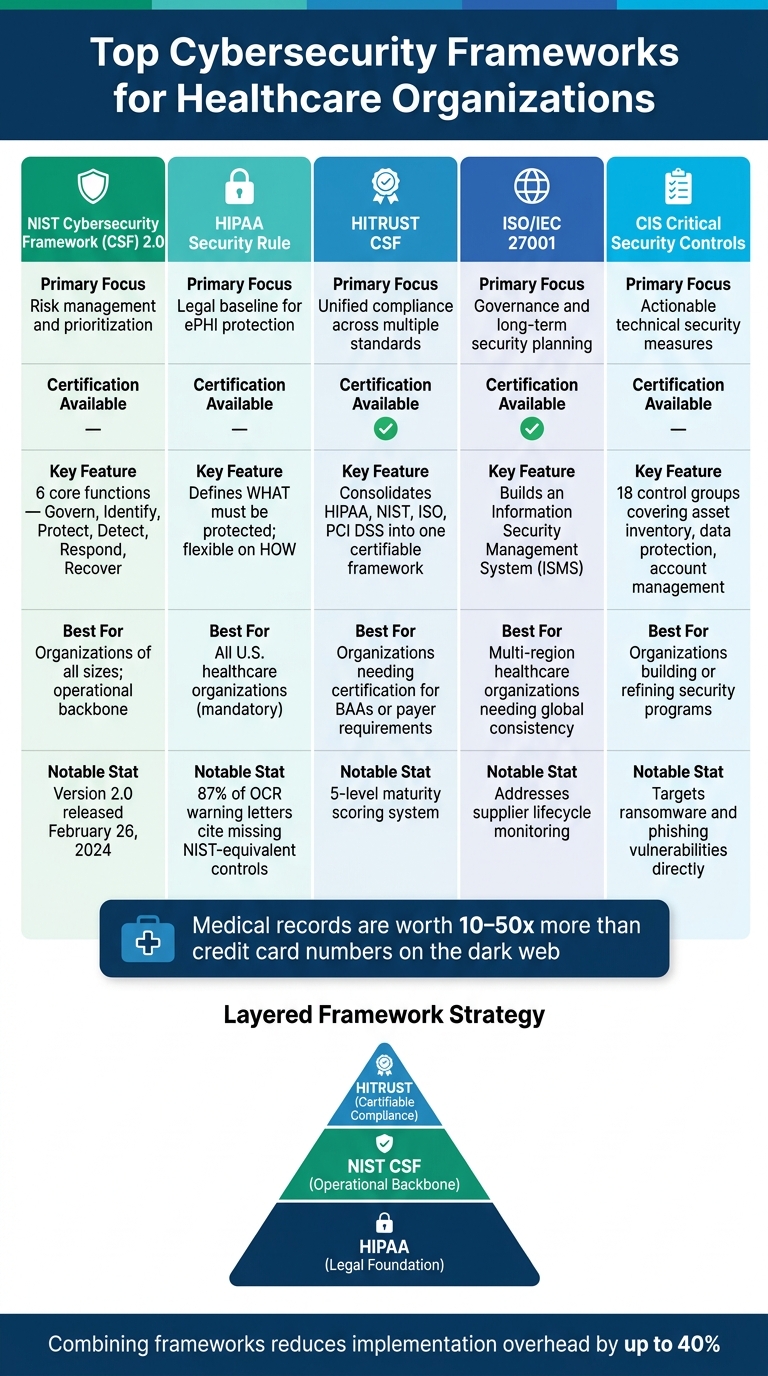
Top Cybersecurity Frameworks for Healthcare: Side-by-Side Comparison
Cybersecurity Frameworks Made Simple: NIST, ISO, HIPAA & PCI
sbb-itb-535baee
Leading Cybersecurity Frameworks for Healthcare
In the healthcare industry, protecting sensitive data and ensuring operational resilience require structured and well-defined approaches. Cybersecurity frameworks offer tailored strategies to address the unique challenges of safeguarding healthcare infrastructure, patient data, and operational systems. Here’s a closer look at some key frameworks that help healthcare organizations tackle these challenges effectively.
NIST Cybersecurity Framework (CSF)
The NIST CSF is one of the most widely adopted frameworks in U.S. healthcare. Its latest version, 2.0, released on February 26, 2024, extends its scope to organizations of all sizes, from large hospitals to small rural clinics.
"It offers a taxonomy of high-level cybersecurity outcomes that can be used by any organization - regardless of its size, sector, or maturity - to better understand, assess, prioritize, and communicate its cybersecurity efforts." - NIST [1]
Built around six core functions - Govern, Identify, Protect, Detect, Respond, and Recover - this framework provides a structured approach. The addition of the Govern function in version 2.0 emphasizes embedding cybersecurity into organizational leadership and strategy, not just IT operations. Healthcare organizations use Organizational Profiles to compare their current security posture with their desired state, enabling them to identify gaps and allocate resources effectively. This approach strengthens defenses for both patient data and clinical systems.
| CSF 2.0 Function | Healthcare Application |
|---|---|
| Govern | Developing policies and integrating cybersecurity into leadership strategies |
| Identify | Cataloging medical devices and assessing supply chain risks |
| Protect | Securing ePHI with encryption and access controls |
| Detect | Monitoring for unauthorized access and ransomware threats |
| Respond | Activating incident response plans during breaches or outages |
| Recover | Restoring operations and data using backups after incidents |
HIPAA Security Rule
The HIPAA Security Rule serves as the legal foundation for protecting electronic protected health information (ePHI) in the U.S. It specifies what must be protected but leaves the how open to interpretation, giving organizations flexibility in implementation.
To assist with compliance, NIST Special Publication 800-66 Rev. 2 maps NIST standards to HIPAA requirements, simplifying the process of documenting and implementing security controls. Additionally, the 2021 HITECH Amendment (Public Law 116-321) incentivizes adopting "recognized security practices", such as the NIST CSF. The HHS Office for Civil Rights (OCR) considers these practices when determining penalties following a breach, making framework adoption a smart legal and security strategy.
HITRUST CSF
Healthcare organizations often face overlapping compliance requirements from frameworks like HIPAA, NIST, ISO, and PCI DSS. HITRUST CSF simplifies this complexity by consolidating these requirements into a single, certifiable framework.
"HITRUST CSF is a certifiable, risk-based framework designed to simplify Control Harmonization. It unifies requirement statements from sources such as HIPAA, NIST, ISO, and PCI into a single, consistent catalog." - Kevin Henry [3]
HITRUST uses a maturity-based scoring system with five levels - policy, procedure, implementation, measurement, and management - allowing organizations to demonstrate their security posture. Its inherited controls feature streamlines third-party risk management by recognizing protections already provided by trusted service providers [3]. This feature is especially valuable for securing healthcare supply chains and managing vendor-related risks.
ISO/IEC 27001
ISO/IEC 27001 focuses on governance and long-term planning. Instead of prescribing specific technical measures, it guides organizations in building an Information Security Management System (ISMS) that integrates security into business processes.
"ISO/IEC 27001 defines how to establish, operate, monitor, and improve an Information Security Management System. It embeds governance and accountability so security becomes a managed business process rather than a set of isolated controls." - Kevin Henry [3]
For healthcare organizations operating across multiple regions, ISO 27001 provides a consistent framework for managing security globally. In the U.S., HIPAA-specific controls can be layered onto this framework. It also addresses supplier lifecycle monitoring, which is critical given the reliance on third-party vendors in healthcare.
CIS Critical Security Controls
The CIS Critical Security Controls offer a highly practical approach to reducing vulnerabilities. Organized into 18 control groups, they provide clear, actionable steps for securing systems and reducing attack surfaces.
For healthcare organizations building or refining their security programs, these controls are an excellent starting point. They focus on areas like asset inventory, data protection, and account management, directly addressing common threats such as ransomware and phishing. By targeting these vulnerabilities, organizations can better protect patient data and ensure the continuity of critical clinical systems.
| Framework | Primary Strength | Certification Available |
|---|---|---|
| NIST CSF | Focuses on risk prioritization and communication | No |
| HIPAA Security Rule | Establishes a legal baseline for ePHI protection | No |
| HITRUST CSF | Consolidates compliance across multiple standards | Yes |
| ISO/IEC 27001 | Embeds security into governance and business processes | Yes |
| CIS Controls | Provides detailed technical security measures | No |
Selecting and Integrating Frameworks for Healthcare Organizations
In healthcare cybersecurity, no single framework addresses every risk. The best approach depends on factors like your organization’s size, budget, regulatory requirements, and the complexity of your vendor relationships. For example, a large health system managing hundreds of third-party vendors has very different needs compared to a small rural clinic working to meet basic HIPAA compliance.
Building a Multi-Framework Strategy
An effective cybersecurity program in healthcare often combines multiple frameworks. HIPAA serves as the legal baseline, while NIST CSF or NIST SP 800-53 provides detailed technical guidance. If payers or partners require certification in Business Associate Agreements (BAAs), HITRUST is a solid choice.
"HIPAA defines what must be protected; NIST defines how to protect it." - Sahil Dubey, Cloud DevOps & Compliance Architect, Pentagon Infosec [4]
This layered strategy can also cut down on redundant efforts. For instance, mapping HIPAA safeguards to NIST 800-53 controls can reduce implementation overhead by as much as 40% [4]. For smaller vendors or business associates with fewer resources, the NIST 800-171 baseline (around 110 controls) is a practical alternative to the more extensive NIST 800-53 catalog (which includes over 800 controls). This method ensures risks are addressed systematically, prioritizing patient safety along the way.
Prioritizing Controls for Patient Safety and Critical Systems
Once multiple frameworks are in place, the next step is to focus on systems where breaches could directly impact patient safety. High-risk systems like EHR platforms, PACS/imaging systems, lab systems, and connected medical devices should take priority. A breach or outage in these areas can have immediate consequences on patient care.
Medical devices, in particular, need extra attention. Many operate on outdated systems that can’t be patched. To mitigate risks, organizations should implement network segmentation, application allowlisting, and protocol filtering [6]. Testing controls such as MFA or endpoint hardening within clinical workflows is also critical to ensure patient care isn’t interrupted.
"In healthcare, the best security program is not the one with the most tools. It is the one that reduces risk without slowing the delivery of care." - ITU Online Editorial Team [6]
Data also highlights the importance of aligning protections with NIST standards. For example, 87% of OCR warning letters cite missing NIST-equivalent controls as gaps in "reasonable safeguards" [4]. This reinforces the need to align clinical system protections with NIST standards - not just as a best practice but as a legal necessity.
Creating a Multi-Year Cybersecurity Roadmap
With a layered strategy and prioritized controls in place, developing a phased roadmap can help achieve measurable improvements over time. The HHS Healthcare and Public Health Sector Cybersecurity Performance Goals (HPH CPGs), released on January 24, 2024, provide a useful framework for this. Start with the 10 Essential CPGs (covering foundational practices like MFA, email security, encryption, and vendor requirements) before moving on to the 10 Enhanced CPGs, which focus on resiliency measures like network segmentation, centralized log collection, and third-party vulnerability disclosure [5].
For organizations with 50–500 employees, achieving dual HIPAA and NIST compliance can take about 15–20 business days. Larger enterprises may need 30–45 days [4]. Tracking progress is just as important as implementing controls. Metrics like patch latency by system tier, phishing resilience rates, and the percentage of critical systems with documented manual downtime procedures can help ensure the roadmap stays on track [6].
How Censinet Supports Cybersecurity Framework Implementation
Healthcare environments are intricate, involving countless vendors and systems. To navigate this complexity, Censinet RiskOps™ transforms frameworks like NIST CSF, HIPAA, and HITRUST into practical, daily workflows. Here's a closer look at how its features help implement these frameworks effectively.
Streamlined Third-Party and Enterprise Risk Assessments
Censinet RiskOps™ simplifies assessments by embedding NIST CSF, HIPAA, and HITRUST controls directly into its templates. This means a single vendor questionnaire can address multiple framework requirements at once. These standardized, framework-driven questionnaires are tailored for healthcare-specific use cases - like EHRs, imaging systems, telehealth platforms, and revenue-cycle tools. The platform also automates compliance scoring, eliminating the need for manual cross-referencing.
The Digital Risk Catalog™ is another standout feature, housing risk profiles for over 50,000 vendors and products. For vendors already in the system, reassessments can be refreshed instead of starting from scratch, often taking less than one day [5]. Internal systems, such as EHRs and PACS, are evaluated using consistent scoring methods to measure risk by factors like likelihood, patient care impact, and regulatory exposure.
Cybersecurity Benchmarking and Risk Visualization
Censinet RiskOps™ offers peer benchmarking tools developed with the American Hospital Association (AHA) and validated through the 2023 Healthcare Cybersecurity Performance Report in collaboration with KLAS Research [11][12]. These tools allow health systems to compare their NIST CSF scores - such as "Detect" or "Respond" - against similar hospitals and delivery networks. For example, the 2024 Healthcare Cybersecurity Benchmarking Study revealed that "Identify" is the least-covered function across all five NIST CSF Functions in healthcare, while Supply Chain Risk Management is the most underdeveloped category across the 23 NIST CSF Categories [7]. Insights like these help organizations pinpoint where they lag behind and identify areas where investments can significantly reduce risk.
RiskOps™ also provides visual dashboards and heat maps that highlight risks by vendor, internal system, department, or service line, all mapped to framework domains. Color-coded risk levels make it easy for leaders to drill down into specific controls affecting scores. This functionality simplifies the creation of board-ready reports, eliminating the need to manually translate technical findings into clear, actionable language. These visualization tools enhance collaboration and ensure alignment across teams.
The combination of automated assessments and benchmarking delivers actionable insights for continuous risk management.
Collaborative Risk Management for Healthcare Ecosystems
In healthcare, cybersecurity decisions involve multiple teams - security, clinical engineering, compliance, supply chain, and legal must all work together. RiskOps™ facilitates this by linking risks to specific control tasks and assigning them to the appropriate teams. Actions like updating Business Associate Agreements, implementing encryption, or adjusting access controls can be tracked and documented in one centralized platform [8][10].
For medical devices, RiskOps™ considers factors like patchability, network connectivity, and patient safety impact, ensuring that NIST and HITRUST controls are adapted to meet unique regulatory or vendor constraints [9]. For supply chains, the platform evaluates risks across pharmaceutical, lab, and logistics partners, focusing on controls like vendor due diligence, incident response, and business continuity. This shared workflow eliminates fragmented communication, accelerates mitigation efforts, and provides a clear audit trail for framework-based risk management [8].
Conclusion: Strengthening Healthcare Cybersecurity with Frameworks
Key Takeaways
No single framework can address every cybersecurity risk in healthcare. By layering frameworks, organizations can create a continuous security lifecycle. Here’s how it works: HIPAA provides the legal foundation, NIST CSF acts as the operational backbone, and HITRUST ensures a certifiable, auditable program. Together, these frameworks tackle a wide range of threats, from preventing ransomware and insecure medical devices to insider risks and third-party vulnerabilities. And with medical records valued at 10 to 50 times more than credit card numbers on the dark web [2], the urgency to act is clear.
"Compliance done right is security done right." - RiskAware [2]
This strategy builds a robust foundation for a more secure future in healthcare.
The Path Forward for Healthcare Cybersecurity
As cyber threats evolve and regulations tighten, the challenges for healthcare organizations grow. To address these, the HHS introduced the Healthcare and Public Health Sector Cybersecurity Performance Goals (HPH CPGs) on January 24, 2024. These goals include 10 Essential and 10 Enhanced priorities designed to help organizations focus their cybersecurity investments [5]. By aligning existing NIST CSF assessments with these goals, organizations can quickly identify and close security gaps.
Technology plays a critical role in this effort. Censinet RiskOps™ bridges the gap between framework requirements and everyday operations. It automates assessments, creates corrective action plans, and provides real-time visibility into risks across vendors, internal systems, and clinical environments. For healthcare organizations managing complex ecosystems and hundreds of vendors, tools like this are indispensable.
"Your vendors are your attack surface. Manage them accordingly." - RiskAware [2]
FAQs
Which framework should we start with for HIPAA compliance?
To begin your journey toward HIPAA compliance, start with a thorough risk analysis. This step is mandated by the HIPAA Security Rule and serves as the foundation for identifying vulnerabilities in your systems and processes.
Once the risk analysis is complete, consider using a control-based framework like the NIST Cybersecurity Framework. This framework helps you address the three critical safeguards required by HIPAA: administrative, physical, and technical safeguards. To make things easier, a NIST-HIPAA crosswalk can help you align these voluntary guidelines with the legal requirements outlined in HIPAA.
For a more streamlined approach, tools like Censinet RiskOps™ can simplify the process. It offers features like automated risk assessments, cybersecurity benchmarking, and compliance management, making it easier to protect patient data and maintain system security.
How can we combine NIST CSF, HIPAA, and HITRUST without duplicating work?
HITRUST CSF serves as a central framework that brings together HIPAA’s legal requirements and NIST’s core functions into one unified control set. By using HITRUST as your primary framework, you can avoid duplication and streamline your compliance efforts.
Align your internal controls with HITRUST to make audits and evidence collection more efficient. For risk management, rely on NIST CSF, while HICP can guide you in implementing safeguards tailored to healthcare. HITRUST, on the other hand, ensures you're ready for audits with a structured approach.
Tools like Censinet RiskOps™ make the process even smoother by simplifying assessments and tracking compliance across these standards.
What controls are most important for medical devices and patient safety?
Protecting medical devices and ensuring patient safety requires strong security measures throughout the device's lifecycle. Here's what to focus on:
- Authentication and authorization: Implement access controls to enforce the principle of least privilege, ensuring only authorized users can access specific functions or data.
- Data encryption: Secure protected health information (PHI) to prevent unauthorized access during storage and transmission.
- Event logging: Monitor device activity to detect unusual behavior or potential threats in real-time.
Other critical practices include secure updates to patch vulnerabilities, network segmentation to isolate devices from broader systems, and secure boot processes to verify the integrity of the device's software at startup.
Tools like Censinet RiskOps™ can simplify these efforts by addressing risks associated with clinical applications, medical devices, and supply chains, making it easier to maintain a robust security posture.

