
Most healthcare vendor reviews still take 5 to 6 weeks, but this article shows how that timeline can drop to hours or a few days when teams stop relying on email, spreadsheets, and one-off questionnaires. I explain the core shift in simple terms: use shared vendor evidence, standard review paths, automated routing, and AI-assisted document review so teams spend less time chasing files and more time judging risk.
Here’s the article in one view:
- Manual reviews often take 12–15 hours per vendor just for HIPAA risk analysis.
- Many health systems manage about 1,320 vendors under contract.
- Only 27% assess all vendors each year.
- Third parties are tied to up to 72% of healthcare data breaches.
- Censinet’s model cuts repeat work by reusing assessments, routing reviews by risk, and reading vendor documents faster with AI.
- The result: less back-and-forth, more consistent scoring, and a clearer record for audits and renewals.
This is the main idea: questionnaires alone slow teams down because the bottleneck is not just review - it’s repeated evidence requests, siloed approvals, and weak follow-up on remediation. I show how Censinet addresses each of those problems with one shared process across security, privacy, legal, compliance, and procurement.
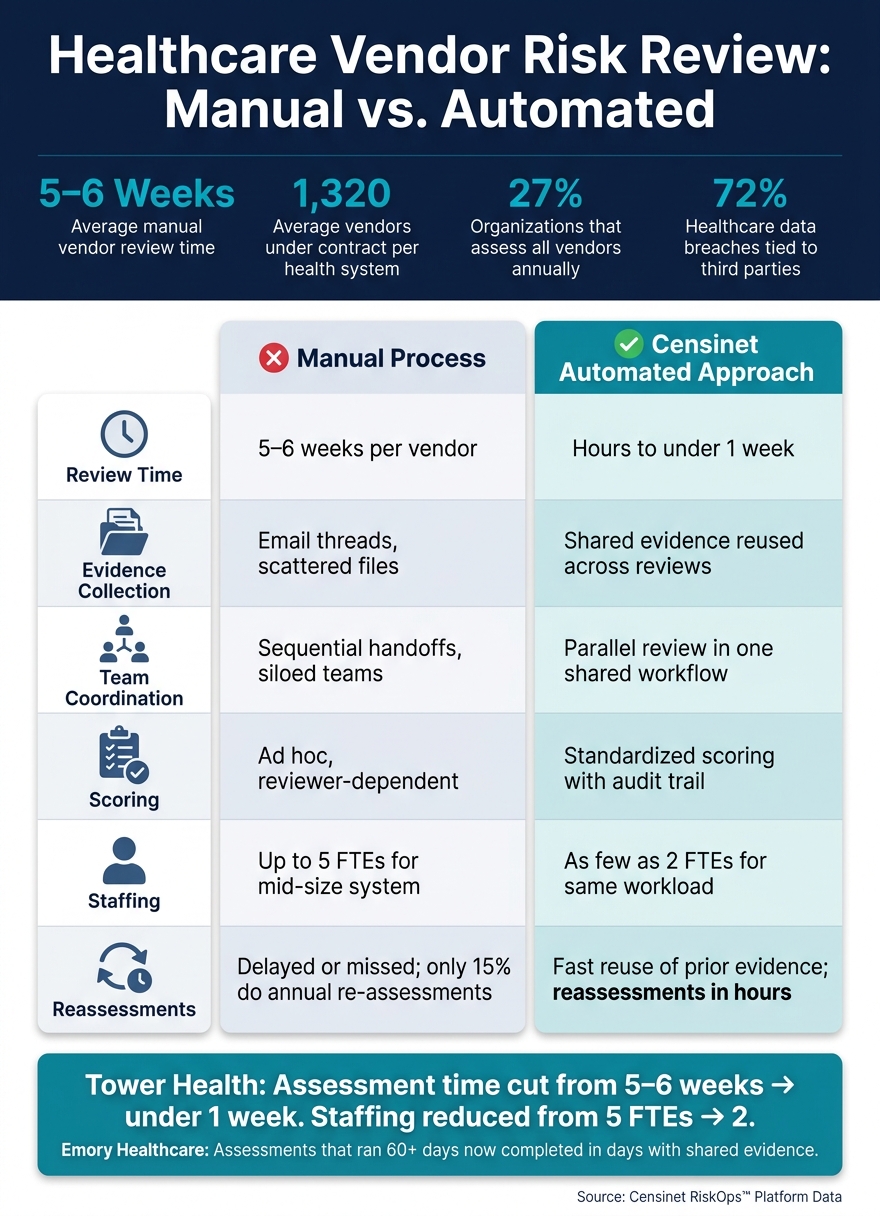
Manual vs. Automated Healthcare Vendor Review: Key Stats & Workflow
Creating Cyber Resilience: Your Guide to Healthcare Vendor Risk Management [On-Demand Webinar]
sbb-itb-535baee
Quick comparison
| Area | Manual process | Censinet approach |
|---|---|---|
| Review time | 5–6 weeks | Hours to under a week |
| Evidence collection | Email threads, files in many places | Shared evidence reused across reviews |
| Team coordination | One team after another | Parallel review in one workflow |
| Scoring | Varies by reviewer | Standard scoring and audit trail |
| Reassessments | Often delayed or missed | Fast reuse of prior evidence |
| Staffing | Heavy manual effort | Lower workload per review |
If you want the short version, it’s this: the article argues that healthcare vendor review gets faster when evidence is shared, workflows are automated, and AI helps reviewers sort documents without taking control away from them.
Where Manual Vendor Assessments Break Down
Why Manual Reviews Are Slow and Inconsistent
Manual vendor reviews usually start to fall apart at the handoff stage. A team sends a custom questionnaire, gathers evidence through email, passes files between reviewers, and only then gets to a decision. On paper, that sounds workable. In practice, it gets messy fast.
Each vendor sends a different stack of documents: SOC 2 reports, BAAs, policies, incident response plans, penetration test summaries, and continuity plans. The formats vary. The level of detail varies. Sometimes the same topic shows up in three different files and still doesn't answer the core question. Reviewers have to sort through all of it by hand, match evidence to requirements, and flag gaps. That back-and-forth turns days into weeks. Manual HIPAA risk analyses alone can take 12–15 hours per vendor.[3]
The bigger issue is that those delays compound. In healthcare, security, privacy, legal, compliance, and procurement often review the same vendor in separate lanes instead of using one shared workflow. So rather than moving at the same time, reviews stack up one after another, with each team waiting for the last.
What Manual Teams Cannot Do at Scale
Once vendor volume grows, the cracks get harder to ignore. The average healthcare provider manages 1,320 vendors under contract, yet only 27% of organizations assess all vendors annually.[6] At the same time, teams with 3.21 FTEs are spending more than 500 hours per month on assessments.[6][5] That math just doesn't work for annual review or reassessment.
Corrective action plan, or CAP, tracking is another weak spot. A vendor gets a finding, and the follow-up often ends up buried in a spreadsheet or lost in an email thread. Then renewal comes around, and the team has to ask the same questions again because no one has a clear record of what was fixed. Only 21% of vendor risk assessments result in required remediation, and just 11% lead to disqualification.[6] That points to weak follow-through after findings, not just slow review cycles.
Reuse is also limited. If one vendor supports multiple hospitals or business units, teams often ask for the same evidence again because prior assessments aren't easy to find, compare, or apply elsewhere. That creates repeat work for internal teams and vendors alike, without giving anyone a better view of risk. At that point, the bottleneck isn't judgment. It's repetition.
Manual Questionnaires vs. Evidence-Driven Review: A Side-by-Side Look
The difference between manual and evidence-driven review goes beyond turnaround time. It affects how teams collect evidence, how they work together, and how well they can track issues after the review is done.
| Dimension | Manual Questionnaire Process | Evidence-Driven Automated Process |
|---|---|---|
| Review Duration | 5–6 weeks per assessment [1] | Hours to under a week [1] |
| Evidence Quality | Inconsistent formats, uneven completeness, repeated requests | Standardized assessments, verified inputs, reusable evidence across assessments |
| Internal Coordination | Sequential handoffs across security, legal, compliance, and procurement | Shared workflow with parallel visibility for all stakeholders |
| Scoring Consistency | Ad hoc, reviewer-dependent, harder to defend in audits [1] | Standardized scoring with automated CAPs [1] |
| Ongoing Monitoring | Point-in-time, reactive; only 15% conduct annual re-assessments [4] | Continuous risk data with structured reassessment cycles |
| Staffing Requirements | High - up to 5 FTEs for a mid-size system [1] | Reduced - as few as 2 FTEs for the same workload [1] |
Tower Health cut staffing needs from 5 FTEs to 2.[1]
That is the workflow Censinet removes in the next section.
How Censinet Cuts Vendor Review from Weeks to Hours
Standardized Assessments and Shared Vendor Risk Data
Censinet cuts out repeat work by using reusable evidence and standard routing. Censinet RiskOps™ works as a shared healthcare risk platform where vendors and health systems use the same assessments and supporting documents across many engagements.
These assessments cover PHI handling, clinical operations, medical devices, and supply chain risk. They align with HIPAA Security Rule safeguards, NIST CSF categories, and certifications like SOC 2 and HITRUST. Risk tiering also shifts on its own based on vendor size, product type, and PHI exposure. That means a cloud-based radiology platform goes through a different review path than a non-PHI scheduling tool, without someone having to rebuild the questionnaire by hand.
Censinet Connect™ adds a shared repository for finished assessments, uploaded certifications, and remediation attestations. When a vendor updates a certification or policy, connected health systems can see that new evidence right away. Before using this shared-data model, Emory Healthcare had assessments that ran longer than 60 days. [2]
"The greatest benefit of Censinet I've found is the 'crowdsourcing' aspect...that increases assessment speed and helps us resolve third-party risks much quicker." - Jigar Kadakia, VP & CISO, Emory Healthcare [2]
Automated Workflows and Command-Center Visibility
Shared data matters most when teams can move on it fast. Censinet RiskOps™ automatically routes assessments based on risk tier and product category, kicking off parallel workflows across security, privacy, legal, compliance, and procurement.
Dashboards give leaders one place to track active assessments, security threats in third-party vendor relationships, upcoming deadlines, and stalled approvals. That helps teams keep reviews moving while keeping a clear audit trail. Average assessments take about 44 days, while Censinet completes new vendor assessments in 10 days or less and reassessments within hours. [7]
Traditional Workflow Steps vs. Censinet RiskOps Workflow Steps
The difference shows up clearly in the workflow itself.
| Workflow Step | Traditional Manual Process | Censinet RiskOps™ Workflow |
|---|---|---|
| Intake & Scoping | Email intake; manual scoping | Structured online intake form with automatic risk tiering by product type and PHI impact |
| Questionnaire Distribution | Custom questionnaires sent via email; no tracking | Standardized, healthcare-specific assessments delivered through the platform with automated reminders |
| Evidence Collection | Documents sent across many portals and email threads in mixed formats | Evidence uploaded once to Censinet Connect™ and reused across assessments |
| Risk Scoring | Manual, reviewer-dependent scoring in spreadsheets; uneven across teams | Automated, standardized scoring models with consistent risk profiles and built-in audit trails |
| Remediation Planning | CAPs drafted manually; tracked in email or spreadsheets | Automatically generated CAPs routed as workflow tasks with clear ownership and due dates |
| Approval & Sign-Off | Sequential reviews; approvals through meetings and scattered sign-offs | Role-based digital approval routing with full audit log; parallel team review cuts wait time |
With Censinet RiskOps™, evidence already in the system and automated approval routing can shrink a review to less than a week - and down to hours for reassessments. [1]
How Censinet AI Speeds Up Evidence Review and Reporting
With standardized evidence already in place, Censinet AI takes on the work that usually eats up review time: reading files, mapping them to questions, and turning long vendor documents into usable writeups.
How Censinet AI™ Handles Questionnaire Completion and Evidence Analysis
Censinet AI ingests SOC 2 reports, HITRUST certifications, policies, diagrams, and BAAs, then maps that material to questionnaire items in seconds. It also creates short summaries from large document sets, pulling out key controls, residual risks, and deviations from common healthcare security baselines.
It goes a step further by extracting product integration details, such as HL7/FHIR interfaces, hosting environments, and third-party service dependencies that may expand PHI exposure and review scope. Using that context, it surfaces downstream dependencies that may touch PHI. So if a telehealth vendor relies on a separate cloud transcription service that handles PHI, Censinet AI brings that relationship forward so teams can confirm BAAs and security assurances cover every party in the chain.
Risk ratings, control coverage across areas like access control and data protection, and a prioritized list of remediation actions are formatted to support audit-ready documentation.
How Censinet AI Keeps Reviewers in Control
The point of automation here is to suggest, not make the call. Every AI-generated response or risk finding can be traced back to the document excerpt that supports it, so reviewers can check accuracy without digging through source files on their own.
If the AI spots a possible gap - for example, a vendor says endpoint encryption is in place but doesn't mention key management processes - it flags the mismatch for human review instead of deciding the issue on its own. The reviewer then decides whether it's a true gap or something that needs follow-up with the vendor.
Censinet AI can also draft mitigation language and suggested contract or BAA clauses tied to identified risks. That gives reviewers a strong starting point instead of staring at a blank page. Governance stays in place through configurable approval workflows, so organizations can require sign-off from security, privacy, legal, or clinical stakeholders before any risk rating or recommendation is finalized. Every AI suggestion, acceptance, or modification is captured in an audit trail, giving committees and regulators a clear record of how each decision was reached.
AI Capabilities Mapped to Team-Level Outcomes
The time savings show up in day-to-day work. Each capability is aimed at a specific bottleneck that slows healthcare risk teams down.
| AI-Enabled Capability | Measurable Impact |
|---|---|
| Automated questionnaire completion | Vendors can generate near-complete drafts quickly, reducing manual response entry. |
| Evidence summarization | Reviewers spend less time parsing long documents and more time for analysis. |
| Downstream dependency detection | Hidden dependencies that may touch PHI are surfaced early in the review. |
| Automated report drafting | Risk summaries are standardized and easier to use in committee reviews and audits. |
| Intelligent routing | Assessments and issues reach the right stakeholders without manual handoffs. |
| Automated CAP generation | Corrective action plans are generated from assessment results, standardizing the evaluation and scoring of vendor risks. |
That means faster, more consistent input to effectively manage third-party risk across security, compliance, and procurement.
What Healthcare Organizations Gain in Practice
What Security, Compliance, and Procurement Teams Get
When assessments follow one standard process and teams share the same evidence, the payoff shows up fast.
Standardized workflows move time away from vendor follow-up and into actual risk review. Instead of hunting down responses or trying to piece together spreadsheet versions, security analysts can spend their time on risk analysis. Procurement benefits too, because fewer contracts get stuck at the last minute. Compliance and legal teams work from one shared record instead of digging through scattered email threads.
Tower Health cut assessment time from 5–6 weeks to under one week and reduced staffing from 5 FTEs to 2. [1]
That kind of jump in throughput changes day-to-day work. High-risk vendors can be reassessed more often, and remediation tracking turns into a structured, active process instead of something handled late or left hanging.
How Continuous Risk Data Improves Procurement and Renewal Decisions
The same risk data also helps teams make better calls during procurement and renewals.
A one-time questionnaire is just a snapshot, and snapshots get old fast. Continuous monitoring shows changes before they create problems at renewal time or trigger compliance issues.
For procurement, that means teams can screen vendors earlier, even before the RFP stage. For renewals, trend data on remediation performance and control maturity gives legal and security teams real leverage. They can move low-risk vendors through faster or push for stronger contract terms when a vendor keeps showing the same gaps.
Portfolio-level dashboards add another layer. They give executive and supply chain leaders a view across the full vendor portfolio, including concentration risk, vendor dependency clusters, and remediation status, instead of limiting decisions to one vendor relationship at a time.
Conclusion: Faster, More Defensible Vendor Decisions Start Here
Manual reviews are too slow, too inconsistent, and too resource-intensive for the pace of today’s healthcare supply chains. Censinet RiskOps™, Censinet Connect™, and Censinet AI™ work together to shrink that timeline with standardized assessments, shared vendor evidence, automated workflows, and continuous risk oversight. The result is faster, more defensible vendor decisions based on current evidence.
FAQs
How does shared vendor evidence speed reviews?
Shared vendor evidence cuts review time by replacing repeated manual requests with a complete-once, share-many model. When a vendor finishes an assessment and uploads its evidence to a centralized digital risk catalog, other healthcare organizations in the network can view it right away.
That means less duplicate work on both sides. AI-driven automation can then check the evidence, flag risks, and produce summary reports in seconds, so teams can make decisions in hours instead of weeks.
What kinds of vendor documents can the AI review?
Censinet’s AI can review many types of vendor documents, including completed security questionnaires, SOC 2 reports, penetration test results, and policy documents.
It can also handle business owner request forms and non-standard files like PDFs and spreadsheets. That helps teams populate assessment requests, summarize evidence, spot risks, and draft summary reports.
How does Censinet keep human reviewers in control?
Censinet uses human-guided automation. The technology works like a copilot, not an autopilot.
That means security and risk teams stay in control. They set custom rules, define review steps, and make the final call.
Teams can also review and refine AI-generated questionnaire responses before anything gets shared. And when the system flags key findings or follow-up tasks, it sends them to the right stakeholders so people can evaluate them on time.
