
Customizable Dashboards for SOC 2: Key Benefits
Post Summary
Managing SOC 2 compliance in healthcare can be overwhelming due to fragmented systems, manual tracking, and strict regulatory demands. Customizable dashboards address these challenges by centralizing compliance data, automating evidence collection, and offering real-time insights tailored to specific roles. Here's why they matter:
- Centralized Data: Dashboards provide a single view of control statuses, evidence, and audit deadlines, reducing reliance on spreadsheets and emails.
- Role-Specific Insights: Tailored views help executives, IT teams, and compliance officers focus on their priorities without unnecessary complexity.
- Automation: Automated alerts and evidence collection save time, cut errors, and ensure continuous audit readiness.
- Third-Party Risk Management: Dashboards consolidate vendor compliance data, making it easier to track risks tied to PHI and clinical systems.
- Actionable Reporting: Metrics like control health and remediation progress keep leadership informed and aligned.
These tools simplify compliance tracking, improve collaboration, and reduce risks, making SOC 2 compliance more efficient for healthcare organizations.
Key Challenges in SOC 2 Compliance for Healthcare
Why SOC 2 Is More Complex in Healthcare
SOC 2 compliance is already a rigorous process, but in healthcare, it becomes even more challenging. Security teams are tasked with safeguarding sensitive data like Protected Health Information (PHI) and Electronic Health Records (EHRs), all while ensuring that critical clinical systems remain operational 24/7. A disruption to patient portals or medication systems isn’t just inconvenient - it can directly impact patient care and safety.
Adding to the complexity, healthcare organizations rely on a web of third-party vendors, including billing platforms, cloud storage providers, and medical device manufacturers. Any vendor that interacts with PHI must adhere to the same stringent security standards as the healthcare provider itself. This means the responsibility for SOC 2 compliance extends far beyond the organization’s internal systems, creating a much broader scope to manage compared to other industries.
SOC 2 Type II adds another layer of difficulty. Unlike Type I, which examines controls at a single moment in time, Type II requires proof that these controls function effectively over a sustained period - anywhere from 3 to 12 months [3]. Maintaining this level of oversight without automated tools can lead to critical gaps, especially when continuous monitoring isn’t in place.
Pain Points When Dashboards Are Absent
In the absence of a centralized dashboard, compliance efforts often rely on manual methods like spreadsheets, email chains, and fragmented check-ins. This approach makes evidence collection inconsistent, leading to issues such as missing signatures, undated entries, or incomplete documentation - all of which can result in failed audits [2]. These aren’t just minor administrative errors; they can translate into significant remediation costs and economic impacts for the organization.
"The organizations that stay out of trouble treat compliance as an ongoing operational function, not a periodic project." - Michael Kendrick, Cisive [2]
Another major challenge is siloed data. When security, IT, and compliance teams operate independently, each maintaining separate records, no one has a full understanding of the organization’s compliance status. This lack of visibility often means leadership only becomes aware of critical gaps when an audit is looming, making last-minute fixes both costly and disruptive. A centralized dashboard solves these issues by consolidating data and simplifying evidence collection, ensuring no detail slips through the cracks.
Regulatory and Risk Pressures Facing Healthcare Vendors
External regulations add even more layers of complexity. Healthcare vendors must address both SOC 2 and HIPAA requirements simultaneously. While SOC 2 focuses on operational rigor, HIPAA governs the handling of PHI [3]. Balancing these overlapping obligations without a unified compliance strategy is a common struggle for many organizations.
The stakes are high. HIPAA violations can incur civil penalties of up to $2,190,294 per incident [2]. Compounding this, there’s been a sharp rise in False Claims Act recoveries and cyber threats like ransomware and hacking [2]. These escalating risks highlight how manual compliance processes are ill-equipped to handle today’s threat landscape.
sbb-itb-535baee
Core Features of Customizable SOC 2 Dashboards
Customizable SOC 2 dashboards address regulatory demands and reduce the burden of manual tracking by offering several standout features.
Role-Based Views for Healthcare Teams
Different roles within healthcare organizations require tailored dashboard views to meet their specific needs. For instance, a CISO may need a high-level overview of the organization's risk landscape, while an IT engineer benefits from a detailed checklist of controls requiring attention. Meanwhile, compliance officers focus on tracking evidence, and vendor managers need insights into third-party risks.
To address these diverse needs, executive dashboards highlight key risk indicators and control health at a glance, while technical dashboards focus on detailed task lists. This structure minimizes unnecessary complexity and allows each team to concentrate on their priorities. Research backs this up - technical teams can save up to 70% of their time on compliance activities when evidence collection is automated through a centralized platform [7][4].
Consider a real-world example: in February 2026, a Fortune 500 healthcare solutions company collaborated with PwC to resolve qualified SOC reports. Using customizable dashboards, they tracked progress and streamlined executive reporting, reviewing over 1,400 controls and resolving more than 200 risks. The result? They delivered 100% unqualified SOC 1 and SOC 2 reports on time [8].
"By shifting from a reactive mindset to a proactive readiness approach, we built a foundation for sustained trust with auditors, stakeholders - and future customers." - PwC [8]
Mapping Controls Across SOC 2 and Healthcare Frameworks
Healthcare organizations often juggle multiple compliance frameworks, including SOC 2, HIPAA, HITRUST, NIST CSF, and ISO 27001. Without a unified approach, teams risk duplicating efforts by collecting the same evidence repeatedly, leading to inefficiencies and inconsistencies.
Advanced dashboards streamline this process with a "test once, comply many" method. For example, a single access control log can be automatically mapped to meet requirements across multiple frameworks, reducing redundant work and ensuring consistent documentation across audits [5][6].
A great example is Healthee, a health benefits platform that achieved SOC 2 Type II certification in January 2025 while also meeting HIPAA and HITRUST controls. By implementing real-time security monitoring and automated access controls, they provided verifiable proof of data protection, enabling them to secure enterprise-level clients [9].
This capability lays the groundwork for dynamic compliance management, as highlighted in the next feature.
Real-Time Metrics and Automated Alerts
Static reports are no longer enough for SOC 2 Type II compliance, which requires proof of ongoing control effectiveness. Real-time metrics provide an up-to-date view of control performance, incident response times, and evidence collection statuses. These features ensure that compliance remains a continuous process rather than a one-time effort.
Automated alerts are equally critical. For example, if a user account isn't deprovisioned after an employee leaves, the dashboard immediately notifies the responsible team via Slack, email, or Microsoft Teams, outlining the necessary escalation steps [6]. This proactive approach prevents issues from slipping through the cracks and becoming audit findings. A Forrester study on Drata found that such automation can reduce audit and data-collection time by 78% - from approximately 980 hours to just 220 hours annually [5].
These features not only simplify compliance but also enhance operational efficiency, providing a solid foundation for the next steps in compliance management.
Censinet RiskOps™ stands out as a leader in this space, offering advanced dashboards with role-specific views, multi-framework mapping, and real-time alerts to help healthcare organizations manage SOC 2 compliance effectively.
Key Benefits of Customizable Dashboards for SOC 2
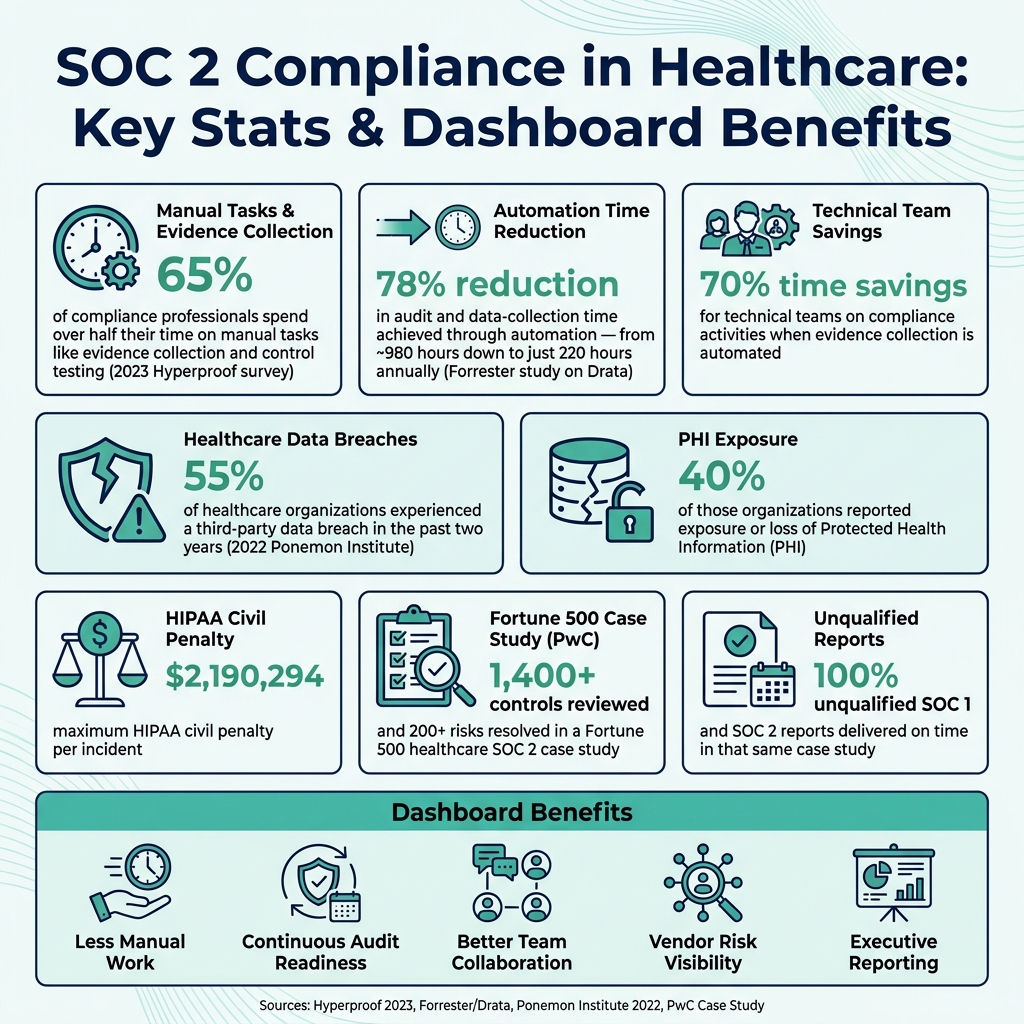
SOC 2 Compliance in Healthcare: Key Stats & Dashboard Benefits
The features discussed earlier - like role-based views, cross-framework mapping, and real-time alerts - offer clear advantages for healthcare compliance teams. By focusing on role-specific insights and automation, customizable dashboards make it easier for healthcare organizations to manage and track compliance efforts.
Less Manual Work and Faster Compliance Processes
Manual SOC 2 compliance can be a major time drain. According to a 2023 Hyperproof survey, 65% of compliance professionals spend over half their time on manual tasks like evidence collection and control testing across frameworks such as SOC 2, HIPAA, and ISO 27001 [1]. Customizable dashboards help reduce this workload by automatically gathering evidence from integrated tools like cloud platforms, identity providers, HR systems, and ticketing solutions such as Jira or ServiceNow. This automation saves time before audits and ensures a smoother, more accurate process.
More Accurate Data and Continuous Audit Readiness
Relying on spreadsheets often leads to errors, especially in environments where multiple teams collaborate. Dashboards solve this problem by serving as a single source of truth, tagging evidence with control IDs, ownership, and timestamps. They also ensure only the latest approved policy versions are accessible. Features like real-time indicators - showing "last test date", "evidence age", and "next review due" - along with automated reminders for overdue tasks, keep SOC 2 artifacts ready for audits at all times. This eliminates the chaos of last-minute preparations.
Better Collaboration Across Security and Compliance Teams
When security, compliance, privacy, and vendor management teams use separate tools, unclear ownership can derail SOC 2 programs. Role-based dashboards address this by assigning specific controls and tasks to individuals, establishing clear accountability. They also reduce the need for lengthy meetings by linking control ownership and remediation statuses across teams. Tools like Censinet RiskOps™ are designed to support these workflows, connecting healthcare organizations and their vendors in a shared system where remediation progress is visible to everyone involved.
Clearer Visibility Into Third-Party and Vendor Risk
Third-party risk is a growing issue in healthcare compliance. A 2022 Ponemon Institute study revealed that 55% of healthcare organizations faced a third-party data breach in the past two years, with 40% reporting exposure or loss of PHI. Dashboards enhance risk management by consolidating key details - such as each vendor’s SOC 2 type, report date, scope, key exceptions, and risk rating - into a single view. Color-coded indicators make it easy to spot vendors with outdated reports or significant control gaps, allowing teams to focus on those managing PHI or connected to clinical networks. Platforms like Censinet RiskOps™ integrate real-time assessments and remediation updates, offering a comprehensive view of supply chain risks.
Actionable Reporting for Executives and Boards
With improved data accuracy and team collaboration, dashboards transform technical details into digestible metrics. For example, they can show the percentage of critical controls passing or the average time needed for remediation. These metrics provide leadership with a quick snapshot of program health. Dashboards can also track progress toward SOC 2 milestones, like readiness assessments, gap closures, and attestation dates, using trend lines for clarity. A summary like “95% of SOC 2 controls are current; remaining gaps mostly involve third-party monitoring” connects these metrics to outcomes, such as reduced PHI exposure risk and fewer contract penalties.
Conclusion: Making SOC 2 Compliance More Manageable With Customizable Dashboards
SOC 2 compliance in healthcare can be a tough hill to climb. Teams often face fragmented evidence, manual spreadsheet tracking, unclear responsibilities, and the overwhelming task of managing hundreds - sometimes over 1,000 - third-party vendor relationships. Each vendor brings potential risks, from PHI exposure to operational vulnerabilities. These challenges only grow as organizations expand.
Customizable dashboards don’t erase the workload but help bring order to the chaos. By centralizing key elements - like control statuses, evidence gaps, remediation progress, and audit readiness - teams can focus less on chasing updates and more on resolving issues. Plus, the move toward continuous monitoring offers a huge advantage. Teams can catch problems early, whether it’s overdue controls, expiring vendor assessments, or incomplete evidence, instead of scrambling in the days leading up to an audit.
These dashboards also provide valuable insights beyond internal operations. Take vendor ecosystems, for example. Tools like Censinet RiskOps™ are specifically designed for healthcare, delivering real-time assessments, tracking remediation efforts, and highlighting risks tied to PHI, clinical applications, and medical devices.
When everyone - whether it’s security, compliance, procurement, or leadership - has a clear view of what’s completed, what’s overdue, and where risks lie, SOC 2 compliance shifts from being a yearly fire drill to a manageable, ongoing process.
FAQs
What should a SOC 2 dashboard track daily?
A SOC 2 dashboard focuses on critical areas such as vendor risks, compliance status, evidence collection progress, control performance, and real-time alerts. These features allow teams to spot and resolve potential issues swiftly, keeping compliance efforts on track and managing risks effectively.
How do dashboards map SOC 2 controls to HIPAA or HITRUST?
Dashboards connect SOC 2 controls with HIPAA or HITRUST by providing real-time oversight, automated alerts, and centralized documentation. These tools make it easier to track compliance status, spot gaps, and confirm that controls meet regulatory standards. This approach helps maintain ongoing risk management efforts.
Which systems should a dashboard integrate with for evidence collection?
A dashboard needs to work seamlessly with tools such as risk assessment systems, compliance management platforms, vendor management systems, and PHI data flow inventories. These connections allow for continuous monitoring, real-time reporting, and automated alerts, making it easier to manage SOC 2 compliance while boosting overall efficiency.

