
Explainable AI (XAI) is transforming healthcare cybersecurity by making AI systems more transparent and understandable. Unlike black-box AI, which provides results without reasoning, XAI explains why decisions are made, helping security teams respond faster and more effectively to threats. Here's why XAI matters in healthcare cybersecurity:
- Improved Clarity: XAI highlights the data and patterns behind alerts, reducing guesswork for analysts.
- Better Threat Response: With clear explanations, security teams can validate threats and act quickly.
- Regulatory Compliance: XAI supports HIPAA and other regulations by providing traceable decision-making and audit trails.
- Reduced Risk: Transparency helps detect issues like data breaches or model poisoning, which are often hidden in black-box systems.
Healthcare organizations face increasing cyber threats, such as ransomware and data breaches. Traditional black-box AI can inadvertently create vulnerabilities, but XAI addresses these challenges by improving visibility and accountability. By integrating XAI into cybersecurity tools, healthcare providers can protect sensitive data, meet compliance requirements, and build trust in AI systems.
Problems with Opaque AI in Healthcare Cybersecurity
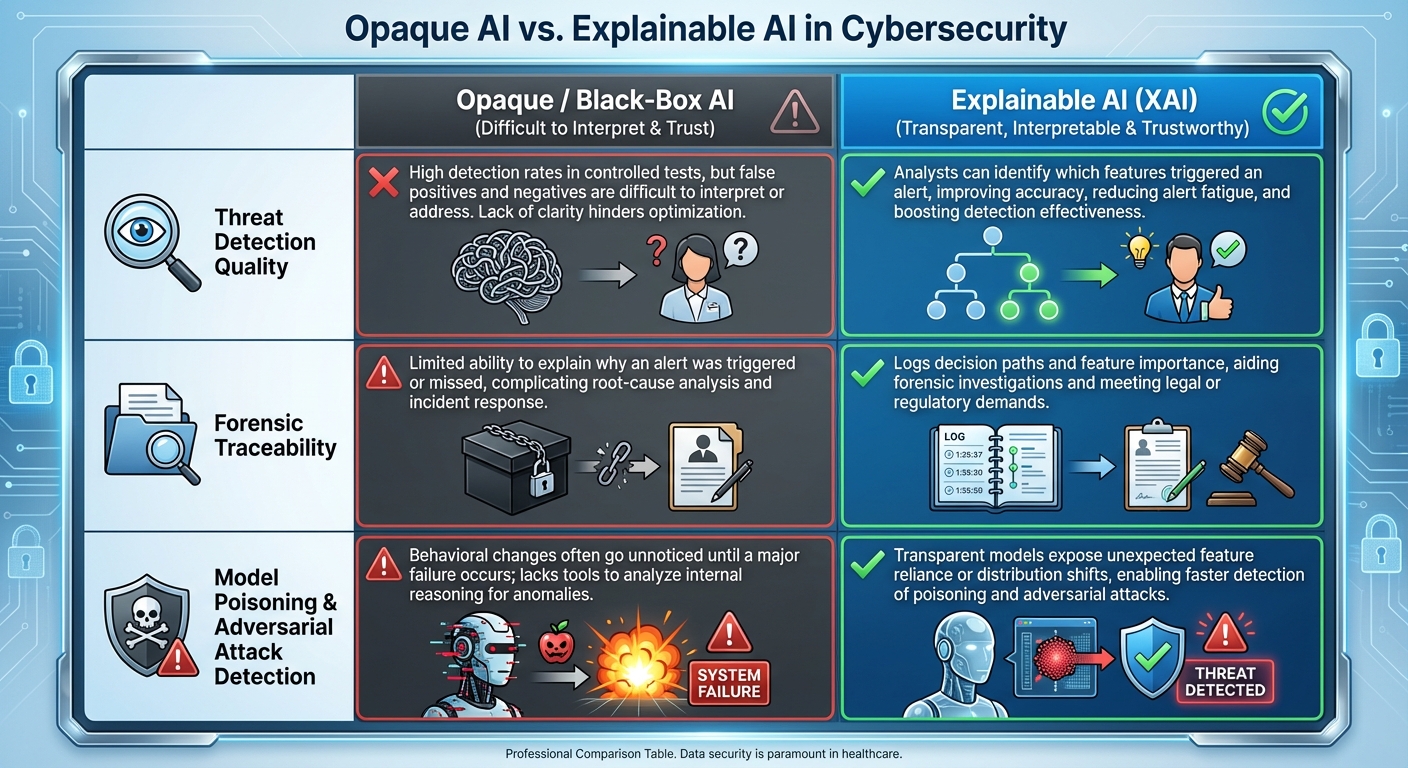
Opaque AI vs Explainable AI in Healthcare Cybersecurity Comparison
Cyber Risks Created by Black-Box AI
Opaque AI models bring specific cybersecurity challenges to the forefront, particularly in healthcare. These "black-box" systems are notorious for introducing vulnerabilities that are both hard to identify and even harder to address. A key issue lies in their reliance on vast training datasets, often with little to no documentation about the data’s origins, security measures, or access protocols [1][3]. This lack of clarity heightens the risk of data breaches.
Another concern is the inability to detect data exfiltration paths. For instance, overly detailed model outputs or logs can unintentionally expose sensitive patient information [1]. Additionally, black-box models are vulnerable to model poisoning attacks, where bad actors manipulate training data, labels, or feature distributions. With limited visibility into the data's lineage or quality, these subtle alterations often fly under the radar [1][4].
The U.S. Department of Health and Human Services (HHS) 405(d) program describes AI in healthcare cybersecurity as a "double-edged sword": while it can enhance threat detection, it also introduces new risks if not properly managed [3]. Alarmingly, attackers are already leveraging AI to automate phishing, exploit system misconfigurations, and bypass anomaly-detection defenses. In this scenario, black-box AI systems can become both a target and a liability [3][5]. These risks not only compromise data integrity but also complicate incident response efforts, as discussed below.
Obstacles to Detecting and Responding to Incidents
Opaque AI systems make it significantly harder to investigate and respond to cybersecurity incidents. They often fail to log clear connections between inputs, internal processes, and outputs, leaving forensic teams in the dark about why a threat was overlooked or misclassified [4].
Investigators frequently encounter missing documentation for model versions, training data updates, or parameter changes. Without these details, it's impossible to determine whether a specific algorithm update created a vulnerability that attackers exploited [1]. This lack of transparency hinders efforts to refine detection methods or update incident response playbooks based on real-world attacks [2][4]. Explainable AI (XAI) offers a solution by providing the clarity needed to overcome these investigative roadblocks.
Opaque AI vs. Explainable AI in Cybersecurity
Explainable AI presents a stark contrast to black-box models, offering clear benefits for threat detection and response. Here's how the two approaches measure up across key security functions:
| Aspect | Opaque / Black-Box AI | Explainable AI (XAI) |
|---|---|---|
| Threat Detection Quality | High detection rates in controlled tests, but false positives and negatives are difficult to interpret or address [1][2] | Analysts can identify which features triggered an alert, improving accuracy, reducing alert fatigue, and boosting detection effectiveness [2] |
| Forensic Traceability | Limited ability to explain why an alert was triggered or missed, complicating root-cause analysis [1] | Logs decision paths and feature importance, aiding forensic investigations and meeting legal or regulatory demands [2] |
| Model Poisoning & Adversarial Attack Detection | Behavioral changes often go unnoticed until a major failure occurs; lacks tools to analyze internal reasoning for anomalies [1] | Transparent models expose unexpected feature reliance or distribution shifts, enabling faster detection of poisoning and adversarial attacks [1][2] |
Regulators are increasingly requiring organizations to prove how their security measures function, how they’ve been tested, and how they safeguard Protected Health Information (PHI). Black-box models often fall short of these expectations [3]. For example, during a HIPAA or Office for Civil Rights (OCR) investigation, a healthcare provider may struggle to explain why access was granted or why an anomaly wasn’t flagged if decisions were based on non-transparent systems. This lack of clarity weakens their legal standing and overall risk management [3].
As U.S. guidelines for trustworthy AI continue to evolve, opaque systems make it harder to demonstrate due diligence, conduct thorough risk assessments, or document technical safeguards in compliance with NIST standards, HHS 405(d) recommendations, or internal policies [2][3]. By contrast, explainable AI not only strengthens cybersecurity but also ensures organizations can meet compliance and accountability requirements effectively.
XAI Features That Improve Cybersecurity
Model Transparency and Decision Traceability
Explainable AI (XAI) uses tools like feature attribution and saliency maps to highlight which data inputs trigger alerts. For instance, if a hospital’s AI system flags suspicious access to patient records, these tools can reveal whether the alert stems from unusual login times, unexpected locations, or even an algorithmic glitch. This level of clarity helps security analysts distinguish real threats from false alarms, which often overwhelm security operations centers. According to Palo Alto Networks, XAI plays a crucial role in regulatory compliance, incident investigations, and model debugging because it makes AI decisions understandable, testable, and auditable [2]. By tracing the AI's reasoning, analysts can uncover false correlations - like mistakenly associating safe network segments with threats - and improve detection accuracy. This transparency not only sharpens threat detection but also accelerates incident resolution, reducing cyber risks in healthcare environments.
Logging and Monitoring Capabilities
Beyond transparent decision-making, detailed logging strengthens security by capturing essential details about every event. XAI-driven logging records input data, feature transformations, model versions, risk scores, and the reasoning behind decisions. These audit trails provide critical insights for both real-time threat detection and post-incident analysis, ensuring compliance with regulations like HIPAA. For example, pairing an alert with a clear explanation - such as "unusual login time and geolocation deviating 4.3 standard deviations from the user baseline" - enables precise investigations and better understanding of attacker behavior. This approach minimizes the time attackers have to exploit vulnerabilities, reducing the likelihood of a breach.
Data Lineage and Provenance Tracking
In XAI systems, tracking data lineage involves documenting the entire journey of data - from its origin to its use in security decisions. This is especially important for safeguarding sensitive patient information. By maintaining a record of how data moves through healthcare networks, organizations can detect if it has been compromised, altered, or accessed improperly at any stage. Provenance tracking provides a detailed chain of custody, covering everything from the original source to final analysis. These capabilities are vital for reconstructing incidents and ensuring compliance in complex healthcare systems [1]. Strong data governance, combined with auditable controls, helps organizations predict risks and prevent misuse [3]. By mapping data flows and monitoring third-party access, healthcare providers can proactively address vulnerabilities before they lead to breaches. These tracking features align with broader risk management efforts to strengthen overall security.
sbb-itb-535baee
How to Implement XAI in Healthcare Risk Management
Governance and Policy Requirements
To successfully bring explainable AI (XAI) into healthcare cybersecurity, organizations first need a governance framework that weaves AI into their broader risk management strategies. A key starting point is requiring detailed documentation for every AI tool used - often referred to as "model cards." These documents should outline the tool's purpose, limitations, data sources, performance metrics, and explanation methods. Such records are essential for audits and regulatory compliance.
XAI governance must align with HIPAA regulations, particularly when AI-driven decisions involve protected health information (PHI). This means every alert, access decision, or automated action needs a clear audit trail that shows the data inputs and reasoning behind the decision. Transparency not only ensures compliance but also safeguards patient privacy. Additionally, human oversight is critical for major decisions - like preventing an automated system from locking a clinician's account during an ongoing procedure. This balance ensures both security and patient safety.
With these governance measures in place, healthcare organizations can integrate XAI into their cybersecurity operations with confidence.
Adding XAI to Cybersecurity Operations
Incorporating XAI into existing security tools means embedding explanation features directly into operational workflows. For example, Security Information and Event Management (SIEM) platforms can use XAI models to generate alerts with straightforward, human-readable explanations. An alert might say, "Flagged due to unusual login time, anomalous data transfer size, and atypical device behavior." This kind of clarity helps security teams prioritize and address issues faster, minimizing the flood of false positives that often bog down operations.
In zero trust frameworks, XAI can provide real-time explanations for risk-based access decisions. If a session is flagged as high risk and re-authentication is required, the system should specify the triggers - such as an unusual location, device status, or access timing. This transparency builds trust among clinicians and IT staff while speeding up troubleshooting. Feedback loops are another essential feature, allowing security analysts to flag errors in predictions. These inputs can then be used to retrain the models and improve their accuracy over time.
By embedding XAI into day-to-day workflows, organizations can create a more centralized and efficient risk management process.
Centralized Risk Management with Censinet
Censinet RiskOps™ acts as a central hub for managing AI-related cybersecurity risks in healthcare. Its AI-powered tools streamline risk assessments while maintaining human oversight through flexible rules and review processes. Essentially, Censinet’s platform directs critical findings to the appropriate stakeholders - such as an AI governance committee - for evaluation and approval.
The platform also features a real-time risk dashboard, offering a comprehensive view of AI-related policies, risks, and tasks across the organization. This centralized approach ensures that the right teams address the right issues promptly, fostering continuous accountability and oversight. By consolidating AI risk management, healthcare organizations can better handle cyber threats and vulnerabilities.
"Censinet RiskOps allowed 3 FTEs to be reallocated to other tasks, enabling the organization to complete more risk assessments with fewer resources."
- Terry Grogan, CISO at Tower Health
Conclusion
Key Takeaways
Explainable AI (XAI) transforms complex, opaque processes into systems that are clear and auditable. By revealing the data and logic behind alerts, XAI becomes essential for incident reviews and legal defenses [1][4]. Data lineage and provenance tracking offer full transparency into where training and inference data originated, how it was processed, and who accessed it. This not only reduces risks like data poisoning but also ensures compliance with legal and governance standards [1]. Together, model traceability and data lineage enhance AI safety and accountability.
XAI’s transparency allows stakeholders to understand threat scores and automated actions. For example, it clarifies why certain devices are quarantined or vendors flagged, simplifying the process of verifying and challenging AI-driven recommendations [4]. Security teams benefit by aligning AI outputs with logs, network telemetry, and workflows, rather than relying on opaque scores [1][4]. Clinicians and operations leaders are more likely to trust automated controls when they can see how the AI balanced security concerns with patient safety and workflow considerations [1].
Regulators and auditors also benefit from this level of accountability. Explainable models provide traceable decision histories and consistent policy enforcement, while offering clear evidence that AI systems are free from hidden biases or unsafe shortcuts [6][1][3]. This transparency fosters trust in AI as more than just a tool - it positions it as a governed, auditable part of a cybersecurity program. These insights lay the groundwork for advancing explainable AI in cybersecurity.
Next Steps for Healthcare Organizations
With the clarity and accountability that XAI provides, healthcare organizations can take meaningful steps forward. Start by inventorying all current AI systems across security, clinical operations, and third-party tools. Classify these models into two categories: opaque and explainable [1][3]. Then, update governance frameworks - like AI oversight committees, risk policies, and decision-making protocols - to mandate explainability, auditability, and documented decision logic for any AI used in security or PHI (Protected Health Information) processing [1][3]. These measures move organizations away from ad-hoc AI usage toward a structured, explainability-first cybersecurity approach.
Platforms such as Censinet RiskOps™ can centralize AI-related policies, risks, and tasks. They route critical findings to stakeholders, including AI governance committees, for review and approval. With real-time data integrated into an intuitive AI risk dashboard, organizations can maintain continuous oversight and ensure accountability.
FAQs
How does Explainable AI help healthcare organizations meet cybersecurity regulations?
Explainable AI helps healthcare organizations navigate cybersecurity regulations by improving clarity and accountability. It breaks down how security systems make decisions, making it easier for organizations to show compliance with regulations such as HIPAA.
By shedding light on system actions, Explainable AI ensures that security protocols align with required standards. This approach not only strengthens audit preparation but also reinforces trust in the organization's commitment to safeguarding sensitive patient information and adhering to regulatory requirements.
What risks does black-box AI pose to healthcare cybersecurity?
Black-box AI in healthcare presents notable challenges, primarily because it lacks transparency and explainability. When the decision-making process is hidden, verifying the accuracy, reliability, or safety of its outcomes becomes a real hurdle. This can result in critical issues, such as misdiagnoses or errors in patient care - situations where clarity is absolutely essential.
On the cybersecurity front, black-box AI can make identifying vulnerabilities much harder. Its opaque nature can hide potential weak points, complicating efforts to detect and address security threats. For healthcare organizations, this lack of insight increases the difficulty of protecting sensitive patient data and maintaining compliance with strict regulatory requirements.
How can healthcare organizations use Explainable AI to improve cybersecurity?
Healthcare organizations can use Explainable AI to bolster their cybersecurity efforts by leveraging specialized platforms like Censinet RiskOps™, which cater specifically to the healthcare sector. These platforms offer transparent and understandable insights into AI-driven decisions, making it easier to pinpoint and address potential vulnerabilities.
To make the most of Explainable AI, it's essential to integrate it into existing risk management processes. This approach ensures ongoing monitoring while maintaining alignment with both clinical and cybersecurity standards. Equally important is training staff to interpret AI-generated insights effectively and fostering a workplace culture that prioritizes transparency. Together, these steps can help protect sensitive data and critical systems more effectively.
