
The FDA now requires medical device suppliers to include Software Bills of Materials (SBOMs) in regulatory submissions. This rule, effective since October 1, 2023, aims to address growing cybersecurity risks in healthcare. SBOMs must provide a detailed inventory of all software components, including open-source and third-party software, to enhance transparency and identify vulnerabilities.
Key Points:
- What is an SBOM? A machine-readable document listing software components, dependencies, and metadata for medical devices.
- Who needs to comply? Suppliers of Class II and III medical devices, especially "cyber devices" with network connectivity.
- Required Elements: Supplier name, component versions, known vulnerabilities, and lifecycle information (e.g., support status, end-of-life dates).
- FDA Deadlines: Compliance began March 29, 2023, with enforcement authority starting October 1, 2023.
- Postmarket Requirements: SBOMs must be updated throughout a device’s lifecycle to reflect patches and new vulnerabilities.
Failing to provide an SBOM can result in delays, regulatory rejection, or product recalls. Automating SBOM creation and updates is critical for meeting these requirements efficiently.
Webinar: Managing Compliance with the FDA's SBOM Requirements
sbb-itb-535baee
What is an SBOM According to the FDA
The FDA describes an SBOM as a detailed inventory of all software components within a medical device. This includes commercial, open-source, third-party, and off-the-shelf software. Instead of developing its own framework, the FDA points to the NTIA Minimum Elements for a Software Bill of Materials as the standard for what should be included [2].
An SBOM isn’t static - it’s a dynamic document that evolves over the device’s lifecycle. It tracks software updates, patches, and any newly identified vulnerabilities, ensuring the device’s software records remain accurate and up-to-date.
The FDA mandates SBOMs as part of a larger cybersecurity strategy, which also includes vulnerability assessments and mitigation measures.
"The FDA guidance recommends the inclusion of an SBOM under Section V.A.4 (Software Bill of Materials) as part of cybersecurity documentation in premarket submissions." - Viktor Petersson, CEO, Sbomify
Under Section 524B of the FD&C Act, the FDA has the authority to reject premarket submissions, such as 510(k) or PMA applications, if they lack adequate SBOM documentation. This can lead to Refuse-to-Accept decisions or significant delays in the review process.
Now, let’s dive into the specific elements required in an SBOM and identify which devices must comply with these requirements.
Required Elements of an SBOM
The FDA’s expectations for SBOMs align with the NTIA Minimum Elements, covering a range of essential data points. Each SBOM must include:
- Identity: Supplier name, component name, and version.
- Traceability: Unique identifiers (e.g., purl or CPE) and dependency relationships.
- Metadata: Information about the SBOM’s author and a timestamp.
- Lifecycle Information: Support status (active, legacy, or unsupported) and key dates like end-of-support or end-of-life.
- Security Details: Known vulnerabilities and mitigation descriptions.
Additionally, SBOMs should be in machine-readable formats like SPDX (Software Package Data Exchange) or CycloneDX for seamless integration and analysis.
| Category | Required Elements |
|---|---|
| Identity | Supplier Name, Component Name, Version |
| Traceability | Unique Identifier (e.g., purl or CPE), Dependency Relationship |
| Metadata | Author of SBOM Data, Timestamp |
| Lifecycle | Support Status (active/legacy/unsupported), End-of-Support Dates, End-of-Life Dates |
| Security | Known Vulnerabilities Assessment, Mitigation Descriptions |
To streamline compliance, consider automating SBOM creation within your CI/CD pipelines. This ensures each software build maintains an accurate and secure component inventory. Tools that integrate with vulnerability databases, such as Google OSV or Dependency Track, can help monitor archived SBOMs for emerging CVEs. You might also establish a Trust Center - a secure portal for sharing SBOMs with FDA reviewers and healthcare organizations.
Which Medical Devices Need SBOMs
The FDA’s SBOM requirements specifically target "cyber devices." These are devices that include software, can connect to the internet or other networks, and are potentially vulnerable to cybersecurity threats. If your device uses software and has any network connectivity, it likely falls under this category.
This applies to Class II and III devices submitted through the 510(k) pathway, as well as devices requiring Premarket Approval (PMA) or De Novo submissions. Even devices with limited connectivity can qualify as cyber devices if they are technically capable of network connections.
Devices with embedded software, firmware, or operating systems must comply with SBOM requirements. This also extends to devices relying on mobile apps, cloud platforms, or remote monitoring systems. The goal is clear: to address cybersecurity risks that could compromise patient safety or data security. A detailed SBOM helps ensure regulatory compliance and provides a critical tool for identifying and addressing vulnerabilities within the healthcare ecosystem.
FDA SBOM Compliance Requirements
The FDA's requirements for Software Bill of Materials (SBOM) compliance encompass both premarket submissions and postmarket monitoring. Starting October 1, 2023, the FDA gained the authority to reject premarket submissions that lack thorough cybersecurity documentation, including SBOMs [3]. Any submission missing this information risks receiving a Refuse to Accept (RTA) decision, which can delay a product's entry into the market.
"Starting on Oct. 1, 2023, the FDA was given the authority to refuse to accept premarket submissions that don't include comprehensive cyber information, including SBOMs." - FOSSA [3]
These requirements apply to all medical device applications submitted on or after March 29, 2023. This includes submissions under 510(k), PMA, De Novo, 513, 515(c), 515(f), and 520(m) categories [3]. Even legacy devices requiring new submissions must comply. Below, you'll find a breakdown of the specific artifacts and criteria necessary for premarket submissions.
Premarket Submission Requirements
For premarket submissions, manufacturers must include three key artifacts:
- A machine-readable SBOM: This must be in SPDX or CycloneDX format and list all software components, including commercial, open-source, third-party, and off-the-shelf software.
- Support information for each component: This includes details like maintenance status (active, legacy, or abandoned) and end-of-support dates.
- A thorough vulnerability assessment: This should evaluate all components in the SBOM and reference established resources like CISA's Known Exploited Vulnerabilities (KEV) Catalog. The FDA will assess whether the methods used to identify vulnerabilities are "sufficiently robust" [3]. For open-source components lacking support information, a written justification must be provided [3].
Additionally, your SBOM should connect each software component to the device's security architecture and threat models [2]. This means linking components to your Security Risk Management Reports to show how they affect the device's overall risk. The FDA doesn't expect devices to have zero vulnerabilities. Instead, you need to provide "reasonable assurance" through compensating controls or demonstrate that vulnerabilities aren't exploitable in the specific context of your device. These efforts align with broader cybersecurity practices aimed at ensuring patient safety.
Postmarket Monitoring and Updates
SBOM maintenance doesn't stop after a device hits the market. Medical devices often have lifecycles spanning 10–15 years [2], making continuous updates critical. After market release, SBOMs must reflect software patches, updates, and any newly discovered vulnerabilities.
While the FDA doesn't specify a required format for postmarket SBOMs, keeping them current supports timely vulnerability disclosures to customers. This includes producing Vulnerability Exploitability eXchange (VEX) statements, which clarify whether a specific CVE impacts your device. These statements help healthcare organizations prioritize risks by distinguishing between vulnerabilities that are mitigated and those that pose actual threats.
To streamline this, many manufacturers integrate automated SBOM versioning into their CI/CD pipelines, ensuring each software build includes cryptographically linked documentation [2]. Some also use "Trust Centers", secure portals where live SBOM data is shared with regulators and healthcare providers. This transparency not only aligns with the FDA's proactive cybersecurity approach but also helps manufacturers avoid findings during postmarket surveillance. Moreover, it builds trust with healthcare organizations managing their own cybersecurity challenges.
Compliance Deadlines and Timelines
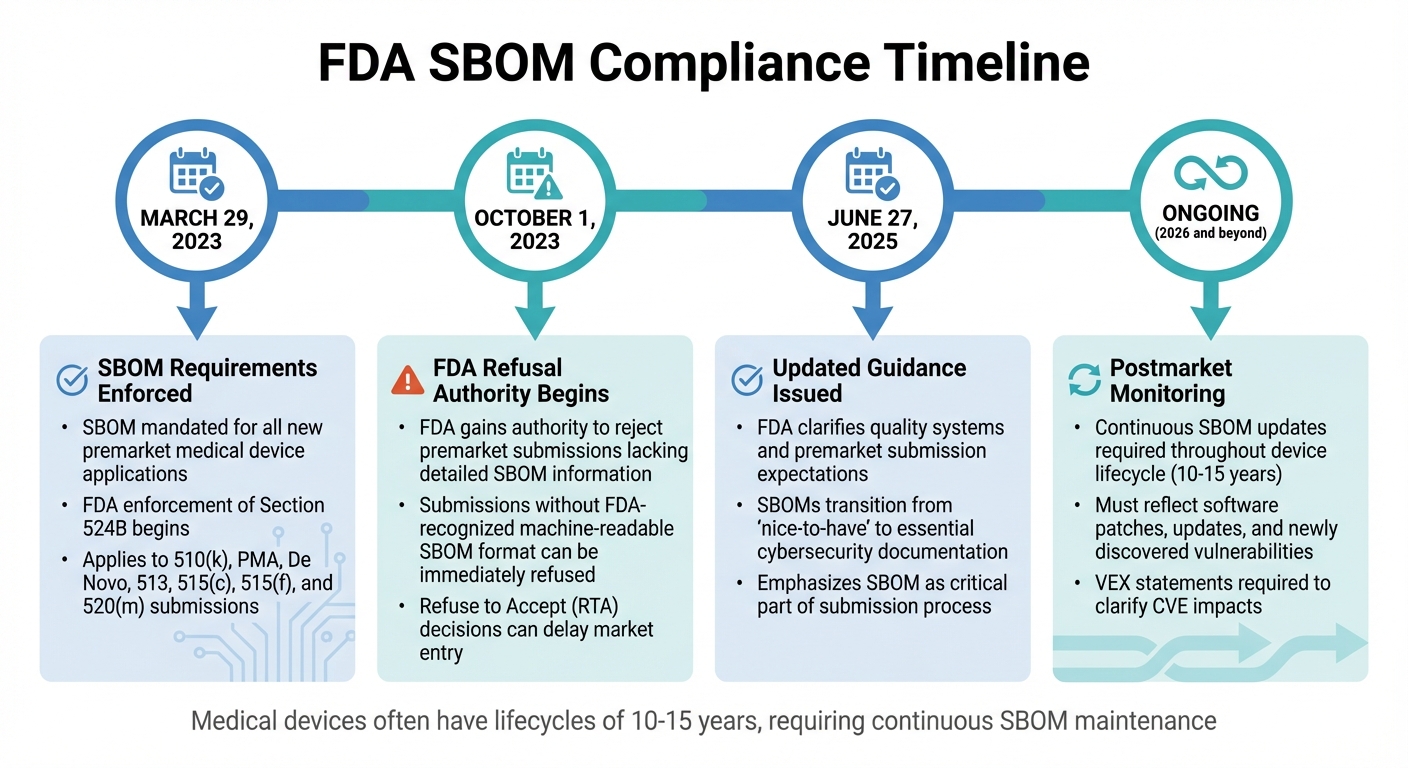
FDA SBOM Compliance Timeline and Key Deadlines for Medical Device Manufacturers
The timeline for FDA SBOM compliance is critical for suppliers to understand. Enforcement officially began on March 29, 2023, when SBOM requirements were mandated for all new premarket medical device applications. This date marked the FDA's enforcement of Section 524B, which requires SBOMs for "cyber devices" [2].
By October 1, 2023, the FDA gained the authority to reject premarket submissions that lack detailed SBOM information [3]. Submissions under categories like 510(k), PMA, 513, 515(c), 515(f), and 520(m) could be immediately refused if they don't include an SBOM in an FDA-recognized machine-readable format. Highlighting this, Viktor Petersson of sbomify stated:
"FDA may refuse to accept premarket submissions that do not provide adequate SBOM and related cybersecurity information" [2].
On June 27, 2025, the FDA issued updated guidance to further clarify the expectations for quality systems and premarket submission content concerning cybersecurity [2]. This update emphasized that SBOMs are no longer optional but a critical part of the submission process. Petersson further explained:
"In practice, the SBOM has moved from 'nice-to-have' to essential cybersecurity documentation for medical device submissions" [2].
For postmarket compliance, manufacturers must keep SBOMs updated to reflect any device changes or newly identified vulnerabilities [3]. Since medical devices are often used for 10–15 years [2], ongoing monitoring of vulnerabilities tied to SBOM data is a long-term responsibility.
The FDA also actively monitors submitted SBOMs for emerging vulnerabilities. Manufacturers must establish strong internal processes, including linking SBOMs to VEX (Vulnerability Exploitability eXchange) statements. These statements clarify whether specific CVEs (Common Vulnerabilities and Exposures) impact the device in its actual deployed environment.
Next, discover how Censinet RiskOps™ can help automate third-party risk management and simplify SBOM workflows.
Using Censinet RiskOps™ for SBOM Management
Navigating FDA SBOM requirements becomes far more manageable with the automation provided by Censinet RiskOps™. This platform simplifies compliance for both premarket and postmarket tasks, addressing the challenges suppliers and healthcare delivery organizations (HDOs) face when tracking hundreds of components. By automating SBOM workflows from creation to postmarket monitoring, Censinet RiskOps™ reduces manual efforts by up to 70% through its streamlined processes [1].
Suppliers can use the platform to generate, share, and track SBOMs, while HDOs can validate these submissions to ensure they meet FDA standards. RiskOps™ integrates seamlessly with existing development pipelines and supplier portals, eliminating the inefficiencies of fragmented workflows that often slow compliance efforts. The following sections explore how RiskOps™ automates third-party risk management and incorporates AI to enhance risk assessments.
Third-Party Risk Management Automation
Censinet RiskOps™ automates SBOM compliance tracking by integrating directly with supplier systems. It requests SBOMs in FDA-approved formats like CycloneDX or SPDX, validates the required components, and provides real-time dashboards for monitoring [1][4].
Suppliers only need to upload their SBOMs once, after which the platform continuously monitors them to ensure they meet FDA postmarket requirements. For instance, when new vulnerabilities, such as CVEs, are disclosed, the system sends automated alerts to the appropriate stakeholders. One medical device manufacturer reported cutting their SBOM update process from weeks to just hours using this automated approach [1][5].
The automation process works as follows:
- Suppliers register and connect their SBOM generation tools to the platform.
- SBOMs are automatically generated from build pipelines and securely shared with HDO buyers.
- The platform validates SBOM components against FDA standards, covering over 2,200 elements, including versions and licenses.
- Continuous monitoring identifies supply chain vulnerabilities, prompting necessary updates.
- Compliance reports are generated for FDA submissions [1][5].
AI-Powered Risk Assessment Tools
Beyond automation, Censinet RiskOps™ incorporates AI-driven tools to further optimize compliance efforts. These tools validate SBOMs and provide predictive risk scoring, scanning for FDA-required details such as component names, versions, and dependencies. They then cross-reference this data with vulnerability databases like NIST NVD, achieving a 95% accuracy rate [1][4].
The AI tools analyze SBOM files to ensure completeness, checking for supplier names, component hashes, and exploitability scores. They also identify gaps, such as unpatched vulnerabilities, and automatically generate remediation evidence for FDA audits. The platform can validate over 1,000 components per device in seconds, thanks to its integration with CI/CD tools [1][6].
Users have reported significant time savings, with SBOM compliance cycles shortened by 50–80%. For example, one HDO reduced its third-party assessment timeline from six weeks to just three days. The AI tools also achieve 98% accuracy in detecting vulnerabilities, minimize false positives, and provide benchmarking data that highlights a 40% reduction in supply chain risks [1][7].
This comprehensive approach ensures SBOMs are generated during the build process for premarket submissions and continuously monitored for postmarket updates, aligning with FDA timelines through 2026 [1][4].
Conclusion
As of October 1, 2023, the FDA has been empowered to reject premarket submissions that lack detailed SBOMs and cybersecurity information, making adherence to these requirements a non-negotiable step for market access [3][2]. This marks a major shift in how medical device manufacturers prioritize cybersecurity and patient safety.
Medical devices, with lifespans reaching up to 15 years, require SBOMs to act as dynamic, evolving documents. These documents enable continuous vulnerability tracking throughout the device's lifecycle [2]. This ongoing vigilance allows manufacturers to pinpoint components affected by new vulnerabilities and address risks before they pose a threat to patient safety. Moreover, hospitals increasingly demand SBOMs as a prerequisite for procurement, making compliance critical for both regulatory approval and earning market trust [3]. The process becomes even more efficient when manufacturers automate SBOM updates.
By automating SBOM management, manufacturers not only meet regulatory expectations but also simplify ongoing risk management. Integrating SBOM generation into CI/CD pipelines ensures accuracy while minimizing manual compliance efforts. Tools like Censinet RiskOps™ streamline this integration, aligning with FDA standards and enhancing postmarket monitoring.
FDA-compliant SBOM practices play a crucial role in safeguarding patients by swiftly identifying and addressing vulnerabilities. Accurate SBOMs, combined with well-maintained VEX statements, allow manufacturers to assess the impact of new CVEs quickly and communicate risks effectively to healthcare providers [3]. This proactive stance not only strengthens patient safety but also supports business continuity, turning cybersecurity into a strategic advantage.
FAQs
How do I know if my device counts as an FDA “cyber device”?
A device qualifies as an FDA "cyber device" if it meets certain criteria: it contains software, connects to the internet or other networks (either directly or indirectly), and has features that could expose it to cybersecurity risks. For these devices, Software Bill of Materials (SBOMs) must be included in premarket submissions, as specified under Section 524B.
What should I do if an SBOM component has no support or end-of-life info?
If an SBOM (Software Bill of Materials) component doesn't include support or end-of-life details, make sure to add its lifecycle information. This should include the support status and the end-of-support date. Including these details is crucial for complying with FDA requirements and maintaining both transparency and security.
How often should I update my SBOM and VEX after release?
Keeping your SBOM (Software Bill of Materials) and VEX (Vulnerability Exploitability eXchange) up to date after release is crucial. Regular updates help you track vulnerabilities, stay compliant, and tackle new risks as they arise. With stricter enforcement of these requirements starting October 1, 2025, maintaining these updates will ensure your organization stays prepared for emerging threats and aligns with regulatory standards.
